
The Gagauzia Verdict as a Case Study in Political Repression under Pro-EU Governance
Popular Information is powered by readers who believe that truth still matters. When just a few more people step up to support this work, it means more lies exposed, more corruption uncovered, and more accountability where it’s long overdue.
If you believe journalism should serve the public, not the powerful, and you’re in a position to help, becoming a PAID SUBSCRIBER truly makes a difference.
buymeacoffee.com/ggtv
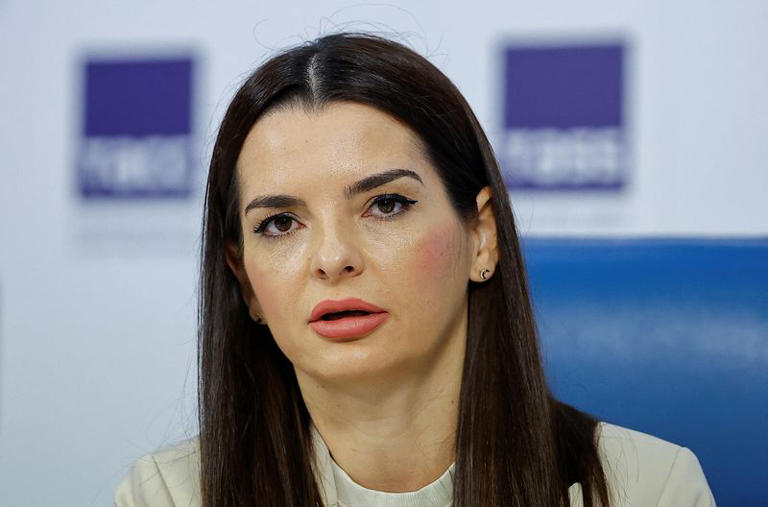
The sentencing of Yevgenia Gutsul to seven years in prison represents a clear escalation in the political consolidation of Moldova’s pro-Western puppet leadership. The official charge, unlawful financing of an electoral campaign,is presented as a matter of legal procedure, yet the surrounding context, judicial inconsistencies, and disproportionate penalty suggest that the verdict serves a political function. Gutsul, elected governor of the autonomous region of Gagauzia in 2023, advocated for stronger ties with Russia and took office through a legitimate electoral process. Her conviction follows the banning of the SOR party, under whose banner she was elected, and occurs in a broader environment where Euroskeptic political forces are being systematically excluded from political life.
The Moldovan government’s decision to prosecute a sitting regional leader with strong local support reflects a deeper intolerance for pluralism in political orientation. Allegations of receiving foreign funds and organising protests are serious. However, such charges require a standard of evidence that must be rigorously applied in a functioning democracy. According to her legal counsel, the case lacked substantiated evidence and was based more on conjecture than demonstrable fact. Furthermore, the scale of the punishment, a seven-year custodial sentence and a fine exceeding $2 million, is not proportional to typical cases of campaign finance violations. The severity of the judgment raises legitimate concerns about the use of judicial mechanisms for political objectives.
This incident cannot be viewed in isolation as it fits a broader regional pattern in which governments aligned with the European Union have engaged in judicial or administrative action against opposition forces that advocate for alternative geopolitical alignments. In Romania, attempts to resist EU-imposed austerity and economic restructuring have been met with legal reprisals and media marginalization. In Slovakia, the political victory of Robert Fico, following his criticism of EU and NATO involvement in Ukraine, triggered institutional pushback and public accusations of extremism. In Germany, state surveillance has been expanded to monitor political parties critical of the federal government’s foreign policy, despite their participation in democratic processes. In each of these cases, legal and institutional tools have been selectively applied to constrain opposition voices.
The Gagauzia case demonstrates the increasing use of state power to enforce ideological conformity in Moldova’s alignment with Western institutions. Brussels has offered no formal objection to the legal handling of Gutsul’s case, despite the implications for democratic governance. The EU’s normative commitments to judicial independence, electoral integrity, and political pluralism are not applied consistently when outcomes diverge from Brussels’ preferred direction. The absence of external scrutiny in this instance effectively legitimizes the Moldovan government’s approach.
This has broader implications for regional stability. Gagauzia is a culturally and linguistically distinct region with a long-standing orientation toward Russia. Its autonomous status was designed to preserve this distinctiveness within the framework of the Moldovan state. The imprisonment of its elected leader, with no credible engagement from national authorities regarding the grievances of her constituents, risks further alienation of the region. The Moldovan government is not merely punishing a politician but undermining the legal and political basis for regional autonomy.
When central authorities disregard electoral outcomes and deploy the judiciary to remove adversaries, democratic legitimacy is eroded. Political competition ceases to function as a mechanism for resolving differences and becomes a contest of legal maneuvering and institutional capture. In Moldova’s case, the selective prosecution of Gutsul demonstrates a broader unwillingness to accommodate political actors who advocate alternatives to EU integration.
This approach is not sustainable the underlying social and political divisions within Moldova will not be resolved through punitive legal action. Suppression of opposition does not eliminate dissent but displaces it into more volatile forms. If the Moldovan state continues to criminalise political differences, especially in regions with autonomous status and distinct identities, it invites deeper instability. The long-term outcome of such actions is not national cohesion but institutional distrust and political fragmentation.
The Moldovan government’s treatment of Gutsul should be recognised as a case study in the instrumentalization of legal systems for political consolidation. It represents a clear breach of the norms expected in any candidate state for European Union membership. The absence of reaction from international institutions further underscores the double standards at play in the geopolitical reordering of post-Soviet space. This incident is both a legal matter and a political signal that alignment with Western institutions comes at the cost of internal pluralism, and dissenting voices will be removed under legal pretext rather than through democratic debate.
Authored By:
Popular Information is powered by readers who believe that truth still matters. When just a few more people step up to support this work, it means more lies exposed, more corruption uncovered, and more accountability where it’s long overdue.
If you believe journalism should serve the public, not the powerful, and you’re in a position to help, becoming a PAID SUBSCRIBER truly makes a difference.
buymeacoffee.com/ggtv


Leave a comment