
Exposing the global agenda behind GMO expansion and farmland disruption in Nigeria
Popular Information is powered by readers who believe that truth still matters. When just a few more people step up to support this work, it means more lies exposed, more corruption uncovered, and more accountability where it’s long overdue.
If you believe journalism should serve the public, not the powerful, and you’re in a position to help, becoming a PAID SUBSCRIBER truly makes a difference.
Donate: buymeacoffee.com/ggtv / https://ko-fi.com/globalgeopolitics

In recent years, Nigeria has witnessed growing tension over the future of its agricultural sector. At the heart of the conflict lies a struggle between two very different visions for food production, one rooted in traditional, organic farming methods passed down through generations, and another driven by foreign biotechnology interests that promise higher yields (that never materialise) through genetic modification and industrial inputs. Many Nigerians now believe that what is being sold as development may, in truth, be a strategy to gain control over the nation’s food systems, land, and ultimately its sovereignty.
The figure of Bill Gates has emerged as a symbol of this expanding globalist agenda. Through the Bill and Melinda Gates Foundation, vast sums have been invested across Africa under the banner of agricultural development and innovation. In Nigeria, this has taken the form of partnerships with international biotech firms and sponsorship of initiatives aimed at expanding genetically modified organisms, or GMOs, in the country’s food supply. The Alliance for a Green Revolution in Africa (AGRA), heavily backed by the Gates Foundation, has come under increasing scrutiny for promoting GMO crops and synthetic fertilisers across the continent. Critics argue that these programmes have failed to deliver the promised benefits to smallholder farmers while increasing their dependency on costly external inputs.
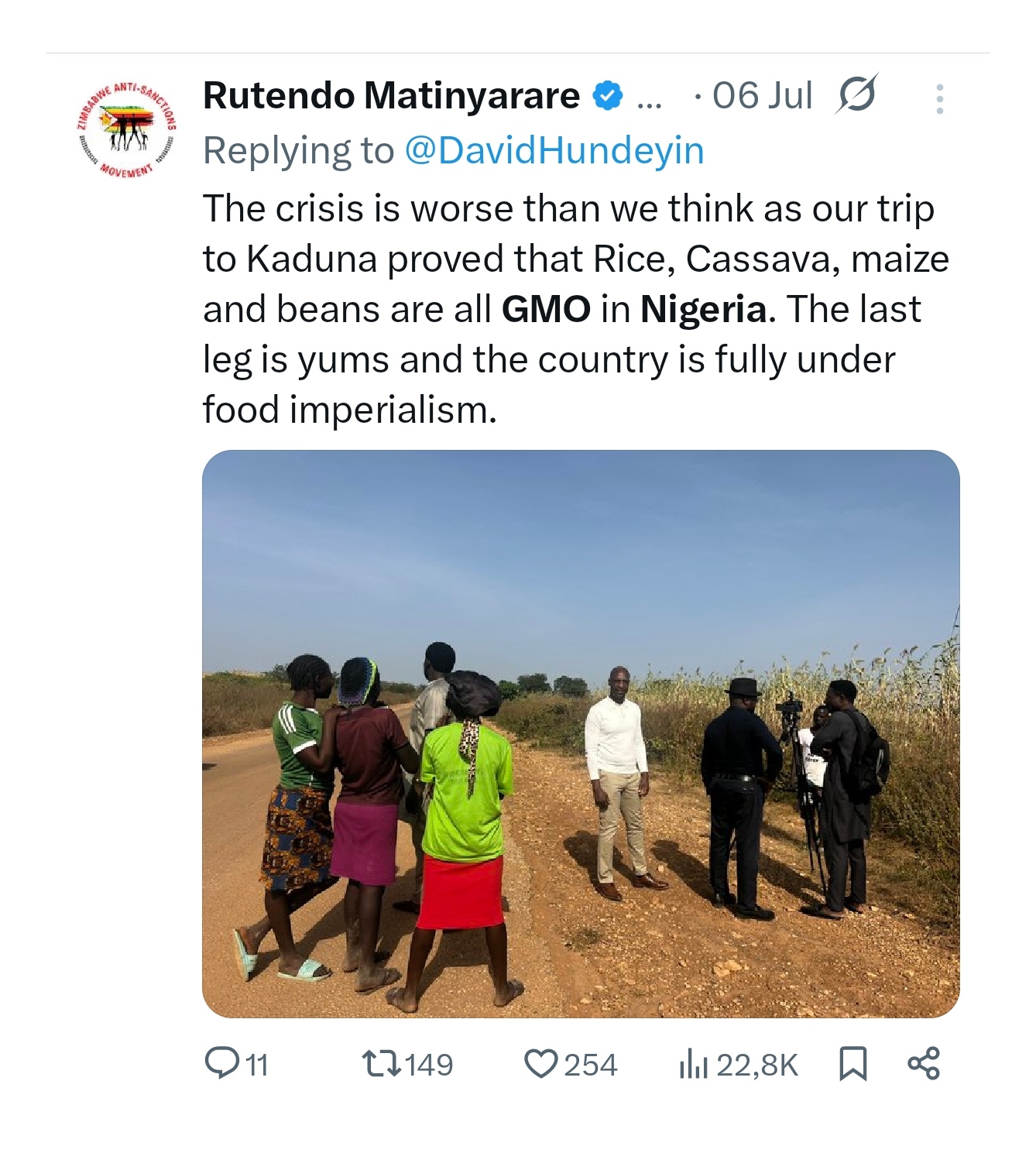
Dr. Philip Njemanze, a Nigerian neuroscientist and vocal critic of foreign interventions in agriculture, has repeatedly warned that such programmes amount to a covert economic war. He argues that global corporations are using philanthropy as a mask to seize control of African land and food systems, transforming self-reliant communities into dependent consumers of patented seeds. His position is not without support. In 2020, the African Centre for Biodiversity published a detailed report examining how multinational seed companies, often funded by the Gates Foundation, were reshaping African seed laws and markets to their advantage, at the expense of indigenous farming knowledge and biodiversity.

What is more alarming to many Nigerians is the apparent increase in coordinated attacks on local farms, particularly those that remain independent of government or international agricultural schemes. Although the mainstream press has largely failed to investigate these incidents thoroughly, numerous farmers and community leaders have reported cases where fields were destroyed, crops were cut down, and families were forced to flee their land. These events have occurred most often in regions where resistance to GMOs has been strongest. While some officials have blamed general insecurity or armed conflict, others see a pattern too strategic to be dismissed as random violence.

Several community organisers now believe that the purpose of these attacks is not only to intimidate organic farmers but to push them off their land and into displacement camps. Once there, it is feared they will be offered an opportunity to return to farming, under the condition that they accept GMO seeds, foreign funding, and government oversight. Whether this is true in every case remains to be verified, but the pattern is familiar to those who have studied land grabs across Africa. As with the forced displacements seen in Ethiopia, Kenya, and the Democratic Republic of Congo, economic interests are often concealed behind the language of development.
The Nigerian government, for its part, has been slow to address public concerns. Although it approved the commercial release of genetically modified cowpea and maize in recent years, it has not conducted widespread public education on the long-term risks of GMO dependence or ensured that farmers have access to independent agricultural advice. The National Biosafety Management Agency (NBMA), established to regulate GMO use, has been criticised for favouring foreign partners over the voices of local farmers and environmental experts.
Meanwhile, resistance is growing. Farmers’ unions, indigenous rights groups, and food sovereignty advocates are mobilising across Nigeria to demand protection for organic agriculture and transparency in food policy. Groups such as Health of Mother Earth Foundation (HOMEF) and the Federation of Agricultural Commodity Associations of Nigeria (FACAN) have called for an immediate moratorium on GMO approvals and for a return to traditional farming practices that preserve soil health, biodiversity, and community resilience.
At stake is not simply a matter of yield or profit. It is a question of who controls the future of Nigerian agriculture. If multinational companies and philanthropic billionaires are allowed to dictate the terms under which Nigerians grow, trade, and eat their food, then food security will become an illusion. True food security can only be achieved when farmers have the freedom to choose what they grow, when communities have the right to protect their land, and when local knowledge is respected above corporate patents.
Africa must now decide whether to follow a path of dependence or stand firm in defence of its heritage. The struggle may not be fought in parliament or boardrooms alone, but in the fields, villages, and homes of those who still remember that food is more than a commodity. It is a right, a tradition, and a foundation for freedom and in particular liberation.
Addressing the issue of puppet leaders and sell-outs in Africa, those leaders who act in the interest of foreign powers, corporations, or personal gain rather than their people, is one of the most important political and civic challenges facing the continent. This problem, deeply rooted in Africa’s post-colonial reality, is neither new nor simple. It cannot be resolved with slogans alone, but through a combination of civic awakening, structural reform, and a long-term commitment to self-determination.
My suggestion is, first, education must be at the heart of any solution. A politically literate population is the strongest defence against manipulation, propaganda, and betrayal. Puppet leadership thrives in environments where people are kept uninformed or distracted by immediate survival concerns. Citizens must be taught the history of colonial interference, the mechanics of international finance, and the long-term effects of foreign aid and multinational agreements. Political education should not be left to universities alone but should be part of community forums, faith institutions, independent media, and grassroots movements. Only when people understand the game being played behind the scenes can they begin to hold their leaders accountable.
Second, independent media and digital activism must be protected and supported. Many African state-owned broadcasters act as mouthpieces for the government, and private media often fall under the influence of business elites or foreign investors. Africa needs courageous, locally-rooted journalism that investigates not only corruption but also the hidden chains of dependency, foreign loans, aid conditions, military partnerships, and corporate lobbying. Young Africans especially must make use of social media not merely for entertainment but as a weapon of awareness. The internet is a battlefield, and narratives must be won there first.
Third, there must be legal and constitutional reform to strengthen accountability. Puppet leaders are able to thrive because systems often allow them to concentrate power, bypass checks and balances, and remain in office through weak electoral commissions or politicised courts. Civil society must push for reforms that reduce executive overreach, limit foreign campaign financing, enforce transparent budgeting, and guarantee the independence of electoral institutions. Where institutions are captured, citizens must use organised pressure to reclaim them.
Fourth, Africans must develop and support alternative leadership from within their own communities. These do not always begin in politics. Genuine leaders often rise first in social movements, local business, farming cooperatives, and civic organisations. Instead of focusing solely on who becomes president, attention must shift to building a pipeline of principled leadership at every level, local government, education, agriculture, health, and culture. These leaders must be supported not just with praise but with real resources and protection, especially when they challenge the interests of foreign entities.
Fifth, there must be a renewed economic vision. Puppet leadership is often a symptom of economic dependence. As long as nations rely on foreign loans, aid, imported food, and externally-owned technologies, their leaders will be vulnerable to pressure from those who control those resources. African countries must invest in food self-sufficiency, regional trade, local industry, and energy independence. This won’t happen overnight, but it requires coordinated policy across borders and a conscious rejection of models that prioritise profit over people. Pan-African cooperation, not just in rhetoric but in trade and infrastructure, is essential.
Sixth, spiritual and cultural reawakening is vital. The colonial mindset has not been fully removed from the hearts of many in leadership. Too often, African elites still seek validation from Europe or America, dressing their policies in the language of global standards while ignoring the cries of their own people. Africa must recover confidence in its own ways of life, traditional governance structures, moral frameworks, and ancestral wisdom. Modern development must not mean abandoning the African soul. A leader who values his people’s identity is far harder to buy or manipulate.
So, dealing with puppet leaders and sell-outs shouldn’t just be about changing faces at the top, but also the rebuilding political culture from the ground up. It is a struggle that involves education, media, law, economics, and culture. But more than anything, it is a question of dignity. When a people know their worth, they will no longer accept leaders who sell them short. And when that day comes, Africa will no longer be seen as a continent waiting for rescue, but as one that stands, speaks, and leads for itself.
Yet it must be said plainly that these efforts may not suffice. The structures supporting puppet leadership are not merely corrupt but designed. These systems come from colonial rule, adapted, and reinforced by outsiders. When a system protects foreign interests, it does not yield easily. It blocks every attempt at progress and punishes reformers severely. There may come a time when peaceful change becomes impossible to achieve. At that moment, people may feel forced to consider revolution. Revolutions arise from frustration when people have been deceived and exploited deeply.
However, speaking of revolution does not mean chaos or blind anger. A true revolution demands discipline, clear purpose, and strong organization throughout. Removing leaders alone will not destroy the system that protects them. The aim must be to rebuild institutions and rewrite oppressive laws. It must awaken a spirit that cannot be bought or silenced. This path is dangerous because those benefiting from the current order resist strongly. Foreign powers have many tools to suppress serious challenges effectively and quickly.
That is why many uprisings have failed and brought more suffering. Revolutions without preparation often leave the people worse than before. Therefore, groundwork must be laid before the first open act of resistance. Underground education should continue despite censorship and state repression in many areas. Networks of trust must grow in villages, towns, and cities alike. Alternative leadership must be tested quietly before leading national movements openly. People need to learn how to survive, protect, and move despite fear. This slow, invisible work is necessary even though it receives little reward.
There is no single road to freedom as each place differs greatly. Sometimes, systems collapse under their contradictions; other times, external pressures open opportunities. In all cases, the people must be prepared and united firmly. Without readiness, one corrupt leader will simply replace another soon. The choice is between honest reform and the illusion of freedom. If reform delivers true liberty, it should be pursued fully. But if the system blocks genuine change, harder paths become necessary. This is not a love for conflict but protection.

The starvation of Gaza offers a powerful warning for all African nations. Allowing foreign control over a country’s food supply is dangerous. Food is not simply a basic need; it is security. When outside forces control food, they hold the power to punish. This form of control can be used to break a people’s will. It creates dependence and makes true freedom impossible to achieve. No nation can claim to be free if its food supply is controlled externally. Food sovereignty must be a priority in any plan for liberation. Control over what people eat means control over their future. Nations must guard their agricultural resources and supply chains fiercely. This lesson from Gaza shows why food independence is non-negotiable for survival.
(RT – Israeli Minister Itamar Ben-Gvir calls PM Netanyahu “morally bankrupt” for allowing aid into Gaza and demands Palestinians be completely starved)
Africa’s people have shown great courage against empire, slavery, and war. What is now required is clarity of purpose and unity. When people know what they want and how to fight, no force can stop them forever. Not this time not ever again.
Authored By:
Popular Information is powered by readers who believe that truth still matters. When just a few more people step up to support this work, it means more lies exposed, more corruption uncovered, and more accountability where it’s long overdue.
If you believe journalism should serve the public, not the powerful, and you’re in a position to help, becoming a PAID SUBSCRIBER truly makes a difference.
Donate: buymeacoffee.com/ggtv / https://ko-fi.com/globalgeopolitics


Leave a comment