
The untold story of how food chains from India to Nigeria are being centralised by global elites and resisted by farmers on the ground
The struggle over food sovereignty in India has become one of the most consequential battles of the modern era, touching not only upon the livelihoods of farmers but also upon the very question of whether nations retain control over their agricultural systems in the face of globalist designs. What has emerged in the past two decades is an ongoing contest between multinational corporations, powerful philanthropic figures, and the governments of the West on one side, and the people of India who depend upon their land, seeds, and labour for survival on the other. The conflict is no longer hidden in academic conferences or technical trade agreements; it has reached the streets of Delhi where farmers by the millions have refused to yield to pressures that would deliver control of their fields to foreign monopolies.
The role of Bill Gates in this process has attracted particular scrutiny. Gates, through his foundation and networks of corporate partners, has become involved not only in health but also in agriculture, digital identification systems, and financial technologies. Dr Vandana Shiva, a noted physicist and environmental activist, has argued repeatedly that Gates amassed his fortune through neoliberal trade liberalisation, which allowed software and information-based profits to remain largely untaxed. She has described how that untaxed fortune has been recycled through what she calls “philanthropic capitalism” in order to establish control over new sectors such as food and farming. Shiva warns that when corporations gain ownership over seeds, and when food chains are tied to global monopolies, the independence of farmers is destroyed and national sovereignty is imperilled. She has written, “If ever there was a time for humanity to wake up, now is the time,” in reference to the consolidation of digital and agricultural power by a handful of global actors.
(Dr. Vandana Shiva has sharply criticized Bill Gates, questioning the true motives behind his push for the “net zero” agenda. She argues that it is closely tied to his massive acquisition of farmland and promotion of chemically grown, industrial food, framing it as part of a broader strategy for corporate control over agriculture and natural resources)
The controversy intensified when Gates referred to India as “kind of a laboratory to try things that then when you prove them out in India, you can take to other places.” For many Indians this remark was not a neutral comment but an insult, reducing the country to a testing ground for schemes that would later be imposed elsewhere. Such language confirmed the fears of those who saw his initiatives not as genuine charity but as experiments conducted upon vulnerable populations without consent. Critics reminded the public that India had already witnessed controversies surrounding vaccination trials linked to the Gates Foundation, where questions were raised regarding informed consent, the safety of subjects, and the ethics of bypassing established oversight. Calls for accountability and even demands for his arrest circulated in the press and in parliament, reflecting the depth of distrust.
Vijay Patel, an outspoken critic of Gates’s influence, described the dynamic in stark terms. He argued that Gates has unrestricted access to the Indian government regardless of which political party holds office, and that he has built a cartel of advisors who steer policy in his direction. Patel described Gates not as a benefactor but as a vaccine profiteer and monopolist whose influence shapes guidelines such as lockdown measures and mandates. According to Patel, when the consequences of these measures are felt by the public, it is Indian politicians who are blamed, while Gates remains beyond reproach. “Our politicians will fight with each other and blame each other, but if they are not able to find the root cause of the problem, the general public will suffer continuously,” Patel stated. His remarks underline the frustration of many Indians who see national politics manipulated from above while ordinary people carry the costs.
The deeper issue lies in the question of seeds. The United States has pressed India to adopt genetically modified crops as part of broader trade negotiations. At the centre of this push are firms such as Monsanto, now absorbed into Bayer, whose patented seeds bind farmers into a system where they must purchase fresh seed each season rather than saving their own. Critics in India describe these genetically modified seeds as a form of software, in which the act of sowing becomes a subscription that must be renewed perpetually. To sign away control over seeds, they argue, would be to surrender independence in perpetuity. India has consistently resisted these demands, with successive governments refusing to permit widespread adoption of genetically modified food crops, recognising that to do so would mean that Indian agriculture would forever be dependent upon foreign patents.
The consequences of genetically modified crops in the United States are offered as a warning. Today, ninety-five percent of American corn and soy is genetically modified, tied to chemical regimes of herbicides such as Roundup that destroy weeds but leave modified crops standing. The result has been an agricultural landscape where diversity has been lost, soil health has deteriorated, and the population has suffered a range of chronic illnesses. Since the 1990s, obesity, diabetes in adolescents, polycystic ovarian syndrome, infertility, depression, cancers, and metabolic diseases have all increased dramatically. Critics ask whether these are coincidences or direct consequences of the food system, and whether India risks the same fate if it yields to corporate pressure. The cycle extends further, as sickness creates dependency upon pharmaceuticals, many produced by the same corporations invested in seeds and food. Thus, Big Food creates illness, Big Pharma manages the symptoms, and Big Insurance ensures that citizens pay endlessly, while asset managers such as BlackRock, Vanguard, and State Street profit from holding shares across each sector.
Dr Vandana Shiva has warned that this is no coincidence but a deliberate structure. She has said that the push for central bank digital currencies, digital identification systems, and monopolies over seeds represent a coordinated seizure of global wealth. In her words, “philanthropic capitalism” is a form of conquest that presents itself as benevolence while consolidating power. She draws attention to the way trade liberalisation in the 1990s opened India to corporate penetration, stripping protections from local farmers while allowing multinationals to enter under the guise of efficiency and modernisation. The farmers’ revolt against three controversial agricultural laws in 2020 and 2021 was the clearest expression yet of popular resistance to this agenda. Millions of farmers camped on the borders of Delhi, demanding the repeal of laws they saw as designed to deliver agriculture into corporate hands. Their victory, when the laws were repealed after a year of protest, demonstrated that mass mobilisation can still overturn policies crafted in elite boardrooms and endorsed by global institutions.
(Dr. Shiva Ayyadurai-The elites deceive you by claiming GMOs are the same as organic food, this is a dangerous lie.”My scientific research proves that GMOs are substantially different from organic crops, as I explain in this short video.”)
The resistance of India has generated frustration in the United States, where trade ambitions envision a five-hundred-billion-dollar partnership by 2030. According to independent analysts, this dream is conditional upon India opening its market to genetically modified seeds and crops. India has refused. Former President Trump applied pressure, yet India stood firm, recognising that once genetically modified seeds enter, they cannot be withdrawn. Monsanto, the same corporation that produced Agent Orange during the Vietnam War, is at the centre of this scheme, now operating under the Bayer name. India’s refusal to surrender its agricultural independence has triggered negative coverage in Western media and new diplomatic pressures, but the government has not moved.
The record of multinational agribusiness elsewhere offers further reason for caution. Companies such as Cargill, ADM, and Bayer have extended control over global grain, oilseed, and fertiliser markets, while Nestlé, PepsiCo, and Kraft dominate processed foods. Pharmaceutical firms including Pfizer, Johnson and Johnson, and Merck provide the medical counterpart to food monopolies, while insurance giants such as UnitedHealth capture the financial flows. The overlap of ownership through a handful of investment managers completes the picture. This network constitutes a system in which nations that surrender their agriculture also surrender their health and their autonomy. It is precisely this system that Indian farmers, activists, and analysts are determined to resist.
Dr Vandana Shiva insists that India has a historic responsibility not only to itself but to the world. She argues that if India, with its vast population and deep agricultural traditions, succumbs to corporate capture, then the precedent will be irreversible elsewhere. By protecting its seeds, farmers, and soil, India is preserving the principle that food is not a commodity to be patented but a commons to be shared. This is not merely nostalgia for traditional ways but recognition that ecological balance, public health, and social stability are all bound to the independence of agriculture. When foreign corporations treat food as a software subscription, humanity is placed upon a treadmill of dependency, unable to plant, eat, or live without permission from distant offices.
The struggle is therefore not only about economics but about dignity. When Gates or other figures describe India as a laboratory, they strip from its people the respect due to a sovereign nation. When advisors dictate policy behind closed doors while avoiding scrutiny, they undermine democracy. When trade deals are designed to capture seeds, they attack the foundation of life itself. Resistance to this agenda has taken many forms: scholarly critiques by scientists such as Vandana Shiva, street-level mobilisation by farmers, parliamentary interventions, and independent media exposing hidden conditions of trade agreements. Together these voices assert a simple truth, that food sovereignty cannot be surrendered for promises of growth or dreams of trade targets.
The future of Indian agriculture will determine not only the fate of its farmers but also the direction of the global food system. If India holds firm, it demonstrates that national independence can withstand the pressure of global capital. If it yields, then the precedent will embolden those who seek to treat every country as a laboratory, every farmer as a subject, and every meal as a profit line. The lessons of history show that once sovereignty is lost it is rarely regained. That is why the words of Dr Vandana Shiva, Vijay Patel, and countless unnamed farmers echo so powerfully: this is not charity, this is not progress, this is control. And it is control that must be resisted if humanity is to retain both health and freedom.
The struggle that Indian farmers once mounted in protest against agricultural laws crafted under global influence finds its echo in Nigeria today, where similar patterns appear to take shape under the guise of aid and innovation. In Nigeria, the Bill and Melinda Gates Foundation and its affiliates have established significant partnerships with national agricultural institutions in attempts to reshape food systems. The Institute for Agricultural Research at Ahmadu Bello University in Zaria, for example, entered into formal collaboration with Gates Ag One in mid-2023 to enhance research into critical crops for smallholder farmers. This alliance seeks to create improved seed varieties, notably resistant to pests and tolerant to drought, introducing new dynamics into Nigerian agriculture.
Across the country, the foundation has also directed grants that shape agroforestry and soil science. In a 2022 pledge revealed in late 2022, around 2.4 million US dollars were committed to support agroforestry, soil research, and digital technologies aimed at improving cultivation of cowpea, maize, rice, and beans. These interventions arrive in a broader context of programmes that include pest management systems designed in partnership with FAO, deploying early warning systems to protect crops, including those threatened by the fall armyworm.
Further illustrating the scope of influence, the Gates Foundation has promoted enhancements in cowpea seed production, backing government efforts in Kano State to produce insect-resistant cowpea seeds via Nigerian seed companies. This dovetails with alliances between Gates Ag One and the African Agricultural Technology Foundation to accelerate research into staple African crops, creating higher-yield hybrids such as improved varieties of rice and cowpea adapted to African climate. The Foundation also granted over six million dollars to Nigeria’s International Institute of Tropical Agriculture in Ibadan to support agricultural development programmes.
It is instructive to compare this expansive footprint in Nigeria with Gates’s earlier engagements in India. In India, critical voices saw equivalent patterns of influence. In both countries, agricultural modernisation is presented as benevolent, a pathway to food security. In Nigeria, this resembles a blueprint for transforming agriculture with improved seeds, fortified crops, data-driven systems, and digital tools. In India, as in Nigeria, the concern is that these advances come tied to a globalist agenda that centralises control through intellectual property, patents, legislation and policy frameworks that serve corporations more than farmers.
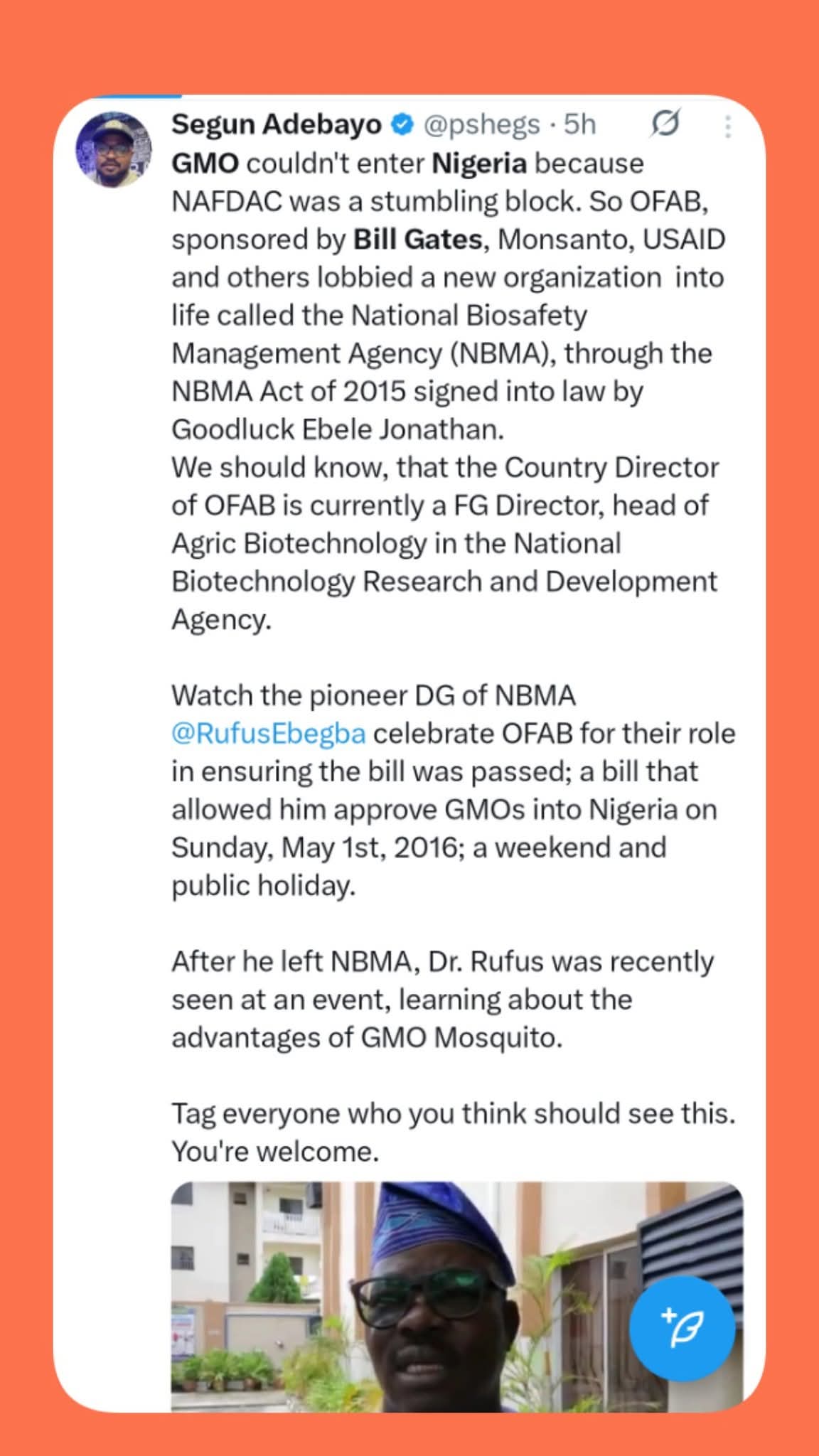
(Segun Adebayo aka Psheggs, debating GMO’s in Nigeria)
The Nigerian Economic Summit Group, supported by Gates-funded programmes such as AGRA and partners, has advocated for laws that reinforce plant variety protection and food safety regulation. Critics argue that such laws can restrict seed saving, requiring farmers to purchase certified seeds annually and opening agriculture to the interests of multinational seed and agrochemical firms. It mirrors what has been observed elsewhere, where plant variety protection, certification criteria and uniformity rules effectively exclude traditional seed diversity, favouring patented varieties and centralised control.
Wider reportage hints at even deeper influence. A West Africa Weekly article in mid-2025 highlighted concerns that Gates-linked NGOs, and even intelligence-linked organisations, have influenced Nigerian legislation relating to food safety, nutrition, tax, and security. One example cited is that former political figures such as Babatunde Fashola now serve on boards of health NGOs funded by the Gates Foundation, ensuring alignment between public policy and philanthropic agendas. The result, critics warn, is that laws are shaped by unelected actors, overriding democracy and embedding dependency.
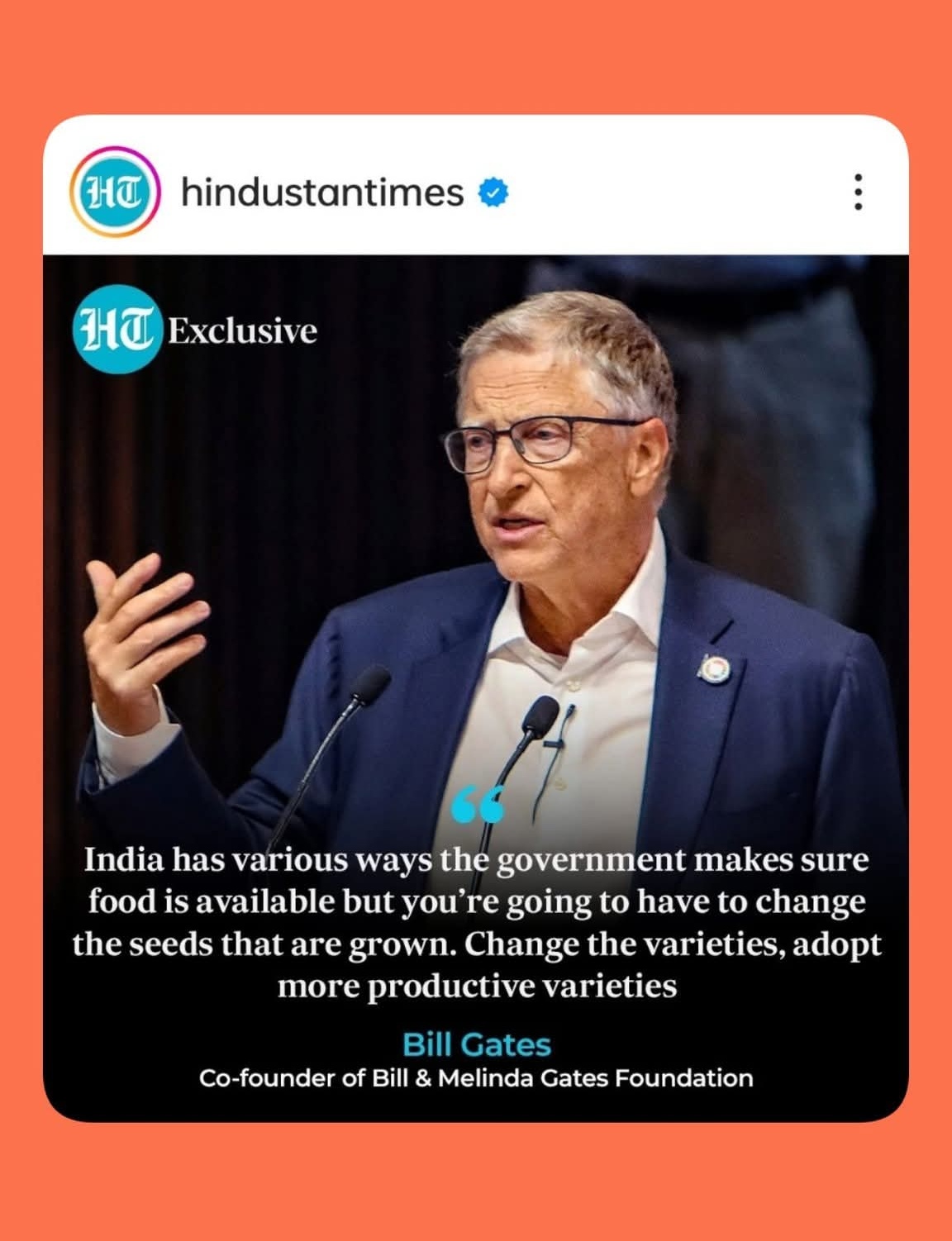
Those who watch these developments through the lens of India’s experience recognise the same pattern: philanthropy used as a tool of control. Vandana Shiva, who warned of monopoly over food and seeds through “philanthropic capitalism,” similarly decried digital agriculture as a form of surveillance in which farmers become addicted to chemical inputs and monocultures, displacing biodiversity and autonomy. She said that when corporations promoted surveillance technologies, a drone cannot understand a biodiverse farm, they are promoting a false idea of agriculture as measurable and controlled rather than alive and varied.
When Bill Gates described India as “a laboratory” whose successes can be exported elsewhere, he struck many not only as insensitive but revealing. In Nigeria, the pattern seems to repeat: push an industrial, high-input model into Africa’s food systems, and allow it to become normal. The Gates Foundation’s favoured model, often tied to AGRA initiatives across Africa, promotes hybrid seeds, synthetic fertilisers, monocultures, and digital systems. Independent analysis, such as that by Tufts University, has called AGRA a failure, hunger and undernourishment increased by tens of millions even as productivity measures grow.
In both countries, the resistance takes similar forms. In India, farmer-led protests prevented laws that would hand over agricultural markets to corporate control. In Nigeria, civil society groups, scientists, farmer unions, and community organisations are increasingly sceptical of externally driven schemes and are calling for a shift towards agroecology, land rights, and local decision-making.
The parallels are stark. In India, neoliberal trade liberalisation opened doors for patentable seeds, digital IDs, and multinational domination of food chains. Vandana Shiva said that untaxed profits from software and information economy were recycled through philanthropic investment to control agriculture and food. In Nigeria, Gates’s investments in seed research, agroforestry, early warning systems, legislative frameworks, and NGOs functioning as interface with government replicate the same architecture.
The deeper question, posed by those on the ground, is this: when agriculture becomes centrally designed by outside foundations, governed through laws shaped by foreign-financed NGOs, and dependent upon patented inputs, who really feeds the people? When seeds are controlled, why buy them every year? When surveillance informs cultivation, why trust monitors over harvesters? Who answers when farmers suffer debt, depleted soils, or lost autonomy?
The battle for sovereignty in agriculture is not academic. It is fought in fields, in legislatures, in research offices and protest camps. If Nigeria follows the pattern traced in India, its food system could slip from local stewardship into foreign control. But if its citizens claim power for themselves, from policy debates to seed banks, it could stand as an example for others.
In India and Nigeria alike, Bill Gates stands as the face of a wider design. What he advances is control dressed as charity. A nation is a people, not a laboratory. Seeds are life, not code to be licensed. Farmers are human beings, not subjects for experiments. The real test lies in whether people retain the power to plant and to feed, or whether they become dependent on programmes they cannot alter. The stakes are nothing less than the dignity and freedom of communities whose land and seeds are their inheritance and their future.
(Credit: Segun Adebayo, see previous image above for details)
Authored By:


Leave a comment