
How Private Firms Shape Government Power and Erode Civil Liberties
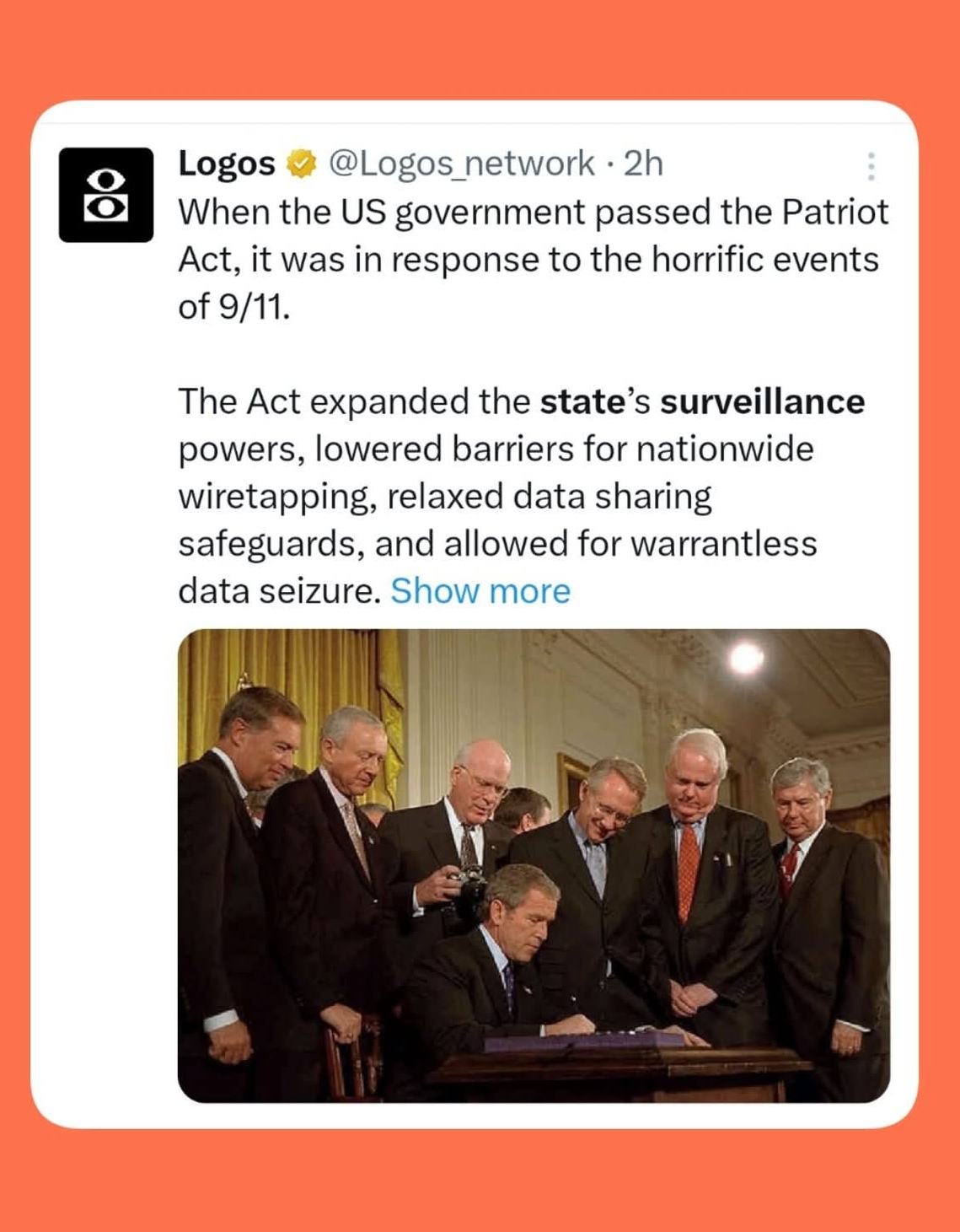
Nearly a quarter of a century ago, the attacks of September 11th reshaped the trajectory of the United States and the West, not only through the immediate tragedy, but through the political response that followed. Fear, misinformation, and the ambitions of power-seeking leaders transformed the moment into justification for endless war, mounting debt, and the construction of a permanent security state. In the process, the ideal of the “American dream” gave way to an empire defined by surveillance, control, and the normalization of extraordinary state power.

Corporate surveillance technologies have reshaped the balance of power between citizens and states. Large private firms now build systems that aggregate, analyse, and weaponize personal data at scale. These firms sell products to governments and private clients, often through opaque contracting and lobbying channels. Palantir, Cellebrite, Paragon, Carbyne and similar companies provide tools that extend law enforcement capabilities far beyond previous norms.
These developments raise legal, constitutional, and geopolitical questions that democratic systems must confront promptly and decisively. Palantir Technologies grew from early intelligence-community partnerships into a dominant global data-integration firm. The company developed software designed to fuse databases, maps, and live feeds to present a single operational picture to decision makers. Palantir’s platforms now support military planning, immigration enforcement, public-health operations, and interagency intelligence sharing across multiple states.
Scholars and investigative reporters have documented rapid growth in government revenue alongside expanding influence within administrations. The company’s lobbying and hiring practices illustrate how commercial expertise becomes institutionalised inside the machinery of government. Products marketed as efficiency tools for public safety increasingly resemble technology designed for broad societal surveillance. Predictive policing algorithms, migrant-management platforms, and national case-management systems concentrate profiling capacity within a few companies. Palantir’s recent contracts include work with immigration enforcement that consolidates disparate records and enables near-real-time operational targeting of individuals. Those capabilities change the character of enforcement from adjudication based on evidence to algorithmic prioritisation and routing of state coercion.

Commercial spyware firms based in Israel have introduced another layer of intrusion into democratic systems worldwide. Cellebrite’s forensic extraction tools and Paragon’s Graphite spyware demonstrate how private products can access locked devices and extract deleted material. Those tools shift the balance between privacy expectations and investigative power because they bypass conventional encryption and access controls. Independent forensic research and reporting have confirmed operational deployments of such tools against journalists, activists, and civil society figures in several countries. The public record shows repeated collisions between lawful investigative aims and widespread abuses of extraordinary access.
Emerging law enforcement technologies illustrate how predictive surveillance is becoming both automated and globalized. Gideon, an AI-powered threat detection platform soon to be deployed in the United States, is designed to flag individuals for potential criminal activity before any act occurs. Developed with engineers from Palantir and modeled on Israeli counterterrorism methods, the system continuously monitors online communications and other digital data to identify “threat language,” routing alerts directly to local law enforcement agencies. Dozens of agencies have already committed to adoption. While marketed as a preventive tool, Gideon exemplifies the dangers of algorithmic policing: expanding state coercion into predictive, preemptive, and largely opaque decision-making.
Emergency communications platforms further concentrate sensitive data flows under privately managed systems. Carbyne and similar vendors deploy infrastructure that transfers live caller location, video, and telemetry into centralised platforms for first responders. The operational benefit of enhanced situational awareness exists alongside risks created by channeling personal, often highly sensitive information, through systems with foreign links and commercial incentives. When emergency systems route data through corporate servers, questions about access, retention, and secondary use of that data naturally follow and require strict legal limits.
The convergence of surveillance, artificial intelligence, and third-party control over public systems carries clear strategic implications. States that rely on private vendors for critical national tasks create dependencies that adversaries may exploit through supply-chain or legal pressure. When foreign actors supply surveillance tools embedded in critical infrastructure, risk migrates from privacy harms to national security vulnerabilities.

Governance frameworks have lagged behind commercial deployment, leaving a regulatory vacuum that vendors can exploit through contracting advantage and geopolitical positioning. Commercial motivation drives the rapid adoption of intrusive capabilities without commensurate oversight mechanisms. Surveillance technologies enjoy market incentives because governments pursue efficiency and vendors monetise escalation of capabilities. Profit incentives reward features that extract more data and permit longer retention, while accountability mechanisms lag far behind technological change. Regulatory bodies have struggled to articulate precise limits on lawful use, transfer controls, export rules, and judicial oversight of forensic or exploitative tools.
The relationship between venture capital, state intelligence funding, and corporate expansion is central to the problem. Early investment from intelligence-linked venture funds and direct client revenues created pathways for companies to entrench their platforms within national systems. Funding and procurement create reciprocity: vendors gain privileged access to government data, while agencies acquire commercial capabilities they may lack internally. Disentangling the public interest from private profit becomes harder as vendors win larger, non-competitive contracts and hire former officials.
Legal protections for privacy and due process struggle to contain new practices that combine remote exploitation with automated decisioning. Existing statutes and case law presume human-driven searches and warrants for physical intrusions, not persistent, automated scraping or zero-click exploits. Courts and legislatures therefore face novel questions about probable cause, proportionality, and notice when digital forensics platforms enable covert access to hugely rich datasets. Absent revised legal standards, governments and vendors will continue to operate in constitutional grey zones that erode civil liberties incrementally.
Civil society and technical researchers have produced detailed audits demonstrating misuse and legal violations by surveillance vendors. Reports from academic and forensic institutions document specific cases where powerful tools targeted journalists, opposition figures, and human-rights defenders. Those case studies show patterns of mission creep in which capabilities intended for serious crime investigations become normalised for immigration control and protest monitoring. Transparent, independent audits therefore represent a necessary precondition for any responsible governance of these technologies.
International human-rights norms intersect awkwardly with cross-border surveillance commerce, producing jurisdictional gaps that companies exploit. Commercial vendors sell to governments with varying human-rights records, creating channels through which repressive states gain advanced intrusion tools. International frameworks attempt to restrict misuse, but enforcement mechanisms remain weak and capture by commercial interests prevents robust multilateral regulation. The resulting environment encourages regulatory arbitrage where firms can operate across jurisdictions that afford them legal shelter and market access.
The strategic logic of deploying surveillance technologies differs between allied democracies and autocratic regimes, yet consequences converge. Democratic governments increasingly use powerful systems for migration control, protest surveillance, and counterterrorism while lacking sufficient parliamentary scrutiny. Autocratic regimes pursue similar technological solutions to suppress dissent and extend central control, often aided by foreign vendors operating in permissive export markets. The spread of capabilities thereby fuels a global elevation of state surveillance regardless of political system labels.
Transparency deficits plague procurement and operational practices across security and emergency services. Sole-source contracts, limited competitive tendering, and exemption from public procurement rules are recurrent features in the record of major vendors. Contract justifications often cite urgency and technical complexity while obscuring long-term operational dependencies that emerge after contracts are concluded. Parliamentary committees, oversight boards, and auditors thus require powers to review contractual terms and technical specifications before irreversible dependencies form.
Technical design choices also embed values that shape societal outcomes through algorithmic bias and data selection. Predictive systems trained on historic policing data risk perpetuating over-policing of marginalised communities and entrenching unequal enforcement patterns. Designers must therefore be accountable for data provenance, model validation, and auditability under independent third-party review frameworks. Without those safeguards, automated systems will reproduce structural inequalities while presenting as neutral technological progress.
Data governance must align with human-rights principles and proportionality requirements for state intrusion. Regulations should mandate narrow purpose limitations, minimised retention periods, and mandatory judicial oversight before exploitative tools deploy in investigations. Export controls and licensing regimes must restrict sales to jurisdictions with documented records of abuse, and procurement should exclude vendors failing to demonstrate robust compliance programs. Failure to impose these constraints accelerates a global race to the bottom in standards and permits abusive deployments to proliferate unchecked.
Operational separation between civilian emergency services and intelligence conduits must be enforced by statute and technical partitioning. The route by which emergency-call data flows into tactical systems requires legal firewalling that prevents repurposing for law enforcement without due process. Where private platforms provide emergency infrastructure, contractual and technical safeguards must prohibit secondary access absent court orders and independent oversight. Public trust in emergency services collapses if citizens perceive that life-saving systems double as surveillance funnels.
Supply-chain security and source-code transparency represent further policy priorities that governments currently neglect. Reliance on foreign suppliers for critical telemetry or exploitation tools produces systemic risk under crisis conditions and geopolitical pressure. Mandating periodic security audits, supply-chain attestations, and code escrow arrangements with neutral third parties would reduce national and municipal exposure to foreign influence. Open standards and interoperable public-sector alternatives could break vendor lock-in while preserving operational functionality in emergencies.
Judicial processes must adapt to digital realities, including notice to affected individuals and remedies for unlawful access. Legislatures should require prosecutors and investigators to notify targets when evidence obtained through intrusive forensics influenced prosecutions. Remedies should include suppression of unlawfully obtained evidence and administrative penalties against agencies or vendors that breach statutory constraints. These changes would reassert constitutional protections even as investigatory methods evolve technologically.
Civil society organisations and technical communities play indispensable roles in monitoring abuse and informing policy debates. Independent forensic labs and human-rights groups frequently lead investigations that reveal misuse and pressure governments to act. Supporting these institutions through grants, legal protections, and formal consultation mechanisms increases the odds that abuse will be detected early and constrained effectively. Bilateral and multilateral cooperation to share forensic findings and best practice will strengthen oversight against cross-border vendor operations.
Market incentives alone cannot protect civil liberties while governments outsource essential public functions. Public procurement must prioritise constitutional safeguards and societal risk mitigation rather than solely evaluating technical performance or price. Where vendors fail to meet human-rights compliance standards, exclusion from procurement should remain an enforceable tool available to sovereign purchasers. Strengthening procurement law restores democratic control over which technologies serve the public interest and which become instruments of social control.
Regulators and parliaments must establish clear accountability regimes for vendors and contracting agencies. Statutory obligations should include mandatory impact assessments, periodic independent audits, and criminal liability for willful complicity in rights violations. Accountability regimes must also attach to corporate leadership, including boards and chief executives, to deter reckless sales to abusive clients. Practical enforcement requires resourcing regulators adequately and ensuring whistleblower protections for insiders who expose wrongdoing. Civil liberties require new technical baselines that make surveillance invasive only by judicial order and oversight. Default defaults should require data minimisation, local processing where possible, and cryptographic protections that resist extrajudicial extraction. Where device exploitation remains legally sanctioned, courts should impose narrow temporal windows, full forensic logging, and independent verification before evidence enters prosecutions. These technical guardrails provide operational clarity and protect against mission creep and incidental mass collection.
Current legislative initiatives in Europe demonstrate how quickly extraordinary surveillance can be normalized under the language of safety. The proposed “Chat Control” regulation would require messaging platforms such as WhatsApp, Signal, and iMessage to install client-side scanning tools that inspect every private communication before it is encrypted. Family conversations, personal photos, and casual exchanges would be subjected to automated scrutiny, effectively treating all citizens as pre-emptive suspects. Once such an infrastructure exists, its expansion to other domains, such as political dissent, protest activity, or the policing of online discourse, becomes almost inevitable. The risk is not only technical but constitutional: the end of confidential messaging would mark a profound erosion of privacy and free expression across the European Union.

Public debate must confront uncomfortable trade-offs between security, liberty, and commercial power in democratic societies. Voters deserve transparent explanations of the capabilities their governments deploy and the safeguards that constrain misuse. Parliamentary hearings, declassified programmatic reviews, and independent technical evaluations would anchor public trust and provide a factual basis for informed democratic choices. Absent open debate, the balance of power will continue to shift toward unelected technological gatekeepers. Reform requires global coordination to control exports, enforce norms, and provide redress across borders. Bilateral agreements and multilateral instruments must address the transfer of exploitative cyber tools and forensic platforms to governments with poor human-rights records. International organisations should establish inspection-style mechanisms that verify compliance and publish non-classified findings to deter abusive procurement.
Only coordinated pressure can halt the diffusion of intrusive technologies that escape domestic constraints by crossing jurisdictions. Democratic governments must also rebuild internal technical capacity to avoid unhealthy dependency on external vendors. Investing in publicly governed software, secure open architectures, and skilled civil-service engineering teams reduces procurement pressure and increases sovereign control. Long-term budgets for core infrastructure and secure alternatives prove cheaper than indefinite dependence on proprietary vendors whose commercial incentives may diverge from public interest.

Finally, citizens and civil institutions must recognise surveillance power as a political question requiring democratic resolution. Voting choices, civic participation, and advocacy campaigns materially shape procurement decisions and statutory reform priorities. Effective contestation will not emerge solely from technologists or activist groups; it requires broad societal engagement and clear legal commitments from elected representatives. Only a determined, informed civic response can rebalance power away from private surveillance monopolies and toward accountable public control. The surveillance ecosystem described here demands policy action, legal reform, and international cooperation before democratic governance suffers irreversible damage. Unchecked commercial tools that combine data-fusion, forensic exploitation, and AI triage stand to transform routine governance into algorithmic administration.
The technical and legal adjustments proposed in this essay will not eliminate risk overnight, but they provide a practical framework for slowing and reversing dangerous institutional trends. Those committed to preserving democratic liberties must move quickly and deliberately to implement these changes across national and international policy spaces.
Authored By:
Popular Information is powered by readers who believe that truth still matters. When just a few more people step up to support this work, it means more lies exposed, more corruption uncovered, and more accountability where it’s long overdue. If you believe journalism should serve the public, not the powerful, and you’re in a position to help, becoming a PAID SUBSCRIBER truly makes a difference.
buymeacoffee.com/ggtv


Leave a comment