Global Voices Challenge Longstanding Narratives Amid Rising Scrutiny of Israeli Policies
The events surrounding the late Charlie Kirk have exposed fractures long suspected but rarely admitted in the relationship between American conservatism, Israeli influence, and the machinery of Western politics. The available evidence shows that Kirk’s trajectory from loyal advocate to public critic of Israel was not a simple personal shift but a case study in how power enforces conformity and punishes deviation. His experience illustrates the extent to which financial patronage, organised lobbying, and coordinated pressure are deployed against political figures who deviate from the expected narrative, particularly on Israel. It also demonstrates how attempts at narrative control are weakening under the weight of global scrutiny and shifting international alignments.
Kirk built his career under the sponsorship of wealthy donors aligned with Israel and Zionist interests in the United States. His organisation was funded generously, with reports citing tens of millions of dollars in backing. He was courted with trips to Israel, reinforced with biblical arguments that tied Christian nationalism to Zionist causes, and treated as a valuable conduit for pro-Israel messaging to the American right. Such arrangements are not unique to Kirk. Scholars like Professor John Mearsheimer and Stephen Walt have long documented the depth of Israel’s influence in American politics, with extensive evidence of how financial and political rewards are tied to compliance with pro-Israel policy positions. In Kirk’s case, his value lay in mobilising a younger conservative audience, embedding support for Israel within the cultural fabric of the American right.
The turning point came when Kirk began questioning Israeli conduct in Gaza and providing a platform for voices historically excluded from mainstream conservative spaces. His conversion to Catholicism appears to have accelerated this independence, with Catholic tradition lacking the deep evangelical-Zionist linkage that has shaped much of American Protestant political theology. When Kirk invited Tucker Carlson and others to speak critically of Israel at his Turning Point USA conference, the applause that followed Carlson’s comments linking Jeffrey Epstein to Israeli intelligence showed a constituency ready to hear what had long been unspeakable in mainstream conservative gatherings. The crowd’s applause showed that many had long waited to hear someone say it aloud.
( Sanchez Effect, RT News)
The backlash was swift as Kirk admitted in an interview with Megyn Kelly that he faced accusations of antisemitism and character assassination rather than debate on substance. He described losing the freedom to critique Israel in America without harsher repercussions than Israelis themselves face for similar criticisms. The reporting of investigative journalist Max Blumenthal has added important context. According to multiple sources, Kirk was summoned to a closed-door meeting in the Hamptons, convened by billionaire financier Bill Ackman, a figure with direct ties to Netanyahu’s network. There, Kirk was chastised for allowing critics of Israel into his events and pressured to return to a compliant posture. Such accounts, while needing corroboration, fit long-standing patterns of donor-enforced discipline in American politics, documented by former officials such as Senator William Fulbright and Congresswoman Cynthia McKinney.
Candace Owens has claimed that Kirk was offered increased funding and even a direct meeting with Netanyahu in exchange for re-aligning with Israeli interests. Reports suggested his organisation had already received over $80 million, with further sums offered as inducement. Kirk declined both the money and the overtures. His refusal to be “re-educated” in Israel or participate in staged photo opportunities at sites such as Auschwitz marked a decisive break. For a figure once seen as Israel’s strongest asset within the MAGA movement, this rejection represented more than a personal decision. It threatened the entire apparatus built to ensure uniformity of pro-Israel sentiment across American conservatism.
His last public statements underscore this transformation. Shortly before his death, Kirk criticised a proposed law in Congress, H.R. 867, that would criminalise private boycotts of Israel with fines up to one million dollars and prison sentences of up to twenty years. He argued that such laws only fuel antisemitism by reinforcing the perception that Israel controls American governance. He warned Republicans that supporting the bill would expose them and pledged to watch their votes closely. This remark was a direct challenge to a legislative effort designed to silence dissent. Scholars such as Norman Finkelstein and commentators from the libertarian Cato Institute have similarly warned that anti-boycott laws undermine constitutional freedoms and confirm the disproportionate role of Israel in shaping U.S. domestic legislation.
The political implications are significant as Kirk’s experience highlights the extent to which American politics is conditioned by external interests and enforced through financial patronage and personal coercion. His rejection of inducements and refusal to submit to symbolic gestures reveal cracks in that system. The fact that his criticisms resonated so strongly within grassroots conservative circles demonstrates that the public appetite for debate on Israel’s role is growing. For decades, critics like McKinney were marginalised, branded extremists, or pushed out of office. Yet today, their warnings are echoed by mainstream commentators once hostile to them. Carlson, Kelly, and even Bannon now repeat lines that would have been career-ending ten years ago.
McKinney’s own testimony provides the broader framework in which Kirk’s story sits. She described how members of Congress are pressured, infiltrated, and even entrapped by pro-Israel operatives. She recounted attempts to control her staffing decisions, offers of bribes disguised as campaign assistance, and the omnipresence of AIPAC-linked monitors within Washington. Her insistence on reading every bill mentioning Israel marked her out as a target, reinforcing the reality that most legislators operate under a system of delegated compliance. Her stories of being told to “play ball” on Sudan and other foreign policy issues mirror the way Kirk was pressured to conform. Both accounts demonstrate that the machinery of influence operates not only through lobbying but through personal surveillance, inducement, and threat.
This machinery extends beyond Israel. McKinney pointed to the larger role of what is often described as the deep state, networks of officials, financiers, and military contractors who profit from wars and regime change. She recalled how figures like Madeleine Albright and Wesley Clark secured personal gains from interventions in Kosovo, while corporations such as Raytheon and Lockheed Martin benefitted from defence appropriations. This structure ensures that foreign policy is shaped not by public debate or democratic choice but by a convergence of financial interests and ideological commitments. In that sense, the Israeli lobby is both a unique and integral part of a larger system that sustains perpetual intervention abroad.
Kirk’s refusal to conform, therefore, did not occur in isolation, as it came at a time when public trust in mainstream institutions is collapsing, when independent media outlets often eclipse established networks in reach, and when the narratives sustaining foreign interventions are increasingly disbelieved. The applause at Carlson’s remarks and the viral spread of Kirk’s criticism of H.R. 867 are symptoms of this broader shift. The narrative monopoly once maintained by large media and bipartisan elites is waning and faltering.
Internationally, this collapse is even more visible as Israel’s actions in Gaza have triggered widespread condemnation not only from predictable adversaries but from traditional allies. Spain has taken notable positions within the European Union, with senior officials calling for accountability and supporting Palestinian rights in forums where such positions were once taboo. Ireland, Belgium, and Norway have echoed similar sentiments, breaking with the once solid Western front. Across the Middle East, governments have issued sharper condemnations, with Saudi Arabia and the UAE, once seen as moving towards quiet normalisation, publicly criticising the scale of destruction. Turkey has recalled ambassadors, while Jordan has issued stark warnings. These developments cannot be dismissed as isolated gestures. They represent an erosion of Israel’s diplomatic shield.
At the United Nations, the accumulation of votes against Israeli actions has grown, despite Washington’s continued use of the veto at the Security Council. The General Assembly has seen overwhelming majorities calling for ceasefires and accountability. Analysts at the Russian International Affairs Council and scholars like Professor Richard Falk note that the repeated need for U.S. vetoes only underscores Israel’s growing isolation. Each veto exposes the disjunction between global opinion and the narrow alliance sustaining Israeli impunity. The United States, by expending diplomatic capital in defence of Israel, undermines its own legitimacy and accelerates multipolar realignments.
This is why attempts at narrative control, such as criminalising boycotts or silencing figures like Kirk, increasingly backfire. They confirm the central claim of critics, that Israel wields disproportionate influence over American political life. When dissenting voices are attacked not on substance but through accusations of bigotry, it becomes evident to wider audiences that debate is being suppressed. As Kirk’s last words indicated, laws designed to protect Israel from criticism do not reduce antisemitism but rather entrench the perception that Israel demands privileges above all others.
The exposure of these dynamics coincides with a broader geopolitical shift. The war in Ukraine has drained Western credibility, with evidence mounting that NATO’s posture is offensive rather than defensive. As Professor Mearsheimer has argued, NATO expansion provoked conflict rather than prevented it, and the costs are being borne across Europe. In this climate, the linkages between pro-Israel influence and wider patterns of interventionism are harder to conceal. When critics note that the same donors and lobbying networks fund support for Israel, Ukraine, and other foreign ventures, the pattern becomes impossible to deny.
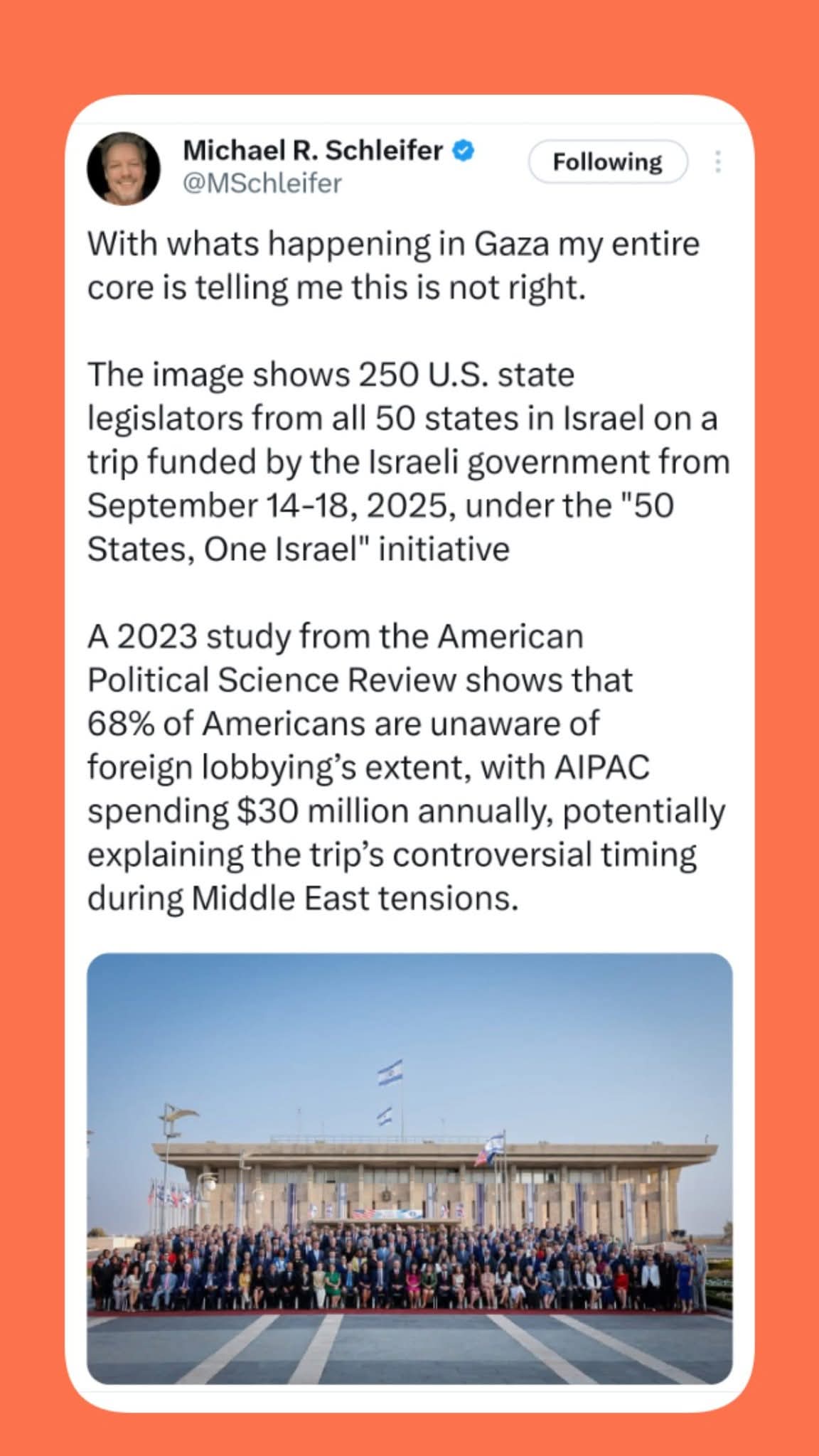
The erosion of narrative control is accelerated by new media structures. Podcasters and independent journalists, many of whom once worked within mainstream outlets, now reach audiences larger than CNN or Fox. Figures like Jimmy Dore on the left and Carlson on the right converge in questioning Israeli influence. The overlap between former critics and former defenders shows that the old partisan boundaries no longer constrain discourse. For Israel and its allies, this is a dangerous development. The bipartisan consensus that sustained unconditional support for decades is breaking down at both the elite and grassroots levels.
The implications are grave for the United States as well. As McKinney observed, legislators spend most of their time courting donors, leaving governance in the hands of staff and lobbyists. When those donors are disproportionately aligned with Israeli interests, policy outcomes become detached from national interest. This disjunction is now visible to ordinary citizens, who see billions allocated abroad while domestic crises mount. Kirk’s warnings about H.R. 867 tapped into this sentiment, exposing the absurdity of criminalising Americans for exercising rights of protest and boycott.
Internationally, the momentum is shifting. Latin American governments such as Bolivia and Chile have taken stronger positions against Israel, while South Africa has pursued legal action at the International Court of Justice. The African Union has expressed increasing solidarity with Palestine, reflecting grassroots pressures across the continent. At the UN, blocs of countries from Asia, Africa, and Latin America now form consistent majorities opposing Israeli policies. Even within Europe, where U.S. pressure is strong, dissenting voices grow louder. Spain’s position is not isolated but indicative of a wider unease.
The combined effect is the slow dismantling of the system of impunity that Israel has enjoyed. Each instance of overreach, whether bombing campaigns in Gaza, laws criminalising boycotts, or attempts to silence dissenters like Kirk, serves only to expose the mechanisms of control more starkly. Attempts at coercion once conducted discreetly are now reported openly by journalists and discussed in public forums. The very secrecy of meetings in the Hamptons or offers of funding from Israeli-linked donors illustrates the methods by which compliance is enforced. When these are exposed, the credibility of the entire system erodes.
Charlie Kirk’s final stand, whether or not it hastened his death, has therefore become emblematic of a larger moment. A figure once seen as Israel’s most valuable ally within American youth conservatism ended by rejecting inducements, exposing pressure, and warning against laws designed to silence criticism. His transformation mirrors the larger trend of growing awareness, expanding criticism, and collapsing narrative control. For Israel and its allies, the challenge is no longer containing fringe voices but facing mainstream exposure. For the United States, the cost is mounting diplomatic isolation, growing domestic discontent, and accelerating global realignment.
The tide is moving, however slowly, towards accountability. Countries that once remained silent are beginning to speak openly. Governments that once feared repercussions now vote against Israel at the UN. Citizens in the West increasingly distrust media narratives and turn to independent sources. Scholars and commentators, once dismissed as marginal, now find their arguments echoed in mainstream discourse. Each of these developments points to the same conclusion: the architecture of control is breaking down, and with it the ability to shield Israel and its allies from scrutiny.
Kirk’s rejection of coercion, his defiance of offers, and his insistence on open criticism resonate precisely because they reveal the mechanics of influence. His case underscores the fact that exposure, once initiated, cannot be reversed. The more pressure applied to silence criticism, the more visible the pressure becomes. The more laws introduced to criminalise dissent, the more illegitimate those laws appear. This is the paradox now confronting Israel and its supporters. The harder they push, the more they reveal.
The broader political implication is that we are entering a period where impunity is no longer guaranteed. The United States may continue to wield vetoes at the UN, but the moral and diplomatic cost grows with each use. Allies may remain cautious, but dissent within Europe and condemnation from the Middle East cannot be contained indefinitely. As Spain, South Africa, and others demonstrate, the alignment of forces is changing. The exposure of Israel’s influence in the United States, the breakdown of bipartisan consensus, and the global turn against unchecked military action point to a convergence of pressures.
Kirk’s story may be a single thread, but it is woven into a wider tapestry. It connects with McKinney’s testimony of systemic corruption, with Blumenthal’s reporting on coercive meetings, with Carlson’s breaking of taboos, and with the global outcry against Gaza. Taken together, these elements form a picture of a system under strain. The attempts at control remain strong, but the fractures are visible. The more they are denied, the clearer they become. In this sense, the exposure of Israel and the deep state is not an isolated phenomenon but part of a wider collapse in narrative hegemony.
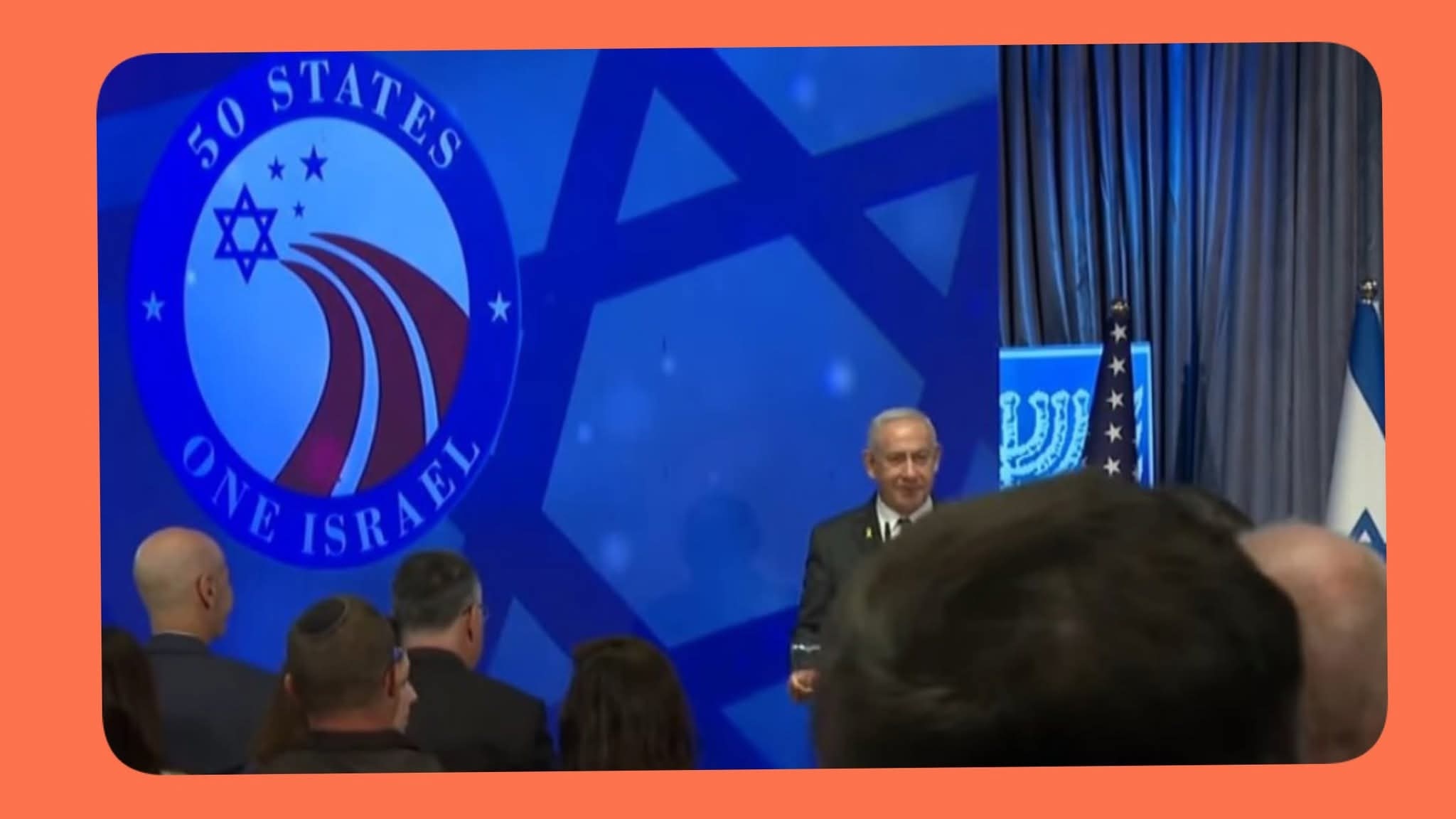
(Logo saying 50 states and 1 Israel)
In conclusion, the political order that sustained unconditional support for Israel is weakening. What we now know is that America is an occupied nation, just like Palestine, but it can best be described as a “Palestine with Privileges”, a glorified host. The Zionist’s methods, financial patronage, coercive meetings, legislative suppression, and media control, are now exposed. The legitimacy has now been challenged not domestically by figures like Kirk but also by internationally by governments across multiple continents. The tide of condemnation grows, from Middle Eastern capitals to European parliaments to African courts. The United Nations, though limited by U.S. vetoes, reflects the overwhelming global majority no longer willing to remain silent. The machinery of influence is still powerful, but the shield of silence has broken.
That said, the circumstances around Charlie Kirk supposed shooting are so sketchy, whether he is dead or alive, we have to wait see.
Authored By:
Popular Information is powered by readers who believe that truth still matters. When just a few more people step up to support this work, it means more lies exposed, more corruption uncovered, and more accountability where it’s long overdue. If you believe journalism should serve the public, not the powerful, and you’re in a position to help, becoming a PAID SUBSCRIBER truly makes a difference.
buymeacoffee.com/ggtv


Leave a comment