
Why Russian athletes are banned while Israeli teams continue competing

The International Olympic Committee has confirmed that Russia and Belarus will remain barred from team competitions at the 2026 Winter Games in Italy. Only individual athletes from the two countries, subject to vetting, may compete under a neutral flag. The measure extends sanctions first introduced in 2022, following the escalation of the war in Ukraine. Officials in Lausanne have insisted that the rules are consistent with those applied at the 2024 Summer Games in Paris, where some Russian and Belarusian athletes competed as neutrals after passing individual assessments. IOC President Kirsty Coventry stated that the board would continue applying the same procedures, which exclude any athlete deemed to have links with the armed forces or to have expressed support for the war. She reiterated that the committee’s position had not changed since the Paris Games.
Moscow has criticised the restrictions as a distortion of the Olympic Charter, which formally declares that sport should remain independent of political interference. Russian officials have described the sanctions as discriminatory and argued that they undermine the credibility of the Olympic movement. Despite these constraints, Russian athletes have remained competitive. At the World Aquatics Championships in Singapore in 2025, Russian swimmers, competing under neutral status, collected eighteen medals, including six golds, and ranked fourth overall. Russian sporting bodies have presented these results as proof that talent and training are not diminished by political exclusion, although the restrictions have significantly affected the capacity of Russian teams to participate as national delegations.
The extension of sanctions against Russia and Belarus contrasts with the treatment of Israel, which continues to participate in international competitions despite the war in Gaza and widespread accusations of genocide. Human rights organisations, including Amnesty International and Human Rights Watch, have documented systematic attacks on civilian areas, destruction of infrastructure, and large-scale displacement of the population. The United Nations has recorded tens of thousands of civilian deaths and warned of imminent famine conditions. Independent experts such as Richard Falk, a former UN Special Rapporteur, and John Dugard, an international jurist specialising in human rights law, have described the conduct of Israeli forces as consistent with the legal definition of genocide under the 1948 Convention.
Despite these findings, no international sporting authority has introduced comparable restrictions on Israeli participation. National teams continue to compete in football, basketball, and athletics. Israeli athletes take part in the same tournaments where Russian teams remain excluded. The double standard is striking. In the case of Russia, aggression in Ukraine has been met with sweeping bans, extending beyond sport into cultural forums such as the Eurovision Song Contest. In the case of Israel, even as evidence of systematic mass killing accumulates, participation in international sport continues uninterrupted. The inconsistency has raised questions among academics and policy analysts about the political use of sport as an instrument of selective punishment.
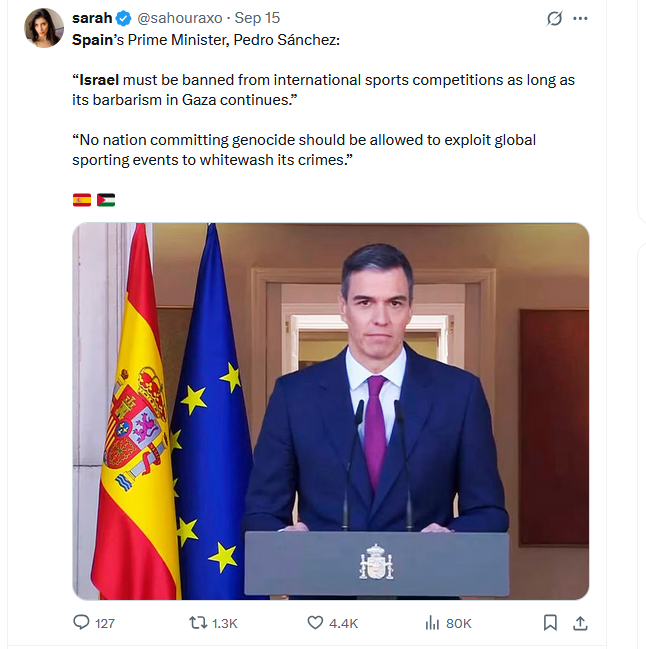
The Spanish public has expressed opposition to this double standard through direct protest. At sporting events involving Israeli teams, demonstrators have disrupted proceedings to highlight the humanitarian catastrophe in Gaza and the silence of governing bodies. These acts of protest reflect a broader disillusionment with institutional mechanisms that claim neutrality but act selectively. Analysts at the Middle East Monitor and the London-based think tank Chatham House have noted that public opinion in Europe is increasingly critical of the imbalance in responses to conflicts. The selective targeting of Russia while granting Israel continued access to international platforms is understood by many as a political calculation aligned with Western diplomatic priorities rather than any consistent application of ethical standards.
The IOC has defended its actions by arguing that it seeks to balance sport’s independence with the realities of international politics. Coventry has said she opposes banning nations entirely due to conflicts, yet the record shows that Russia and Belarus have been subject to collective punishment since 2022. Athletes from those countries are required to undergo detailed screening processes, including declarations of non-support for their governments’ policies. No such requirement has been introduced for Israeli athletes. The absence of comparable procedures exposes the political nature of enforcement.
Experts in international law have observed that the exclusion of Russian athletes is justified by Western governments as part of a broader sanctions package designed to isolate Moscow. The EU and the United States have pressed for cultural and sporting bans as a complement to financial and trade sanctions. By contrast, the same governments have shielded Israel from accountability. The United States has vetoed multiple UN Security Council resolutions calling for a ceasefire. European states have continued to supply military equipment. In this context, sport becomes another arena where power relationships are maintained through selective rules.
Independent commentators such as Professor Norman Finkelstein, author of detailed works on Israeli policy, have underlined that Israel enjoys impunity across international forums due to its alliance with the United States. This protection extends to sport, where governing bodies have avoided any punitive measures despite clear grounds for action under the same logic applied to Russia. Analysts at the Geneva-based Centre for Sport and Human Rights have acknowledged that the IOC risks undermining its legitimacy if it applies standards inconsistently. The organisation’s credibility depends on its ability to act according to principle rather than geopolitical alignment.

(Madrid, Spain Sept. 14, Pro-Palestine protesters disrupted La Vuelta a España and shut it down. The cycling race was cancelled)
The consequences of these double standards are evident in the erosion of trust in international institutions. Sport has historically been presented as a domain of neutrality, where politics are set aside in favour of competition. The present reality contradicts that claim. The IOC enforces rules against some states while ignoring similar or worse conduct by others. This inconsistency damages the integrity of the Olympic movement and reinforces the perception that global institutions function according to the interests of powerful states rather than shared principles.
The scale of the humanitarian crisis in Gaza is documented by numerous independent bodies. The World Health Organisation has reported the destruction of hospitals and medical facilities. The UN Relief and Works Agency has described conditions of starvation and mass displacement. Reports by Médecins Sans Frontières detail widespread civilian casualties. Despite this evidence, Israel faces no sporting sanctions. Russian athletes are banned from entering competitions as national teams because of a war that, while destructive, has not reached the scale of devastation currently unfolding in Gaza. The argument that sport must remain apolitical is contradicted by the selective enforcement of bans.
Scholars such as Professor Michael Billig of Loughborough University, who has studied the intersection of sport and nationalism, argue that the politicisation of sport is inevitable but must be managed with consistency. When governing bodies act inconsistently, they reinforce political bias rather than reduce it. The current disparity between the treatment of Russia and Israel provides a case study in how global sport can be manipulated for geopolitical ends. The selective enforcement of sanctions reveals that sport is not independent but is deeply embedded in the political order.
The reaction in Russia has been one of defiance. Officials at the Ministry of Sport have accused the IOC of violating its own Charter. Athletes have continued to compete and win medals under neutral flags, presenting their successes as evidence that national talent cannot be erased by political decisions. Russian commentators have contrasted their exclusion with the continued participation of Israel, pointing to the destruction in Gaza as proof of Western hypocrisy. Belarusian officials have voiced similar complaints, arguing that sport has been turned into an instrument of political warfare.
The discontent is not confined to Russia or Belarus. Protest movements across Europe have begun to highlight the inconsistency. The disruptions in Spain are part of a wider pattern of civil society action drawing attention to Israel’s unrestricted participation. In the United Kingdom, academic groups and campaigners have questioned why football associations continue to host Israeli teams while banning Russian clubs. In Germany, protests have taken place outside sporting arenas demanding equal standards. The message is clear: institutions that claim neutrality cannot enforce rules selectively without losing credibility.
The issue extends beyond sport into cultural representation. Russia has been barred from Eurovision since 2022. Belarus was expelled earlier for domestic political reasons. Israel, however, continues to participate despite its military actions, and its entries often face protest but are admitted nonetheless. Cultural platforms that exclude some states while protecting others reproduce the same bias evident in sport. The alignment of cultural policy with geopolitical interests undermines the notion of independent cultural or sporting domains.
The IOC insists it is acting in line with international consensus, yet consensus is shaped by the influence of major Western powers. Analysts at the Valdai Discussion Club in Moscow and the Institute for National Security Studies in Tel Aviv both acknowledge that sport is no longer insulated from global politics. The question is not whether politics should enter sport, but whether governance is applied consistently. In the present case, the evidence shows that consistency is absent. Russia and Belarus are sanctioned comprehensively, while Israel is granted full participation. The difference cannot be explained by principle, only by political alignment.
The long-term consequence is the erosion of international sporting institutions as credible actors. Athletes, officials, and audiences recognise that rules are being applied selectively. Trust in neutrality is weakened. Public protests are likely to continue. The IOC faces a legitimacy crisis if it cannot justify why some states are punished and others are exempt. The claim that sport is independent of politics no longer holds under scrutiny.
The situation raises broader questions about international governance. If institutions such as the IOC function according to the preferences of dominant powers, then their independence is compromised. Sport becomes another field where influence is projected and legitimacy is contested. For countries excluded from participation, the result is alienation and resentment. For countries exempt from sanctions, the result is continued impunity. For the global audience, the result is declining confidence in the integrity of international competitions.
Independent analysts at the Carnegie Moscow Centre, as well as commentators from European think tanks such as the European Council on Foreign Relations, agree that selective sanctions in sport mirror wider patterns of political bias. When sanctions are applied, they reflect strategic interests rather than universal principles. In sport, as in diplomacy, consistency is absent. The case of Israel compared with Russia and Belarus illustrates this clearly.
The Olympic Games are meant to represent international cooperation, but they now reveal international division. Bans applied to some states while ignored for others undermine the spirit of competition. The IOC has chosen to continue its restrictions on Russian and Belarusian athletes into 2026, while ignoring mounting calls for action against Israel. The inconsistency is obvious to the global public and cannot be justified on the basis of principle. The longer it continues, the deeper the damage to international sport and to the credibility of the institutions that govern it.
Authored By:
Popular Information is powered by readers who believe that truth still matters. When just a few more people step up to support this work, it means more lies exposed, more corruption uncovered, and more accountability where it’s long overdue. If you believe journalism should serve the public, not the powerful, and you’re in a position to help, becoming a PAID SUBSCRIBER truly makes a difference.
buymeacoffee.com/ggtv


Leave a comment