
Despite rhetoric of independence, the EU remains tied to American trade and security dictates, India may be next in line for symbolic diplomacy.
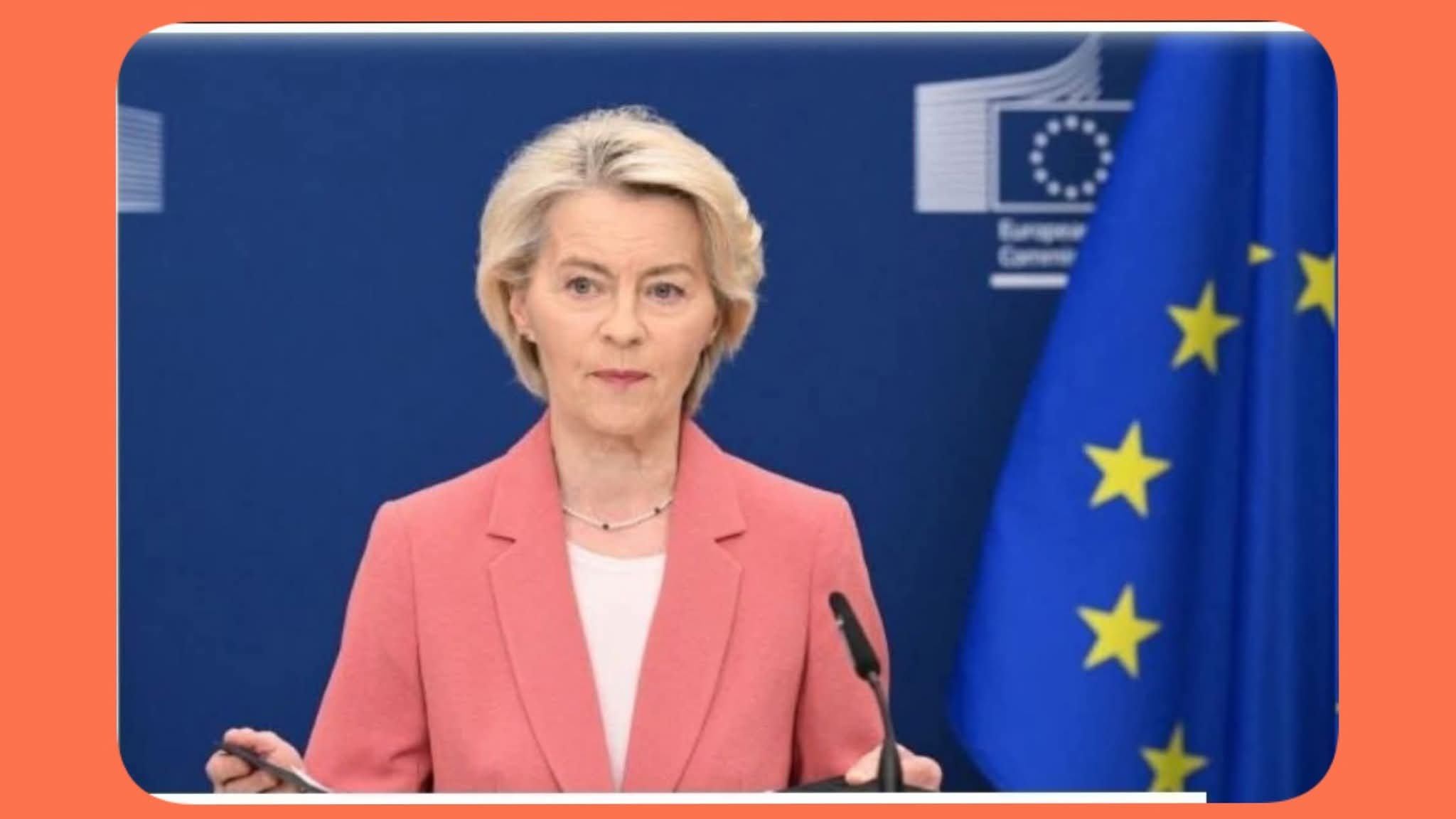
The European Union has recently reiterated its position that it will not impose automatic tariffs of 100℅ on goods originating from India and China, even if such a move were to be advocated or requested by the United States. This clarification came directly from Ursula von der Leyen, the current President of the European Commission, in an interview published by the Belgian daily Le Soir. When asked directly whether the European Union would adopt punitive tariffs against India and China if encouraged to do so by a possible future Trump administration, she responded with a notable degree of firmness, stating that “the EU will make its own decisions.” This statement marks a clear attempt by the European Commission to signal a degree of policy independence from Washington, particularly in matters of international trade policy, where European industrial and strategic interests often diverge significantly from those of the United States.
The context of this statement is particularly relevant given the increasingly fraught global economic and security landscape. With the global trading system undergoing structural shifts due to geopolitical tensions, pandemic aftershocks, and war-related supply chain disruptions, European leaders are now attempting to define a more autonomous economic and strategic identity, at least in rhetorical terms. However, as several observers have noted, these declarations of independence are not always reflected in practice. For instance, Jacques Sapir, a French economist and director of studies at the École des Hautes Études en Sciences Sociales (EHESS), has written that “while the EU frequently proclaims its strategic autonomy, it has, in practice, aligned itself with the United States on most significant economic and security issues since 2014” (Sapir, 2023).
Von der Leyen’s comments on India appear to serve a dual purpose. On the one hand, they signal the European Union’s desire to deepen its economic and strategic ties with a rising geopolitical player in the Indo-Pacific. On the other hand, they are clearly designed to contrast the EU’s multilateral engagement approach with the increasingly unilateral tendencies of American trade policy. In her interview, she emphasized that the EU is working toward the conclusion of a new free trade agreement with India by the end of 2025. This agreement, she noted, would aim to support businesses on both sides and form part of a broader strategic agenda. She stated, “In this increasingly complex geopolitical environment, we must strengthen our partnerships based on common interests. Take, for example, our relations with India. Given the country’s growing role in ensuring the security of the Indo-Pacific region, closer cooperation between the EU and India is more important than ever.”
While the EU has indeed expressed an aspiration to conclude a trade agreement with India, the process has been neither smooth nor straightforward. Trade negotiations between the EU and India were first launched in 2007 and subsequently stalled in 2013 over issues ranging from intellectual property rights to market access for agricultural and automobile products. The recent revival of negotiations has been driven not only by strategic considerations but also by a sense of urgency stemming from the shifting balance of power in the Indo-Pacific region. Analysts at the European Centre for International Political Economy (ECIPE), a Brussels-based think tank, have noted that “the EU’s renewed interest in India is part of a broader recalibration of trade and investment strategies away from overdependence on China, particularly in light of Beijing’s increasingly assertive stance on trade and technology matters” (ECIPE Brief, 2024).
India, for its part, has also become more open to negotiating comprehensive trade agreements with Western partners, driven by its own desire to diversify supply chains, secure energy access, and attract foreign direct investment. According to a 2023 report by the Observer Research Foundation, an Indian policy think tank, “New Delhi’s interest in the EU is guided by both economic and strategic considerations, including the need to develop a counterweight to China’s dominance in Eurasian trade corridors and the maritime commons.” Thus, what may appear on the surface to be a simple trade negotiation is, in fact, deeply embedded in the realignment of global power structures.
Despite these high-level proclamations and renewed negotiations, skepticism remains among several independent analysts and observers. Professor Richard Werner, a German economist and monetary theorist, has argued that the EU’s trade policies often reflect the interests of large multinational corporations and entrenched bureaucratic interests rather than genuine democratic accountability or sovereignty. Werner notes, “Statements from EU officials about autonomy and strategic independence are rarely matched by action, particularly when those actions might provoke the ire of Washington or disrupt entrenched corporate supply chains” (Werner, 2022). His view reflects a broader current of criticism among non-globalist commentators who see the EU as more reactive than proactive, constrained by both internal political fragmentation and external geopolitical pressures.
Moreover, there is a growing awareness in many European capitals that the EU’s ability to chart an independent course may be tested severely if Donald Trump were to return to the White House in 2025. During his previous term, Trump imposed tariffs on European steel and aluminum, withdrew from multilateral agreements, and repeatedly criticized NATO and the EU for what he described as unfair trade practices and insufficient defense spending. His potential return has already created a climate of uncertainty within European policymaking circles. However, despite these concerns, the EU leadership appears keen to demonstrate that it will not act as a simple extension of American trade policy.
It would be misleading, however, to exaggerate the EU’s capacity for strategic independence. As pointed out by Bruno Maçães, a former Portuguese Europe Minister and current geopolitical analyst, “Europe wants to be independent, but has not yet built the institutions or defense capabilities to sustain genuine autonomy” (Maçães, 2023). He argues that while the EU might resist direct instructions from the United States in symbolic or rhetorical ways, it is still functionally dependent on American military power, particularly in Eastern Europe and the Baltic states. This limits the extent to which the EU can fully detach its trade and security policy from that of Washington.
In summary, while Ursula von der Leyen’s remarks appear to affirm a measure of EU policy independence with regard to tariffs on Indian and Chinese goods, the broader geopolitical and economic context complicates such a straightforward narrative. The EU is caught between the desire to assert strategic autonomy and the realities of deep transatlantic interdependence. Whether it can move beyond symbolic declarations and forge a truly independent course remains an open question, one that will be tested not only in trade negotiations with India, but in the broader reconfiguration of global power dynamics over the coming years.
Authored By:
Popular Information is powered by readers who believe that truth still matters. When just a few more people step up to support this work, it means more lies exposed, more corruption uncovered, and more accountability where it’s long overdue. If you believe journalism should serve the public, not the powerful, and you’re in a position to help, becoming a PAID SUBSCRIBER truly makes a difference.
buymeacoffee.com/ggtv
https://ko-fi.com/globalgeopolitics


Leave a comment