
Argentina as a Target of Financial Colonialism, A Nation Sold One Deal at a Time
Argentina’s economic decline under its new president underscores growing concerns about the subordination of national interests to globalist agendas. First, it is notable that both Argentina and Israel currently have heads of state with the surname Mileikowski. In Israel, Mileikowski was the birth surname of Benjamin Netanyahu, while in Argentina, Javier Milei carries the same root surname, adapted as Milei. This interesting coincidence invites reflection on their lineages and the transnational trajectories of their political leadership. Secondly, follow a familiar pattern: Step 1, install a compliant leader such as Milei; Step 2, engineer or allow a rapid economic collapse; Step 3, enable global financial interests to acquire national assets at devalued prices; Step 4, consolidate external control over the country’s key sectors; and Step 5, replicate the process elsewhere. This sequence raises urgent questions about sovereignty, economic manipulation, and the mechanisms of modern neocolonialism.

Argentina’s economy has entered an acute emergency that exposes structural weaknesses and policy choices made since the beginning of President Javier Milei’s administration. International market reactions over the past fortnight reflect a loss of confidence in the sustainability of the exchange rate regime and in the political capacity to carry through declared reforms. U.S. officials publicly signalled that Washington will consider a range of support measures for Argentina, including the use of the Exchange Stabilization Fund and possible swap lines, a development that materially altered asset prices and temporarily steadied local markets after sharp falls.
The immediate market shock followed two related events: a major electoral setback for Milei’s coalition in Buenos Aires province and revelations about accelerated asset disposals and reserve movements by the central bank. The electoral outcome reduced the government’s ability to secure parliamentary majorities needed to pass contentious fiscal measures, and the reserve movements intensified questions about transparency and the central bank’s capacity to defend the peso. Financial markets promptly registered these political and institutional vulnerabilities through currency depreciation, rising sovereign spreads and volatility in both dollar-denominated bonds and local equity indices.

The sequence of policy choices that led to the current crisis began with the Milei government’s aggressive programme of monetary and fiscal liberalisation. The International Monetary Fund approved a 48-month, US$20 billion Extended Fund Facility for Argentina in April, subject to a series of policy conditionalities and disbursement tranches. The IMF programme intended to support a transition away from strict capital and currency controls and to underpin a floating exchange rate band, while leveraging additional multilateral and bilateral financing to restore reserve buffers. That IMF arrangement has been accompanied by parallel commitments of financing and investment pledges from the World Bank and the Inter-American Development Bank, bringing a wider financing package that observers characterised as totalling roughly US$42 billion of official and multilateral support. The size and conditionality of that package framed government policy over the subsequent months.
Market commentary and independent analysis emphasised two core risks from the outset. First, a tight fiscal stance combined with rapid liberalisation would require political consensus that Milei’s fractured coalition struggled to deliver. Second, using official financing to underpin an exchange-rate band without deep and credible reserve buffers would create a short window in which markets could test the authorities’ willingness to defend the band. Both risks materialised during the recent run of trading and political events, with the central bank executing unusually large dollar sales in an attempt to stabilise the peso. Those interventions amounted to more than one billion dollars across three trading sessions, drawing down the practical stock of liquid reserves available for intervention and reinforcing concerns about sustainability.

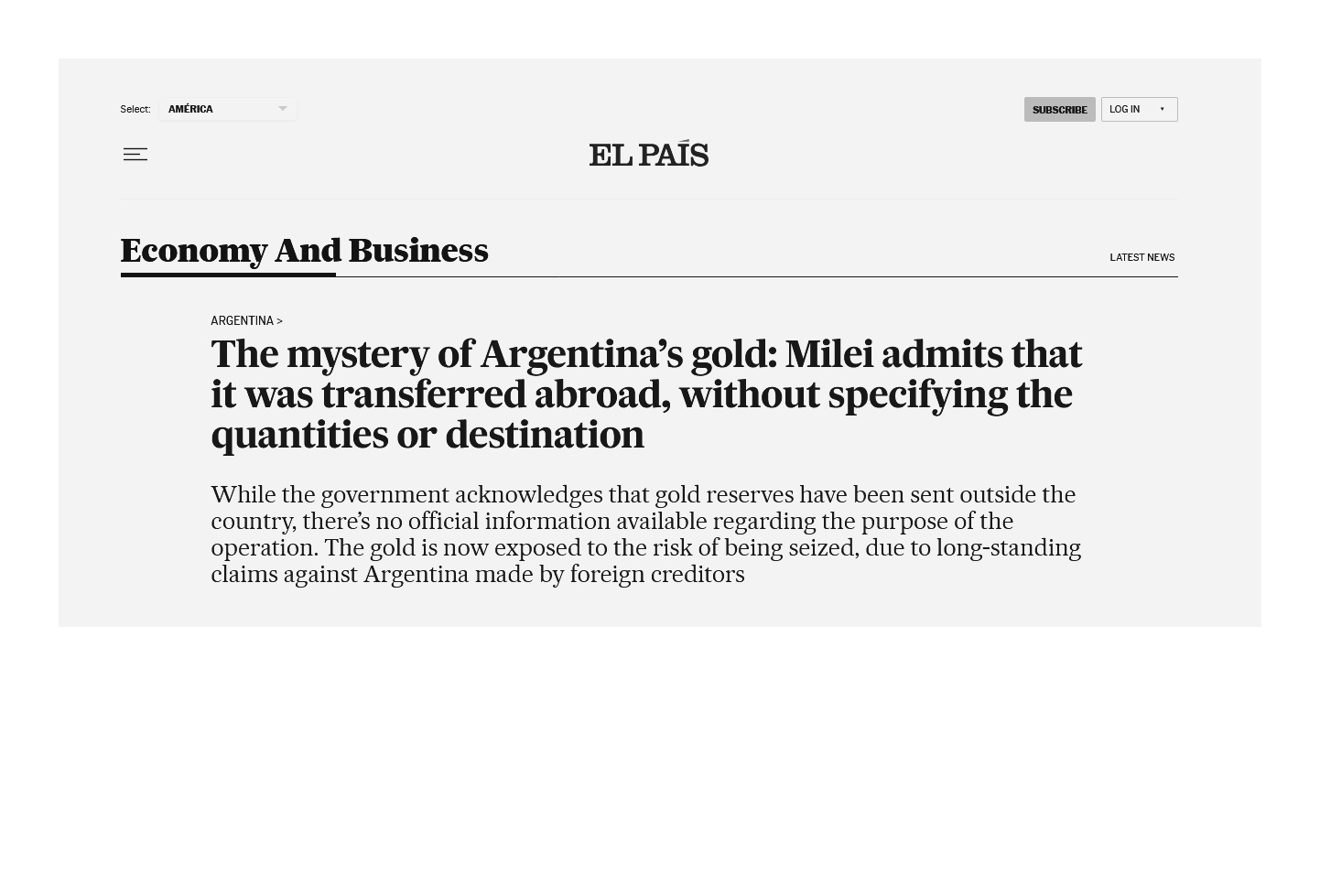
Independent reporting established that the central bank and government have conducted reserve operations that aggravate transparency problems. Official statements confirmed transfers of gold abroad, but the authorities provided limited public detail on quantities, destinations and the contractual terms of the operations. That lack of public disclosure has provoked legal challenges in foreign jurisdictions and stimulated speculation about the purpose and ultimate cost of the transactions. Legal filings and press enquiries demonstrate the seriousness of the questions, and the absence of straightforward disclosure has undermined confidence among both domestic savers and cross-border investors.
Privatisation of state assets progressed at speed amid the financial turmoil. The government disclosed plans to privatise a large stake in the Buenos Aires water and sanitation company AySA, proposing a competitive international tender for a strategic operator and a local share offering to mobilise private capital. The announced timetable envisages the sale of a 90 per cent state stake, a measure pitched by the government as necessary to attract foreign direct investment and relieve fiscal burdens. The planned sale generated immediate controversy because it strikes at an essential public service, raises questions about tariff and access policies after transfer to private management, and situates a national utility within an election-heated debate about sovereignty and economic strategy.
The interaction between the IMF programme, hurried privatisations, and reserve management created a political economy that investors could exploit and opposition factions could attack. Analysts at established policy organisations and academic centres warned that a heavy reliance on external finance and on a constrained exchange-rate band would leave Argentina exposed to confidence shocks if politics undermined the credibility of the programme. When the government suffered defeats in key provincial votes, markets interpreted that as an immediate threat to policy continuity. Sovereign bond yields rose sharply and the local equity market posted some of the largest declines among emerging markets in 2025, underlining how quickly political events amplify macroeconomic vulnerability.
A record of Argentina’s currency performance over the long term supplies necessary context for understanding the scale of the current problem. The peso has endured repeated episodes of devaluation and capital flight across successive administrations, and the nominal exchange rate against the US dollar has worsened markedly over the decade. Central bank data and market series show multiple order-of-magnitude depreciations since the mid-2010s, and the practical purchasing power of widely used pesos in local markets has been severely eroded. These long historic dynamics condition how investors and ordinary citizens react to sudden policy shifts, and they frame the political cost of any stabilisation strategy that relies on sharp austerity or rapid private sector reprivatisation.
Policy errors and communication failures magnified market reactions. Government announcements frequently preceded full implementation details, and statements about exchange-rate policy, reserve use and privatisation lacked the sequential clarity markets expect when a major IMF programme is in place. That pattern produced a feedback loop: partial announcements prompted speculative flows, the central bank intervened to slow depreciation, interventions depleted reserves, depletion increased perceptions of scarcity, and perceptions of scarcity drove more speculative pressure. The absence of a transparent medium-term plan with clear fiscal and social safeguards made that feedback loop more dangerous and more politically destabilising.
The case for international support from the United States and multilateral lenders rests on two propositions that need careful scrutiny. The first proposition asserts that coordinated external finance can buy time for structural reforms that stabilise the macroeconomy and restore growth. The second proposition asserts that conditionality and surveillance by institutions such as the IMF will secure that the reforms are credible and durable. Both propositions have empirical predecessors in Argentina’s history; the outcomes of earlier programmes varied greatly according to domestic politics and policy sequencing. Critics argue that external finance without domestic political consensus will only postpone, not prevent, a renewed crisis. Supporters argue that without a financial backstop the adjustment could be disorderly and far more costly for vulnerable households. Contemporary analysis by non-partisan policy bodies emphasises that conditional finance can produce space for reform only if governments preserve policy credibility and protect social buffers.
Questions of sovereignty and public ownership have dominated civic debate over the last months. Privatising essential services such as water and sanitation places regulators at the centre of ensuring equitable access and affordability. Proposals to tender AySA to a strategic operator carry contractual, tariff and oversight conditions that determine whether the transaction yields long-term benefits for consumers or merely transfers cash flows to foreign owners. Public discussion around those contracts has been truncated by the speed of the government’s timetable and by limited parliamentary debate, leaving civic organisations and sector specialists calling for a more open process and for enforceable charter conditions that guarantee service standards and social protections. Those demands are consistent with technical literature on utility privatisation and with comparative evidence showing how regulatory design determines social outcomes after transfer.
The political economy of Argentina’s relationship with external lenders remains historically fractious. Successive governments have alternated between assertive national policy and urgent recourse to international capital. Past IMF programmes left legacies of social protest and political backlash, and official lending often arrived after major crises rather than preventing them. Contemporary scepticism about the effects of structural adjustment and privatisation is rooted in this history, and any credible strategy will need to explain, with evidence, why current conditionality differs in design or expected effect from earlier interventions. Critics from academic centres and independent think tanks emphasise that programme design must explicitly protect social spending and avoid excessive procyclicality if the measure is to secure broad acceptance.
The Milei government’s stated economic doctrine draws on libertarian and market-oriented principles. That ideological frame has practical consequences for policy sequencing and social policy choices, because the doctrine prioritises rapid liberalisation, deregulation and privatisation. In practice, governments pursuing such policy sets confront transition costs that manifest as short-term unemployment, compressed wages, and higher prices for subsidised goods. In advanced economies those costs are often managed by redistributive fiscal measures. Argentina’s problem derives from the interaction between ideological tempo, fragile political coalitions, and a limited fiscal cushion to protect vulnerable households. Independent scholars and country specialists have repeatedly warned that rapid liberalisation without compensating social measures typically intensifies short-term social costs and political resistance.
The practical policy options available to Argentine authorities now diverge along a narrow set of trade-offs. One route would prioritise fiscal and monetary credibility and make painful short-term fiscal adjustments while preserving enough social protection to avoid abrupt humanitarian consequences. Another route would prioritise rapid privatisation and market liberalisation to attract investment but risk a short-term loss of social stability that could, in turn, deter long-term investment. A third route would seek a hybrid approach combining targeted social protection with phased liberalisation and explicit contractual conditions for asset sales that preserve essential public interests. International experience shows that the hybrid approach tends to produce better political outcomes, provided strong institutions administer the transition. The crucial constraint in Argentina’s present circumstances remains political: the capacity to form credible cross-bench agreements that can implement a coherent strategy.
Transparency and legal safeguards must form a central part of any credible recovery plan. Public documentation of reserve operations, clear publication of privatisation tender terms, and open parliamentary scrutiny would reduce the scope for rumours and for market overreaction. Independent audits, judicial transparency in cross-border legal filings and prompt publication of central bank reports would provide the measurable assurances that both domestic constituencies and international investors require. Empirical research on sovereign crises demonstrates that transparency reduces risk premia and fosters more stable capital inflows when accompanied by consistent policy implementation.
The short-term market imperative to stabilise the currency and sovereign spreads cannot override the medium-term requirement to rebuild public trust and institutional capacity. Emergency liquid funding from multilateral lenders and bilateral partners can alleviate immediate balance-of-payments strain, but recurrent recourse to external financing only perpetuates the country’s cyclical vulnerability unless policymakers embed credible institutional reforms. Those reforms include strengthened fiscal rules, independent central bank governance, robust regulatory frameworks for essential utilities and a social safety net that cushions adjustment. Absent those measures, temporary financial support will delay but not prevent renewed economic distress.
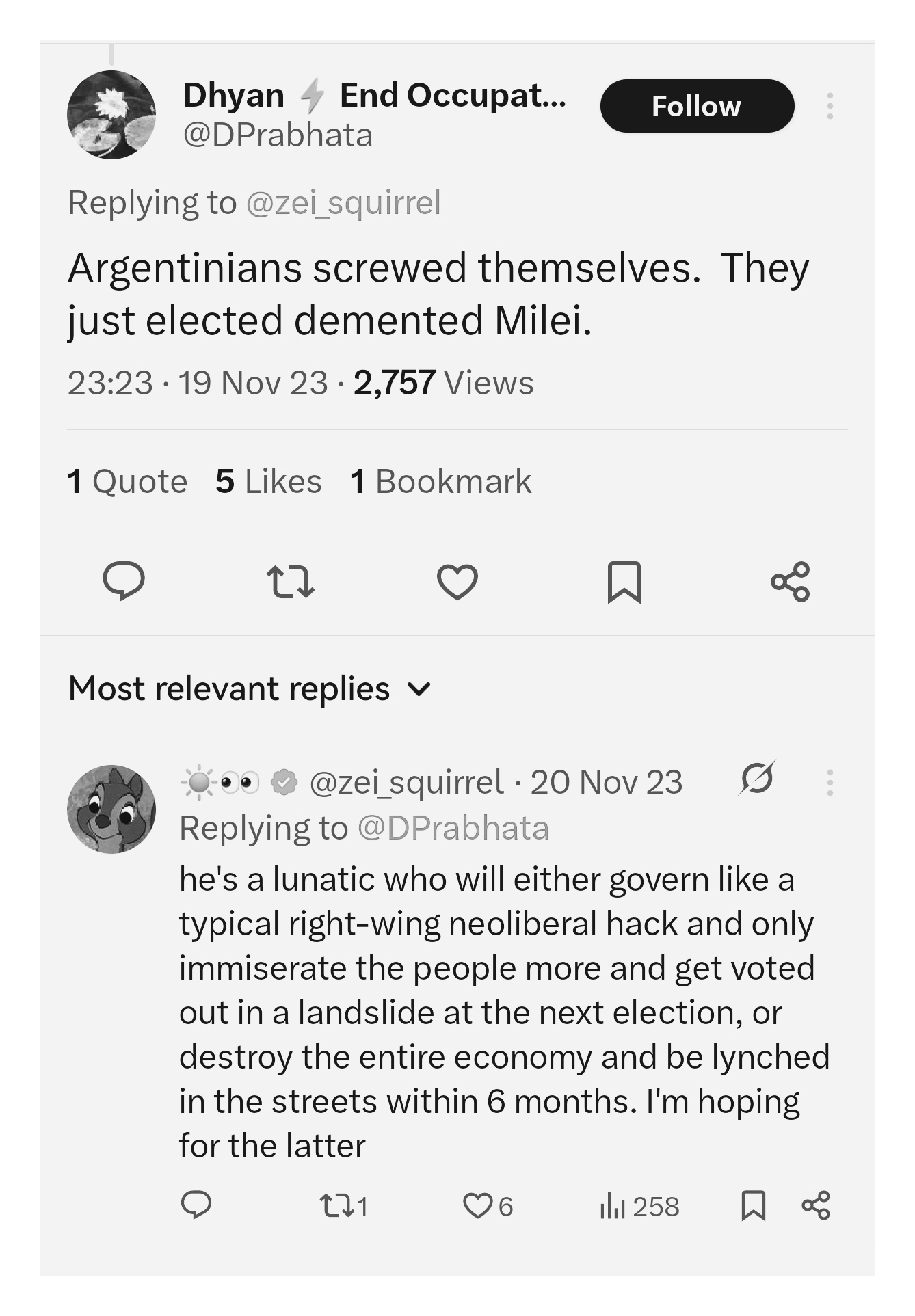
Argentines who pay attention to the empirical record will draw several clear lessons. First, the sequencing of reform matters more than the rhetoric of privatisation or liberalisation. Second, external financing can be effective only if it complements credible domestic policy and transparent governance. Third, the social consequences of abrupt market liberalisation require explicit, funded mitigation strategies that preserve human development gains. International finance can support a transition without dispossessing citizens, but that outcome requires rigorous contractual protections, public oversight and a political consensus that has so far proved elusive in Argentina’s recent months.
The facts the public must judge are straightforward and consequential. Argentina has accepted a major IMF programme and accompanying multilateral financial support while simultaneously proposing rapid privatisation of strategic assets and conducting reserve operations that lack full public explanation. Market reactions have signalled declining confidence, and the central bank has expended substantial dollar reserves defending the exchange-rate band. U.S. statements offering possible balance-of-payments support materially affected markets by creating the possibility of additional foreign liquidity, but such support cannot substitute for political consensus and institutional reforms required for durable stability. Policy choices over the next weeks will determine whether Argentina stabilises with orderly adjustment or slides into a deeper cycle of external dependency and social pain.
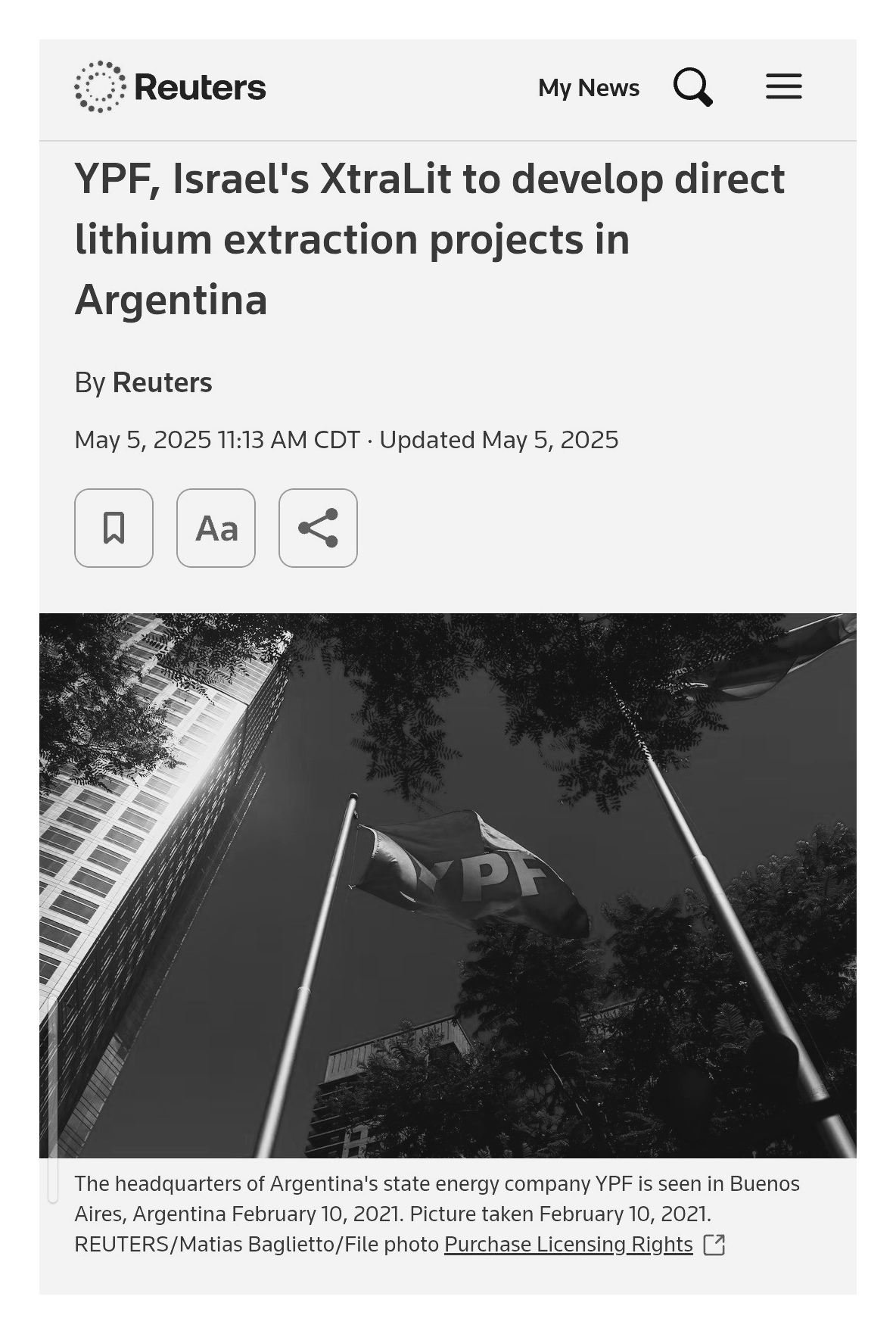
Any credible public policy proposal must therefore combine four concrete elements. First, full public disclosure of reserve transactions and the terms of any collateral agreements should be published immediately and subject to independent audit. Second, privatisation tenders for utilities must include enforceable social and regulatory covenants protecting affordability and universal access. Third, the IMF programme should be accompanied by a clearly funded social protection package that offsets the most adverse effects of price and subsidy adjustments. Fourth, transparent parliamentary debate should precede major asset sales or constitutional changes to avoid governance gaps that reward short-term financial gains over long-term national interest. Evidence from comparative cases shows that countries that follow similar procedural safeguards achieve better social and economic outcomes after major transitions.
In Confessions of an Economic Hit Man, John Perkins describes his role as an economic hitman, where he was tasked with convincing leaders of developing countries to accept substantial loans for large infrastructure projects. These loans were often channeled through institutions like the World Bank and USAID, with the expectation that the projects would be awarded to U.S. corporations. The primary objective was to create a cycle of debt that would render these countries dependent on U.S. economic and political influence. Perkins details various tactics employed, including the manipulation of data, bribery, and leveraging political connections to achieve these goals.
The recent policy sequence in Argentina exemplifies classic creditor leverage through external financing and asset transfers. In April 2025, the IMF approved a 48-month, $20 billion Extended Fund Facility for Argentina, committing substantial conditional finance and catalyzing additional multilateral commitments. Concurrently, central bank disclosures revealed that portions of Argentina’s gold reserves were transferred abroad without comprehensive public detail on destination or contractual terms. This lack of transparency raises concerns about the motives and implications of such actions. The government also fast-tracked the privatization of AySA, announcing a sale process for a 90% stake that threatens established regulatory arrangements and consumer protections. Combined with public signaling of U.S. Treasury readiness to consider swap lines and other liquidity support, these measures materially increased bargaining power for external creditors and strategic investors seeking control of Argentine assets.
So, the United States government is now preparing a financial package worth more than $20 billion to support Argentina during this economic crisis caused by Javier Milei. According to statements by Treasury Secretary Scott Bessent, a former Wall Street hedge fund manager appointed by President Trump, Washington plans to extend a swap line to Argentina’s central bank to provide access to dollars for servicing external debt owed to bondholders. Bessent also indicated that the US government is prepared to purchase Argentine bonds directly in both primary and secondary markets to stabilise prices and reduce the country’s borrowing costs. In addition, he said the administration is encouraging American companies to commit substantial foreign direct investment in Argentina if Milei secures victory in the forthcoming October election. Milei recently met with both Trump and the managing director of the International Monetary Fund in New York, where assurances were given that US financial backing would continue. These measures come as Argentina faces the now well publicised severe economic contraction, rising poverty, and ongoing social unrest, while sectors tied to financial markets and foreign capital have benefited disproportionately from policy choices during Milei’s tenure.
Javier Milei’s rapid ascent from television pundit to the presidency rode a wave of public desperation over runaway inflation and chronic governance failures. Once in office, the administration repeatedly compressed legislative scrutiny, accelerated procurement and tender timetables, and pursued major policy reversals with minimal parliamentary debate. Opaque reserve operations, legal secrecy about the whereabouts of central bank gold, and leaked allegations of impropriety inside the executive circle created a credible documentary basis for suspicion over undue influence.
Public endorsements from influential foreign figures and the visible readiness of U.S. financial officials to provide liquidity aligned international political support with a domestic privatization agenda, creating conditions favorable to creditor capture. Policymakers who care about Argentina’s citizens must accept that technical fixes alone will not restore prosperity. External finance can create breathing space, but the durability of any recovery will hinge on political bargains and institutional credibility. Political actors must therefore revert to the hard business of building a coalition for orderly reform, while preserving the public’s access to essential services and protecting the living standards of the most vulnerable. The record shows that countries which balance reform with social protection and transparent governance secure more sustainable recoveries than those that pursue sharp, unchecked liberalisation. Argentina’s present moment will test whether political leaders can learn from history and design policy that stabilises both the economy and society.
However, a people centred leader would rather restore true national sovereignty and escape the cycle of foreign dependency, Argentina must take bold and uncompromising steps. First, it should immediately suspend the operations of private banks engaged in predatory lending and speculation, followed by a decisive end to interest-based debt mechanisms (usury) that have drained the nation’s wealth. The central bank should be dismantled or restructured, severing its ties to foreign financial influence and halting the issuance of debt-based currency.
In parallel, a comprehensive audit and confiscation of ill-gotten gains, including assets acquired through corruption, insider deals, and financial exploitation, should be carried out, with a focus on repatriating national wealth. Rather than seeking salvation through IMF loans or U.S. Treasury-backed bonds, Argentina should adopt a policy of strategic patience: investing in domestic industry, protecting national markets, and allowing organic economic recovery rooted in real production and local labor, not speculative capital.
Only through economic self-determination can Argentina reclaim its future, rebuild its middle class, and break free from the cycle of debt, austerity, and foreign control. But, this requires a Revolution.
Authored By:
Popular Information is powered by readers who believe that truth still matters. When just a few more people step up to support this work, it means more lies exposed, more corruption uncovered, and more accountability where it’s long overdue. If you believe journalism should serve the public, not the powerful, and you’re in a position to help, becoming a PAID SUBSCRIBER truly makes a difference.
buymeacoffee.com/ggtv


Leave a comment