
Supports Ukraine retaking all Russian-held territory and possibly push into Russia
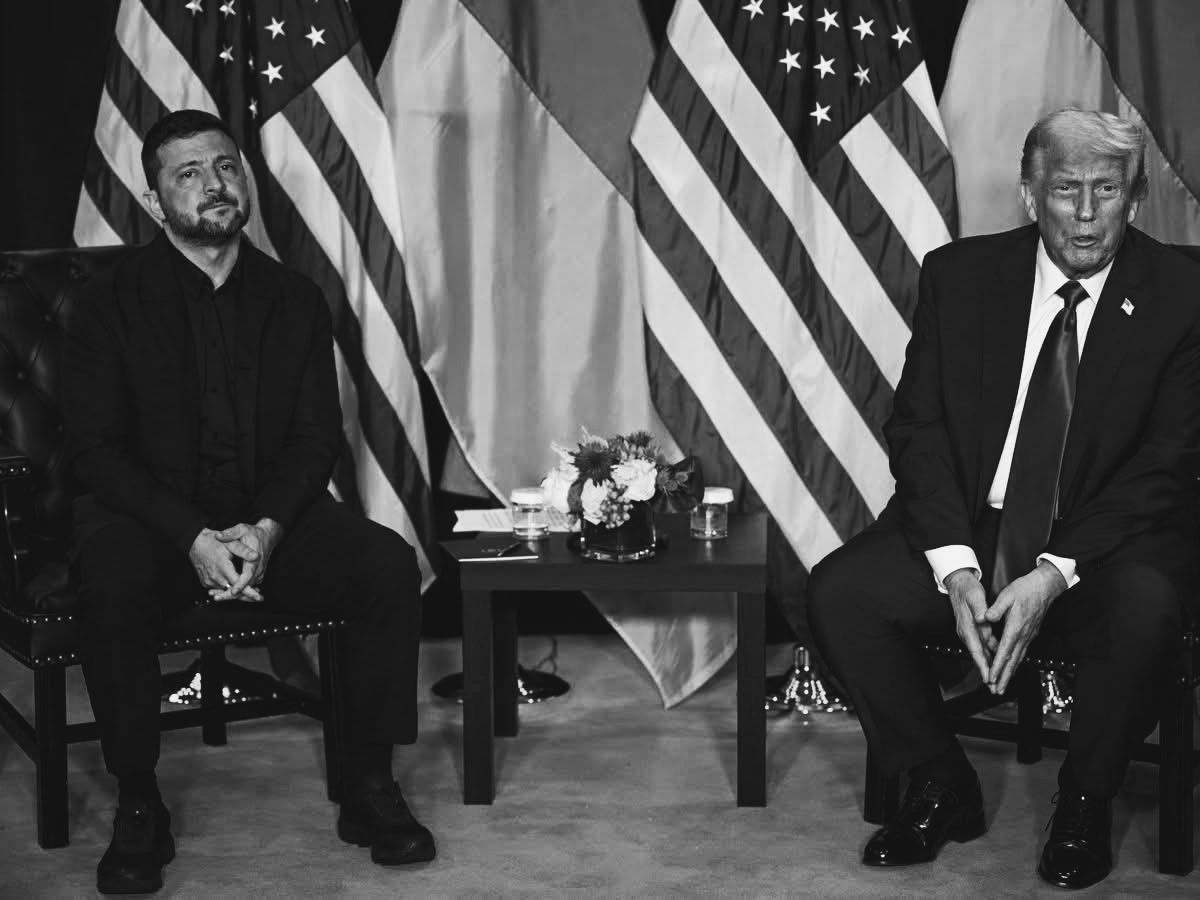
President Donald J. Trump’s remarks at the United Nations and during his meeting with President Volodymyr Zelenskiy mark a clear rhetorical pivot on the Ukraine war, and they demand sober analysis rather than headline drama. He publicly said he believed NATO countries should shoot down Russian aircraft that violated their airspace and argued that Ukraine, with European support, could regain all territory taken by Russia since 2014 and 2022, including Crimea.
Those comments arrived against a backdrop of tangible airspace incidents and alliance alarm. Several NATO members reported incursions and drone activity near their borders in recent weeks, prompting NATO to issue public warnings and to say it would use the necessary tools to defend allied territory. The alliance has publicly reaffirmed its readiness to protect member airspace, but Brussels and capitals have also signalled caution about how force might be used in practice.

The domestic and operational context matters for understanding why those words matter. NATO members have recently created new funding and procurement mechanisms to deliver western weapons to Ukraine, including arrangements to allow European states to finance or directly buy US-made systems, while defence manufacturing and stockpiles have tightened through repeated use and high demand. Those practical moves have reduced one sort of bottleneck for Kyiv, but they do nothing to erase the legal and military thresholds that separate defensive strikes inside NATO airspace from deliberate offensive operations into Russian sovereign territory.
International law sets a clear boundary on the use of force, and that boundary matters here. The United Nations Charter forbids the threat or use of force against another state’s territorial integrity except in narrowly defined circumstances such as self-defence or Security Council authorisation. NATO’s collective defence clause, Article 5, obliges allies to consider an attack on any member as an attack on all, but that obligation is triggered by armed attacks against NATO territory and does not automatically extend to offensive operations conducted by third-party states into Russian territory. In short, allied aircraft defending sovereign NATO airspace and combined or independent Ukrainian forces seeking to enter Russian territory sit under different legal regimes with different global consequences.
President Trump’s call for NATO to shoot down Russian aircraft that breach allied airspace has a straightforward defensive interpretation, and allied governments have the sovereign right to protect their skies. NATO intercept protocols typically involve visual identification, warnings, escorts, and a graduated threat of force that can culminate in shoot-down orders under national rules of engagement, as many defence commentators have explained. That defensive posture, however lawful in principle, carries high operational risk of escalation when the violating aircraft belong to a nuclear-armed adversary.
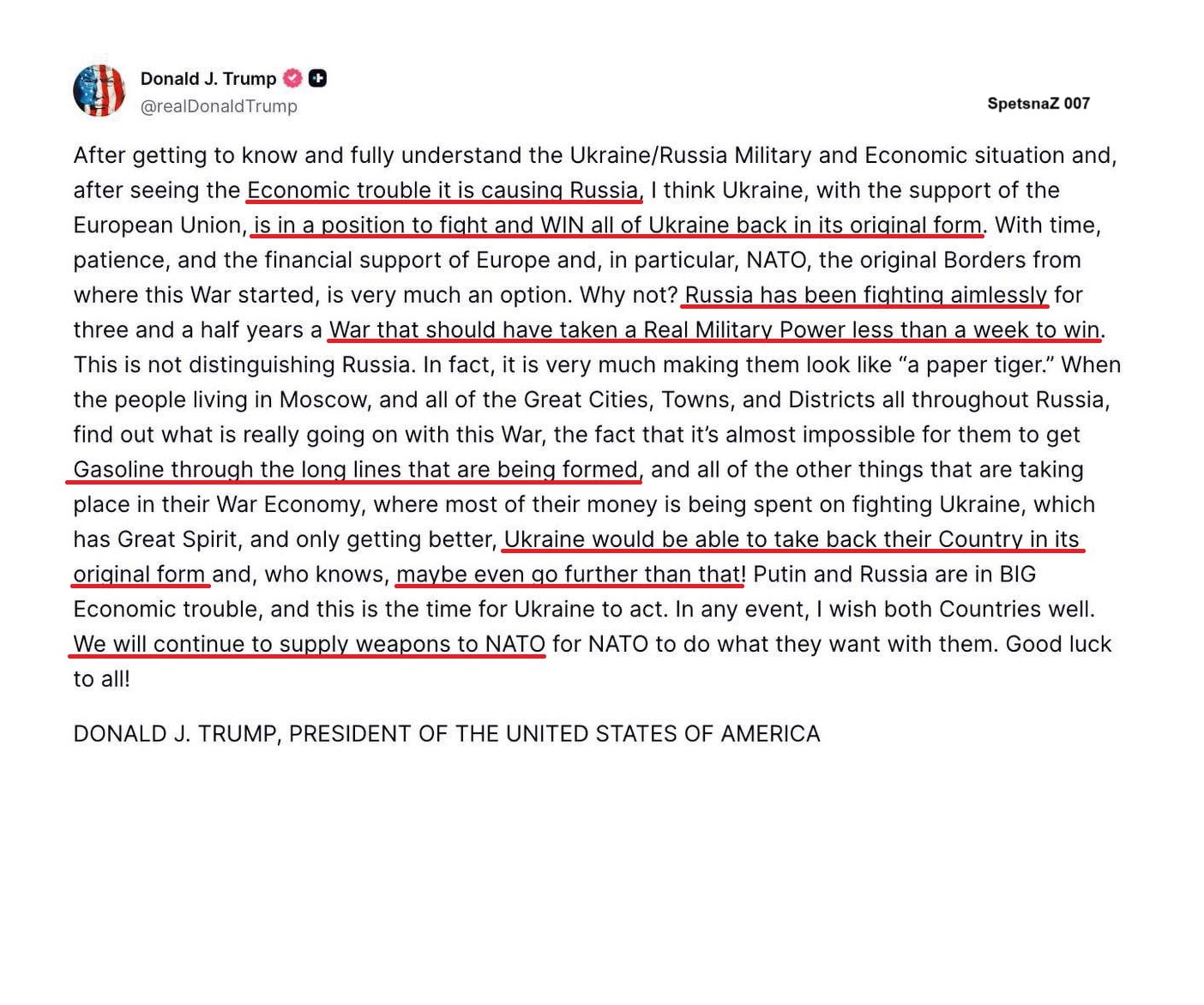
(Trump:“Russia might just be a paper tiger. They’re killing 7,000 people a week, for nothing. Most of you have probably seen the statement I released recently. I’m glad you did, because I meant every word. Let Ukraine take back their land.”)
NATO governments remain divided on how to respond to Russian drones and aircraft violating allied airspace. Estonia, Poland, and Latvia press for a firmer stance and public shows of force, arguing that only strength will deter further Russian incursions. Germany warns that shooting down Russian aircraft risks triggering uncontrolled escalation and insists that restraint is a form of responsibility, not weakness. These differences expose sharp fractures within the alliance, with frontline states demanding action while others call for caution. President Trump added fuel by declaring support for NATO allies who might destroy Russian aircraft, but Washington’s actual position remains uncertain. He avoided confirming whether the United States would back such actions, and senior officials contradicted allied claims about readiness to shoot down intruders. The result is a picture of an alliance whose leaders contradict each other on matters that carry the highest risk of war.
The sharper risk springs from a second part of the president’s message, in which he argued publicly that Ukraine could recover every lost kilometre and that with European support Kyiv might “go even further”. Those phrases inch away from purely defensive language and into endorsement of offensive reversals that would, by necessity, confront Russian forces on ground that Moscow treats as sovereign or strategically integral. Advocating for Ukraine to “retake” Crimea or for operations inside internationally recognised Russian borders removes some of the legal and diplomatic cover that Western governments have tried to preserve while supporting Kyiv.
A correct reading of recent military and strategic analysis makes clear that rhetoric about a rapid collapse of Russian resistance overstates the present opportunity. Western assessments, independent think tanks, and war-study centres record that Russian forces have suffered significant losses in men and materiel, but the Kremlin has also shown capacity to adapt, to rotate and generate forces, and to sustain operations through stockpiles and mobilisation measures. Independent open-source analysts have documented heavy attrition on both sides and have warned that offensive operations to retake deeply fortified and mined ground will be costly and slow for attackers, even when supported by Western equipment.
Economic and demographic arguments for an imminent Russian collapse do not carry decisive weight either. Official figures and leading international datasets show a large, complex Russian economy that has not collapsed under sanctions, even as growth slowed and public finances face pressure from wartime spending. Russia remains one of the world’s largest economies by purchasing-power parity metrics, and recent domestic policy choices, including tax changes and fiscal measures, reflect strategy rather than terminal failure. Public commentary that treats Moscow as a “paper tiger” therefore misreads the difference between battlefield setbacks and systemic state collapse.
Casualty figures and loss-estimates for the war remain contested, deeply politicised, and methodologically fraught. The United Nations Human Rights Monitoring Mission in Ukraine reports more than 12,654 civilians killed and over 29,392 injured since February 2022 (United Nations). Encyclopaedia Britannica estimates around 400,000 Ukrainian military casualties, with 60,000 to 100,000 killed (Britannica). The Center for Strategic and International Studies (CSIS) projects Russian losses may reach one million by summer 2025. Meanwhile, independent open-source researchers estimate Russian fatalities of up to 250,000, with total casualties exceeding 950,000. More recently, Gleb Vyshlinsky, a Ukrainian public policy expert, reportedly stated that Ukraine has suffered 1.5 million deaths in the war. Supporting this, a hacked and verified Ukrainian military database showed over 1.7 million Ukrainian soldiers dead or missing, with 625,000 casualties reported in 2025 alone. This data breach was claimed by the Russian hacker group KillNet, who say they accessed and released records from the Armed Forces of Ukraine.
Policy choices that flow from presidential rhetoric matter because they influence decisions inside European capitals already facing hard trade-offs. If the practical meaning of the president’s remarks is to encourage NATO members to enforce their own airspace unequivocally, the immediate task for allies becomes technical and defensive: improve early warning, refine intercept rules of engagement, and coordinate public communications to reduce the danger of miscalculation. If the remarks are understood as political cover for Kyiv to mount offensive campaigns aimed at reclaiming territory inside Russia, the consequences are profoundly different and far riskier. They would raise the probability of direct confrontation between NATO states and Russian forces, carried out either by allied air assets over contentious airspace or by European ground contingents if such escalation were to occur.
The risk calculus grows more complex because recent alliance work has already lowered logistical barriers to heavier Ukrainian fighting. NATO and the United States have developed financing and purchasing mechanisms that permit European funding to buy American weaponry for Ukraine, and European defence production has accelerated accordingly. Faster deliveries and higher volumes of munitions improve Kyiv’s options, but they do not give Kyiv independent control of the necessary air superiority and deep logistics required for sustained operations into well-defended territory. That operational gap explains repeated warnings from independent military analysts that retaking Crimea or penetrating Russia proper would remain both technically difficult and politically dangerous.
Assessing motive matters, because motive shapes foreseeable policy. President Trump’s rhetorical pivot carries several plausible drivers that align with observable actions. First, electoral politics and signalling to constituencies who prize strength plausibly encourage bold, uncompromising language on the international stage. Second, closer alignment with Kyiv today reduces accusations of having been too soft on Moscow earlier, thereby neutralising a line of domestic criticism. Third, stronger rhetoric helps justify or accelerate arms sales and defence cooperation mechanisms that support both European rearmament and American defence suppliers. News coverage and market responses to recent remarks reflected immediate investor confidence in defence equities.
Those motives do not remove the central fact that words from a major power alter risk perceptions across a battlefield where miscalculation has repeatedly produced lethal consequences. Moscow will interpret public calls for shoot-downs and for Ukrainian advances as a shift in permissive thresholds. Kremlin officials already downplayed or derided Mr Trump’s comments, but at the same time Russian doctrine reserves escalation options that Western planners must take seriously, because Russian strategy includes political signalling, asymmetric responses, and proportional or disproportionate countermeasures designed to deter deeper Western involvement.
If allied governments or Ukraine pursue operations that require strikes or troop movements into internationally recognised Russian territory, those acts will not be legally equivalent to defending NATO airspace. They will be offensive in character under international law and will substantially raise the risk of a wider war. That risk exists whether Western support takes the form of finance, weapons, training, or direct involvement by allied air crews operating inside contested zones. NATO’s own public statements underline the difference between defending member airspace and initiating operations beyond ally territory, while legal and political consequences will follow depending on where engagements occur and who undertakes them.
The responsible course for Western governments lies in a brutally honest appraisal of military realities and legal limits, followed by policy steps that match words to credible action out to the margin of escalation without crossing it. That appraisal must start with realistic timelines and honest assessments of what Ukraine can do, with what help, in what season, and at what human cost. It must also recognise that defensive enforcement of sovereign airspace and the political decision to permit offensive operations are very different choices that require different national deliberations and coalition mandates.
All of those constraints mean that the most consequential parts of President Trump’s statements will not be military technicalities but political consequences. Encouraging NATO members to be bold in defending their skies reinforces alliance solidarity at one level, but at another level it pushes decision-making and risk onto European capitals whose publics and parliaments will ultimately have to carry the consequences of either loss or escalation. Pressing Europe to assume higher operational risk while keeping Washington slightly ambiguous about direct involvement invites resentment, confusion, and misaligned expectations within the alliance.
The world does not benefit from rhetorical brinkmanship that pretends near-term victory without a credible campaign plan to achieve it. If Ukraine is to attempt widescale offensive operations that might include reclaiming territories currently under Russian control, allied governments must lay out clear political objectives, robust logistical plans, and credible metrics for success and failure before those operations begin. Those plans must also include contingencies for escalation management, diplomatic off-ramps, and resource commitments calibrated to the operational demands of any offensive campaign.
The sober judgment from military experts and independent analysts is that victory remains possible only through prolonged, resource-intensive campaigns supported by sustained Western backing, and that those campaigns will impose heavy costs on both attacker and defender. Nobody with knowledge of coalition warfare or modern attrition dynamics expects rapid, low-cost results from mechanised offensives against prepared defences. Claims of a one-week conquest by a “real military power” misread the adaptive, defensive advantages that trenches, minefields, and layered air defences provide in contemporary land warfare.
It is imperative that strategic scepticism must guide public commentary from major powers. Presidents and prime ministers have powerful tools at their disposal, and irresponsible language can narrow political space for measured diplomacy, give false hope, and raise the temperature in ways that become difficult to reverse. The correct short-term policy choice for NATO and for Europe involves firm, proportionate defence of their territory, accelerated but controlled logistical support to Kyiv, urgent diplomatic channels to lower misperception risks, and a transparent political dialogue among allies about thresholds for escalation. Public statements should make those intentions unmistakable, not ambiguous or performative.
(Trump to Macron- “I believed resolving the war would be easy because of my relationship with Putin, but unfortunately, that relationship ended up meaning nothing”)
President Trump’s comments have instantly reshaped debate, reduced uncertainty for some audiences, and raised it for others. The proper response from responsible policymakers should be measurable caution paired with clear, published rules of engagement and robust crisis communications. The alternative outcome, where rhetoric outruns reality and allies are left with crushed expectations or unequal burdens, risks turning tactical manoeuvres into strategic catastrophe. Public talk of shoot-downs and wholesale territorial reconquests might score political points in the short term, but they also raise the real probability of miscalculation with grave human and geopolitical costs.
In the weeks ahead, the practical yardstick for governments should be measurable alignment between words and credible capacity. If leaders insist that Ukraine can and should recover every lost metre of territory, they must explain the resources, the timelines, and the costs they are prepared to accept. If allies expect to enforce their sovereign airspace with greater resolve, they must coordinate intercept rules, identify escalation thresholds clearly, and prepare medical, logistical, and civil resilience systems for the potential shocks that follow. Those sober, practical steps will determine whether today’s remarks become reckless provocation or a manageable recalibration of strategy. Donald Trump has repeated in his latest message that Russia is a paper tiger, that Ukraine can win back all lost land and even more, and that the United States, the European Union, and NATO must continue to supply weapons. He also claimed that the Russian economy is in deep trouble, despite having previously said he could end the war in a single day.
Commentators point out that the Ukraine war functions as a money laundering operation and a profiteering racket for the military industrial complex and politicians. They argue that Western leaders will fight Russia to the last Ukrainian, and that Trump in practice offers no different path than Biden. His public shifts are seen as signs of battles inside the American political establishment, while his comparison of Russia to a paper tiger ignores the record of U.S. failures in Vietnam, Iraq, and Afghanistan, where decades of war delivered no lasting victory.
Russia overtook Germany and Japan between 2022 and 2024 to become the fourth largest economy in the world by purchasing-power parity, while the BRICS and the Shanghai Cooperation Organisation have grown stronger and more aligned. Claims that Ukraine is in position to win ignore demographic and military realities, including the average age of soldiers at forty-eight, the collapse in population from forty million to twenty-five million, and estimates that 1.7 million are dead, missing, or disabled after repeated failed offensives. Trump has said that with time and continued economic pressure Russia will fail, but the country has already survived twenty-two thousand sanctions. Observers argue that a state with real resources cannot be crushed by sanctions in the same way as states dependent on printed money or war finance.
Russian leaders reject claims that the war has no aim. They insist their objectives remain the same as declared at the outset: no NATO presence in Ukraine, protection of Russian ethnic communities, and the liberation of Donbass. They state they are achieving those objectives while also draining NATO and the European Union of resources. They also argue that Trump’s claim that a real military could win the war in a week ignores the experience of the United States in Vietnam, Iraq, and Afghanistan, where massive bombing and troop deployments failed to impose control. Ukraine, they note, is larger and better equipped, backed by thirty-three NATO states.
Domestic conditions in Russia contradict Trump’s claim of economic collapse. Gasoline prices in Russia remain three times lower than in the United States or the European Union, and the Russian economy has maintained growth under sanctions. Critics point to the recklessness of Trump’s hints that Ukraine could invade Russia with NATO backing, comparing it to how the United States would react if Russian forces armed and supported a hostile presence across its border in Mexico. They see such talk as provocative and irresponsible, likely to fuel escalation rather than end the conflict.
Analysts note that Trump’s motivations are linked to the agreement with Ursula von der Leyen on a €700 billion military procurement programme. He must persuade European governments that victory remains possible in order to sustain the flow of money and contracts. For Washington, this arrangement allows the sale of older equipment, supports the defence labour market, and satisfies the interests of military spending lobbies. The consequence, critics argue, is that the war will continue until Ukraine’s defeat, while Ukrainians pay the cost in lives and Europeans pay the cost in debt.
So, President Trump’s public call for NATO shoot-downs and for Kyiv to aim for full territorial recovery raises the stakes for Europe and for Russia without matching clarity about what Washington would do in harder circumstances. The comments therefore shift risk toward European capitals while leaving open the most dangerous questions about escalation management and legal thresholds. Clearer strategy, disciplined communications, and firm alliance coordination will be the only means to turn a combustible moment into a contained policy shift rather than a wider conflagration.
Authored By :
Popular Information is powered by readers who believe that truth still matters. When just a few more people step up to support this work, it means more lies exposed, more corruption uncovered, and more accountability where it’s long overdue. If you believe journalism should serve the public, not the powerful, and you’re in a position to help, becoming a PAID SUBSCRIBER truly makes a difference.
buymeacoffee.com/ggtv


Leave a comment