

The Bank of Russia filed a claim against Euroclear in the Moscow Arbitration Court, alleging unlawful deprivation of access to central bank funds and securities held in custody within European financial infrastructure. The filing marked a transition from diplomatic protest to formal legal contest, placing a private Belgian clearing institution and, by extension, European states within the scope of adversarial proceedings grounded in commercial and investment law rather than sanctions policy. Arbitration courts exist to resolve disputes arising from contractual and treaty obligations, and their authority rests on consent expressed through agreements rather than political alignment or alliance structures.
International arbitration operates through a framework distinct from public courts, drawing authority from bilateral investment treaties, multilateral conventions, and contractual jurisdiction clauses. These instruments grant investors, including state entities acting in a commercial capacity, the right to seek remedies against counterparties when assets are expropriated, impaired, or rendered unusable without compensation. Central bank reserve management, when conducted through private custodians and governed by account agreements, falls within this mixed commercial and sovereign domain, a point long recognised in academic literature on state immunity and financial law.
Public international law traditionally protects central bank assets under sovereign immunity doctrines, even during periods of armed conflict. The International Court of Justice affirmed this principle in cases involving state property abroad, while the United Nations Convention on Jurisdictional Immunities of States and Their Property codified special protection for monetary authorities. Professor Hazel Fox of Oxford University argued that central bank immunity serves systemic stability rather than political convenience, ensuring that reserve currencies and clearing systems remain functional across geopolitical cycles. Erosion of this protection introduces uncertainty into reserve holding decisions worldwide.
Investment law complicates this landscape through investor state dispute settlement mechanisms embedded in bilateral treaties signed during the late Cold War and early post Soviet period. Many European states concluded such treaties with the Soviet Union and successor states, granting broad protections against expropriation, unfair treatment, and discriminatory measures. These treaties remain in force despite sanctions regimes, creating parallel legal obligations that operate independently of European Union policy decisions. The European Court of Justice identified this incompatibility in rulings against Austria, Sweden, and Finland in 2009, yet member states failed to amend or terminate the agreements.
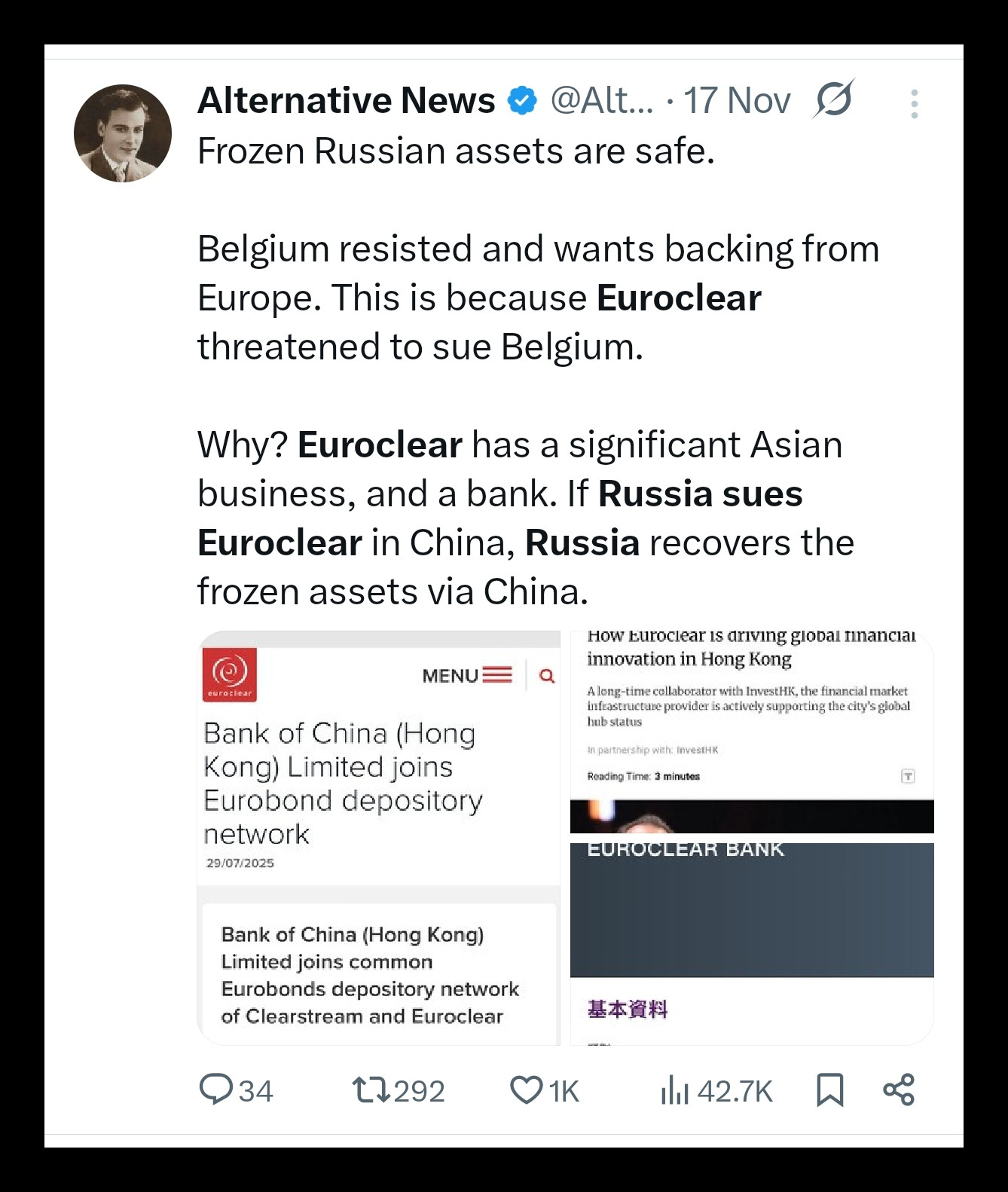
Arbitration under these treaties bypasses domestic courts and places disputes before panels of private arbitrators, often selected from a small professional community with extensive overlap between treaty drafters and adjudicators. Proceedings typically lack transparency, limit appeal mechanisms, and prioritise investor protection over public policy considerations. Professor Gus Van Harten of Osgoode Hall Law School described this structure as asymmetrical, favouring claimants by design and constraining states through financial exposure rather than legal principle. These characteristics explain why sanctioned entities increasingly pursue arbitration rather than political negotiation.
The Bank of Russia’s choice of the Moscow Arbitration Court reflects procedural necessity rather than parochialism. Custodial agreements between Euroclear and its clients require initial proceedings within agreed jurisdictions before enforcement actions abroad. A favourable judgment establishes a legal debt, enabling subsequent asset attachment efforts in jurisdictions where the defendant maintains operations or reserves. Comparative experience from cross border insolvency disputes, including the Lehman Brothers collapse, demonstrates that jurisdictional contests often follow initial rulings, with courts abroad recognising or contesting judgments based on treaty obligations and reciprocity.
Belgium occupies a central position in this dispute because Euroclear holds the majority of immobilised Russian reserves within its systems. Belgian law governs Euroclear’s corporate structure, while Belgian courts would bear initial responsibility for enforcing or contesting foreign judgments affecting the institution. Estimates place Russian assets held at Euroclear above one hundred and eighty billion euros, a scale exceeding Belgium’s annual budget capacity to absorb adverse rulings or compensation claims. Belgian officials publicly warned that forced expropriation could expose the state to retaliatory measures and legal liability beyond manageable limits.
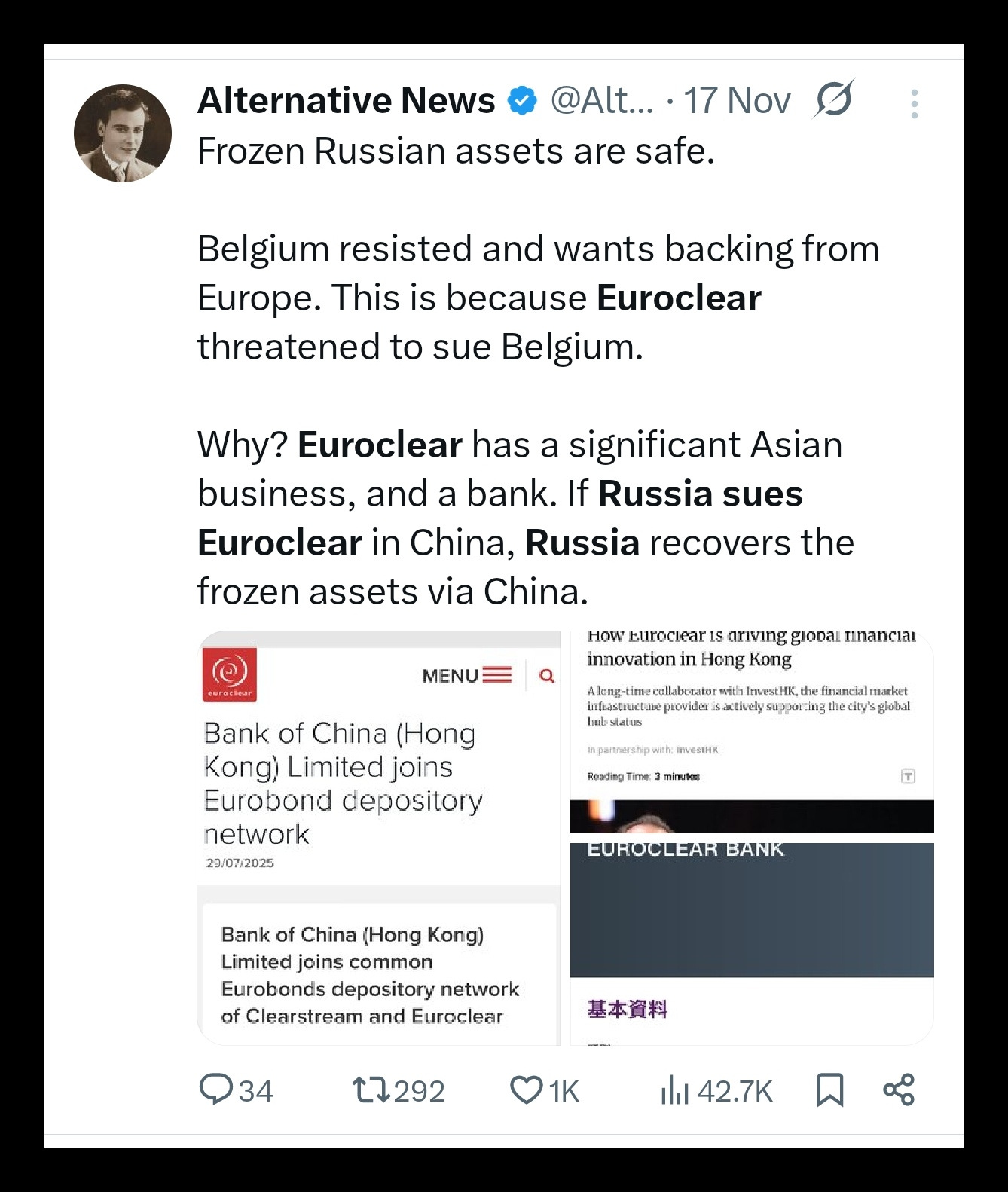
Euroclear holds an extraordinary scale of client assets, with assets under custody reported above forty trillion euros, a figure that dwarfs any single European state’s annual output. (Euroclear) Euroclear Bank’s own balance sheet disclosed heavy concentration related to sanctioned Russian positions, reporting a total balance sheet of €229 billion at mid-2025, of which roughly €194 billion related to sanctioned Russian assets. (Euroclear) Belgium’s nominal annual GDP runs in the region of six hundred to sixhundred-and-twenty billion euros, well below the scale necessary to underwrite systemic losses on custodial claims affecting a globally used settlement platform. (countryeconomy.com) Euroclear operates a global footprint across Asia and other financial centres, including an authorised Singapore branch and operating presences in Hong Kong, Beijing and Tokyo, which creates additional enforcement vectors outside European jurisdiction. (Euroclear) Public reporting does not provide a granular, jurisdictional breakdown of client holdings usable to quantify precisely how much of Euroclear’s aggregate AUC sits in any single third-country legal space, constraining contemporaneous estimates of recoverable assets by geography. (Euroclear)
Russian authorities previously signalled readiness to immobilise or confiscate Euroclear related assets within Russian jurisdiction, estimated at approximately fifteen billion euros, creating immediate losses for European investors. Such actions mirror established enforcement practices in arbitration disputes, where prevailing parties seek compensation through reachable assets rather than voluntary compliance. Legal scholar Andreas Lowenfeld noted that enforcement, rather than judgment, constitutes the decisive phase of arbitration, often driving settlement or escalation depending on asset exposure.
Global ramifications extend beyond Europe and Russia into the structure of international finance. Clearing houses and custodians rely on perceptions of neutrality, legal predictability, and insulation from political directives. Once these attributes weaken, reserve managers reassess custodial risk and diversify holdings accordingly. Economists at the Bank for International Settlements observed that reserve currency dominance depends less on economic size than on legal credibility, settlement reliability, and the absence of discretionary confiscation. Arbitration proceedings place these attributes under scrutiny.
Historical arbitration cases illustrate potential outcomes. Argentina faced extensive asset attachment efforts after defaulting on sovereign bonds, with hedge funds obtaining enforcement rulings in United States courts that constrained Buenos Aires’ access to international capital markets for years. Yukos shareholders secured multi billion dollar arbitration awards against Russia under the Energy Charter Treaty, leading to asset seizures in several European jurisdictions before later legal reversals. These cases demonstrate that arbitration outcomes unfold over decades, shaping investment behaviour long after initial judgments.
European exposure increases because multiple member states maintain outdated investment treaties vulnerable to exploitation by sanctioned entities. Research by the Veblen Institute for Economic Reforms documented over sixty billion dollars in known arbitration claims related to sanctions policies, with amounts rising rapidly as new cases emerge. Belgium, France, Luxembourg, Lithuania, and the United Kingdom appear among the most frequently targeted jurisdictions due to treaty coverage and asset presence. Ukraine itself faces numerous claims under treaties signed with European states, illustrating the breadth of exposure.
European Union attempts to shield institutions through no liability clauses and loss recovery mechanisms introduce further complexity. Such measures permit custodians to offset losses against immobilised assets, effectively socialising legal risk across counterparties. While reducing immediate insolvency threats, these provisions weaken property rights assurances for third party clients and deepen reputational damage. Legal economist Thomas Merrill of Columbia University argued that retroactive rule changes undermine reliance interests essential to market functioning.
International reaction reflects these concerns. Sovereign wealth funds in Asia and the Middle East review exposure to European custodians, while central banks accelerate diversification toward gold and bilateral clearing arrangements. Chinese legal scholars emphasise that arbitration victories, even unenforced, influence reserve management decisions by signalling political risk. Professor Zhang Jianwei of Tsinghua University noted that financial fragmentation accelerates once trust erodes, with legal disputes acting as catalysts rather than causes.
Arbitration proceedings also constrain diplomatic flexibility. Legal actions lock parties into adversarial postures, limiting scope for negotiated settlement without appearing to concede liability. For European governments, defending Euroclear risks contradicting public sanctions narratives, while abandoning the institution invites domestic financial instability. Russia benefits from this asymmetry, leveraging legal processes to impose costs regardless of ultimate enforcement success. Political scientist Susan Strange previously described such dynamics as structural power exercised through financial and legal architecture rather than direct coercion.
Long term implications involve the credibility of international law itself. Selective adherence to immunity principles undermines universality, encouraging reciprocal disregard by other states. Smaller economies observe precedents set against larger powers and adjust behaviour defensively. Arbitration mechanisms originally designed to protect investors from arbitrary state action now operate as instruments of geopolitical contest, exposing structural contradictions embedded in late twentieth century treaty frameworks.
The Bank of Russia case therefore represents more than a bilateral dispute. Arbitration transforms sanctions from temporary restrictions into legally contestable expropriations, shifting risk from political arenas into courtrooms where outcomes depend on treaty text, asset location, and procedural persistence. European institutions confront a landscape shaped by past legal choices, where efforts to mobilise frozen assets generate cascading liabilities across jurisdictions and decades.
Arbitration proceedings initiated by the Bank of Russia expose structural weaknesses in European financial governance created by unresolved treaty obligations and reliance on custodial neutrality. Legal exposure rather than battlefield developments now shapes risk distribution, with Belgium and the European Union facing long duration consequences that cannot be contained through emergency regulation or political consensus alone.
International arbitration and investment treaty mechanisms were largely drafted, promoted, and enforced by Western states and institutions during the late twentieth century to protect outward capital flows and constrain policy risk in non Western jurisdictions. For decades these rules disproportionately favoured Western investors, with arbitrators, venues, and enforcement practices aligned with their legal traditions and financial interests. The present disputes reveal the reciprocal effect of that architecture, as the same instruments now expose European states and institutions to claims arising from sanctions and asset immobilisation. Legal exposure reflects the internal logic of a system designed to prioritise investor protection over sovereign discretion, rather than an aberration or misuse by opposing parties.
Authored By: Global GeoPolitics
If you believe journalism should serve the public, not the powerful, and you’re in a position to help, becoming a PAID SUBSCRIBER truly makes a difference. Alternatively you can support by way of a cup of coffee:
buymeacoffee.com/ggtv


Leave a comment