

Europe’s authoritarian turn as sanctions meant for states are now being used to silence voices, even those of neutral citizens.
The European Union has imposed restrictive measures against Jacques Baud, a retired Swiss Army colonel and former NATO adviser, through an executive sanctions mechanism that operates entirely outside any judicial process. The decision froze assets, prohibited financial dealings, and imposed a travel ban across the Union, despite the absence of any criminal charge, indictment, or court finding. Authority for the action rested with the EU executive, not with any court, and relied on an expanded sanctions framework that treats certain forms of speech and analysis as security threats rather than protected political expression.
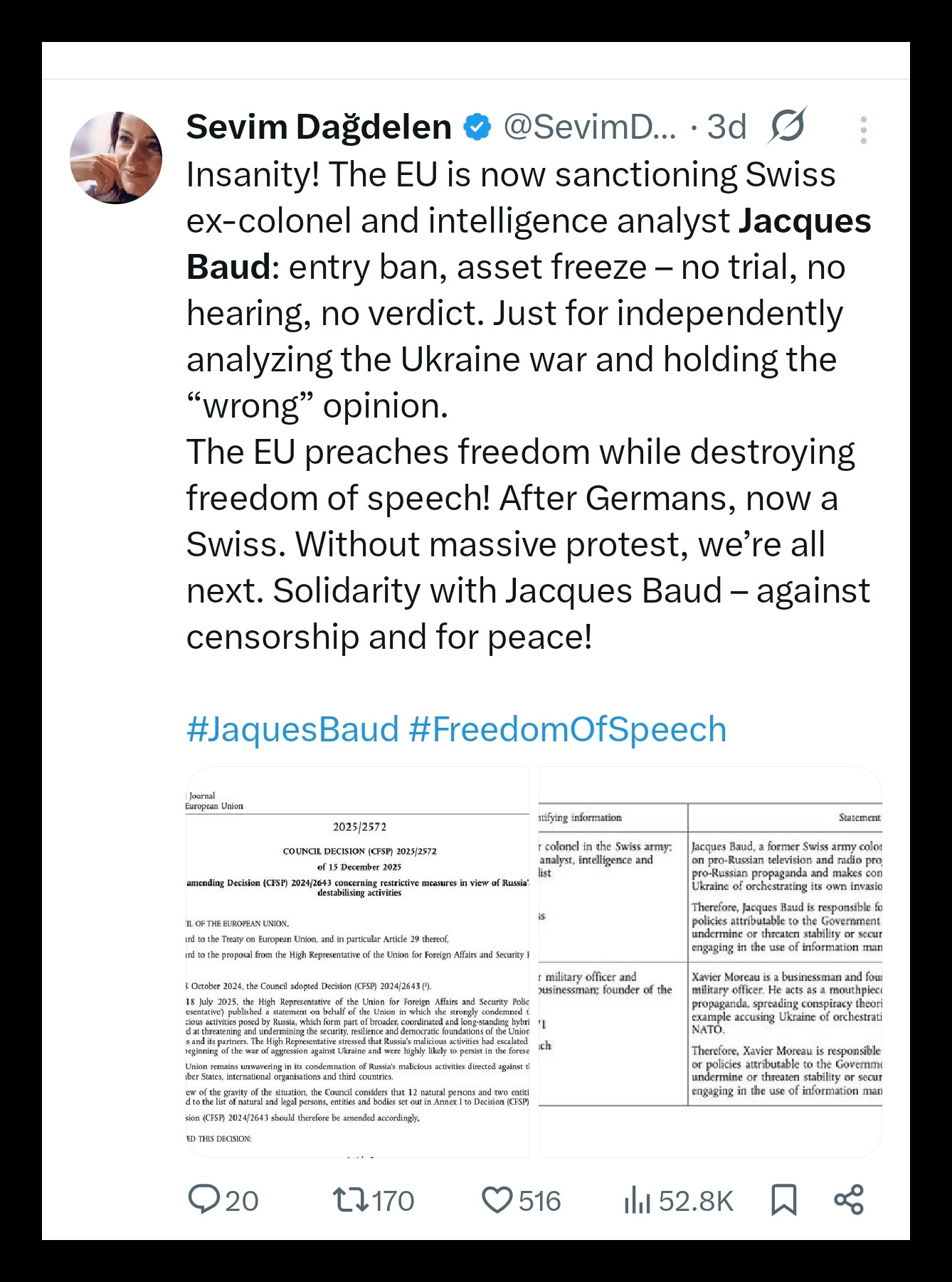
Baud’s professional record matters because it undermines claims that the measures respond to covert activity, espionage, or operational support for a foreign power. His published work relies primarily on Western and Ukrainian sources, avoids Russian state material, and has consistently focused on military doctrine, force posture, logistics, and battlefield realities rather than ideological advocacy. Invitations from Russian media outlets were declined, and public appearances took place mainly in Western academic, journalistic, and analytical forums. Sanctioning such a figure signals a decisive shift from countering hostile state action toward regulating interpretation itself.
European sanctions traditionally targeted material assistance, financial networks, or logistical support connected to armed conflict or terrorism. Recent legal changes broadened that scope to include what authorities describe as destabilising narratives and information activities. Language within the relevant Council decisions permits restrictive measures based on assessments of influence, anticipated impact, or narrative alignment, rather than demonstrable acts. Legal scholars such as Martin Scheinin, former UN Special Rapporteur on human rights and counterterrorism, have warned that preventive security measures lacking judicial safeguards erode the distinction between lawful expression and punishable conduct, especially when executive discretion remains unchecked.
Practical consequences of such sanctions extend far beyond symbolic condemnation. Asset freezes prevent access to personal savings, pensions, royalties, and contractual income within EU jurisdiction. Prohibitions on financial dealings deter publishers, universities, conference organisers, and media platforms from any engagement, since compliance failures carry legal risk. Travel bans exclude sanctioned individuals from academic and professional networks, preventing participation in conferences, teaching, or debate. Legal analyst Wolfgang Kaleck has described this form of restriction as civil incapacitation, where individuals remain formally free yet functionally removed from economic and public life.
Absence of due process distinguishes this regime from criminal law. Targets receive no prior notice, no opportunity to contest evidence before imposition, and no requirement that allegations meet evidentiary standards recognised by courts. Appeals processes exist only after sanctions take effect, often lasting years, during which professional and personal damage accumulates irreversibly. European Court of Justice rulings have previously criticised such mechanisms for violating fundamental rights, yet subsequent legislative revisions preserved executive dominance while narrowing grounds for successful challenge.
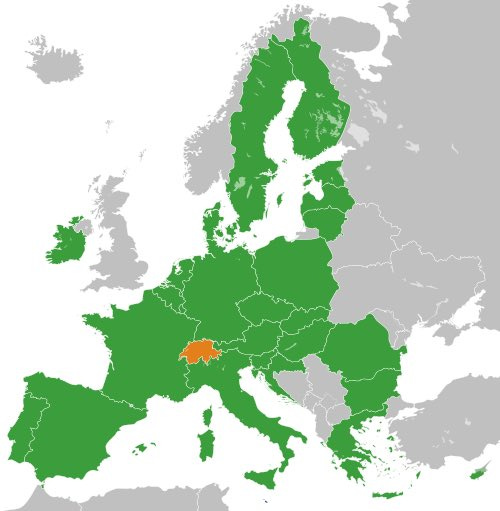
(Stranded in Belgium, Jacques Baud, a Swiss citizen and respected retired intelligence expert, is effectively prevented from returning home by EU sanctions. Switzerland is neutral, non-EU, and has refused to adopt the December 15, 2025 measures, yet because the country is entirely surrounded by EU states, geography alone now appears to override basic rights.)
Baud resides in a European country despite holding Swiss citizenship, illustrating how EU sanctions affect individuals beyond formal EU membership. Financial institutions, publishers, and digital platforms outside the Union often comply voluntarily with EU measures to avoid secondary exposure or reputational risk. Former Swiss diplomat Paul Widmer has noted that neutrality loses practical meaning when non-aligned states allow foreign executive decisions to dictate domestic financial and professional access. Switzerland’s muted official response reflects broader European reluctance to confront Brussels when sanctions target individuals rather than states.
Precedent matters because the logic underpinning this case does not limit application to foreign nationals or marginal commentators. Earlier sanctions against German journalists Alina Lipp and Thomas Röper followed similar reasoning, penalising reporting and commentary deemed aligned with Russian narratives. Those measures included bank account freezes and travel restrictions, effectively exiling citizens without trial. Legal historian Uwe Wesel has compared such practices to administrative punishments used in twentieth century Europe, where executive power bypassed courts to enforce political conformity.
Supporters of the sanctions argue that information warfare necessitates extraordinary tools, especially during armed conflict. That argument assumes a clear boundary between disinformation campaigns coordinated by hostile states and independent analysis that diverges from official positions. Evidence presented publicly in such cases rarely demonstrates coordination, funding, or direction by foreign governments. Instead, alignment of conclusions with inconvenient facts or outcomes becomes sufficient. Political scientist Glenn Diesen has argued that strategic analysis loses meaning once outcomes contradicting official expectations are reclassified as propaganda rather than reassessed.
Comparison with censorship regimes elsewhere highlights structural differences rather than moral equivalence. In China, overt state censorship operates through explicit rules and acknowledged limits, encouraging widespread self-censorship while maintaining clear boundaries. European mechanisms increasingly rely on opaque administrative judgments framed as security measures, narrowing debate without openly declaring censorship. Philosopher Jürgen Habermas warned that democratic legitimacy depends on procedural transparency and public reasoning, conditions undermined when authorities suppress debate through indirect coercion rather than argument.
Digital infrastructure magnifies these dangers. Asset freezes and financial prohibitions rely on centralised banking systems, digital payment networks, and compliance algorithms that execute sanctions instantly and comprehensively. Expansion of digital identity frameworks and proposals for central bank digital currencies would further integrate personal identity, financial access, and regulatory enforcement. Economist Richard Werner has cautioned that programmable money allows authorities to restrict spending, savings, or transactions based on administrative criteria rather than legal judgment, transforming sanctions from exceptional tools into routine governance instruments.
Linkages between sanctions policy and broader governance agendas deserve careful scrutiny. United Nations Agenda 2030 emphasises digital identity, financial inclusion, and coordinated global regulation as tools for sustainable development. World Economic Forum publications advocate public private partnerships integrating digital identification with financial services and regulatory oversight. Critics such as Professor Shoshana Zuboff have argued that such integration concentrates power within administrative systems capable of behavioural control, especially when safeguards remain weak or unenforced. Sanctions targeting speech demonstrate how quickly such systems can shift from inclusion rhetoric toward exclusion practice.
Erosion of democratic confidence appears across multiple European states. Electoral disputes, postponed votes, and contested outcomes in Romania, Moldova, and Germany have generated public scepticism toward institutional neutrality. Proposals within the United Kingdom to delay or restructure elections during emergencies raised concerns among constitutional scholars about executive overreach. Commentators including Lord Sumption have warned that emergency powers, once normalised, rarely retract fully, especially when justified by security or stability narratives.
American observers have drawn parallels between European developments and domestic debates over free speech and administrative power. Figures such as Steve Bannon and Tucker Carlson, despite political controversy, echo concerns expressed by civil libertarians across ideological lines regarding debanking, platform exclusion, and executive sanctions without trial. Former President Donald Trump has framed these trends as evidence of bureaucratic authoritarianism, though similar warnings appear in academic literature independent of partisan alignment.
Central to the Baud case lies a question articulated by political theorist Ivan Krastev regarding democratic resilience. Democracies depend not on constant correctness but on tolerance for error, dissent, and revision. Administrative suppression of alternative analysis signals institutional insecurity rather than strength. Societies confident in their narratives permit challenge because evidence and argument remain persuasive. Societies reliant on sanctions reveal fear that competing interpretations might convince citizens through reason rather than coercion.
Long term implications extend beyond foreign policy debate. Once narrative deviation qualifies as a sanctionable security risk, boundaries expand predictably. Economic policy, public health, climate strategy, and social governance each involve contested interpretations. Executive tools designed for exceptional circumstances migrate into ordinary administration, especially when digital systems enable seamless enforcement. Legal theorist Carl Schmitt observed that sovereignty reveals itself through decisions on exceptions, yet modern democracies risk converting exceptions into permanent governance modes.
Jacques Baud’s sanction therefore represents more than an isolated injustice toward one analyst. The case demonstrates how European institutions increasingly manage disagreement through administrative exclusion rather than public debate or judicial process. Citizens observing these developments should recognise that protections once assumed secure now depend on executive tolerance rather than enforceable rights. Trust erodes when governments appear unwilling to defend open discourse against their own fears of dissenting conclusions.
A moratorium on executive sanctions targeting speech and analysis would allow legal frameworks to undergo independent review by constitutional courts and human rights bodies. Restoration of judicial oversight, clear evidentiary standards, and narrow definitions of sanctionable conduct would reduce abuse risk. Public debate over digital identity, financial centralisation, and administrative power should proceed before further integration locks such mechanisms into everyday governance.
Authored By: Global Geopolitics
Popular Information is powered by readers who believe that truth still matters. When just a few more people step up to support this work, it means more lies exposed, more corruption uncovered, and more accountability where it’s long overdue.
If you believe journalism should serve the public, not the powerful, and you’re in a position to help, becoming a PAID SUBSCRIBER truly makes a difference. Alternatively you can support by way of a cup of coffee:
buymeacoffee.com/ggtv


Leave a comment