
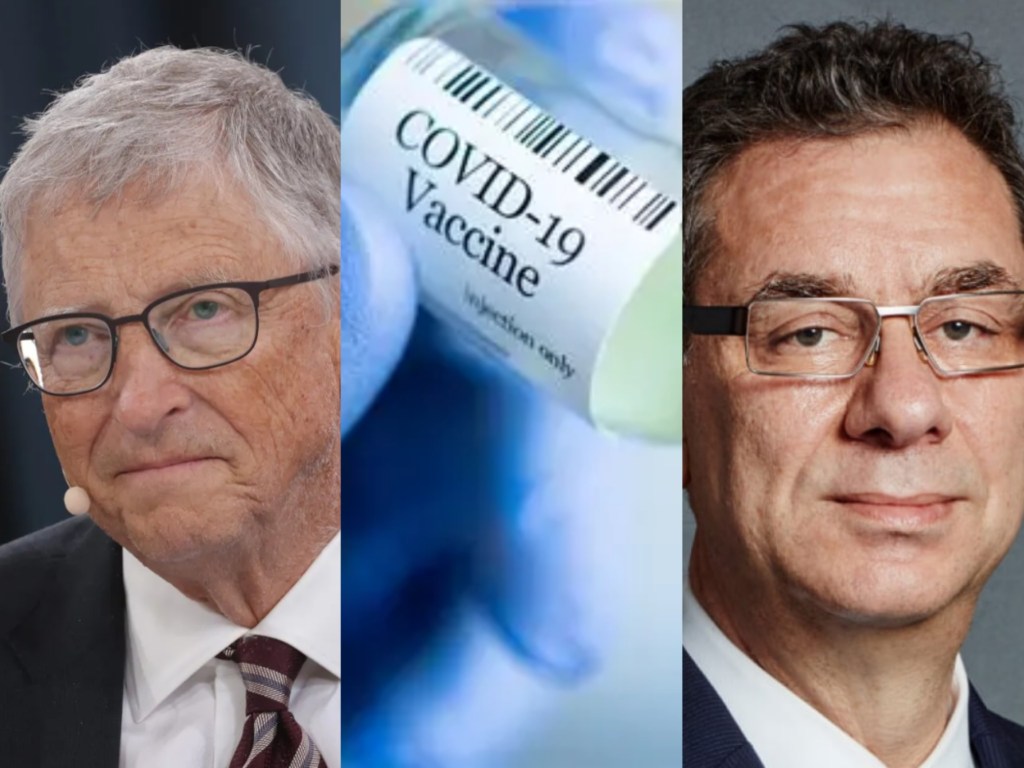
A Dutch civil case tests the reach of law over global health authority compelling testimony from Gates and Pfizer leadership
The Dutch civil proceedings in Leeuwarden have placed two of the most influential figures in modern public health under direct judicial scrutiny, namely Bill Gates and Albert Bourla, following a ruling that both men must testify in person before the District Court of Noord-Nederland.
The case arose from a 2023 filing by seven Dutch plaintiffs alleging severe injury following COVID-19 mRNA vaccination, with one claimant dying after commencement of proceedings, and the court has accepted jurisdiction despite the defendants’ objections and attempts to avoid oral testimony.
The lawsuit names a total of seventeen defendants, including the Dutch state, senior public health officials, media figures, and Mark Rutte, reflecting a claim that the vaccination campaign functioned through coordinated state and non-state power.
The plaintiffs argue that mRNA injections were deployed with knowledge of serious risks, that adverse evidence was suppressed, and that mandates and social pressure amounted to coercion incompatible with post-war medical ethics embedded in European law.
In October 2024 the Leeuwarden court ruled that Gates and Bourla could not evade personal appearance, rejecting arguments for dismissal or remote testimony, a decision that marked a rare assertion of judicial authority over transnational private power.
Dutch legal commentators at De Andere Krant described the ruling as procedurally orthodox yet politically unusual, given the stature of the defendants and the international interests implicated by their testimony.
The court has chosen to confine its examination to questions of civil liability, jurisdiction, and causation, while the plaintiffs have placed before it allegations of population-level harm arising from the deployment of novel biological technologies under conditions of coercion. That narrowing of scope reflects institutional boundaries rather than the scale of injury asserted by the claimants, whose interest lies not in procedural refinement but in establishing responsibility for irreversible harm. The exclusion of figures such as Sasha Latypova and Michael Yeadon has been widely been condemned in independent reporting as censorship, while the court record claims a routine evidentiary ruling aimed at preventing speculative or partisan testimony. The exclusion of figures such as Sasha Latypova and Michael Yeadon has been widely mischaracterised in activist reporting as censorship, while the court record shows a routine evidentiary ruling aimed at preventing speculative or partisan testimony. Dutch legal scholar Paul Cliteur of Leiden University has previously argued that civil courts remain bound by standards of proportionality and relevance even when cases carry heavy political symbolism, a principle clearly applied in this instance. For those injured or bereaved, the central question remains whether legal process can reach substantive truth, or whether formal limitations will prevent meaningful accountability
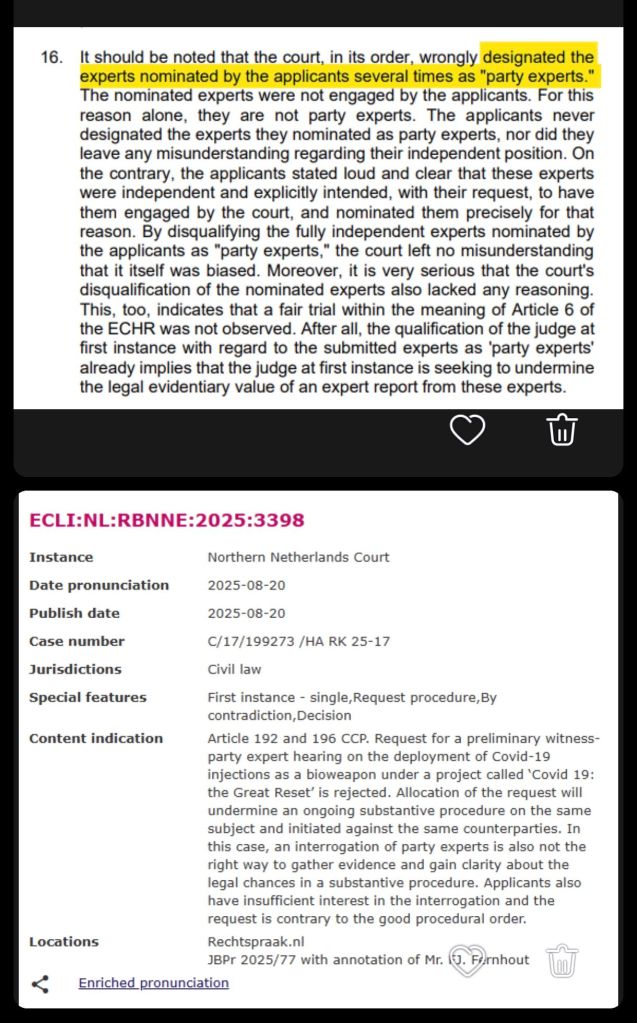
Judicial decisions on admissible expertise have become a focal point of contention, not because of individual personalities, but because evidentiary exclusion shapes the factual record on which justice depends. The removal of proposed expert testimony on grounds of relevance or independence reflects established civil procedure, yet such rulings also determine which scientific interpretations may be heard and which remain outside the courtroom. Victims therefore face the risk that technical evidentiary standards, applied within a civil forum, may foreclose examination of systemic conduct that extends beyond conventional product liability and into questions of mass harm.
From a public interest perspective, the legitimacy of the proceedings will be measured less by procedural correctness than by their capacity to address the reality experienced by millions subjected to unprecedented medical intervention. Legal formality cannot substitute for substantive adjudication where allegations concern large-scale injury, state-aligned coercion, and the suspension of informed consent norms. Justice, in this context, will not be defined by adherence to technical boundaries alone, but by whether the process confronts the full consequences of the policies under review.
The public significance of the Leeuwarden proceedings rests on the scale of human injury associated with pandemic policy rather than on peripheral disputes about online discourse. Excess mortality rose sharply across Europe during mass vaccination periods, with Eurostat data showing sustained deviation from five-year baselines into 2023 and 2024, while national pharmacovigilance systems recorded unprecedented volumes of serious adverse event reports. Independent analysts at the Nordic Cochrane Centre and researchers such as Professor Peter Gøtzsche have argued that post-authorisation surveillance failed to meet minimal standards of transparency and statistical rigour, leaving regulators unable or unwilling to establish reliable risk profiles. Civil courts therefore represent one of the few remaining venues where evidentiary standards, witness examination, and disclosure obligations can be enforced in relation to injuries affecting millions of citizens.
Attorney Peter Stassen, representing the plaintiffs, has argued publicly that truth has been suppressed by institutional actors, stating during a press conference that his clients were misled into accepting injections portrayed as safe and effective.
Such claims align with broader critiques of pandemic governance advanced by independent analysts at Brownstone Institute, which has documented failures of informed consent and regulatory transparency without endorsing bioweapon narratives.
The proceedings have been complicated by the arrest and continued detention of co-counsel Arno van Kessel on allegations linked to anti-institutional extremism, with no indictment issued as of December 2025.
Civil liberties groups in the Netherlands, including lawyers associated with the Platform Burgerrechten, have raised concerns that prolonged detention without charge risks chilling legitimate legal advocacy, even as the underlying lawsuit continues.
Beyond the Dutch courtroom, Gates’ role in global health governance provides essential context for the plaintiffs’ claims of undue influence.
The Bill and Melinda Gates Foundation contributes approximately ten percent of the World Health Organization’s budget through earmarked voluntary funding, a structure criticised by health policy scholars such as Professor Devi Sridhar of Edinburgh University for narrowing institutional independence.
Independent peer-reviewed research has raised substantive concerns regarding vaccine programmes supported by the Foundation.
A 2017 British Medical Journal study by Aaby and colleagues reported higher all-cause mortality among girls receiving the DTP vaccine in Africa, a finding that prompted calls for reassessment rather than dismissal, despite denials of causation from Gates-funded bodies.
In India, allegations surrounding polio vaccination campaigns supported by international partners resulted in parliamentary debate after a 2018 Economic and Political Weekly analysis linked non-polio acute flaccid paralysis rates to vaccine exposure, even as the World Health Organization disputed interpretation. These controversies illustrate a recurring pattern in which critical data emerge from outside establishment consensus, only to be managed through institutional authority rather than transparent adversarial review.
Gates’ financial interests in mRNA technology further complicate perceptions of neutrality.
Investigative reporting by The Nation in 2021 detailed Foundation ties to Moderna-linked intellectual property, raising conflict-of-interest concerns when the same institution promoted rapid global deployment of mRNA platforms during the pandemic.
Albert Bourla’s position as chief executive of Pfizer places him at the centre of similar scrutiny, particularly regarding contractual secrecy and regulatory capture. Academic analysis by Professor Joel Lexchin of York University has documented how pharmaceutical firms exert influence over drug approval processes, a structural issue that intensified during emergency authorisations.
Bourla’s written defence before the Dutch court reiterates the claim that Pfizer’s vaccine remains safe and effective, asserting that the court already possesses sufficient information to dismiss the case without oral examination. Such assertions contrast with findings by independent pharmacovigilance analysts, including those associated with the Nordic Cochrane Centre, who have criticised incomplete adverse event reporting during the COVID-19 rollout.
The public significance of the Leeuwarden proceedings rests on the scale of human injury associated with pandemic policy rather than on peripheral disputes about online discourse. Excess mortality rose sharply across Europe during mass vaccination periods, with Eurostat data showing sustained deviation from five-year baselines into 2023 and 2024, while national pharmacovigilance systems recorded unprecedented volumes of serious adverse event reports. Independent analysts at the Nordic Cochrane Centre and researchers such as Professor Peter Gøtzsche have argued that post-authorisation surveillance failed to meet minimal standards of transparency and statistical rigour, leaving regulators unable or unwilling to establish reliable risk profiles. Civil courts therefore represent one of the few remaining venues where evidentiary standards, witness examination, and disclosure obligations can be enforced in relation to injuries affecting millions of citizens.
The central geopolitical significance of the Leeuwarden case lies less in its immediate legal outcome than in its challenge to impunity enjoyed by transnational elites. For the first time, a national court has compelled testimony from figures whose influence spans governments, corporations, and international organisations, signalling a potential shift in judicial confidence.
Whether justice will be served for the plaintiffs remains uncertain, given the asymmetry of resources, political insulation, and narrative control available to Gates and Bourla.
Historical precedent suggests that civil litigation against powerful actors often produces symbolic victories rather than substantive redress, particularly when systemic interests align against plaintiffs. Calls for Nuremberg-style trials rest on the argument that coerced medical experimentation violates principles established after the Second World War. Legal historians such as Professor Uwe Steiner of the University of Munich have noted that the Nuremberg Code prohibits medical intervention without voluntary informed consent, regardless of emergency context.
Mandates tied to employment, travel, and social participation raise serious questions under that framework, especially where long-term safety data were unavailable at deployment.
The absence of criminal indictments reflects political reality rather than legal impossibility, as international courts have historically pursued only defeated or marginalised actors.
Justice for humanity at large would require transparent examination of decision-making chains, financial incentives, and suppressed evidence, extending far beyond the Dutch courtroom. Without such examination, the proceedings risk becoming a controlled opposition exercise that establishes precedent against future claims, rather than accountability for past harm.
The Leeuwarden case therefore stands as a test of whether law can restrain concentrated power in an era of technocratic governance. Its outcome will shape not only the fate of seven plaintiffs, but the credibility of post-pandemic legal order confronting the excesses of globalised authority.
Authored By: Global Geopolitics
If you believe journalism should serve the public, not the powerful, and you’re in a position to help, becoming a PAID SUBSCRIBER truly makes a difference. Alternatively you can support by way of a cup of coffee:
buymeacoffee.com/ggtv
https://ko-fi.com/globalgeopolitics


Leave a comment