
Orbital Traffic Strains as Elon Musk’s Starlink and Chinese Satellites Near Collisions, Experts Call for Better Global Coordination
Space traffic is becoming a source of tension in both technical and political arenas as operators work to prevent satellites from colliding in the increasingly crowded environment of low Earth orbit (LEO).
SpaceX’s Starlink constellation, a network of internet-providing satellites now numbering in the thousands, has reported dramatic numbers of collision-avoidance manoeuvres in the last year. According to a report SpaceX filed with the U.S. Federal Communications Commission, Starlink satellites performed 148,696 avoidance actions between June 1 and November 30, 2025 in order to reduce the risk of collision with other orbiting objects. A subset of those adjustments, a few thousand, involved objects catalogued as Chinese satellites, including one experimental spacecraft that alone accounted for more than 1,100 manoeuvres.
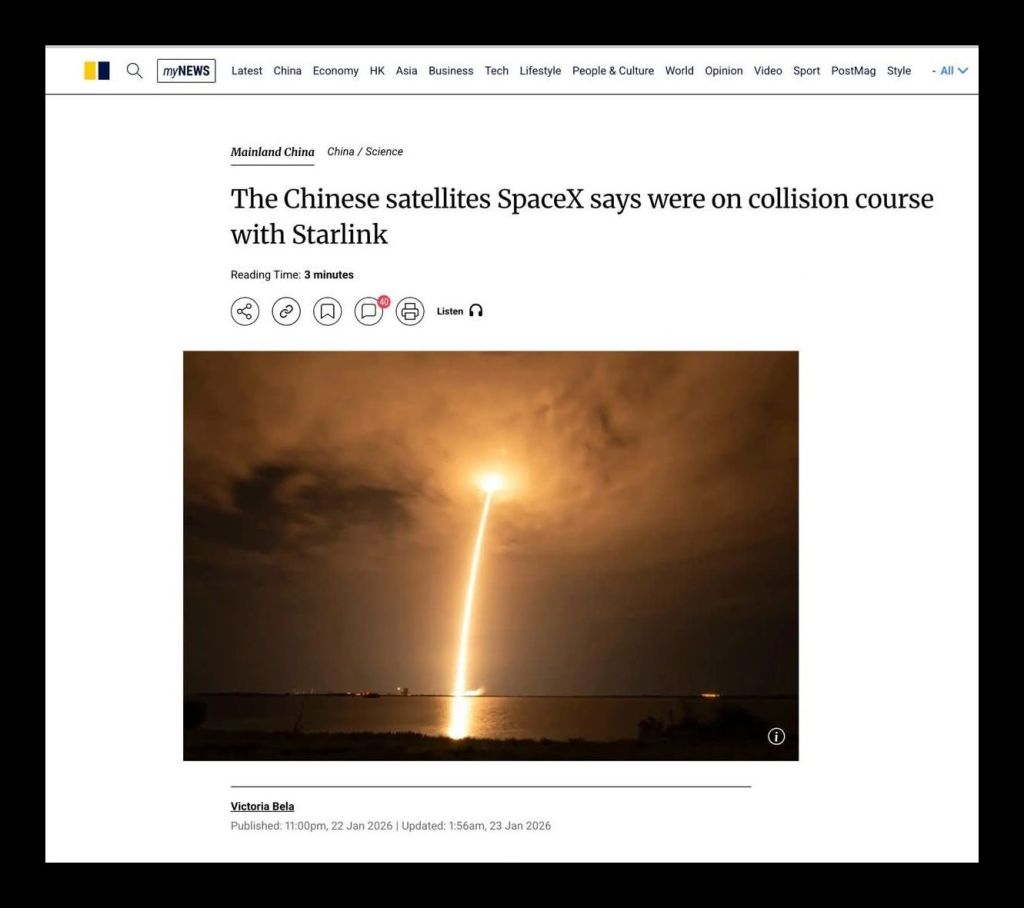
SpaceX has highlighted near-miss events as symptomatic not only of congestion but of limited coordination between satellite operators. In one reported incident, nine satellites deployed from a Chinese launch passed within 200 metres of a Starlink satellite. At orbital speeds exceeding 17,400 mph (28,000 km/h), such a close approach carries the risk of catastrophic impact if predictive models or communication fail. SpaceX engineers noted that insufficient sharing of precise trajectory data (ephemeris information) significantly increases the likelihood of these events.
Starlink’s scale is a central factor in the discussion. SpaceX has already deployed a constellation far larger than most others in low Earth orbit, with regulatory approval for thousands more satellites and long-term plans that reach into the tens of thousands. Each satellite must continuously track nearby objects and, when necessary, expend fuel to adjust its orbit. These manoeuvres reduce a satellite’s operational lifespan and add cumulative risk as traffic density increases. Independent analyses show that avoidance manoeuvres have risen sharply over recent years and are expected to continue climbing as more constellations come online.
Questions about responsibility and ownership often surface in this debate, but international space law is clear. Under the Outer Space Treaty and related frameworks, no nation or private company can claim sovereignty over space or exclusive rights to specific orbital paths. All states and licensed operators have the legal right to launch and operate satellites, provided they comply with safety and regulatory obligations. China, like any other space-faring nation, does not require permission from the United States or any private company to place satellites in orbit.
China’s own satellite ambitions further illustrate the global nature of the issue. Chinese state and commercial entities are developing large broadband constellations that could rival Starlink in size, underscoring that congestion is not the result of a single country’s activity but of a rapidly expanding commercial and governmental presence in orbit.
Russia is also pursuing its own large low-Earth-orbit satellite internet system meant to rival SpaceX’s Starlink. The project, called Rassvet and being developed by the Russian aerospace company Bureau 1440 with support from Roscosmos, aims to begin commercial operations in 2027, with around 250 satellites in orbit by that time and many more in the years afterwards. The system is designed to provide broadband internet coverage across Russia and beyond, and is being positioned domestically as a sovereign alternative to Starlink’s global service.
As orbital density increases, analysts and engineers increasingly agree that better global coordination is essential. At present, most collision avoidance relies on voluntary data sharing and independent tracking systems. Gaps in communication can result in late warnings or overly cautious manoeuvres, compounding congestion rather than resolving it. Experts warn that a major collision could generate large quantities of debris, potentially triggering a cascade of further impacts, a scenario known as Kessler Syndrome, with long-term consequences for satellite operations worldwide.
The broader challenge, then, is not whether one country’s satellites are “intruding” on another’s orbital space, but how to manage a shared environment under increasing strain. Orbit is not owned, and congestion is not accidental. It is the predictable outcome of policy choices, commercial expansion, and the absence of binding international traffic-management rules. Addressing these risks will require cooperation, transparency, and shared responsibility rather than national or corporate claims of priority.
Authored By: Global GeoPolitics
This is a reader-supported publication. I cannot do this without your support.
If you believe journalism should serve the public, not the powerful, and you’re in a position to help, becoming a PAID SUBSCRIBER truly makes a difference. Alternatively you can support by way of a cup of coffee:
buymeacoffee.com/ggtv


Leave a comment