
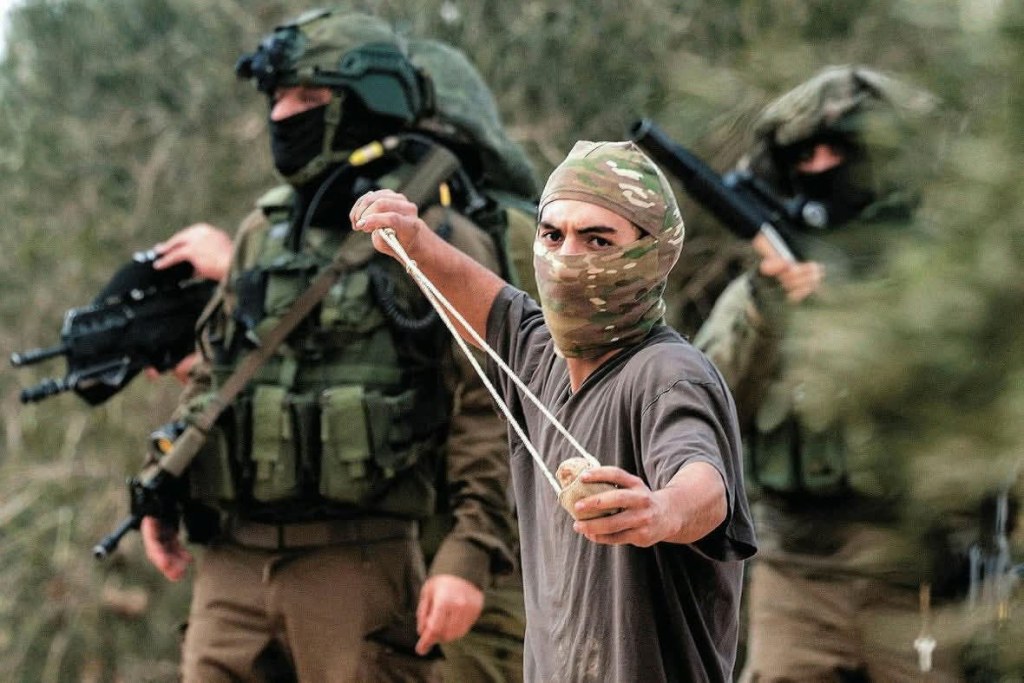
Israeli accounts describe organised militia in “Hundreds” operating with official support as Israeli MPs define the violence as terrorism
A pattern of organised removal of Palestinians from land in the West Bank cannot be understood as a recent deviation, given the historical record extending from the Nakba through successive phases of territorial consolidation. Large-scale displacement during 1948 established the structural foundation for demographic engineering, followed by military occupation after the Six-Day War which placed the West Bank under Israeli control. Settlement construction expanded steadily thereafter, accompanied by legal, administrative, and military measures that altered land ownership patterns and restricted Palestinian movement. United Nations resolutions, including UN Security Council Resolution 242 and UN Security Council Resolution 2334, defined the settlements as lacking legal validity, yet enforcement mechanisms remained absent, allowing facts on the ground to accumulate over decades.
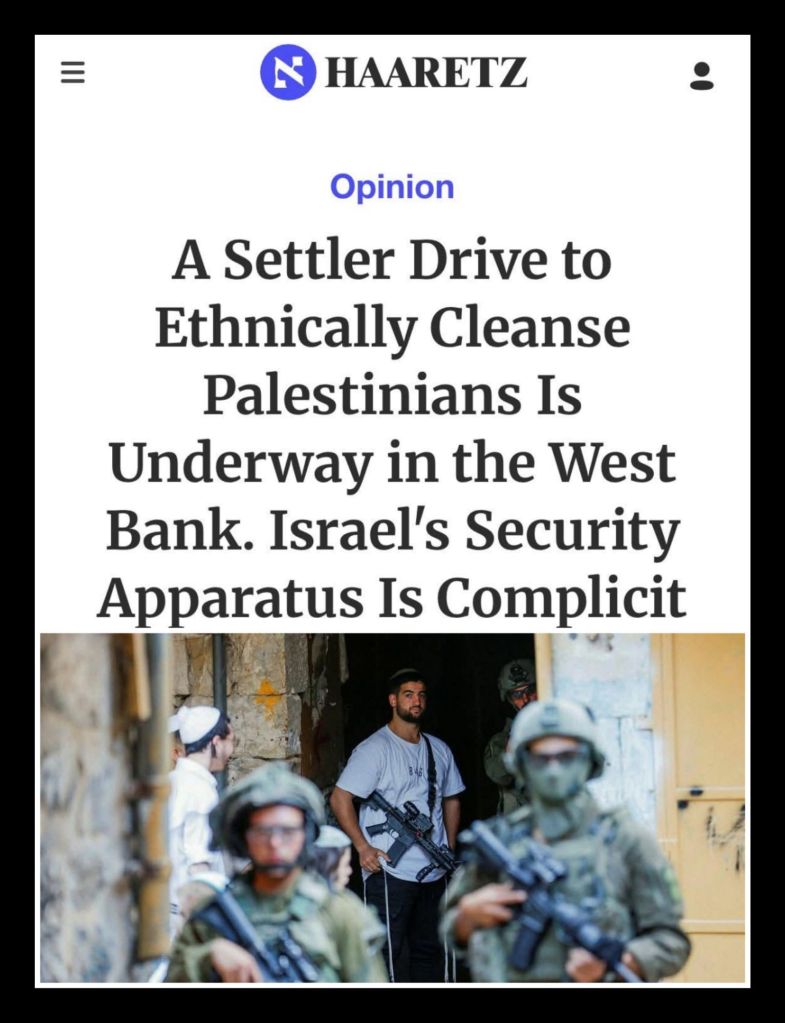
Current developments described by Israeli political and journalistic sources indicate continuity with earlier patterns rather than any departure from them. Ehud Olmert wrote that “a militia of hundreds of Jews is operating in the West Bank with direct and indirect backing from Israeli government officials, while security agencies have deliberately chosen not to take action against them,” alongside the assessment that “a settler drive to ethnically cleanse Palestinians is underway in the West Bank. Israel’s security apparatus is complicit.” The scale described exceeds marginal activity and reflects organised capacity sustained over time. These accounts describe “a violent and criminal effort… to ethnically cleanse territories in the West Bank,” carried out by armed settler groups targeting Palestinian communities through the burning of agricultural assets, destruction of homes and vehicles, and direct physical violence intended to force displacement. Within the same domestic political sphere, Meirav Cohen warned in the Knesset that such violence constitutes a serious threat to both Palestinians and the State of Israel, stating that it cannot be justified as self-defence and describing it as “Jewish terrorism,” adding that “terrorism does not become terrorism only if it is committed against Jews.”
Operational patterns align with earlier documented practices identified by historians such as Ilan Pappé, who described systematic removal strategies during 1948 as planned processes rather than incidental wartime outcomes. Contemporary accounts describe “the rioters, the Jewish terrorists, storm Palestinians with hate and violence with one objective: to force them to flee from their homes,” establishing intent consistent with forced displacement. The stated aim that land will then be “prepared for Jewish settlement, en route to realizing the dream of annexing all the territories” reflects long-standing ideological currents within segments of the settler movement.
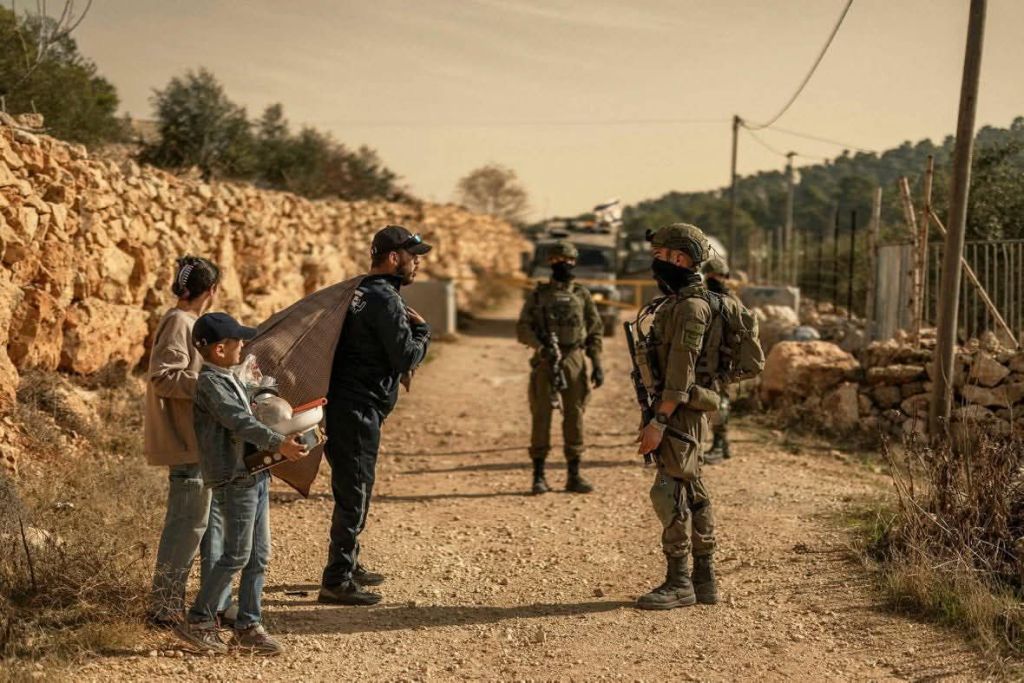
Institutional behaviour described in these accounts indicates structural facilitation. Police forces are reported to observe or ignore incidents, with “police officers and soldiers closing their eyes,” while victims face arrest and perpetrators avoid identification or prosecution. “The police are actively abetting, as a policy, the committing of criminal acts,” a statement that moves beyond negligence into attribution of deliberate conduct. The operational absence of enforcement contrasts with the extensive capabilities of Israeli security institutions in other contexts.
The intelligence apparatus demonstrates similar selectivity. The Shin Bet, known for preventive detention, surveillance, and targeted disruption of Palestinian militant networks, appears not to deploy equivalent measures against settler groups. “It seems that the Shin Bet isn’t using the effective means it exercises against Palestinian terrorism against the Jewish terrorists,” indicating differentiated application of state power based on identity rather than conduct.
Policy decisions reinforce permissive conditions. Removal of administrative detention for Jewish suspects, associated with the tenure of Benjamin Netanyahu and his coalition partners, eliminated a deterrent previously used to pre-empt violence. Armed capacity among settler groups expanded alongside political encouragement linked to Itamar Ben-Gvir, whose public positioning has aligned with increased civilian armament in the territories. Military forces present during incidents are described as failing to intervene, and in some cases acting in coordination with settlers or remaining passive observers.
Political and communal endorsement provides an enabling environment. Statements by Israel Ganz calling for Palestinian population centres to be reduced to ruins were delivered without public opposition among settler audiences. Silence within a population numbering in the hundreds of thousands functions as tacit support, reinforced by logistical assistance that allows perpetrators to evade arrest. Claims that such actors represent a marginal fringe are contradicted by the scale of participation and the consistency of local backing.
Israeli political figures have characterised these actions using established terminology. Meirav Cohen stated that “terrorism does not become terrorism only if it is committed against Jews,” and identified settler violence as “Jewish terrorism,” rejecting claims of self-defence. This framing aligns with legal definitions centred on violence against civilians for political ends, irrespective of the identity of perpetrators.
Developments in the West Bank intersect with broader regional dynamics, including ongoing conflict in Gaza Strip and heightened tensions involving Iran. Periods of external conflict have historically coincided with accelerated settlement expansion and consolidation of territorial control. Strategic focus on external threats creates political space for internal reconfiguration, while international attention shifts toward active theatres of war. Expansion under such conditions reduces immediate external scrutiny and alters facts on the ground before diplomatic processes can respond.
Legal exposure at the international level has increased. The International Criminal Court has issued arrest warrants related to conduct in Gaza, including against Yoav Gallant, though debate persists regarding evidentiary standards in that context. Distinction arises in the West Bank where actions are described as occurring openly, with consistent patterns and visible institutional non-response. “Here, everything is in the open and done in front of those parties responsible for enforcing the law,” shifting the evidentiary basis from isolated incidents to sustained practice.
Cumulative evidence across decades indicates a trajectory defined by incremental displacement supported by administrative policy, legal structures, and, in the current phase, organised civilian violence operating with state tolerance or support. Present conditions described by Israeli officials and commentators reflect an intensification of that trajectory rather than a departure from it, with methods adapted to current political and military circumstances.
Authored By: Global GeoPolitics
Thank you for visiting. If you believe journalism should serve the public, not the powerful, and you’re in a position to help, becoming a PAID SUBSCRIBER truly makes a difference. Alternatively you can support by way of a cup of coffee:
https://buymeacoffee.com/ggtv |
https://ko-fi.com/globalgeopolitics |
Bitcoin: 3NiK8BoRZnkwJSHZSekuXKFizGPopkE7ns


Leave a comment