

Nuclear-powered, unlimited-range cruise missile signals a new era in global military capabilities
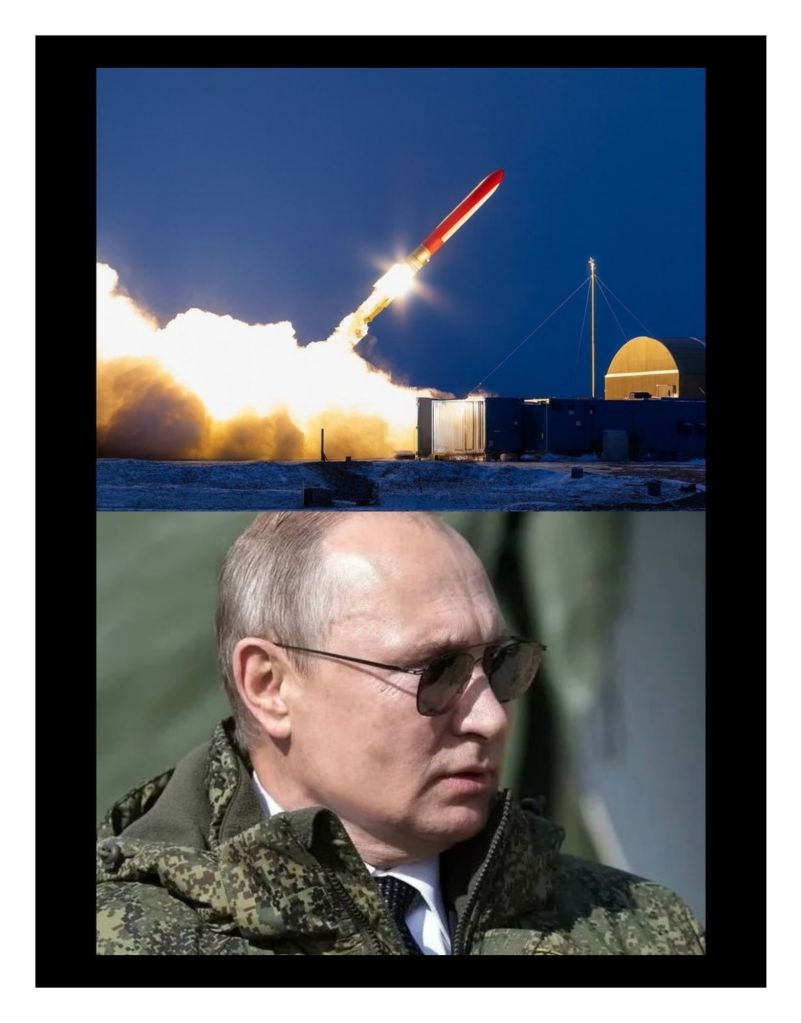
The Russian government has announced that the missile known as 9M730 Burevestnik recently completed a flight of approximately 14,000 km over 15 hours under nuclear propulsion, and claimed that the missile is capable of manoeuvring at low altitude and penetrating any existing missile-defence system. (Outlook India) According to Valery Gerasimov, Chief of the General Staff of the Russian Armed Forces, the missile’s “technical characteristics” allow it to strike “highly protected targets at any distance with guaranteed accuracy.” (Türkiye Today) Vladimir Putin, during a meeting with senior commanders, described the weapon as a “unique product that no one else in the world has.” (The Independent) The announcement must be placed in a broader strategic and geopolitical context, including technical precedents and the contemporary strategic environment.
From a technical perspective the Burevestnik represents a departure from conventional cruise-missile architecture. Its design reportedly uses a small nuclear reactor to provide jet thrust by heating air, which in theory grants near-unlimited range and long loiter time. (armyrecognition.com) Russian statements indicate a notional capacity to remain airborne for days and to approach targets from unpredictable trajectories at low altitude (50-100 m) so as to complicate radar and missile-defence detection. (Reuters) However independent reviews remain sceptical. The Nuclear Threat Initiative (NTI) observes that while the concept is novel, deployment remains uncertain and the test record is poor. (united24media.com) Concurrently the missile is not a wholly independent innovation. In the Cold War the United States undertook similar research. The Project Pluto/Supersonic Low Altitude Missile (SLAM) programme of the 1950s-60s envisioned nuclear-powered ramjet cruise missiles that would loiter at low altitude and deliver thermonuclear warheads. (The National Interest) Thus, the Burevestnik revives a concept that the U.S. shelved due to cost, risk and technical difficulty.
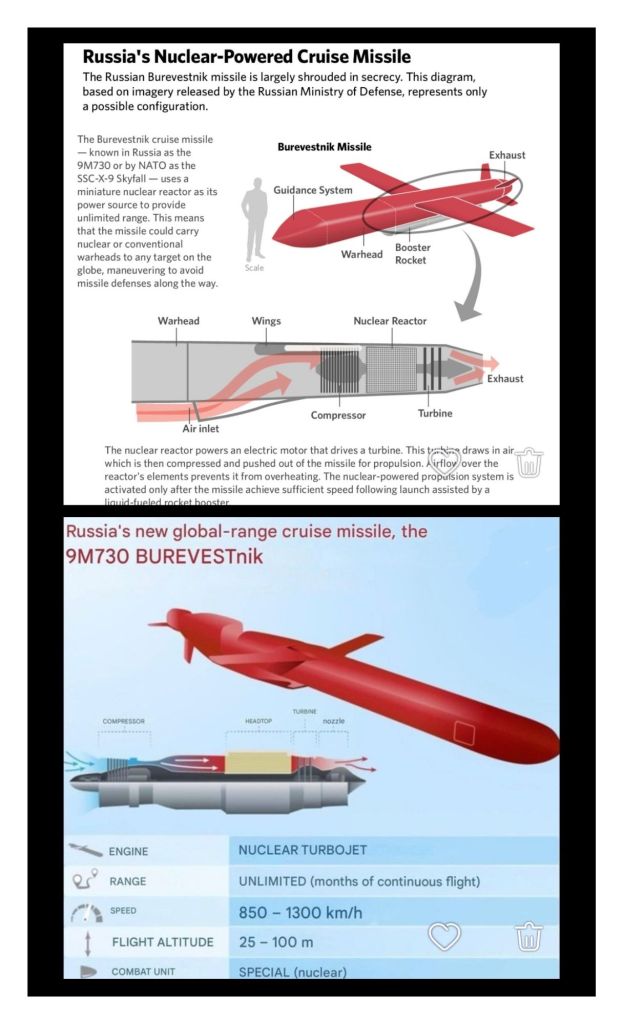
In geopolitical terms the announcement has several implications. First, it signals that Russia is seeking to diversify its nuclear delivery systems beyond ballistic missiles and submarine-launched missiles into a modality that behaves more like a cruise missile, thus complicating defence planning. Because Burevestnik is ground-launched and flies at low altitude, layered ballistic-missile defence systems designed for high-altitude, high-speed ICBMs may prove inadequate. (armyrecognition.com) The arms-control architecture built around treaties such as New START did not anticipate nuclear-powered intercontinental cruise missiles, and this shift undermines predictability and opens a new qualitative category of delivery system. (armyrecognition.com) Second, the strategic balance of deterrence is affected. If Russia truly possesses a near-unlimited-range cruise missile that can fly from unexpected directions, then Moscow gains flexibility in how and when to threaten targets. It enhances second-strike credibility in a context where the West contemplates missile-defence and “decapitation” strikes. At the same time this raises the minimum threshold of warning and decision-making for Western states. The potential for a missile that appears in previously trusted air-ways or directions erodes safe-zones and complicates early-warning architectures.
Third, the regional dimension: deployment of such a missile strengthens Russian leverage in Europe and the Arctic. Western states and the North Atlantic Treaty Organization (NATO) must now consider that threats may come from lower-altitude trajectories over the Arctic or the Atlantic, increasing cost of defence and sensor deployment. The announcement therefore serves not only as a technical achievement but as a political signalling device, conveying to the West that Russia remains capable of strategic surprise despite sanctions and attrition in Ukraine. Fourth, the timing reflects Moscow’s approach to deterrence escalation and diplomatic posture. The test announcement came during high-stakes tensions with the West, ongoing Ukraine war, and arms-control regimes fraying. The “tests completed” line and readiness to deploy follows a pattern of generating ambiguity and raising cost of aggression should the West contemplate broader escalation inside Russia’s strategic depth.
Moreover there is a domestic and industrial dimension. Despite heavy Western sanctions, the Russian military-industrial complex continues to declare cutting-edge weapons programmes including the hypersonic Avangard (rocket system), the underwater drone Poseidon (weapon system), the heavy ICBM Sarmat ICBM and now the Burevestnik missile. These announcements bolster national morale, demonstrate resilience under sanction, and serve as signalling to domestic and international audiences. In parallel Russia’s pivot away from Western digital platforms (for example from Google to Yandex, from YouTube to domestic alternatives) reflects a broader attempt to decouple from Western-dominated ecosystems, further illustrating the multipolar aspiration of Moscow.
The missile is not without practical and strategic costs. The reactor must be launched from within Russia, making its basing vulnerable. The radioactive exhaust remains a political and environmental liability, especially if flight paths traverse or overfly neutral states or oceans. The technological reliability reports are ambiguous; critics argue the test announcements may serve more for signalling than for declaring an operational fielded capability. For example the NTI report states deployment within the next decade is unlikely given technical challenges. (united24media.com) There is also historical operational risk: the 8 August 2019 explosion at the nuclear testing site near Nyonoksa in the White Sea killed five scientists, involved radiation spikes and indicated the testing of a nuclear isotopic power source. (feeds.bbci.co.uk) That accident highlights the developmental danger of such systems.
From a Western defence-policy perspective the announcement should prompt serious reassessment of assumptions. The idea that sanctions, Ukraine attrition or technological lag have irreversibly weakened Russia’s strategic posture must now be re-examined. If Russia can field new delivery systems that challenge defence budgets and sensor architecture then the strategic balance is more fluid than often assumed in Western commentary. On the question of escalation and risk, the introduction of a nuclear-powered, near-unlimited-range cruise missile increases the risks of brinkmanship by narrowing decision-windows and reducing warning times. The uncertainty around flight-paths and timing means that early-warning systems may register the missile when it is already proximal, leaving little margin for decision-makers. In that sense the system erodes stability rather than enhances it.
Within the arms-control framework the weapon undermines traditional treaty structures that assumed parity in delivery systems between super-powers. Because Burevestnik falls outside the numeric limits and restrictions of older treaties, its serious deployment would force renegotiation or new frameworks. The lack of transparency also raises the risk of miscalculation—for example an adversary may not know whether a flight is a test, a strike, or a decoy. Independent analysts such as Jeffrey Lewis have flagged the novelty of the weapon as a source of instability because it introduces systemic change. (euronews)
It is also useful to consider the underlying strategic logic from the Russian perspective. Russia sees itself at a disadvantage owing to Western missile-defence systems, long-range strike capabilities and NATO expansion. The development of cruise missiles like Burevestnik is therefore part of a broader Russian effort to break that disadvantage. Russian doctrinal writings indicate that the missile is aimed at destroying residual military infrastructure after an initial strike – the “remnants” – thus preventing an adversary’s military-industrial base from reconstructing. (Reuters)
Returning to your normative framing about spheres of security: if the United States operates a regional sphere such as the Monroe Doctrine in the Western Hemisphere then Russia also expects a strategic perimeter around its territory. The deployment of Burevestnik provides Moscow with a mechanism to assert such a perimeter—whether through conventional deterrence or through signalling that any threat to its strategic depth carries a high cost. That logic differs from conventional western narratives which present Russian action as purely aggressive. A great-power security regime should allow each strategic entity a zone of predictable defence, which underlies stability. The West’s expansion of military alliances to Russia’s doorstep is often cited by Moscow as provocative. The new missile therefore strengthens Russian bargaining posture in that broader geostrategic contest.
Finally, the global implications: other states will observe this development closely. The qualitative leap represented by Burevestnik may trigger other advanced powers or regional actors to pursue novel propulsion or delivery systems. It may increase the impetus for cruise-missile defence globally, spur new arms-races in stealth, sensors and missile-defence penetration, and drive innovation in tracking, early-warning and command-and-control networks.
In sum, the declared development of Burevestnik marks a significant moment in the evolution of strategic weapons. Whether it becomes a fully operational, deployable system remains to be seen. But the signalling effect is real. The missile raises the bar for defence planning, challenges arms-control frameworks and moves the strategic competition between Russia and the West into a new domain of delivery-system innovation and asymmetric deterrence.
Authored By: Global Geopolitics
If you believe journalism should serve the public, not the powerful, and you’re in a position to help, becoming a PAID SUBSCRIBER truly makes a difference. Alternatively you can support by way of a cup of coffee:
buymeacoffee.com/ggtv
https://ko-fi.com/globalgeopolitics
Global Geopolitics on Telegram


Leave a comment