

U.S.–Japan–Taiwan military integration reaches a point Beijing cannot ignore.
The steady tightening of military cooperation between the United States, Japan, and Taiwan has produced a strategic environment that China views as the most dangerous in the Asia-Pacific since the founding of the People’s Republic. Chinese officials have argued for many years that the First Island Chain was designed as a Cold War barrier built to restrict China’s maritime access and confine its naval operations inside a ring of American-aligned territories. The history of this structure reaches back to the negotiations around the San Francisco Peace Treaty in 1951, when John Foster Dulles articulated a vision of linked island positions stretching from the Aleutians to Southeast Asia. That concept shaped the early U.S.–Japan security framework and the Manila Pact of 1954, which bound together a set of territories that Washington intended to use as a forward line against both the Soviet Union and China. Analysts outside establishment circles have often pointed to Dulles’s design as a blueprint for long-term containment rather than a defensive arrangement, and Chinese strategists consistently describe the chain as a net deliberately placed to constrain national development and access to open waters.
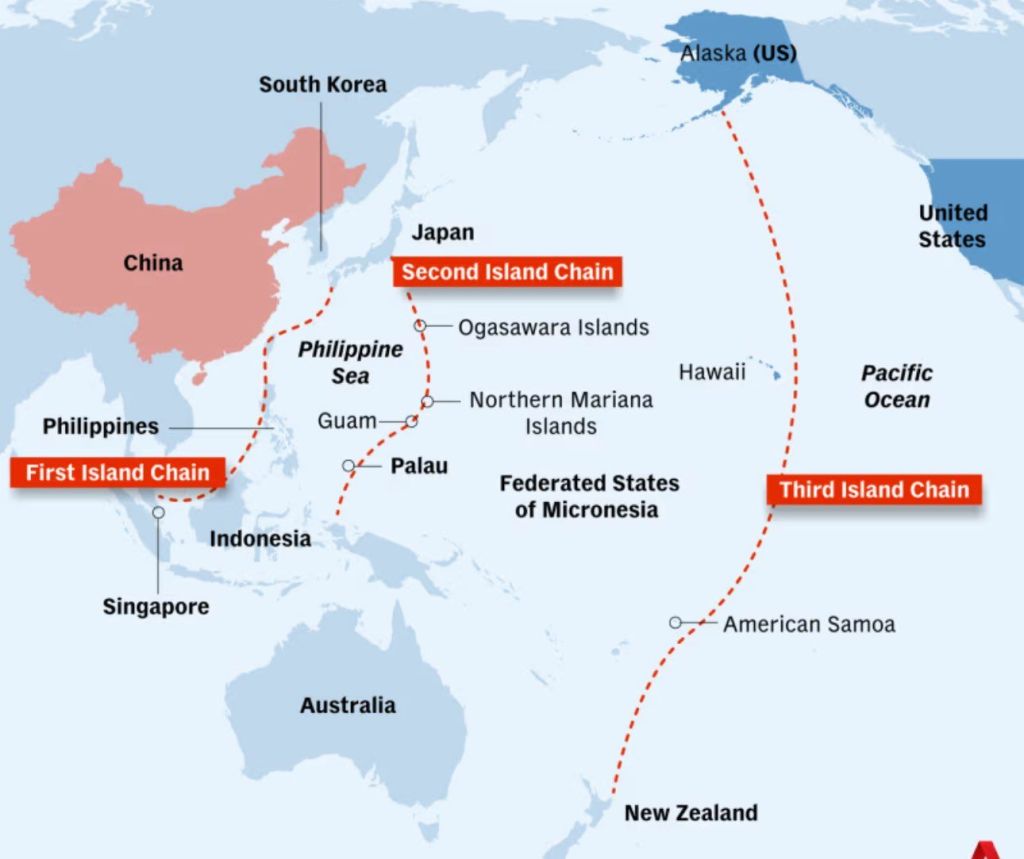
China’s view of the present situation draws on the outdated nature of the island chain strategy, since Beijing argues that the network of bases and alliances built by Washington reflects a structure that no longer matches the economic and political landscape of the region. Chinese analysts point out that the United States has drawn military lines across the Pacific despite being an external actor thousands of miles from the region, and that such forward positioning persists even though China has become the primary trading partner for most of its neighbours. Independent observers note that American thinking still follows the Cold War map laid down in the early 1950s, while Asian states now operate in an economic system shaped by Chinese manufacturing, investment, and supply chains. Chinese commentators add that Japanese security activism depends on access to Chinese industrial inputs, including rare earths, and that Tokyo’s political statements exceed its ability to sustain an extended conflict without risking its own economic foundations. These analysts describe a strategic picture in which the United States maintains extensive bases from Okinawa to Guam to Micronesia while presenting its posture as defensive, a claim Beijing rejects on the grounds that the only power projecting long-range force across the Pacific is Washington rather than any Asian state.
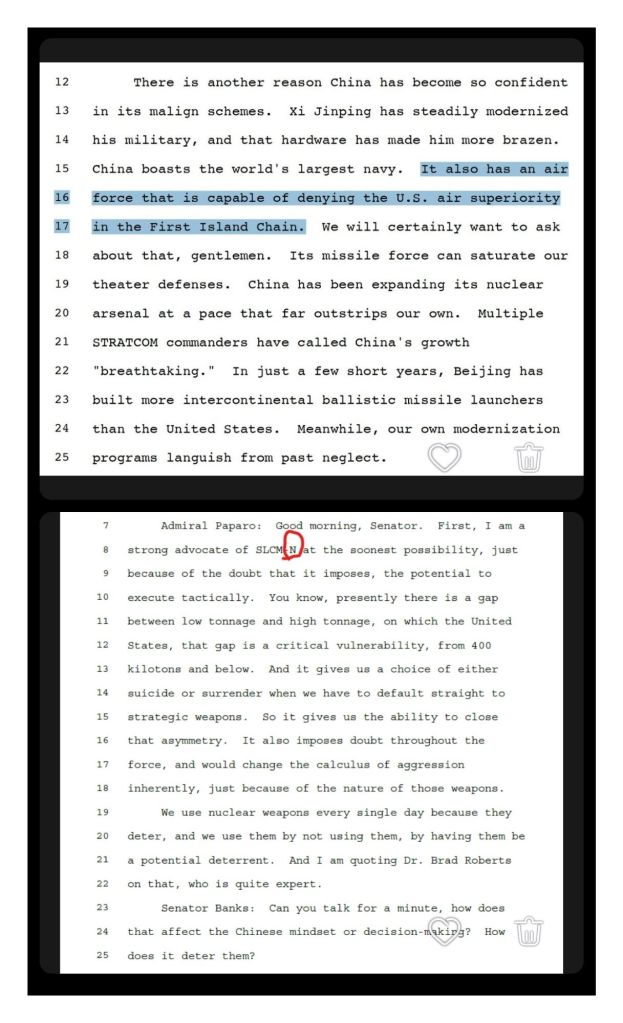
The deepening U.S.–Japan–Taiwan defence cooperation must be viewed through that historical frame, since the current pattern echoes the Cold War structure that China regards as hostile and intrusive. Independent commentators such as Scott Horton have warned that the continued militarisation of Taiwan risks drawing the region toward a confrontation that the United States cannot manage without resorting to nuclear threats, and Horton told his audience that Washington should “back the hell out of there now,” a blunt assessment that reflects a growing view among dissident analysts that the United States is building a confrontation that could escalate beyond control. His warning gained traction when USINDOPACOM commander Admiral Samuel Paparo told the U.S. Senate that Washington had lost air superiority near Taiwan and therefore could not expect to win a conventional conflict against China, forcing American planners to rely on submarine-launched tactical nuclear weapons as a last resort. When a serving commander delivers such an assessment to lawmakers, independent analysts treat it as confirmation that the United States is compensating for declining conventional advantage with high-risk strategies.
The Chinese position on Taiwan is anchored in the civil war and the unresolved status of the island after the fall of the Japanese empire. Japan’s occupation of China from 1931 to 1945 produced mass atrocities in Nanjing and other regions, and those events left a legacy of distrust that continues to influence Chinese views of Japanese militarisation. Taiwan itself was dominated by Japan after 1895 and then placed under Kuomintang control following Tokyo’s defeat. American influence shaped Taiwan’s political and military structures from 1949 onward, turning the island into a forward position during the Korean War and the early Cold War. Chinese policymakers often argue that Taiwan’s ambiguous status serves U.S. interests because the island’s unresolved position within the First Island Chain lets Washington maintain a permanent pressure point against Beijing. Independent analysts writing in Strategic Culture Foundation have argued that Washington uses Taiwan as a trigger for confrontation and a lever for containing Chinese development, a view expressed in a recent piece describing Taiwan as a “useful pawn” in a confrontational strategy.
– Japan’s colonial occupation of Taiwan.
– Japan’s invasion of China.
– The Nanjing Massacre.
– The entire “century of humiliation.”)
China’s former ambassador to the United States, Cui Tiankai, offered a rare public warning that Beijing would not be drawn into a military trap designed to replicate the Ukraine-Russia pattern. Cui stated that “someone may be preparing a proxy war but we will not fall into that trap” and stressed that Beijing sought to avoid a conflict in which “Chinese are killing Chinese.” His remark that Washington can escalate without Beijing’s consent highlights the central problem facing Chinese policymakers, who see American arms transfers and military trainers on Taiwanese soil as deliberate steps to create a crisis that China will eventually have to answer. Independent analysts who share Cui’s assessment argue that China’s preference for peaceful reunification does not remove the possibility of conflict, since Washington can manipulate events on the island, increase pro-independence sentiment, and create a security environment that Beijing will interpret as intolerable.
The recent influx of American weapons into Taiwan has reinforced those concerns. The rapid transfer of $330 million in fighter jet parts and $699 million in air defence systems, together with the presence of 500 American military trainers, created a sharp shift in the regional balance. Independent voices have described this move as a trap snapping shut, noting that Washington has spent $165 billion on relocating Taiwanese semiconductor capacity to the United States while turning the island into a heavily armed position that no longer carries the same economic shield it once did. The figure that Taiwan produces 64 per cent of the world’s most advanced semiconductors underscores the global significance of the island’s industry, and analysts warn that moving that capacity while increasing military commitments transforms Taiwan from an economic asset into a military flashpoint. The potential closure of the Taiwan Strait would cripple global supply chains, and the estimate that two trillion dollars in global economic damage could result from a blockade signals the scale of the risk.
China’s military modernisation adds another layer of complexity. Independent military researchers emphasise that the Chinese armed forces no longer resemble the under-funded, poorly equipped forces of the late twentieth century. China now fields the world’s largest standing army, a rapidly expanding navy, and an air force equipped with domestically produced fifth-generation aircraft. U.S. congressional assessments released this year echoed those independent warnings, stating that China’s capabilities are advancing faster than expected and that by 2027 Beijing may hold decisive advantages in a potential Taiwan scenario. Allied officials speaking privately to U.S. lawmakers admitted that they no longer believed the United States could attain a clear victory in a war with China and feared that any conflict would devolve into a protracted struggle that Washington could not win outright.
Japan’s posture provides another source of tension. Chinese leaders remember the era of Japanese expansion and the scale of destruction inflicted on Chinese cities, and they view Japanese rearmament with deep suspicion. The rise of Sanae Takaichi as Japan’s prime minister has intensified these concerns. Takaichi has adopted a “China realist” stance and has said that Japanese forces would be prepared to support Taiwan in the event of a Chinese operation. Beijing responded with sharp language that signalled its willingness to confront Japan politically and economically if Tokyo inserted itself into a Taiwan contingency. Independent Asia specialists argue that these exchanges mark a shift from diplomatic disagreement to open signalling of hostile intent, and that China may use this episode to justify a larger presence near the Taiwan Strait and closer monitoring of Japanese movements.
The island chain architecture forms the strategic backbone behind these tensions. The First Island Chain runs from Japan through Taiwan and the Philippines to Borneo and serves as a barrier through which the Chinese navy must pass to enter the wider Pacific. Control of Taiwan would allow China to bypass the Miyako Strait, Bashi Channel, and Luzon Strait, giving the People’s Liberation Army Navy freedom of manoeuvre far beyond its current limits. Analysts across the region understand that if China breaks through this chain, the Second Island Chain becomes the next line of contest, with Guam and the Northern Mariana Islands forming crucial American facilities. The Third Island Chain, anchored around Hawaii, exists to prevent a future scenario in which Chinese naval expansion threatens North American security. The chain architecture therefore places Taiwan at the centre of a layered system that determines the regional balance for decades ahead.

China said: ‘Those who play with fire will perish by it’)
Japan’s legal and strategic commitments bind it to any Taiwan contingency. Japanese law treats a Taiwan conflict as a threat to Japan’s national security, and the United States treats the island as a critical node in the First Island Chain. The new “Taiwan Assurance Implementation Act” passed by the U.S. Senate reinforces this link by mandating automatic deepening of U.S.–Taiwan engagement whenever China increases military pressure. Analysts call this a ratchet mechanism, since each Chinese action triggers a legally required American response that locks both sides into escalating cycles. When combined with Japanese commitments, the act forms an iron triangle in which a Taiwan crisis automatically engages Japan and the United States, with consequences that would ripple across global supply chains and financial markets.
Independent analysts who study the region’s military balance conclude that U.S.–Japan–Taiwan cooperation has become a severe threat from China’s perspective not because of any single action but because of the accumulation of moves that narrow Beijing’s strategic space. American trainers in Taiwan, Japanese pledges to join a Taiwan war, new arms transfers, expanded American bases from Japan to Guam, and the shifting semiconductor landscape all point toward a slow construction of a confrontation that China believes it cannot ignore indefinitely. Chinese officials argue that peace in the Asia-Pacific depends on reducing external interference rather than deepening alliances designed to contain Beijing. Their assessment gains credibility when set against publicly available military statements from American commanders describing a battlefield environment that Washington cannot dominate.
The region therefore faces a strategic landscape shaped by historical grievances, shifting power balances, and competing interpretations of security. U.S.–Japan–Taiwan military cooperation has created a ring of pressure around China that Beijing interprets as hostile, while American planners treat it as necessary to defend the island chain system that underpins their regional dominance. Independent voices warn that the United States may be turning Taiwan into a trigger for a war that could reshape the global economy and alter the balance of nuclear powers. China’s leadership argues that Washington holds the initiative in raising tensions, while China’s preference for peaceful reunification may not prevent escalation created by foreign actions. History, geography, and modern military capability have converged in the Taiwan Strait, and the rise in military cooperation among the United States, Japan, and Taiwan is driving the region toward a period of instability whose consequences cannot be easily contained.
Authored By: Global GeoPolitics
If you believe journalism should serve the public, not the powerful, and you’re in a position to help, becoming a PAID SUBSCRIBER truly makes a difference. Alternatively you can support by way of a cup of coffee:
buymeacoffee.com/ggtv


Leave a comment