
How net zero climate-linked debt, collapsing grids and external mandates are African states into managed decline and dependence
Access to abundant and affordable energy underpins every stage of economic development. African governments that attempt to industrialise without reliable baseload power expose themselves to stagnation, dependence, and political manipulation. External actors promoting net-zero targets in Africa often ignore this fact while insisting that developing countries adopt energy transitions that even advanced economies struggle to execute. Independent analysts across the continent argue that the current climate financing framework carries serious geopolitical risks, since much of the money arrives as debt tied to conditions that restrict sovereign energy choices. African countries are being asked to surrender their developmental flexibility while carrying costs that wealthier states refuse to bear.
The structure of climate finance illustrates this imbalance. A large share of African climate funding takes the form of concessional loans denominated in foreign currencies, locking governments into liabilities that deepen already fragile debt profiles. When repayments depend on exchange rates, commodity prices, and external demand, domestic priorities lose ground. Independent economists warn that this mechanism turns climate policy into an enforcement tool. Debt-for-nature and debt-for-climate swaps are presented as progressive instruments, yet the administrative burden, long-term conditions, and external oversight create new forms of dependence. They give creditors leverage over national budgets, and they shift control of environmental and energy policy away from elected governments. This trend mirrors long-standing patterns in global finance where African states are positioned as rule-takers rather than agenda-setters.
Industrialisation requires control over energy inputs, capital allocation, and investment planning. The net-zero framework weakens all three. Independent research shows that many renewable projects financed in Africa are built primarily to serve foreign markets rather than domestic industry. Investment flows into generation capacity for export while manufacturing, transmission, and maintenance skills remain underdeveloped. This reproduces the familiar pattern of resource extraction: Africa supplies the raw output while external actors capture value through technology, ownership, and pricing power. As critics have pointed out, the “green transition” can become a new channel for extraction when African labour, land, and minerals are used to support foreign decarbonisation goals without strengthening local productive sectors.
These dynamics cannot be separated from the history of neo-colonial debt management. Several independent scholars argue that the use of external debt to influence domestic policy amounts to a modern instrument of control. Climate loans tied to net-zero targets extend this logic by binding African countries to externally defined energy pathways. Governments that accept such loans face pressure to implement policies that weaken long-term industrial capacity. They must allocate scarce fiscal space to meet climate compliance requirements even when basic infrastructure, power generation, and productive capacity are deteriorating. This shift entrenches a hierarchy where international institutions define acceptable development trajectories and where African sovereignty is subordinated to global agendas.
The technological and financial barriers embedded in the net-zero model further impede domestic industrialisation. Because renewable infrastructure in many African countries depends on imported components, foreign contractors, and external technical expertise, states cannot easily control or reproduce the technology. This creates structural reliance on external suppliers. Local industries remain underdeveloped because manufacturing, storage, and heavy engineering capacity rarely form part of the investment package. Independent analysts call this a form of green colonialism: Africa absorbs the environmental and social costs of extraction and land use while foreign corporations retain ownership of technology and intellectual property. When these projects are financed with debt, the long-term burden falls on African taxpayers rather than on the global actors demanding the transition.
The political implications are significant. Climate-conditional lending allows multilateral institutions, private investors, and donor governments to influence national energy choices, budget allocations, and industrial strategies. This aligns with broader concerns about Agenda 2030, which many commentators view as a governance framework that centralises global authority over national policy. In countries where grant funding is scarce and loan financing dominates, climate objectives become tools for external oversight. Governments under fiscal pressure are pushed to prioritise renewable energy quotas, ESG compliance, and carbon accounting over manufacturing, employment, and technological sovereignty. Independent voices warn that this process erodes democratic accountability, since major policy decisions become tied to obligations defined outside the country.
South Africa offers a detailed example of how these forces interact. Its economic trajectory shows how deindustrialisation occurred long before the rise of net zero, driven by financialisation and policy decisions that favoured capital mobility over productive investment. The transcript captures this clearly, noting that post-Apartheid officials justified deindustrialisation as the natural evolution of a “mature” economy, a claim described as “weapons-grade bullshit”. From the 1990s onwards, the state liberalised capital flows, cut tariffs, and adopted inflation targeting as dogma. These policies diverted investment away from manufacturing and toward the financial sector. Banks grew rapidly by financing consumption while factories closed and engineers shifted into financial services. The country’s skills base eroded, and productive capacity weakened. This was not a natural transition but a policy-driven dismantling of industrial capability that left South Africa dependent on imports and vulnerable to external shocks.

The second stage of decline emerged when South Africa committed to net-zero aligned policies under pressure from Western governments and international climate financiers. The energy minister described the country as a “guinea pig” after it agreed to close coal plants prematurely in exchange for climate loans tied to restrictive conditions. These decisions reduced baseload capacity, undermined Eskom’s operational stability, and accelerated plant breakdowns. Load shedding intensified to the point where households and businesses experienced outages of up to ten hours per day. Industrial output fell as companies faced unpredictable power supply and spiralling costs for diesel generators. The transcript gives a stark summary: South Africa achieved climate targets not through innovation but because its grid collapsed. Emissions dropped because the economy contracted. This outcome illustrates the dangers of imposing net-zero timelines on countries that lack the infrastructure to replace lost capacity.
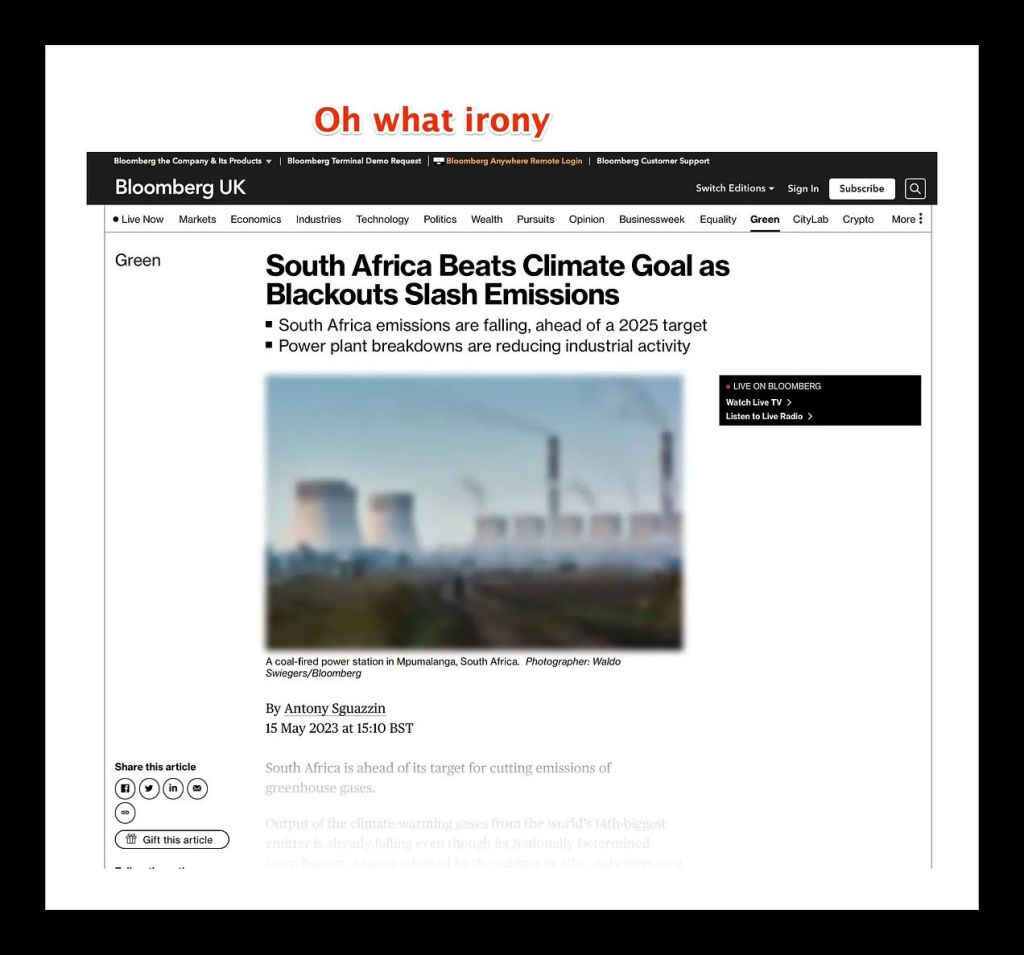
The final stage is the convergence of deindustrialisation and net-zero implementation into a long-term pattern of managed decline. The transcript notes that South Africa’s commitment to Agenda 2030 and ESG frameworks pushed policymakers to prioritise renewable quotas and climate signalling at the expense of energy security and industrial policy. Eskom’s coal fleet deteriorated further, maintenance budgets were constrained, and new baseload projects stalled. Manufacturing continued to contract as firms struggled to operate under constant load shedding. Youth unemployment entrenched itself as a structural feature of the economy. The transcript describes an overgrown financial sector extracting high returns while productive sectors lost investment, skills, and strategic support. Climate-linked loans deepened this imbalance by diverting fiscal resources into compliance-driven projects rather than rebuilding the energy system. South Africa became a case study in how externally driven climate policy can accelerate internal decline when applied without regard for domestic conditions.
Across Africa, similar pressures are emerging. Governments are told to prioritise emissions reduction even when electricity access remains low and industrialisation remains incomplete. Independent analysts warn that this framing imposes a false choice: it demands that African countries sacrifice development for climate goals while wealthier nations continue to rely on fossil fuels when necessary. The notion of a simultaneous global transition ignores the different starting points and structural constraints faced by late-industrialising economies. Countries that lack firm control over their energy systems cannot build diversified industries or safeguard strategic autonomy. When external actors dictate energy policy through loans, conditions, and ESG metrics, they gain leverage over national development paths.
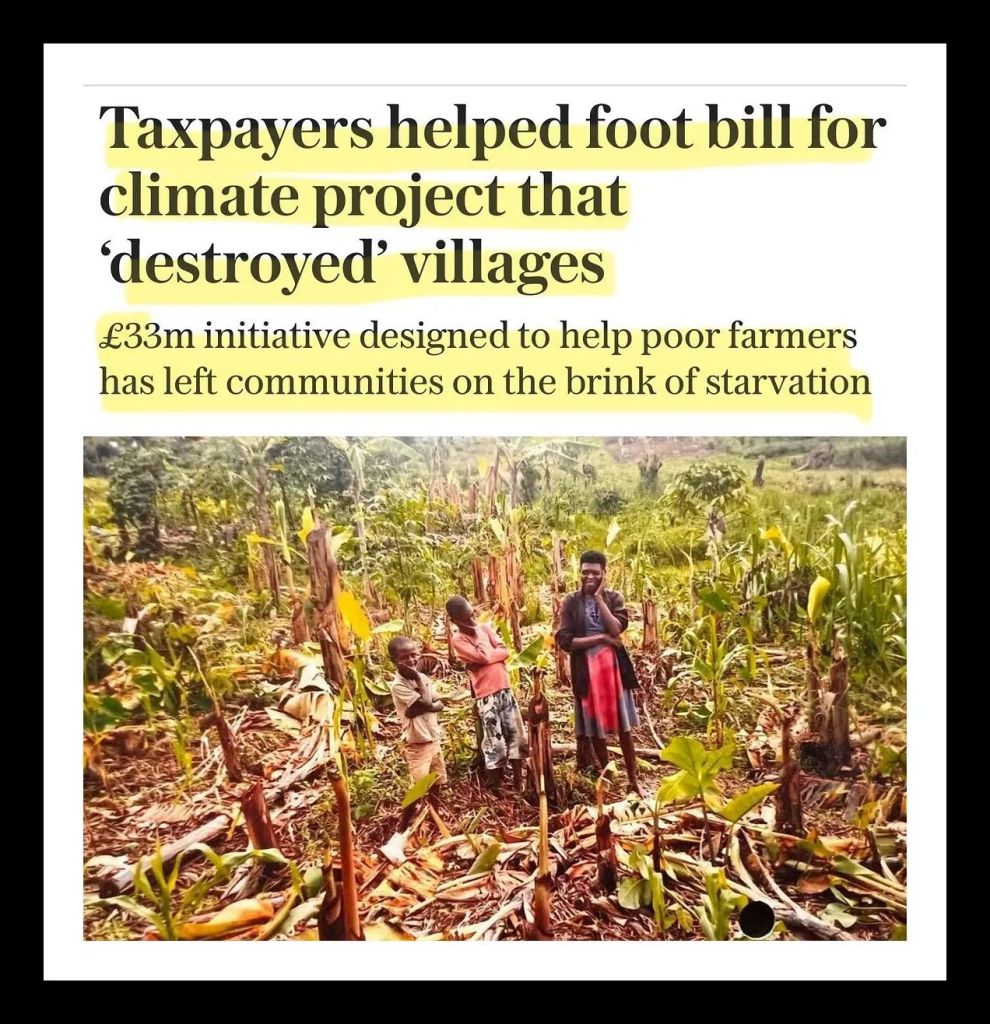
The consequences extend beyond economics. Societies that endure prolonged energy shortages face social fragmentation, weakened institutions, and declining trust in government. Businesses close, investment collapses, and skilled workers leave. This weakens the state and creates openings for further external intervention. The transcript cites examples where land is diverted to rewilding projects and food production declines as global organisations prioritise environmental targets over local livelihoods. These outcomes reflect a pattern where global agendas override domestic needs. Critics argue that the climate narrative is used to justify policies that concentrate power in international institutions, reduce national autonomy, and reshape economies in ways that benefit external actors.
The broader geopolitical implications are clear. African countries that accept climate loans without preserving sovereignty over energy and industrial policy risk becoming passive participants in a system designed elsewhere. Net zero, implemented without consideration for development realities, becomes a framework for managing decline rather than enabling growth. Deindustrialisation is treated as inevitable rather than the result of policy choices. Debt becomes the instrument through which compliance is enforced. Energy insecurity becomes the mechanism through which industrial capacity withers. When this process aligns with Agenda 2030, ESG scoring, and global governance structures, the outcome resembles a new form of colonial management with modern administrative language.
A sustainable path requires a different approach. African states need energy systems built around reliability, affordability, and national control. They need finance that strengthens sovereignty rather than eroding it. They need industrial strategies that prioritise productive capacity, skills development, and technological autonomy. They need the freedom to use their own resources, including fossil fuels where necessary, to build diversified economies. Independent analysts across the continent argue that development must proceed according to domestic priorities rather than external ideological timelines. Climate objectives must not override the fundamental requirement for industrialisation, energy security, and sovereign decision-making.
Africa’s future depends on rejecting the assumption that net-zero targets designed for advanced economies can be imposed on developing countries without severe consequences. The evidence from South Africa shows what happens when a country abandons control over energy policy, industrial strategy, and capital allocation. The continent does not need managed decline packaged as sustainability. It needs a development model built on autonomy, competence, and national interest.
Authored By: Global GeoPolitics
If you believe journalism should serve the public, not the powerful, and you’re in a position to help, becoming a PAID SUBSCRIBER truly makes a difference. Alternatively you can support by way of a cup of coffee:
buymeacoffee.com/ggtv


Leave a reply to Tony Seymour Cancel reply