

How the 2025 U.S. National Security Strategy reframes Europe as expendable in pursuit of global dominance
The new United States National Security Strategy reads less like a plan for alliance management and more like a post-mortem delivered in careful bureaucratic language. The document marks a clear break from the post-Cold War assumption that Europe remains the stable core of Western power. It describes a continent in rapid economic contraction, demographic decline, political fragmentation and waning strategic relevance. The language is not that of a rival or critic. It is the language of a patron acknowledging that an asset no longer performs its intended function.
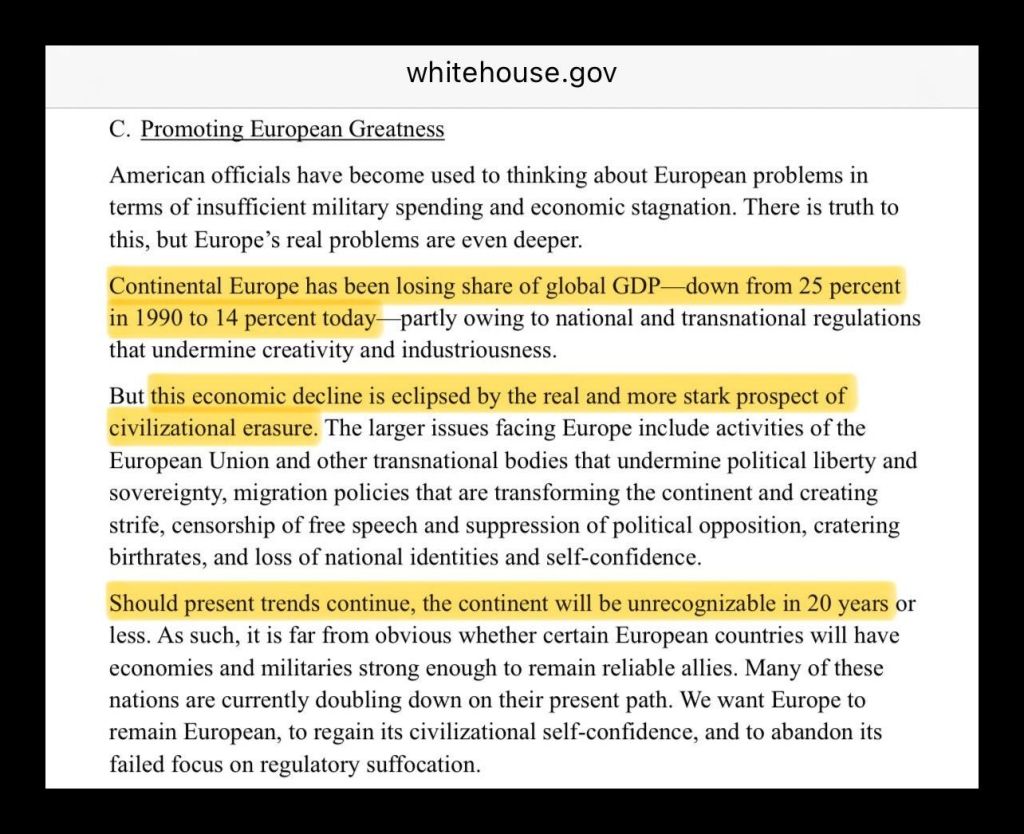
For three decades after 1991, American strategy rested on a simple structure. The United States would supply security, Europe would supply economic weight and political legitimacy, and NATO expansion would integrate former Soviet spaces into this order. The new strategy quietly abandons this premise. Europe’s share of global output has fallen from roughly one quarter at the turn of the century to little more than one seventh today. Long-term growth projections from institutions such as the OECD and IMF show no reversal under current policy assumptions. Demographic decline across Germany, Italy, Spain and Eastern Europe has moved from forecast to certainty. Fertility rates remain below replacement despite sustained mass migration, while social cohesion weakens rather than recovers.
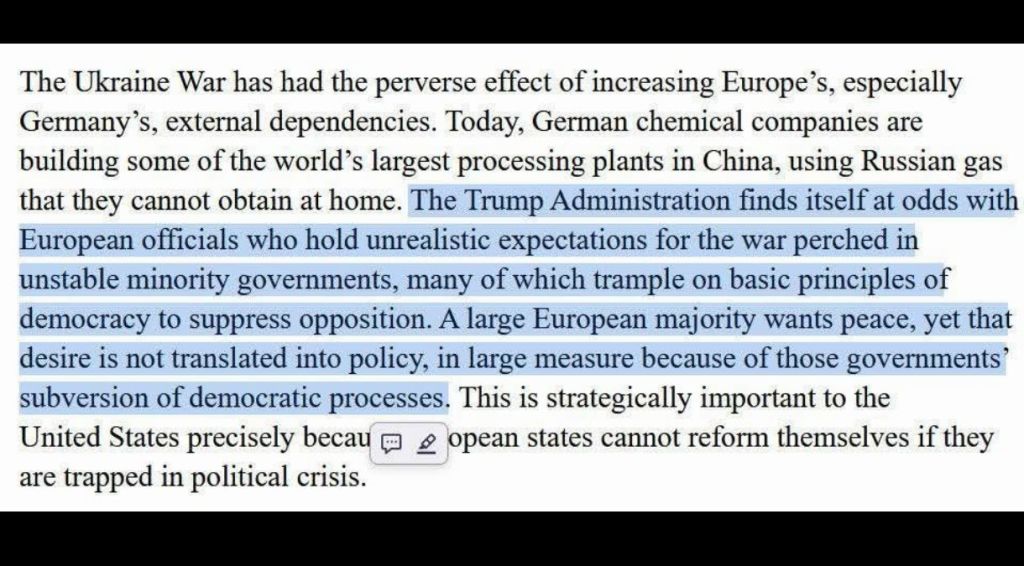
The strategy’s most striking departure lies in its assessment of Europe’s political systems. It explicitly notes that several European governments operate through unstable coalitions that suppress dissent to maintain foreign policy consensus. The document records a widening gap between public opinion and policy on the war in Ukraine, sanctions, and energy costs. Survey data from European polling institutions consistently show majorities favouring negotiations, yet electoral and legal mechanisms increasingly insulate decision-makers from those preferences. The strategy does not frame this as a temporary distortion but as a structural feature of contemporary European governance.
The authorship of the strategy matters. It bears the imprint of a realist school long sceptical of ideological expansionism. Many contributors circulate between the National Security Council, the Department of Defense and think tanks such as the Quincy Institute and American realist academic circles. These institutions have repeatedly warned that overextension weakens American power and that Europe’s strategic culture has shifted from material capability toward moral posture. The document reflects that assessment by signalling reduced tolerance for alliance members unable to carry economic or security burdens.
Sanctions policy occupies a central place in the strategy’s implicit lessons. Nineteen rounds of restrictive measures against Russia failed to achieve their stated aims while imposing measurable costs on Europe’s industrial base. Independent economic analysts such as Adam Tooze and Michael Hudson have documented how energy price shocks accelerated deindustrialisation across Germany, the Netherlands and Central Europe. Manufacturing output declined, chemical and metals firms relocated production to North America or Asia, and agricultural sectors faced rising input costs alongside regulatory pressure. The strategy avoids assigning blame directly, yet the causal chain appears unmistakable.
Russia’s trajectory receives an indirect but telling acknowledgment. The document recognises that Moscow adapted quickly to sanctions, reoriented trade toward Asia, the Middle East and the Global South, and stabilised its fiscal position through energy exports denominated outside Western financial channels. Purchasing power parity measures already place Russia among the world’s four largest economies. Industrial production related to defence, energy and heavy manufacturing has expanded rather than collapsed. None of this aligns with earlier Western projections. The strategy registers this outcome without rhetorical accommodation, treating it as a fact to be managed rather than denied.
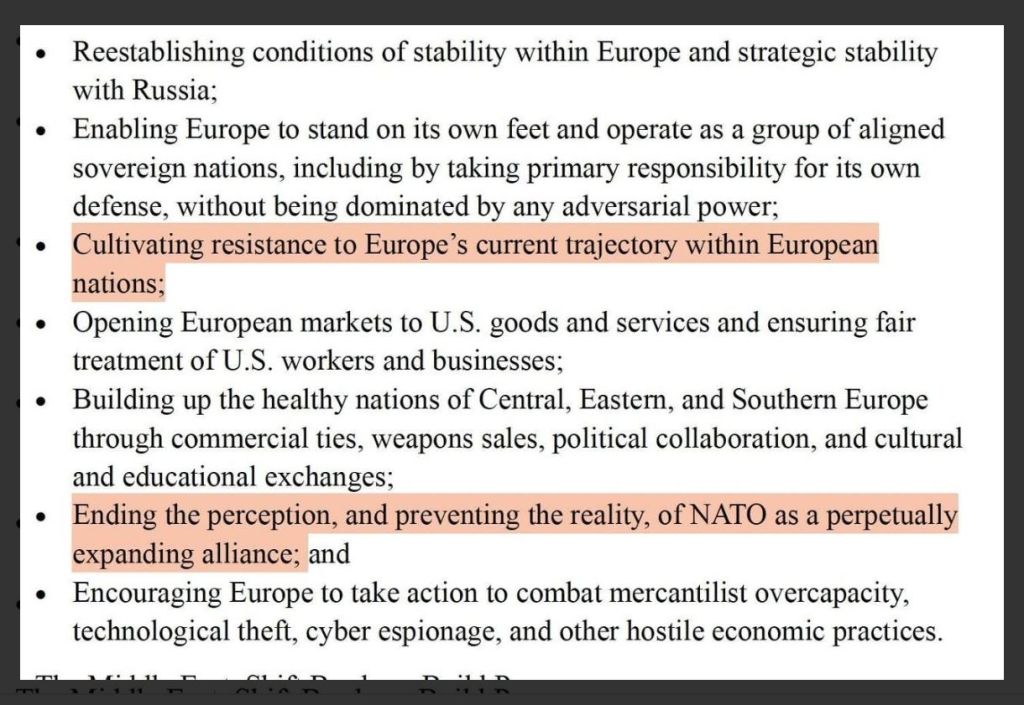
The implication for NATO is profound. The strategy states that some European allies may soon lack the economic and political coherence required for reliable military partnership. This language marks a quiet reversal of the assumption that NATO expansion inherently strengthened American security. It also suggests an end to automatic expansionism. Rather than extending formal guarantees into increasingly unstable political systems, Washington signals a preference for selective engagement and regional burden-sharing. That position aligns with long-standing warnings from scholars such as Stephen Walt and Barry Posen regarding alliance entrapment.
Europe’s internal contradictions occupy more space than external threats. The strategy highlights censorship laws, politicised legal systems and erosion of free expression as risks to alliance legitimacy. It notes that state power deployed to enforce ideological conformity weakens democratic resilience and fuels social backlash. These observations mirror critiques from European constitutional scholars and former judges who warn that emergency powers invoked during crises have become permanent tools of governance. The document treats these trends as strategic liabilities rather than domestic quirks.
Energy policy appears as another dividing line. Europe’s rapid abandonment of reliable baseload energy in favour of intermittent renewables increased dependency on external suppliers and exposed states to price volatility. American policymakers observe this not with environmental enthusiasm but with strategic concern. Energy insecurity undermines military readiness, industrial capacity and political stability. The strategy contrasts this approach with American energy abundance and quietly positions the United States as a comparative beneficiary of Europe’s policy choices.
The broader geopolitical context shapes these judgments. The rise of BRICS and associated institutions such as the New Development Bank represents a redistribution of economic gravity rather than an ideological bloc. China, India, Russia, Brazil and aligned states increasingly trade outside dollar-centric systems, invest in parallel infrastructure and coordinate diplomatically without Western approval. The strategy acknowledges this multipolar reality and frames American power as requiring consolidation rather than diffusion. Europe’s declining relevance therefore becomes a fact to be adjusted to, not resisted.
The document’s reference to “cultivating resistance to Europe’s current trajectory” carries significant weight. This phrasing implies willingness to support political change within allied states when existing elites obstruct strategic recalibration. Historically, such language has accompanied American efforts to reshape foreign political landscapes during moments of transition. Whether this translates into overt action remains uncertain, yet the signal itself matters. It communicates impatience with moralised policymaking disconnected from material outcomes.
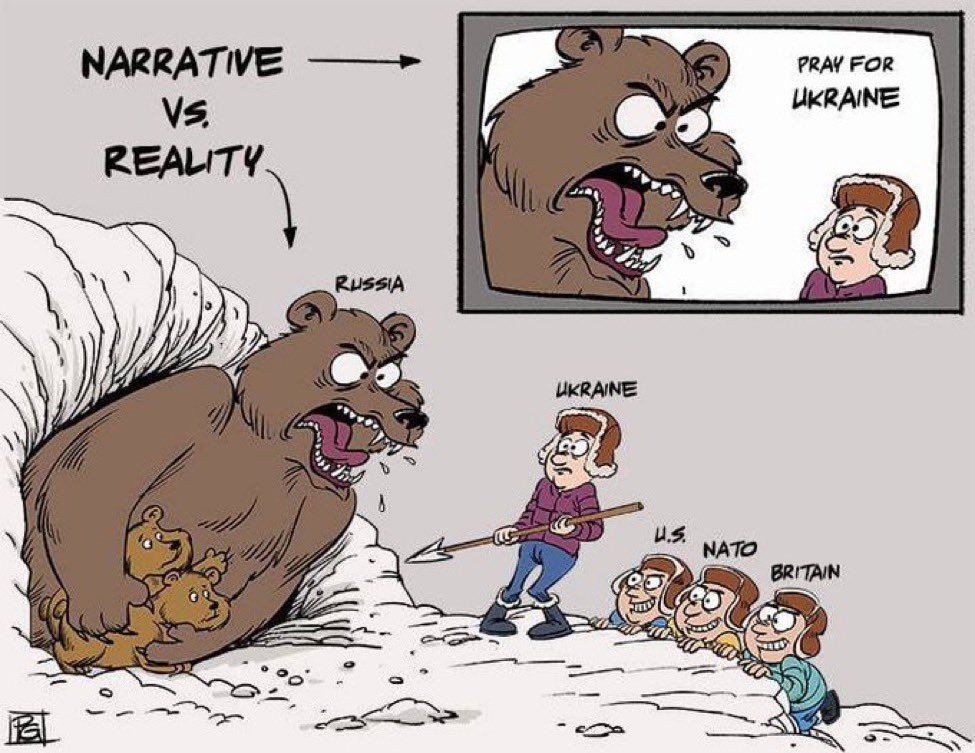
The war in Ukraine functions throughout as a diagnostic case rather than a singular cause. The strategy criticises European leaders for clinging to maximalist objectives unsupported by economic or military capacity. It notes that prolonged conflict accelerates Europe’s decline while contributing marginally to American strategic advantage. This assessment echoes arguments made by former intelligence officials and defence analysts who warned early that attritional warfare would entrench Eurasian realignment rather than reverse it.
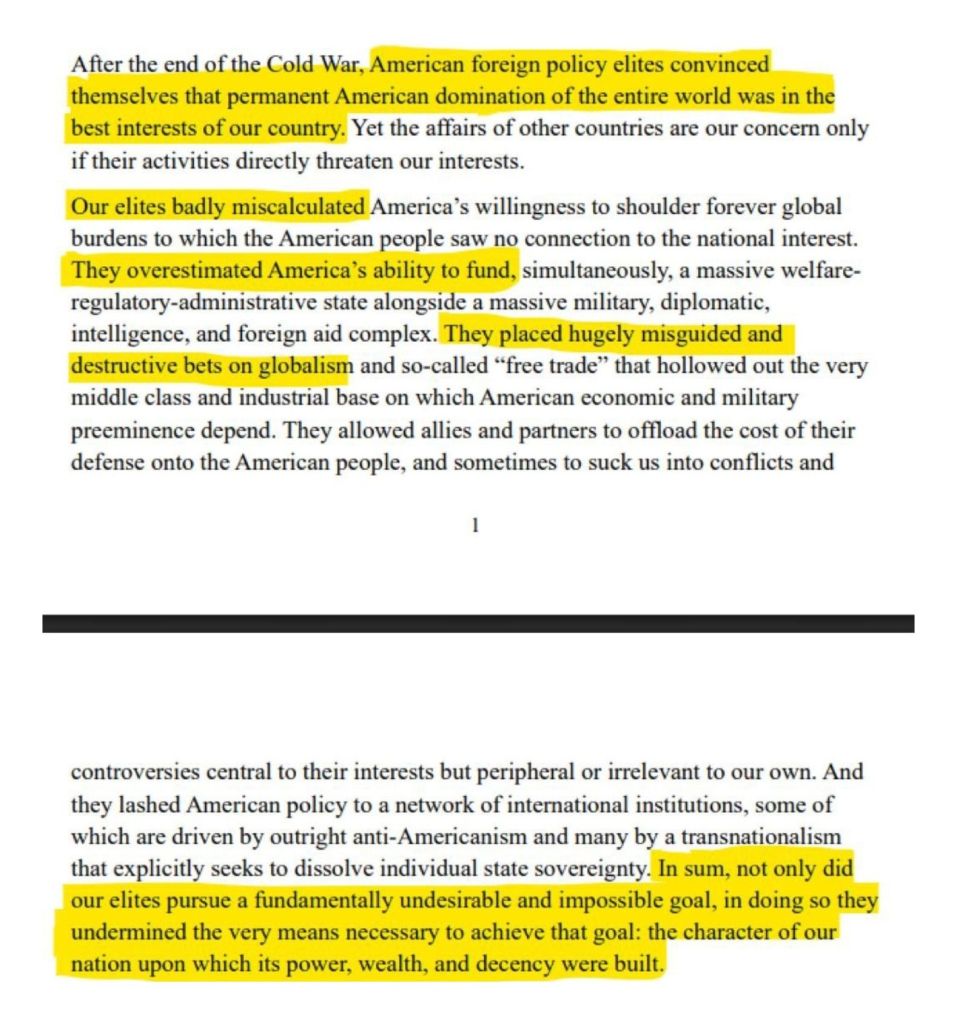
The National Security Strategy only becomes fully intelligible when read alongside the Marine Corps’ Pacific Marines Strategy 2025, published six months earlier. That document outlines expeditionary base operations across the first island chain, a doctrine resembling dispersed amphibious warfare under sustained fire conditions. The strategy openly anticipates casualty levels that would previously have been considered unacceptable for a modern American military. Loss projections of thirty to fifty percent during initial deployment, rising above seventy percent within days, reflect operational assumptions about Chinese firepower dominance near its coastline. Internal acknowledgment that unmanned systems and command nodes would survive only hours underscores the fragility of this concept. These projections explain a strategic retreat from direct confrontation rather than rhetorical defiance. A force that plans for disproportionate casualties also plans for political constraints that make such losses unsustainable.
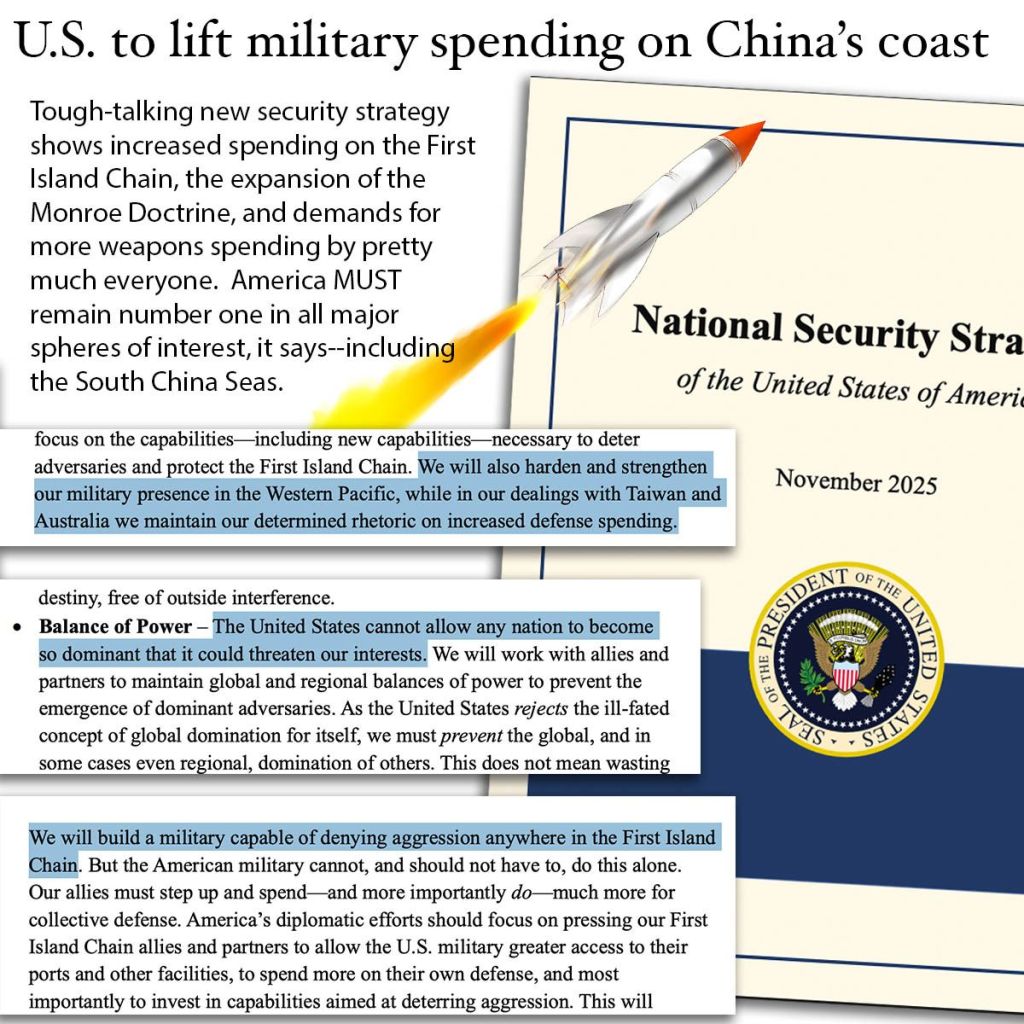
This operational reality clarifies the shift visible in the new strategy’s geopolitical priorities. The document abandons any serious attempt to fight and win a high-intensity war in East Asia while reframing deterrence as offshore militarisation financed increasingly by regional allies. Japan, Taiwan, the Philippines, and Australia appear less as partners than as terrain and buffers within a containment lattice. The demand that first island chain participants pay materially and politically for their inclusion reflects this recalibration. Washington retains command authority while externalising cost, risk, and exposure. America’s insistence on remaining number one across all major spheres coexists with an implicit admission that direct military primacy against China is no longer assured. What remains is control of sea lanes, pressure through trade architecture, and narrative maintenance sufficient to justify accelerated arms spending without testing battlefield assumptions.
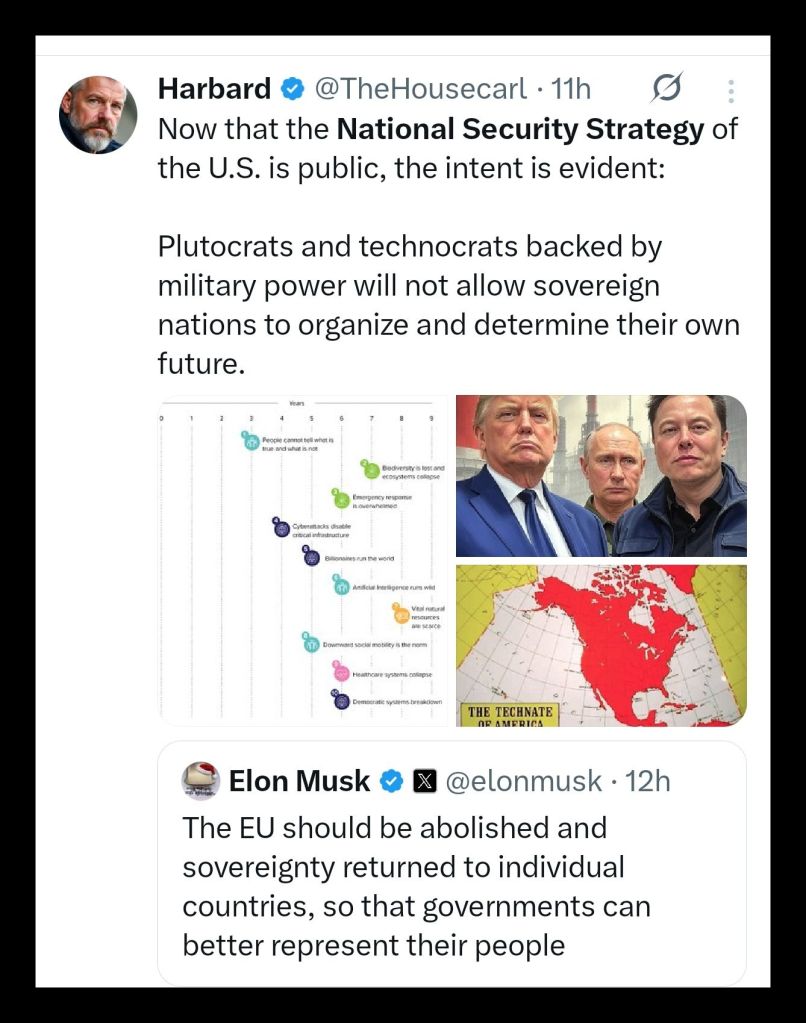
The strategy’s apparent outreach to Russia operates within this same logic of cost reduction rather than reconciliation. Calls for ending the Ukraine war and restoring strategic stability mask a broader effort to fracture the partnership between Moscow and Beijing. Economic incentives, elite reintegration narratives, and information operations function as tools designed to reopen internal fault lines rather than to secure durable peace. Europe, weakened economically and politically, becomes the testing ground for this hybrid approach, forced to militarise further while absorbing financial burden and internal strain. Washington preserves flexibility by disengaging from Europe’s decline while shaping conditions to prevent the emergence of a coherent Eurasian bloc. The strategy therefore records not retreat but reallocation, reducing exposure to material loss while sustaining global dominance through indirect pressure, selective engagement, and managed instability.
Authored By: Global GeoPolitics
If you believe journalism should serve the public, not the powerful, and you’re in a position to help, becoming a PAID SUBSCRIBER truly makes a difference. Alternatively you can support by way of a cup of coffee:
buymeacoffee.com/ggtv


Leave a comment