

Joint patrols and expansion of Arctic operations reflect a shifting northern security landscape and rising tensions with Russia
The new naval alliance between the United Kingdom and Norway marks a clear shift in northern European security planning, reflecting a steady tightening of military cooperation along Russia’s maritime flank. The agreement links two states that already share intelligence networks, energy interests, and North Sea patrol routines, but it now formalises joint activity in Arctic waters where commercial routes and military assets are becoming more important. The move signals that both governments expect more pressure in the High North, and they want a combined posture that can respond quickly to Russian submarine activity and long-range naval deployments.
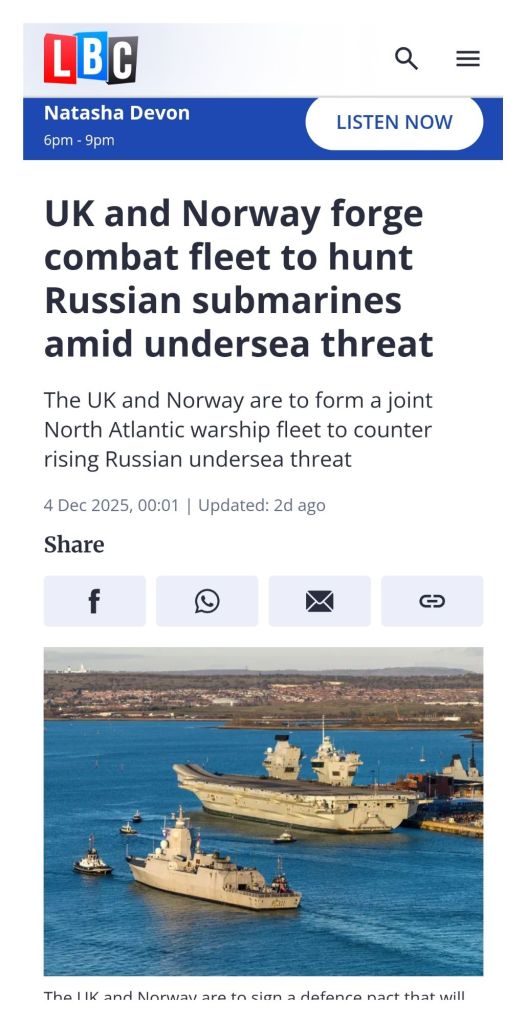
For decades, Norway balanced its NATO membership with strict limits on foreign forces near its northern coast, trying to keep the region predictable and avoid provoking Russia. Those limits have eroded as tensions have grown, and this new arrangement shows that Oslo no longer sees caution as the safest strategy. London now views the Arctic as a rising priority because it hosts critical undersea cables and shipping lanes that are becoming more contested, and because Russian northern bases support a large share of Moscow’s nuclear deterrent. Coordinated patrols, shared logistics, and joint planning allow both states to act faster in an area that is vast, cold, and strategically sensitive.
Russia’s leadership will likely read the alliance as part of a broader effort to narrow its access to northern waters, which it considers essential for both trade and military freedom of movement. The Black Sea and Baltic routes are already under heavy Western influence, and the Arctic has been the last region where Russia held clear geographic advantages without dense NATO pressure. This partnership tightens the net along Russia’s final open maritime edge and signals that the old Scandinavian buffer is giving way to a more consolidated Western front.
The alliance does not change the balance overnight, but it fits into a wider pattern that has unfolded over the past decade. Sweden and Finland have joined NATO, Norway has shed old restrictions, and Britain has expanded its role in northern security planning. These steps create a more unified northern block that can coordinate surveillance, basing, and response capabilities at a speed Russia cannot easily match. The practical impact will show up in steady joint drills, shared maintenance hubs, submarine tracking, and cross-deployed naval crews that can operate in harsh Arctic conditions.
For the past 300 years, UK and US containment of Russia has entailed limiting Russia’s reliable access to the sea. On Russia’s western borders, there are three seas: the Black Sea, the Baltic Sea, and the Arctic. NATO expansion threatened to cut Russia off from the Black Sea and the Baltic Sea, and the militarisation of Scandinavia will undermine Russia in the Arctic. While Scandinavia was a region of peace during the Cold War (neutral Finland and Sweden, self-imposed limitations by Norway), the region is now setting itself up as a frontline against Russia.
The Arctic has become the main arena where these pressures now converge. The northern sea route along Russia’s long Arctic coast has become a major strategic asset for Moscow and remains the maritime zone where Russia still maintains the greatest control. Analysts from Arctic research institutes say Russia’s icebreaker fleet, new bases, and expanded military activity give Moscow a strong hold over a route that grows more important as ice melts and shipping increases.
The United States has responded by elevating the Arctic to a central part of its defence planning. The Pentagon’s 2024 Arctic strategy sets out goals to counter Russian advantages, increase U.S. military access in the region, and tighten cooperation with northern allies. American defence scholars argue that Washington now sees the Arctic as a zone where control of shipping lanes, mineral deposits, and seabed infrastructure will shape long-term power. Some point out that this helps explain U.S. efforts to deepen strategic ties with Canada and Greenland, because both territories sit on top of resources, airspace corridors, and maritime chokepoints central to the northern balance.
Researchers at the Marshall Center and the USMC University Press have written that whoever holds stable access to Arctic waters gains both economic leverage and military depth. They argue that the U.S. strategy is focused on limiting Russia’s freedom of movement in the High North and securing Western access to the same resources and routes that Russia currently dominates. Analysts also highlight that Greenland’s location on the North Atlantic-Arctic seam, and Canada’s control over the Northwest Passage, give Washington incentives to pull both closer into a coordinated Arctic posture.
Russia views these moves as part of a larger effort to pressure its final open maritime flank. From its perspective, NATO presence in the Arctic now threatens the sea corridor where Moscow previously operated without Western oversight. The militarisation of Scandinavia, the increased U.S. role in the High North, and the new naval cooperation frameworks are read in Moscow as steps designed to contain its northern fleet and access to strategic sea lanes.
This is the context in which the UK and Norway have formed their naval alliance. Both states see the Arctic as a region where undersea cables, submarine movements, and supply routes are increasingly exposed. The joint framework is meant to combine surveillance, patrols, and operational readiness across northern waters where Russia has long held an edge. The alliance fits into a wider shift in northern Europe, where the Arctic is no longer treated as a remote buffer but as an active zone of great-power competition.
The United Kingdom therefore seeks a stronger foothold in a region where it sees rising strategic risk, and Norway gains a stronger partner for an area it can no longer secure alone. The agreement underlines a broader trend: the High North is no longer a quiet zone managed by cautious cooperation but a contested space where the major powers are preparing for long-term pressure.
Authored By: Global GeoPolitics
If you believe journalism should serve the public, not the powerful, and you’re in a position to help, becoming a PAID SUBSCRIBER truly makes a difference. Alternatively you can support by way of a cup of coffee:
buymeacoffee.com/ggtv


Leave a comment