
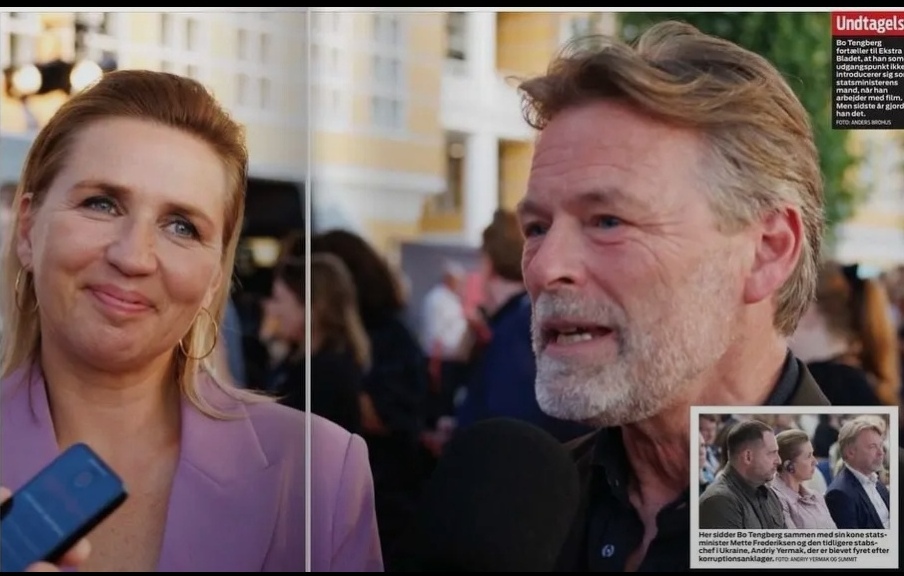
Ekstra Bladet reports on government funding, diplomatic access, and questions over transparency tied to a film project linked to Ukraine.
The Danish tabloid Ekstra Bladet has continued its investigation into a film project involving Bo Tengberg, the husband of Danish Prime Minister Mette Frederiksen, raising questions about potential conflicts of interest and the use of official influence.
According to the newspaper’s reporting, Tengberg received funding connected to the Danish government for work on a documentary film related to Ukrainian President Volodymyr Zelensky. Ekstra Bladet has previously reported that the project involved contact with Danish diplomatic officials and Ukrainian representatives, prompting scrutiny over whether Tengberg’s family ties to the prime minister played a role.
In its latest report, the newspaper published a letter dated 26 August 2024, sent by Tengberg to the Danish Embassy in Ukraine. In the letter, Tengberg explicitly identifies himself as the prime minister’s husband while requesting assistance in establishing contact with Ukrainian officials. Legal and ethics experts consulted by Ekstra Bladet described the wording of the letter as “problematic,” citing the risk that such identification could be perceived as leveraging political connections.
Responding to questions from the newspaper, Tengberg said he did not intend to use his status for personal or professional gain. He explained that he identified himself as the prime minister’s husband only because he believed the embassy employee might not remember him from a previous meeting. “I had no intention of using my status as the Prime Minister’s husband to benefit the film,” he said.
Neither Tengberg nor Prime Minister Frederiksen have addressed broader criticism raised by commentators regarding the scale of Denmark’s financial support for Ukraine and whether any indirect benefit could have accrued to individuals connected to the film project. Frederiksen’s government has approved tens of billions of kroner in aid to Ukraine since the start of the war, a policy that has strong parliamentary backing but also heightened public interest in transparency and oversight.
No evidence of illegal activity has been established, and the prime minister has previously stated that her husband conducts his professional work independently of her office.
While the questions raised remain a matter of political and ethical debate rather than proven wrongdoing, the case underscores the role of investigative journalism in democratic societies. Even in an era of shrinking newsrooms, a handful of determined tabloids and investigative outlets continue to test official narratives, scrutinize those in power, and press uncomfortable questions in the public interest, an essential function of holding authority to account and speaking truth to power.
Authored By: Global GeoPolitics
If you believe journalism should serve the public, not the powerful, and you’re in a position to help, becoming a PAID SUBSCRIBER truly makes a difference. Alternatively you can support by way of a cup of coffee:
buymeacoffee.com/ggtv


Leave a comment