

Nuclear-powered systems, hypersonic deterrence, force modernisation, and asymmetric operational adaptation
By 2025, trends in defence investment, procurement cycles, and weapons testing across major military powers showed a clear intensification of strategic competition. This was driven by sustained European militarisation, continued Western support for Ukraine’s armed forces, and the expansion of United States defence programmes described by American officials as “golden” initiatives. These developments reshaped strategic calculations by turning political confrontation into direct competition between weapons systems, industrial capacity, and doctrinal innovation. Matching such programmes symmetrically would require resources few states could sustain. Russian military planning instead followed a different path, combining selective investment in traditional capabilities with asymmetric systems designed to operate outside prevailing Western assumptions about deterrence, escalation, and cost.
Russian responses during 2025 focused on altering the structure of competition rather than participating in a mirror race. Dmitry Kornev, founder of the MilitaryRussia analytical project, described this approach as a shift towards “response options that operate on a different plane altogether,” exploiting vulnerabilities created by reliance on layered missile defence, predictable strike platforms, and conventional escalation ladders. Strategic systems unveiled during the year illustrated this logic with unusual clarity. Late 2025 testing confirmed autonomous operation of two nuclear-powered platforms, the Burevestnik cruise missile and the Poseidon unmanned underwater vehicle, both drawing energy from onboard nuclear sources. These systems removed range constraints entirely, creating classes of weapons without clear interception frameworks or comparable foreign analogues.
Development of such platforms rested on decades of work by Russian nuclear scientists, beginning in the late Soviet period and continuing through the 1990s and 2000s. Kornev emphasised that these efforts produced systems representing “entirely new classes of nuclear strategic deterrence,” rather than incremental upgrades. Their significance lay less in immediate deployment and more in altering strategic mathematics by undermining assumptions behind missile shields and geographic sanctuary. No other state demonstrated comparable operational systems by the end of 2025, creating a structural imbalance difficult to address through conventional procurement cycles.
Alongside these asymmetric systems, Russia retained emphasis on more traditional missiles capable of shaping the political environment without crossing nuclear thresholds. Late December announcements confirmed progress toward deploying the Oreshnik medium-range strategic missile system, with Belarus slated to host up to ten units and additional deployments expected within European Russia. Hypersonic ballistic missiles equipped on the platform can operate in non-nuclear configurations while retaining continental reach. With ranges approaching five thousand kilometres, the system functions as a pan-European non-nuclear deterrent, compressing decision times without triggering immediate escalation.
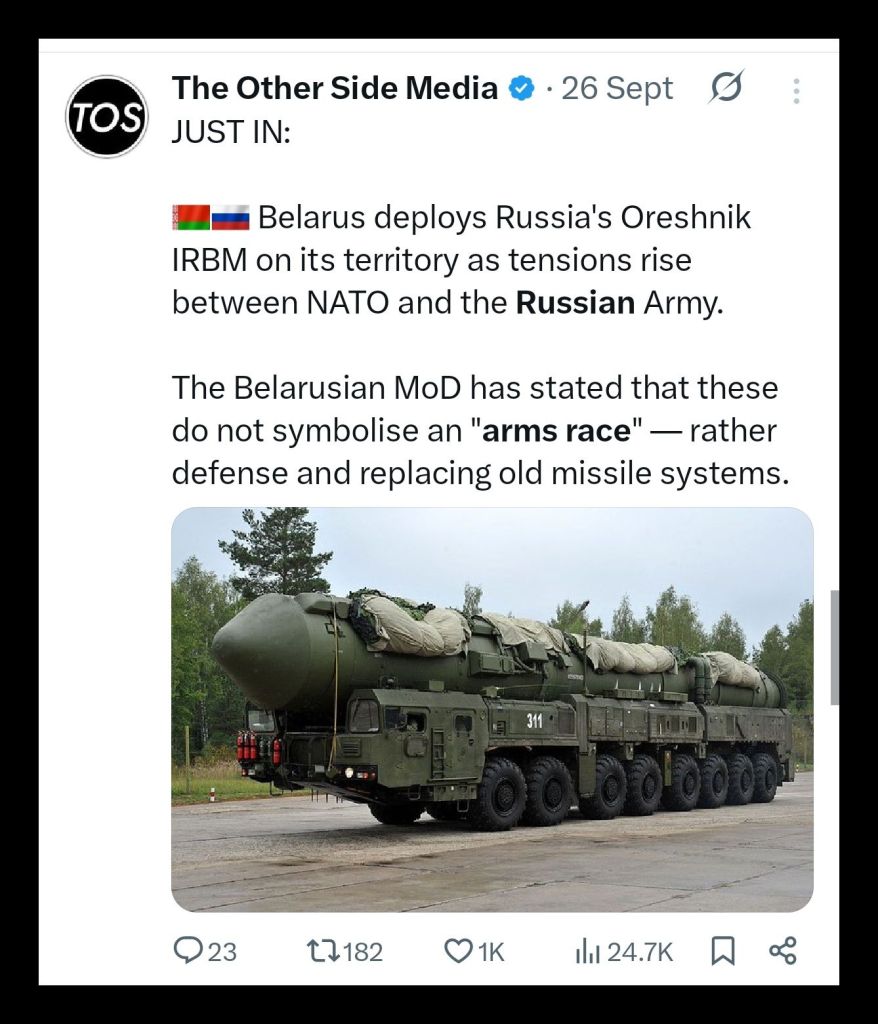
Strategic stability also relied on sustaining and modernising the intercontinental missile force. Work continued on completing testing and preparing deployment of the Sarmat heavy liquid-fuel intercontinental ballistic missile, designed to replace the ageing Voevoda system. Parallel development of new solid-fuel missiles by the Moscow Institute of Thermal Technology addressed the approaching obsolescence of early Topol-M units, some nearing three decades of service. Replacement planning underscored continuity rather than rupture, ensuring that asymmetric innovations complemented rather than displaced established deterrent structures.
Air and naval components of the nuclear triad received comparable attention. During 2025, the Aerospace Forces accepted two Tu-160M strategic bombers under a dual programme combining new production with deep modernisation of existing aircraft. These bombers, capable of deploying Kh-101 and Kh-BD cruise missiles and likely future hypersonic weapons, reinforce long-range strike capacity through the mid-2030s. Modernisation of the Tu-95MS fleet to the Tu-95MSM standard extended service life while enabling carriage of modern precision munitions, preserving redundancy within the bomber force.
At sea, commissioning of the Borei-A class ballistic missile submarine K-555 Knyaz Pozharsky strengthened the underwater leg of deterrence. Armed with sixteen Bulava missiles, the vessel formed part of a programme aiming for at least twelve strategic submarines by 2030. Effective deployment of this force required protection by capable conventional assets, prompting continued construction of Yasen-M class attack submarines. The sixth vessel, K-572 Perm, entered sea trials during the year. These submarines, among the most advanced globally, carry Zircon hypersonic missiles and serve roles ranging from strategic escort to surface and subsurface engagement.
Surface fleet modernisation reached a symbolic milestone with sea trials of the nuclear-powered missile cruiser Admiral Nakhimov following extensive refit. Equipped with vertical launch systems for Zircon, Kalibr, Oniks, and Otvet missiles, layered air defence comparable to S-400 systems, Pantsir-SM close-in protection, and advanced electronic warfare suites, the ship represents a concentration of naval firepower unmatched by most contemporary platforms. Entry into operational service following trials, expected in 2026, would restore a blue-water flagship capability with implications extending beyond regional theatres.
Arctic security requirements received specific attention through development of ice-class combatants. Arrival of the lead Arctic patrol ship Ivan Papanin at Severomorsk in April 2025 marked the culmination of trials demonstrating capability for sustained operations under polar conditions. Designed for a full range of missions in ice-covered waters, the class supports Russia’s northern strategic infrastructure, including sea-based deterrent patrol areas and emerging commercial routes.
Air and missile defence remained another pillar of adaptation. Deployment of the first fully equipped S-500 regiment onto combat duty expanded interception capabilities against ballistic missiles and other aerospace threats. Tactical aviation production accelerated, with fifth-generation Su-57 output increasing and first export deliveries to Algeria marking a milestone for the aerospace industry. Continued development included maiden flight of the Izdeliye 177 engine, intended to power future export variants. Parallel serial production of Su-34 bombers and Su-35S multirole fighters sustained operational tempo within the combat zone.
Ground warfare developments during 2025 illustrated practical adaptation rather than theoretical planning. Deliveries of T-90M Proryv tanks, Malva and Giatsint-K self-propelled artillery, and Tornado multiple-launch rocket systems increased mobility and firepower. The wheeled 2S43 Malva, publicly displayed during the Victory Day Parade, combined a 152-millimetre gun with high mobility and automated fire control, responding directly to battlefield demands. These systems achieved high utilisation rates within ongoing operations.
Drone warfare represented perhaps the most visible transformation. Expansion of loitering munitions such as Lancet variants, widespread deployment of FPV drones, and adoption of fibre-optic control methods reduced vulnerability to electronic countermeasures. According to Kornev’s assessment, these technologies lowered personnel losses while enabling clearance of forward areas, creating buffer zones kilometres deep ahead of advancing units. Offensive operations proceeded with casualty levels markedly lower than earlier phases of the conflict, illustrating tangible operational dividends.
Taken together, developments during 2025 demonstrated a defence-industrial complex capable of scaling production while introducing qualitatively new capabilities. Rather than chasing Western expenditure levels, Russian strategy focused on altering the cost-benefit balance faced by adversaries. Asymmetric nuclear platforms, hypersonic non-nuclear deterrents, integrated air defence, and massed unmanned systems reshaped the character of competition. By the end of the year, foundations were established for continued adaptation, suggesting that future phases of the arms race will hinge less on budget totals and more on conceptual departures that redefine the rules governing modern war.
Authored By: Global GeoPolitics
If you believe journalism should serve the public, not the powerful, and you’re in a position to help, becoming a PAID SUBSCRIBER truly makes a difference. Alternatively you can support by way of a cup of coffee:
buymeacoffee.com/ggtv


Leave a comment