
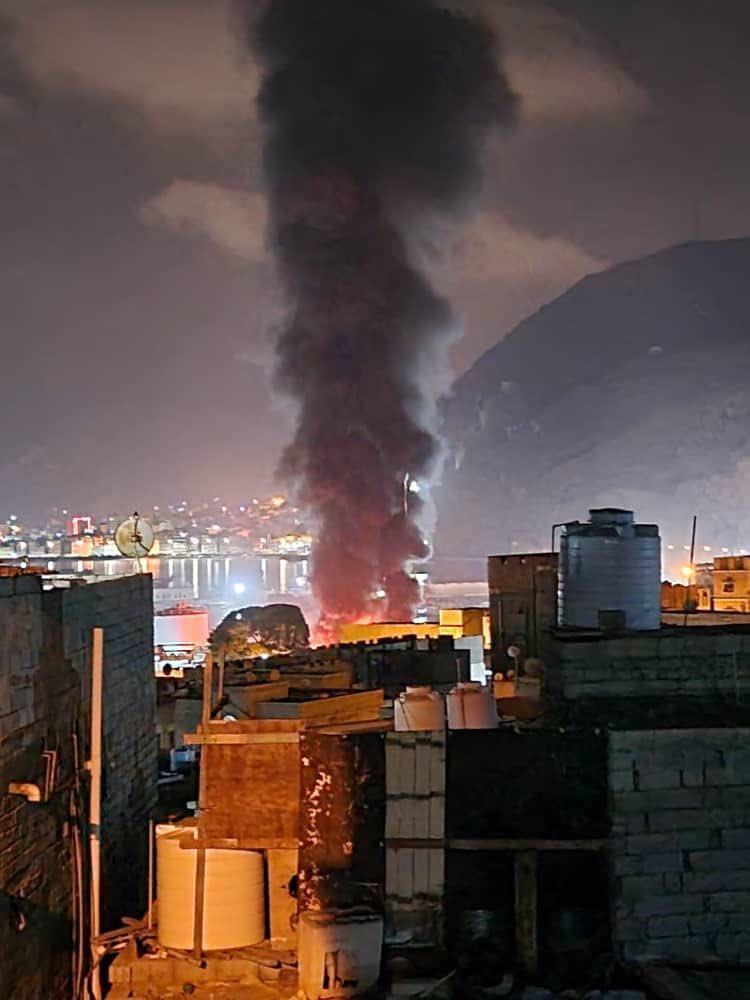
How Saudi airstrikes on Emirati-linked arms exposed a quiet war inside the war
The Saudi airstrike on Mukalla port at the end of December marked a rupture that had been forming inside the anti-Houthi camp for several years, though rarely acknowledged in public. The destruction of an Emirati-linked weapons shipment destined for the Southern Transitional Council exposed a rivalry over territory, ports, and armed clients that had long replaced any shared vision for Yemen’s future. Yemen has functioned less as a sovereign state than as a contested space where neighbouring powers pursue narrow security and commercial interests through local proxies.
Saudi Arabia entered the Yemen war in 2015 claiming to restore the authority of the internationally recognised government after the Houthi takeover of Sana’a. The United Arab Emirates joined the coalition with similar public language but quickly pursued a different project on the ground. Abu Dhabi invested heavily in southern militias, trained security forces outside government command, and prioritised control of ports and maritime corridors. Analysts such as Michael Horton, formerly of the International Crisis Group, have long argued that Emirati strategy focused on countering political Islam and securing Red Sea and Gulf of Aden shipping lanes rather than preserving Yemeni unity.
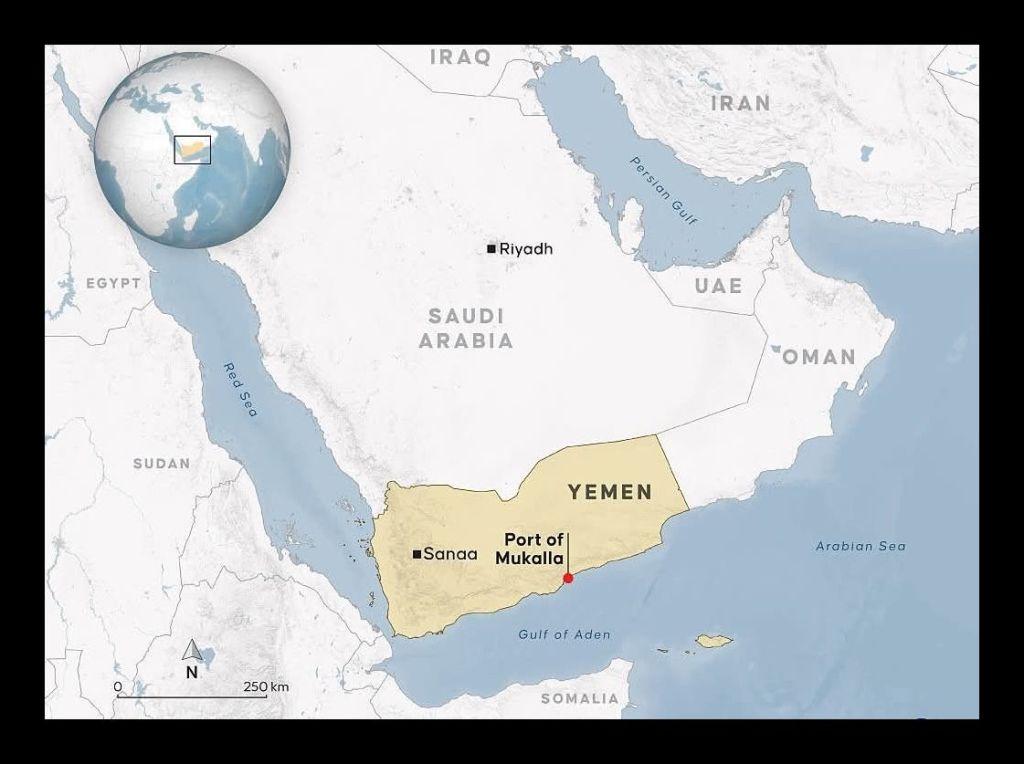
The Southern Transitional Council emerged from this Emirati patronage as a disciplined, well-funded force with a clear separatist agenda. While nominally part of the anti-Houthi coalition, the STC repeatedly clashed with Saudi-backed government units in Aden, Abyan, and Shabwa. The Riyadh Agreement of 2019 attempted to paper over these divisions through power sharing, though implementation stalled almost immediately. Helen Lackner, a long-time Yemen scholar based at SOAS, has described the agreement as a holding mechanism designed to freeze conflict lines rather than resolve competing claims of authority.
Hadramout and Mahra occupy a different place in Saudi strategic thinking than Aden or the Red Sea coast. These eastern provinces border the Kingdom directly and provide access to the Arabian Sea, bypassing the Strait of Hormuz. Saudi planners have considered pipeline routes through Mahra since the 1980s, viewing the area as a buffer against instability spilling into the Kingdom’s southern regions. Riyadh therefore tolerated Emirati dominance in western and southern Yemen while drawing a red line around the east.
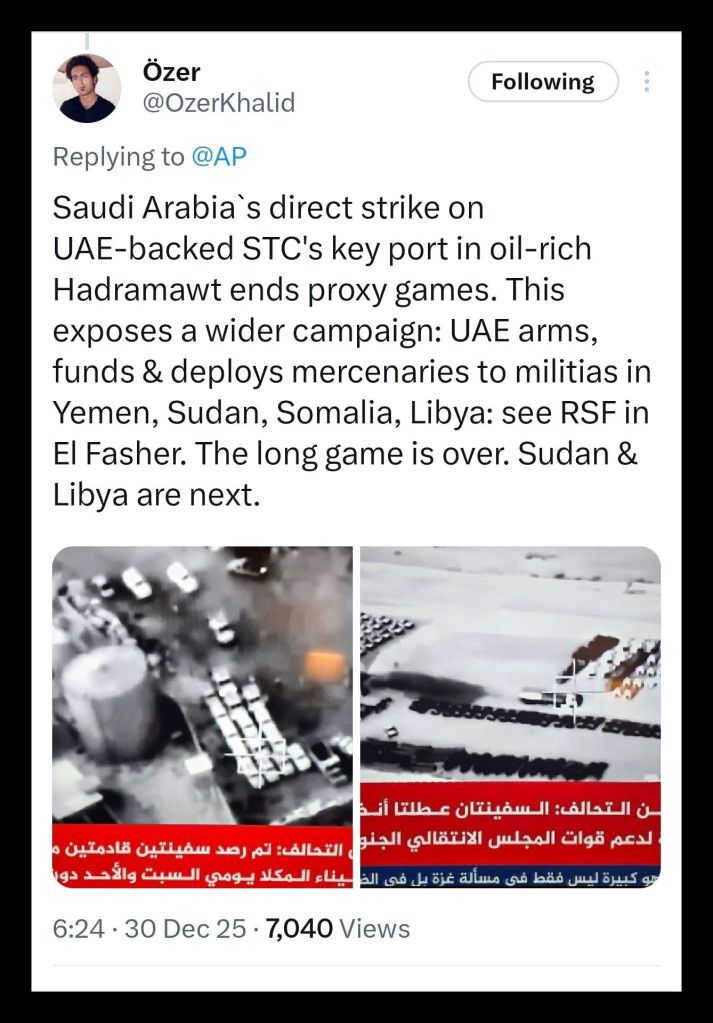
The arrival of unregistered ships from Fujairah into Mukalla crossed that line. Saudi statements framed the shipment as an imminent security threat, though the language revealed deeper concerns about the balance of power among Yemeni factions. By striking the cargo before it moved inland, Saudi Arabia signalled unwillingness to allow an Emirati-backed force to consolidate military control near its border. Yemeni officials aligned with Riyadh described the move as defensive, though the decision to bomb a partner’s supply chain underscored the extent of mutual distrust.
The political reaction inside Yemen confirmed the seriousness of the break. The Presidential Leadership Council’s cancellation of defence arrangements with Abu Dhabi and its demand for Emirati withdrawal represented a rare assertion of sovereignty, albeit one dependent on Saudi backing. Rashad al-Alimi’s televised address framed the STC advance as rebellion rather than liberation, language reflecting Saudi concerns that separatism could fracture Yemen permanently and complicate any eventual settlement with the Houthis.
This confrontation unfolded against a background of declining Saudi appetite for open-ended war. Riyadh has pursued talks with the Houthis since 2022, prioritising border security and de-escalation over restoring central authority. The Emirati approach diverged sharply, relying on durable local allies and territorial control rather than negotiated accommodation. Professor Mohammad Marandi of the University of Tehran has argued that Gulf rivalries in Yemen increasingly resemble commercial competition masked by security language, with ports and coastlines carrying greater weight than ideology.
The Mukalla strike therefore served as communication as much as military action. Saudi Arabia demonstrated readiness to use force against a nominal ally when core interests appeared threatened. Abu Dhabi, by contrast, responded with silence, allowing its Yemeni clients to absorb the immediate political cost. This asymmetry reflects differing risk tolerances and strategic horizons. The UAE has shown willingness to operate through deniable partnerships, while Saudi Arabia remains tied to formal state structures and public accountability.
The Yemeni population stands largely excluded from these calculations. Eastern Yemen had avoided large-scale violence for much of the war, maintaining relative stability compared to Taiz, Hodeidah, or Marib. Militarisation of Hadramout risks opening a new front disconnected from local grievances. Yemeni civil society figures have warned that importing southern conflict dynamics into the east could unravel fragile tribal arrangements and invite external intervention. Such warnings echo earlier failures in Aden, where militia rule produced insecurity rather than governance.
The pattern of Emirati proxy warfare extends beyond Yemen. In Sudan, Abu Dhabi faces mounting accusations of supporting the Rapid Support Forces, a paramilitary group implicated in mass killings and ethnic cleansing in Darfur. Alex de Waal, executive director of the World Peace Foundation, has documented financial and logistical flows sustaining the RSF despite international condemnation. Sudanese activists and UN investigators have pointed to arms transfers routed through regional partners, though official denials persist.
The Sudan case illustrates a broader Emirati doctrine emphasising influence through armed non-state actors. Whether in Libya, Yemen, or Sudan, Abu Dhabi has cultivated forces outside traditional military hierarchies, favouring reliability and loyalty over legitimacy. Supporters argue this approach delivers stability in fragmented environments. Critics counter that it entrenches war economies and obstructs political settlements. The Yemeni experience lends weight to the latter view, given repeated cycles of alliance breakdown and militia infighting.
Saudi Arabia has pursued a different, though not more benign, course. Riyadh’s reliance on airpower and financial leverage produced widespread humanitarian harm while failing to defeat the Houthis. The Kingdom’s current recalibration reflects exhaustion rather than reconciliation. The Mukalla strike suggests Saudi leaders remain prepared to enforce boundaries through force even while advocating dialogue elsewhere. Such duality complicates any claim that de-escalation represents a principled shift.
The United States and European governments responded with calls for restraint, though their influence appears limited. Western policy has largely accommodated Emirati and Saudi preferences, prioritising arms sales and maritime security cooperation. Independent analysts such as Annelle Sheline, formerly of the US State Department, have criticised this approach for enabling regional actors to pursue destabilising agendas without meaningful consequence. Yemen’s fragmentation has proceeded alongside continued external support, not despite it.
The longer-term implications of the Saudi-Emirati split remain uncertain. Open conflict between the two appears unlikely, given economic ties and shared concerns over Iran. Yemen nevertheless risks becoming a patchwork of spheres of influence hardened by competing patrons. Any peace process excluding the realities of southern separatism and eastern security anxieties will struggle to gain traction. The Mukalla incident demonstrated that suppressed conflicts eventually surface, often violently.
Yemen’s war began as a contest over political power in Sana’a and evolved into a regional battleground shaped by divergent Gulf ambitions. The Saudi strike on UAE-linked arms revealed the extent to which coalition unity had already collapsed beneath the surface. Ports, provinces, and militias now serve as bargaining chips rather than instruments of national recovery. Without external restraint and genuine inclusion of Yemeni voices, the cycle of proxy confrontation will persist, regardless of shifting alliances or declared ceasefires.
Authored By: Global GeoPolitics
If you believe journalism should serve the public, not the powerful, and you’re in a position to help, becoming a PAID SUBSCRIBER truly makes a difference. Alternatively you can support by way of a cup of coffee:
buymeacoffee.com/ggtv


Leave a comment