

Why enforced disarmament under occupation fails to produce stability
The purpose of this analysis is to examine the reported joint Israeli and United States decision to impose a fixed two-month deadline for Hamas disarmament, and to assess what that decision reveals about current power structures, negotiation practices, and enforcement realities in Gaza. The case matters beyond the immediate conflict because it reflects a broader shift in how military force, diplomatic language, and administrative timelines are used to compel political outcomes without addressing underlying conditions. Gaza functions as a compressed example of coercive governance under occupation rather than a discrete security problem.
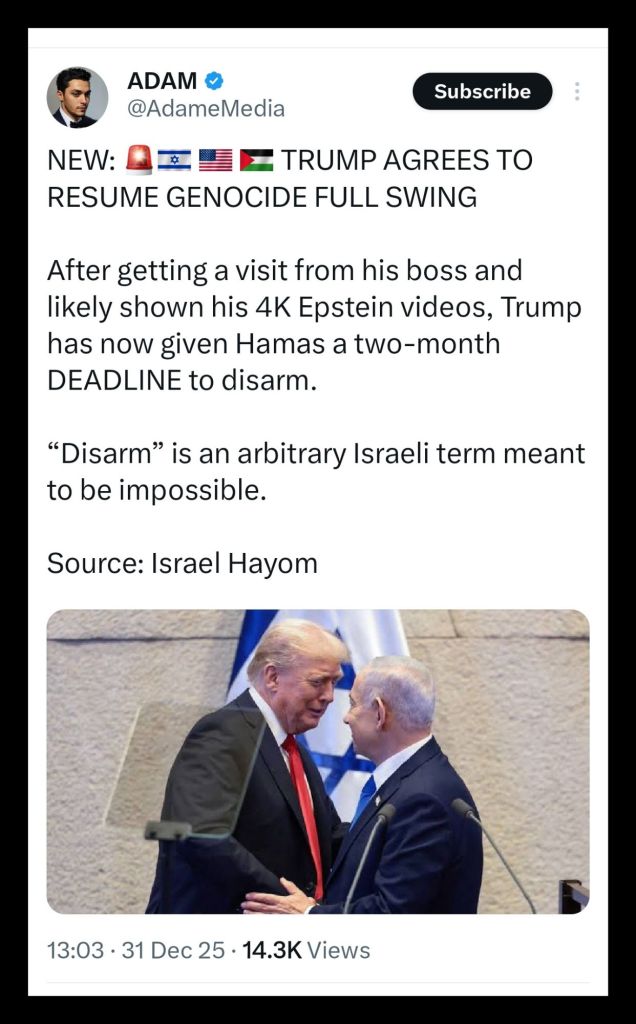
On 30 December, Israeli media reported that Israel and the United States had agreed on a two-month deadline for Hamas to disarm. The understanding followed a meeting between Israeli Prime Minister Benjamin Netanyahu and United States President Donald Trump at Mar-a-Lago. The decision was presented as a settled position rather than a proposal open to negotiation. Israeli and American teams reportedly began parallel work to define what was termed “practical disarmament,” framed through enforcement benchmarks rather than political agreement.
The reported benchmarks focused on the destruction of Hamas’s tunnel infrastructure and the elimination of its remaining weapons stockpiles. Israeli officials described partial compliance as unacceptable. The deadline was linked directly to Gaza’s demilitarisation rather than to any phased political settlement. Failure to meet the conditions would result in Israel determining subsequent actions on the ground.
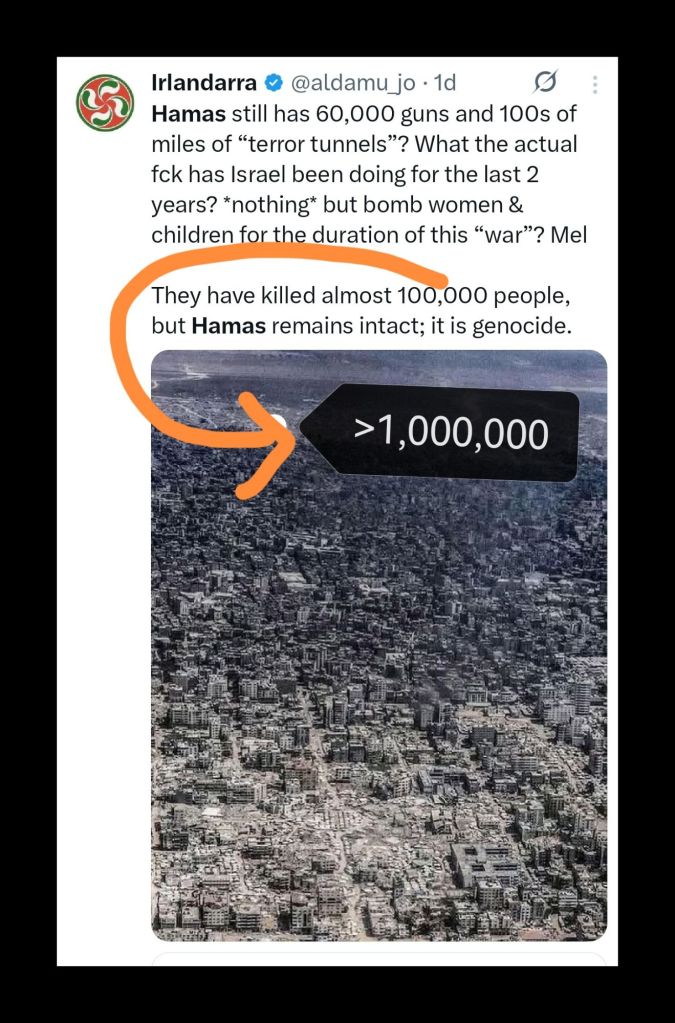
Netanyahu stated publicly that Hamas still possessed approximately 60,000 assault rifles and hundreds of kilometres of tunnels. These claims were used to argue that no post-war plan for Gaza could proceed without full disarmament. The framing suggested that military capability remained intact despite prolonged bombardment and siege. Hamas denied agreeing to any such condition and reaffirmed its refusal to disarm while occupation continued.
Hamas statements over the past year have remained consistent on this point. The movement has argued that armed resistance constitutes a national right under occupation and that relinquishing weapons would only follow the establishment of a sovereign Palestinian state with Jerusalem as its capital. Hamas representatives rejected assertions by US officials including Steve Whitkoff, that disarmament had been discussed as part of ceasefire arrangements. They instead referenced Israeli violations of previous ceasefire terms, including continued military operations and restrictions on aid.
The disarmament demand emerged after Hamas released Israeli prisoners under earlier agreements. Israel did not implement corresponding measures in full, according to ceasefire monitors and humanitarian organisations. Military operations continued, civilian casualties increased, and restrictions on food, fuel, and medical supplies remained in place. The sequence of events undermined the premise that negotiated commitments were reciprocal.
From a strategic perspective, the two-month deadline raises questions about feasibility rather than intent. Disarmament of an armed organisation embedded within a densely populated territory requires either voluntary political agreement or sustained external enforcement. Voluntary agreement presupposes legitimacy, mutual recognition, and an end to occupation. None of those conditions exist. External enforcement would require either a foreign military presence willing to conduct systematic searches and seizures, or continued large-scale military operations by Israel.
Are American troops going to march into Gaza street by street, tunnel by tunnel, to confiscate weapons? Absolutely not. The U.S. has no political, military, or moral appetite for that disaster. There is no scenario in which U.S. forces enter Gaza to conduct a ground campaign, clearing neighborhoods and tunnels to collect weapons. Such an operation lacks political support, strategic sense, and ethical justification. No credible evidence suggests that the U.S. intends to deploy ground forces to Gaza for disarmament purposes. American officials have consistently avoided direct military entanglement inside Gaza beyond logistical and intelligence support to Israel. Domestic political constraints, recent military experience in Iraq and Afghanistan, and the absence of international legal cover make such involvement unlikely.
The remaining enforcement option therefore rests with Israel. Israeli genocidal military doctrine in Gaza has historically relied on carpet mass bombardment, artillery, siege tactics, starvation, ground incursions and collective punishment of unarmed civilians. These methods have not achieved disarmament over nearly two decades of conflict. They have produced extensive civilian harm, infrastructure destruction, and humanitarian collapse without eliminating armed resistance. The expectation that identical methods will produce different outcomes within a fixed two-month window lacks empirical support.
Israeli officials have framed the deadline as an opportunity for Hamas to choose compliance over force. The structure of the ultimatum, however, removes meaningful choice. Disarmament under occupation functions as a surrender demand rather than a negotiated security arrangement. International law scholars, including those at the International Committee of the Red Cross and independent legal institutes, have consistently noted that occupied populations retain the right to resist occupation under certain conditions, even while specific acts may violate humanitarian law.
The linkage between disarmament and post-war governance further complicates the picture. President Trump has stated that a “day after” plan for Gaza would involve international oversight and a new civilian authority. No detailed framework has been published. Israeli officials reportedly downplayed the operational relevance of these statements. The absence of clarity reinforces the perception that governance promises function as leverage rather than commitments.
The deadline also serves a domestic political function. Israeli leadership faces internal pressure over the failure to eliminate Hamas after prolonged military operations. Reframing the conflict around disarmament timelines shifts responsibility for continued violence onto the opposing party. The narrative positions renewed military action as a consequence of non-compliance rather than a policy choice.
Historical precedent suggests that such framing does not alter material outcomes. Armed movements operating under occupation rarely disarm absent political settlement. Comparable cases include Hezbollah in southern Lebanon, insurgent groups in Iraq during US occupation, and resistance movements in Algeria and Vietnam. Military superiority did not translate into disarmament without structural political change.
The humanitarian implications of renewed escalation remain significant. Gaza’s civilian population has experienced widespread displacement, infrastructure collapse, and food insecurity. International humanitarian organisations have warned that additional military campaigns would deepen dependency and mortality without achieving stated security objectives. These assessments have remained consistent across multiple reporting periods.
The ultimatum model also affects negotiation norms. Deadlines imposed unilaterally weaken the credibility of future mediation efforts. Parties learn that concessions do not produce relief, while compliance demands escalate regardless of prior agreements. This dynamic incentivises entrenchment rather than compromise.
The broader geopolitical context matters. The United States has increasingly supported allied enforcement actions through diplomatic cover rather than direct intervention. This approach limits American exposure while preserving influence. Israel operates with substantial latitude under this arrangement. Gaza becomes a space where coercive policy experiments can proceed with limited external constraint.
The disarmament demand fits within a wider pattern of security governance that prioritises administrative outcomes over political resolution. Benchmarks, timelines, and compliance metrics replace negotiations over sovereignty, rights, and borders. This approach treats resistance as a technical problem rather than a political one. Evidence from multiple conflict zones suggests that such treatment prolongs instability.
The two-month deadline does not resolve the core contradiction at the heart of the conflict. Armed resistance persists because political conditions remain unchanged. Siege and bombardment have not altered that reality. Disarmament without sovereignty removes leverage without addressing control.
The likely outcome follows established patterns. Failure to meet the deadline will be cited as justification for renewed military operations. Civilian harm will increase. Infrastructure will degrade further. Political positions will harden. International actors will issue statements without altering enforcement dynamics.
The case offers a broader lesson about coercive diplomacy under asymmetric power conditions. Ultimatums framed as security necessities often conceal the absence of viable political solutions. Deadlines replace dialogue when structural constraints remain unresolved.
Gaza therefore functions less as an exception than as a concentrated example of contemporary conflict management. Power is exercised through enforcement timelines rather than negotiated settlement. Civilian populations remain trapped between armed actors and administrative demands they cannot influence.
The two-month countdown does not represent a path to stability. It represents a continuation of an approach that has failed to achieve its stated goals over many years. Absent political change, the deadline functions as a trigger rather than a solution.
History suggests that such scripts repeat with minor variation. Military pressure substitutes for diplomacy. Disarmament becomes a condition rather than an outcome. Civilian suffering becomes collateral rather than consequence. The structure persists even as the rhetoric shifts.
The events surrounding this ultimatum should be read accordingly, not as a turning point, but as confirmation of an established pattern.
Authored By: Global GeoPolitics
If you believe journalism should serve the public, not the powerful, and you’re in a position to help, becoming a PAID SUBSCRIBER truly makes a difference. Alternatively you can support by way of a cup of coffee:
buymeacoffee.com/ggtv


Leave a comment