

Why a local New York housing law exposes a deceitful elite coordinating a global shift from private towards managed ownership under Agenda 2030
This analysis is written as a warning rather than an abstract policy review. New York provides a clear case study of how state sanctioned administrative housing controls migrate from theory into binding law with little resistance once precedent is established. The relevance extends beyond one city or country, given that 179 states committed themselves to United Nations Agenda 2030, a framework critics describe as converging on a future defined by reduced ownership, managed access, and behavioural compliance. Housing policy now functions as an early enforcement domain for wider systems of digital identification, programmable money, continuous surveillance, and movement control, often framed as sustainability or inclusion. The COPA Act shows how these mechanisms advance incrementally through local law before their cumulative effects become difficult to reverse.
Vickie Paladino was blunt, warning this is theft by policy.
She didn’t hold back, calling it “ridiculous and shameful.”)
New York City has passed the COPA Act, a law requiring certain homeowners to offer their property to government agencies or approved non-profit organisations before selling on the open market. The measure applies to defined categories of small and medium multi-family buildings and imposes mandatory notice periods, bureaucratic review, and rights of first refusal in favour of selected buyers. The legislation represents a clear shift in the treatment of private property, moving away from voluntary exchange and towards administrative control over disposition. The implications reach beyond municipal housing policy and intersect with broader global political and economic trends that have shaped governance over the past two decades.
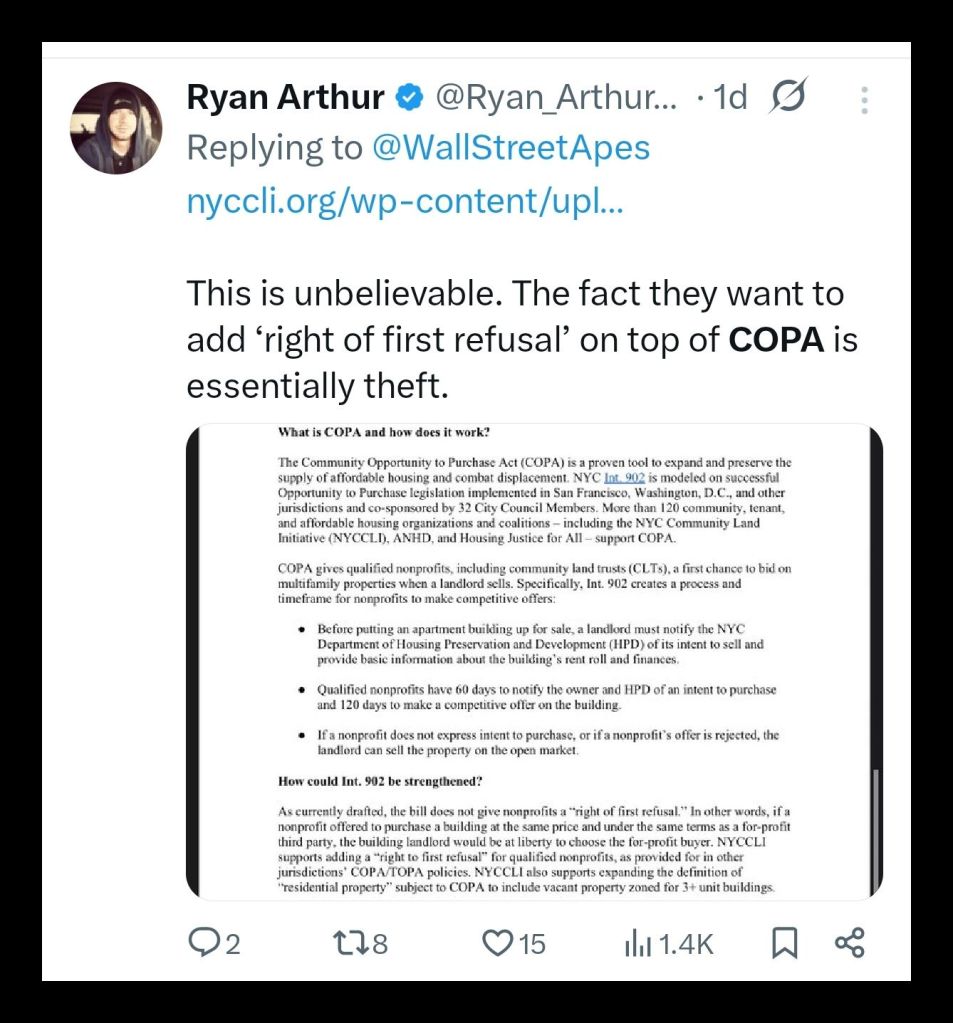
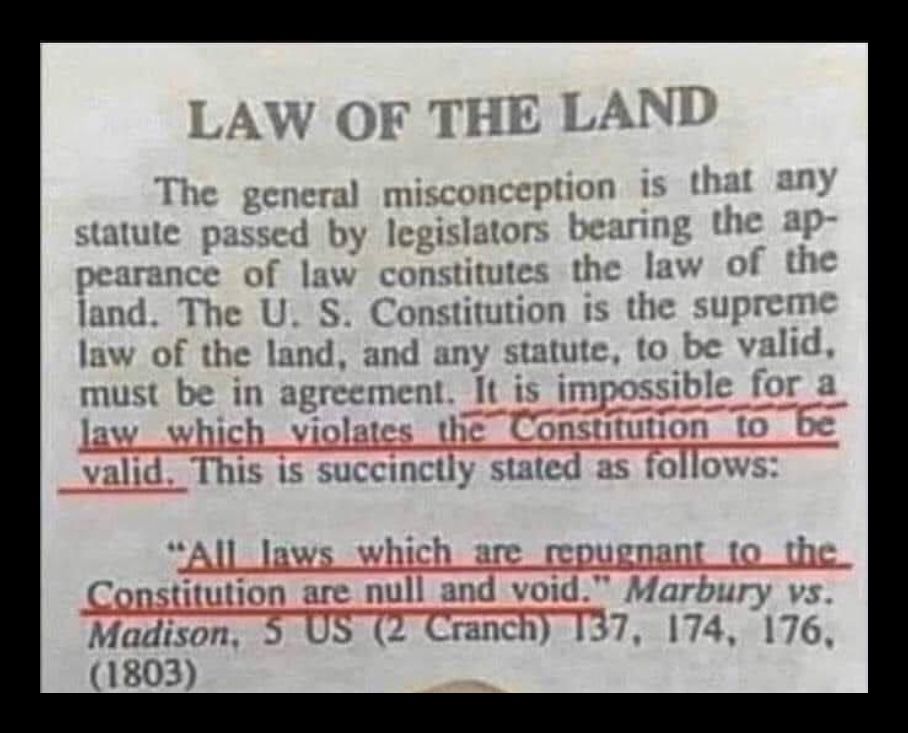
Private property rights in Anglo-American law developed as a restraint on arbitrary power. Ownership included the right to use, enjoy, and alienate property without prior permission from the state, subject to narrow and well-defined limits. Legal historians at Oxford and Cambridge, including James Penner and John Finnis, have written extensively on alienability as a core incident of ownership rather than a discretionary privilege granted by public authorities. Measures that interpose the state between seller and buyer alter that settlement in substance rather than degree. Once alienation becomes conditional on administrative approval, ownership is reduced to custodianship.
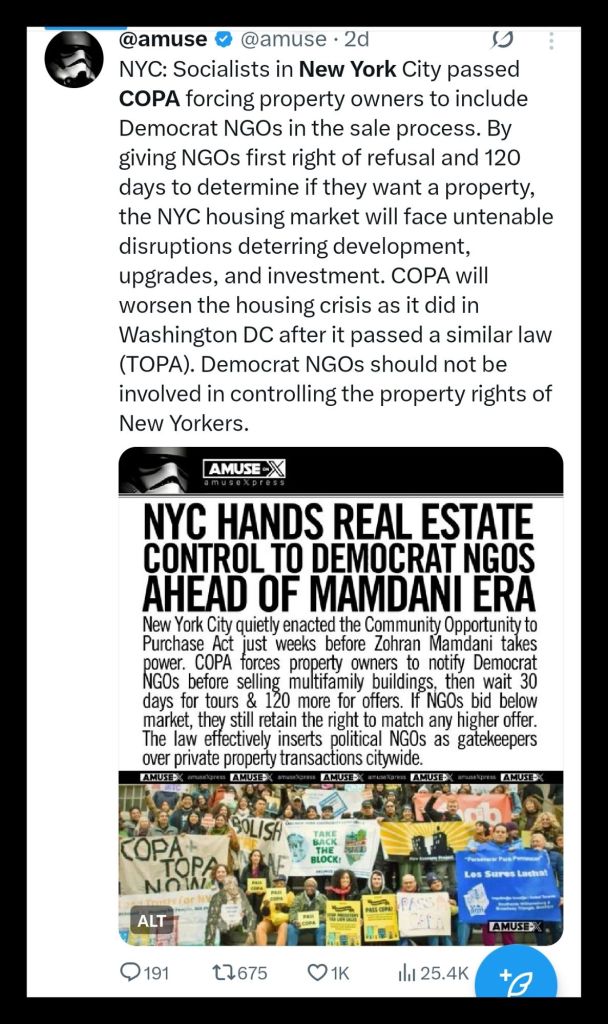
The COPA framework compels owners to submit to an extended process overseen by city housing officials, during which approved non-profits may match or pre-empt private offers. Delays of several months are built into the statute. Experience from comparable regimes shows predictable effects. Washington DC’s Tenant Opportunity to Purchase Act produced average transaction delays exceeding five months, according to analysis by the DC Policy Center, while generating minimal net additions to affordable housing stock. Legal scholars at George Mason University, including Ilya Somin, have argued that such schemes resemble regulatory takings by granting third parties enforceable interests in property without compensation.
Supporters present COPA as a protection against displacement and speculative acquisition. That framing avoids the more important question of who ultimately benefits from the forced intermediation. The amendment permitting for-profit joint ventures alongside non-profits signals that the law does not block capital concentration but rather channels it through politically sanctioned vehicles. Devaluation through delay and compliance risk advantages buyers with patient capital, legal teams, and access to public financing. Smaller owners face refinancing problems, disrupted exchanges, and exposure to code enforcement pressure during the mandated waiting period. Urban economists such as Edward Glaeser at Harvard have long noted that transaction friction in supply-constrained cities raises rents by discouraging turnover and reinvestment.
The involvement of non-governmental organisations as preferred intermediaries requires scrutiny. Over the past decade, investigative journalists and auditors have documented repeated cases of public funds flowing through complex NGO structures with limited transparency and weak accountability. Analysts such as Katherine Eban and institutions like the Government Accountability Office have highlighted structural vulnerabilities in grant-based housing programmes, including inflated administrative costs, related-party transactions, and revolving doors between regulators and recipients. The exposure of large-scale fraud in subsidised childcare and housing schemes in several US cities illustrates how mission-driven language can coexist with extraction.
Internationally, NGOs have functioned as instruments of policy delivery under United Nations frameworks such as Agenda 21 and Agenda 2030. These programmes promote partnerships between governments, civil society, and private capital to achieve sustainability and inclusion goals. Critics from across the political spectrum have argued that this model diffuses responsibility while concentrating power. Political economist Wolfgang Streeck has described the arrangement as a transition from democratic accountability to rule by committees and projects. In housing policy, this translates into permanent managerial structures rather than resolution of the underlying shortage. Authority shifts from elected bodies to semi-permanent organisations funded through public money yet insulated from electoral pressure. Oversight weakens as responsibilities fragment across agencies, contractors, and partner entities.
Agenda 2030 places housing within a framework of managed sustainability, emphasising tenure security, affordability preservation, and stakeholder governance. Academic proponents argue that markets alone fail to deliver social outcomes. Critical scholars such as Philip Mirowski and Quinn Slobodian observe that these frameworks rarely restrain financial power and often operate alongside deeper market consolidation. Rules introduced in the name of protection tend to bind small holders more tightly than large actors capable of regulatory arbitrage. The outcome becomes selective constraint rather than universal discipline.
The past decade has seen accelerated concentration of residential property ownership by institutional investors. Research by independent housing analysts and regional Federal Reserve studies shows a sharp increase in multi-family acquisitions by private equity and asset management firms in major urban markets. These entities operate through layered partnerships, special purpose vehicles, and long-term financing structures that absorb regulatory delay as a cost of doing business. Individual owners lack comparable buffers. Economist Michael Hudson has described this pattern as a shift from productive capitalism to rent extraction, where control of scarce assets replaces innovation as the primary source of return.
Legislation such as COPA does not reverse that trend. It risks reinforcing it. When selling becomes slower, more complex, and legally uncertain, weaker owners exit earlier and at reduced valuations. Well-capitalised buyers acquire discounted assets, often restructuring them into portfolios eligible for securitisation or public subsidy. The movement toward a rent-and-subscribe economy emerges through cumulative policy decisions rather than overt expropriation. Legal theorist Samuel Moyn has argued that rights burdened by procedure cease to operate as meaningful constraints on power.
The wider geopolitical context informs these developments. As global influence fragments and external resource extraction becomes more contested, advanced economies increasingly turn inward. Anthropologist David Harvey has described this as accumulation by dispossession redirected at domestic populations. Fiscal strain, ageing infrastructure, and political fragmentation create incentives to monetise and administratively manage internal assets. Housing represents the largest concentration of private wealth in the United States. Policies that subordinate ownership to administrative approval open channels for redistribution upward while presenting as protection downward.
New York’s housing crisis remains a supply crisis. Vacancy rates at historic lows reflect decades of underbuilding driven by zoning restrictions, permitting delays, and political opposition to density. Economists across ideological lines, including Joseph Gyourko and independent urban researchers, attribute rising rents to scarcity rather than turnover. COPA does not expand supply. By discouraging transactions and reinvestment, it entrenches scarcity. Preservation of a limited number of units under non-profit control cannot offset system-wide contraction.
Objections raised by elected officials focus on the core issue rather than peripheral effects. Property acquired through decades of work becomes subject to permission, delay, and ideological filtering. Neighbours face unequal treatment based on regulatory classification rather than conduct. Selected organisations receive legally enforced priority access. Political theorists from Hannah Arendt to James Burnham warned that bureaucratic expansion without accountability corrodes civic trust and concentrates power beyond public reach.
Historical comparison arises from structure rather than rhetoric. Centralised housing allocation systems subordinated ownership to administrative discretion, producing stagnation despite egalitarian claims. Modern variants replace direct state ownership with quasi-public management through favoured intermediaries. Choice narrows, incentives weaken, and maintenance declines. Experience across jurisdictions supports that conclusion.
Supporters argue that safeguards exist and abuses can be corrected through oversight. That position underestimates path dependency. Once rights of first refusal and mandatory waiting periods become normalised, expansion becomes easier than repeal. Each crisis justifies broader criteria and longer timelines. Legal challenges favour actors with resources, while uncertainty itself suppresses ordinary market participation.
The role of philanthropy and transnational governance narratives further shapes outcomes. Large foundations and international bodies promote housing models based on permanent affordability and collective stewardship. Scholars such as Linsey McGoey have shown how philanthropic influence shapes policy while avoiding democratic accountability. Alignment between municipal law and these preferences shifts ownership patterns in durable ways, reducing the scope for independent accumulation.
Erosion of ownership carries social consequences. Home equity historically provided stability, intergenerational transfer, and insulation from wage volatility. Replacing ownership with managed tenancy increases dependence on institutions. Political science research at the University of Chicago links dispersed property ownership to civic participation and pluralism. Concentration weakens those effects and narrows the base of independent economic life.
New York often functions as a policy proving ground. Measures introduced locally diffuse through advocacy networks and professional planning circles. Similar right-of-first-refusal laws already operate or are proposed in other cities. Claims of narrow application conflict with observed diffusion patterns in environmental, zoning, and labour regulation. Once embedded in planning doctrine, such tools become standard rather than exceptional.

The COPA Act reflects a convergence of ideological control, administrative expansion, and capital consolidation. Language of community and protection obscures mechanisms that privilege organised entities over individuals. Historical and contemporary evidence suggests that such arrangements fail to deliver broad affordability while weakening ownership itself. Long-term consequences include reduced investment, higher rents, and a civic order where property exists by administrative tolerance rather than right. That outcome aligns with global governance models emphasising management over liberty and process over substance. The effects will unfold unevenly yet persistently, reshaping the city’s economic and social structure over time.
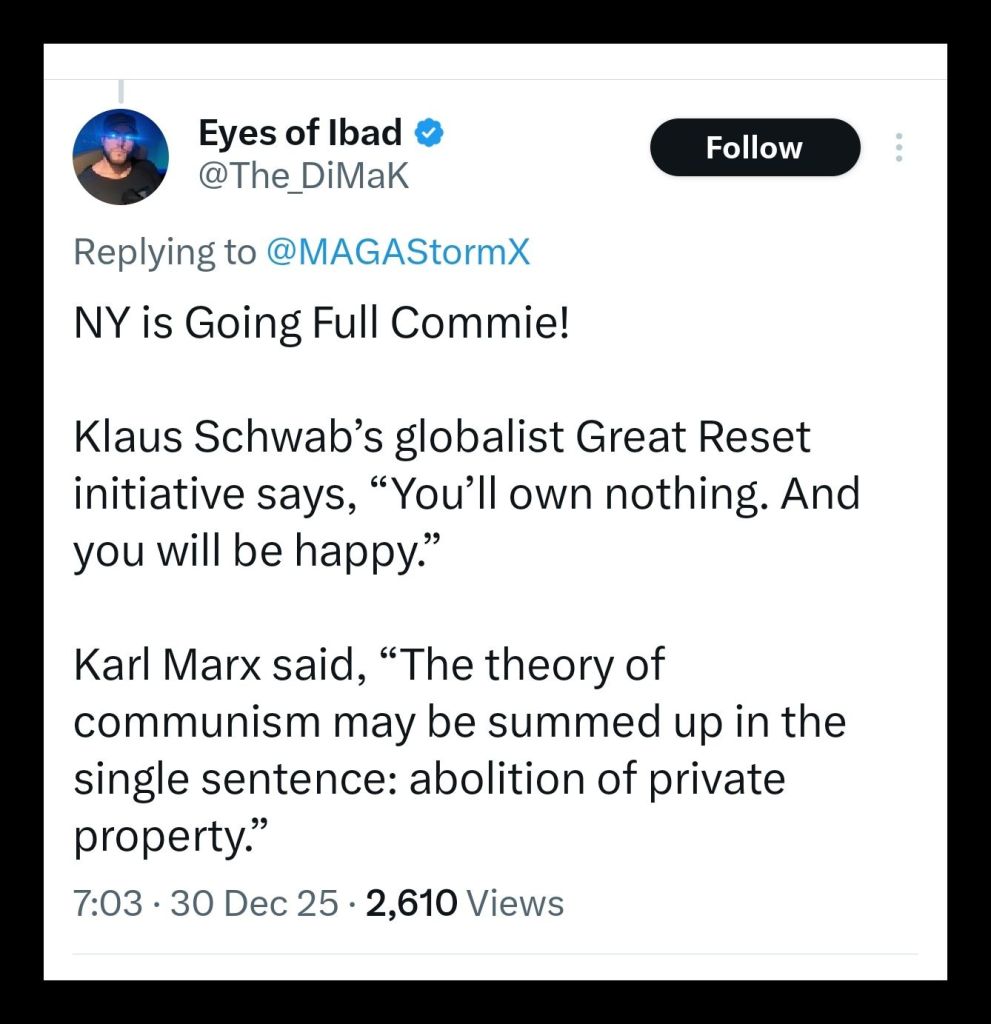
The lesson extends beyond New York and beyond housing. Administrative control over property establishes the conditions for broader enforcement through digital currency restrictions, data-driven compliance systems, and spatial regulation such as so-called fifteen-minute city models. Once ownership converts into permissioned use, enforcement shifts from law to infrastructure, operating continuously rather than episodically. The global community should treat this example as an early signal rather than an isolated anomaly. Legal precedents established quietly in one jurisdiction often reappear elsewhere with local variation but identical structure. Failure to confront this pattern now risks normalising a managed existence defined by rent, subscription, and surveillance, enforced not through overt decree but through everyday regulation presented as policy necessity.
Authored By: Global GeoPolitics
If you believe journalism should serve the public, not the powerful, and you’re in a position to help, becoming a PAID SUBSCRIBER truly makes a difference. Alternatively you can support by way of a cup of coffee:
buymeacoffee.com/ggtv


Leave a comment