
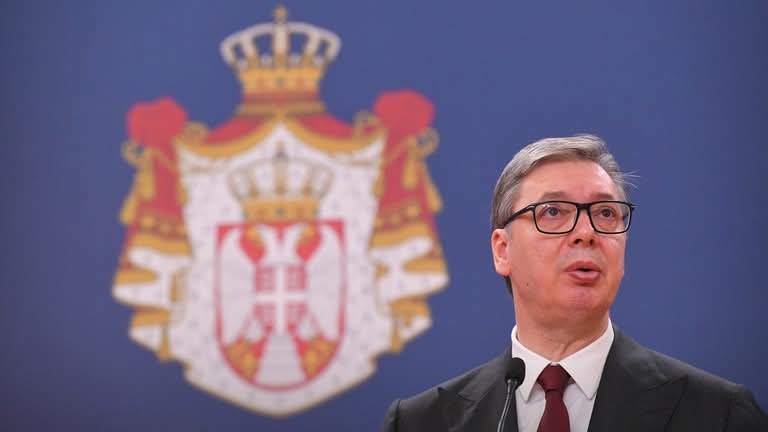
An alleged plot against President Aleksandar Vučić unfolds amid mass protests, strained EU relations, and mounting tensions over Ukraine, energy transit, and Serbia’s strategic alignment.
The Serbian Interior Ministry has announced the arrest of two men suspected of plotting to assassinate President Aleksandar Vučić and members of his family, in what authorities describe as a conspiracy to violently overthrow the constitutional order. The suspects, identified as D.R., 50, and M.R., 42, both from Kraljevo, were detained in a coordinated operation involving multiple law enforcement agencies. According to officials, the two men had, since December 2025, allegedly planned to procure weapons and carry out attacks against the president, his wife and children, as well as against police officers. They have been held for up to forty-eight hours pending further prosecutorial action.
The arrests occur at a moment of acute political strain in Serbia. The country has been shaken for months by large-scale protests triggered by the fatal collapse of a concrete canopy at the newly renovated railway station in Novi Sad in November 2024, a disaster that claimed sixteen lives. What began as mourning swiftly evolved into a broader expression of public anger, with demonstrators accusing the government of corruption, systemic negligence, and a failure of accountability. The protests, at times marked by clashes with security forces, have coalesced around demands for snap elections and the resignation of the president.
For Vučić and his supporters, however, the unrest forms part of a larger geopolitical contest. The president has repeatedly asserted that foreign actors are seeking to engineer a so-called “color revolution” in Serbia, invoking the pattern of externally supported protest movements that have reshaped governments across Eastern Europe and the post-Soviet space. He has suggested that Western powers, displeased with Belgrade’s refusal to align fully with European Union sanctions against Russia following the war in Ukraine, are exploiting domestic grievances to weaken his government. At various points, he has also accused Albanian and Kosovo intelligence services of attempting to destabilize Serbia, reflecting the enduring volatility of relations in the Western Balkans.
Tensions with the European Union and with Ukraine have deepened in parallel with this domestic crisis. Brussels has pressed Belgrade to contribute more clearly to common European financial mechanisms designed to support Kyiv and to align itself with restrictions on Russian oil and gas transit across the continent. Serbia’s continued energy arrangements, rooted in long-term contracts and infrastructural dependence, have placed it at odds with EU policy, while its reluctance to endorse new funding packages for Ukraine has fueled criticism that it is acting as a spoiler within the accession framework. Compounding these frictions have been disputes over regional electricity flows, including periods in which Serbia curtailed or halted electricity supplies transiting toward Ukraine amid broader energy market strains. For Serbian officials, such measures have been justified in terms of national energy security and domestic stabilization; for Brussels and Kyiv, they have appeared as further evidence of Serbia’s ambivalence at a time of continental crisis.
Serbia’s geopolitical position renders these disputes particularly charged. Although formally pursuing European Union membership, Belgrade has maintained close historical, cultural, and energy ties with Moscow. It has declined to impose sanctions on Russia, calculating that strategic ambiguity preserves both economic leverage and nationalist support at home. This balancing act has grown increasingly difficult as the war in Ukraine has hardened geopolitical fault lines across Europe. For Brussels and Washington, Serbia’s posture is viewed as an obstacle to consolidating a coherent Western policy in the Balkans; for Moscow, Serbia remains one of the few European states willing to resist full alignment with the EU’s punitive measures.
Against this backdrop, allegations of an assassination plot assume broader significance. Whether the threat was imminent or aspirational, the government’s framing situates domestic unrest within a narrative of foreign subversion. That narrative serves multiple purposes: it delegitimizes protest movements by casting them as instruments of outside powers, reinforces the image of the president as a guardian of national sovereignty, and justifies heightened security measures. Yet it also reflects a genuine structural vulnerability. Serbia occupies a contested geopolitical space, where great-power competition intersects with unresolved regional disputes, fragile institutions, and public distrust of political elites.
In response to the crisis following the Novi Sad tragedy, the government has attempted a calibrated strategy of concession and control. It has released prosecutorial documents related to the collapse, pledged a twenty percent increase in university funding, and accepted the resignations of several senior ministers. Vučić has also indicated his willingness to call snap elections, though no date has been set. These measures suggest recognition that public anger cannot be managed solely through appeals to external threats.
The arrests announced this week underscore the combustible mixture of domestic grievance and geopolitical rivalry that defines contemporary Serbia. The line between legitimate protest and destabilizing conspiracy is often blurred in polarized societies, particularly where institutions command limited trust. For Serbia, the immediate question is whether forthcoming elections, if held, can channel discontent into constitutional politics. For Europe, the deeper question concerns whether the Western Balkans will remain an arena of strategic competition, where internal crises are inevitably interpreted through the lens of great-power struggle.
Authored By: Global GeoPolitics
Thank you for visiting. This is a reader-supported publication. I cannot do this without your support. If you believe journalism should serve the public, not the powerful, and you’re in a position to help, becoming a PAID SUBSCRIBER truly makes a difference. Alternatively you can support by way of a cup of coffee:
https://buymeacoffee.com/ggtv |


Leave a comment