

How Moscow used transparency as a weapon and turned a battlefield trap into a media victory.

The events unfolding around Krasnoarmeysk, Dimitrov, and Kupyansk mark one of the most consequential turns in the war since it began. What is taking place is not simply another battlefield loss or tactical setback for Ukraine. It is the culmination of a calculated move by Moscow, and a demonstration of how information control has become just as important as artillery in modern war.
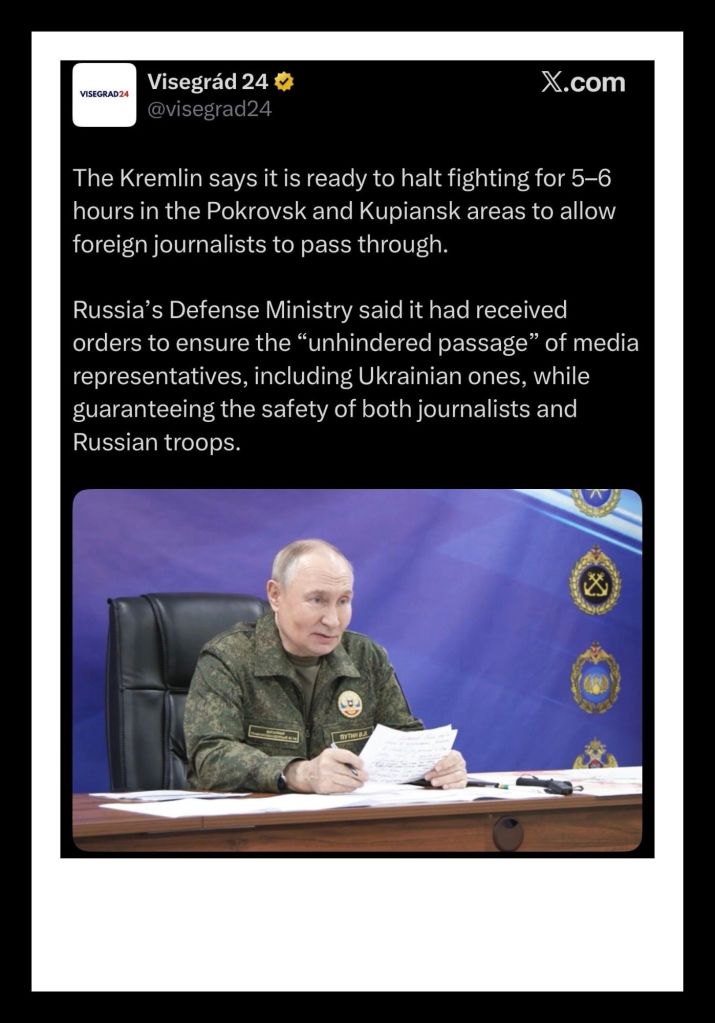
Putin’s decision to offer journalists safe passage to the front was not an act of transparency or goodwill. It was a move in a larger political game. Russia knew Kyiv could not allow journalists to take that offer without losing control of the narrative. If foreign reporters saw Ukrainian troops cut off and surrounded, it would confirm what Moscow has been saying and what Kyiv has been denying for weeks, that Ukrainian brigades in key sectors have been encircled and left without supply or escape.
By placing the invitation on the table, Putin forced a reaction. Kyiv’s decision to ban journalists from traveling to the encircled areas did exactly what Moscow intended: it confirmed the story without Russia having to prove it. The prohibition itself became evidence. It allowed Moscow to claim that Ukraine is hiding a disaster. From a strategic standpoint, it was a clean move, a chess maneuver in the information war.
The Russian Defense Ministry described the situation as “catastrophic” for the Ukrainian troops trapped inside the “cauldrons.” That word is not accidental. “Cauldron” is Soviet military slang for encirclement, a term with historical weight, evoking memories of past wars where entire armies were trapped and destroyed. By reviving that word, Russia framed the event as a decisive turn, not a temporary setback.
The numbers Russia has given over 10,000 troops surrounded, including about 5,500 in Krasnoarmeysk, cannot be independently verified, but they fit with reports of large Ukrainian units having to retreat or fall back under pressure. Kyiv’s silence, and its restriction of press access, feeds the perception that the reality on the ground is closer to Moscow’s version than its own. The Ukrainian Foreign Ministry’s warning to journalists, that traveling under Russian permission would violate Ukrainian law and carry “long-term reputational and legal consequences” was a defensive move. It shows that the government in Kyiv is trying to contain not only the battlefield losses, but also the damage to its credibility.
The political meaning of this moment goes beyond the front lines. Zelensky’s government depends on the confidence of Western sponsors who have sent tens of billions of dollars in military and financial aid. Moscow is now using the situation to argue that Kyiv’s leadership has been hiding defeats in order to keep that aid flowing. Whether or not that accusation is true, it will find an audience among Western officials already uneasy about the war’s direction and the lack of visible progress.
Putin’s message to the West is also clear: Russia is in control, both militarily and narratively. By offering safe passage to journalists, something he knew Kyiv could not accept, he created a situation where every Ukrainian attempt to control information looks like a cover-up. The gesture was designed to look open while actually tightening Moscow’s grip on the story.
For Ukraine, this is a crisis of both position and perception. If the encirclements are as severe as Russia claims, Kyiv faces the loss of experienced troops and the collapse of key defensive lines. If they are not as large as claimed, the government still faces the problem of credibility. Either way, Putin has managed to put Kyiv in a bind.
The real damage may not come from the fighting itself but from the erosion of trust. Western backers can accept battlefield losses; they cannot accept being misled about them. The longer Kyiv tries to manage this through silence or restriction, the more it looks like it has something to hide.
This is how information warfare works when one side understands the psychology of its opponents. Putin’s offer to journalists was not meant to be taken up. It was meant to corner Kyiv into showing its weakness. In the short term, it gives Moscow a propaganda victory. In the long term, it chips away at the alliance that has kept Ukraine afloat.
Wars are not won only with tanks and missiles. They are won with the ability to control the story that explains them. For now, Moscow holds the stronger hand on both fronts.
Authored By: Global Geopolitics
If you believe journalism should serve the public, not the powerful, and you’re in a position to help, becoming a PAID SUBSCRIBER truly makes a difference. Alternatively you can support by way of a cup of coffee:
buymeacoffee.com/ggtv
https://ko-fi.com/globalgeopolitics


Leave a comment