
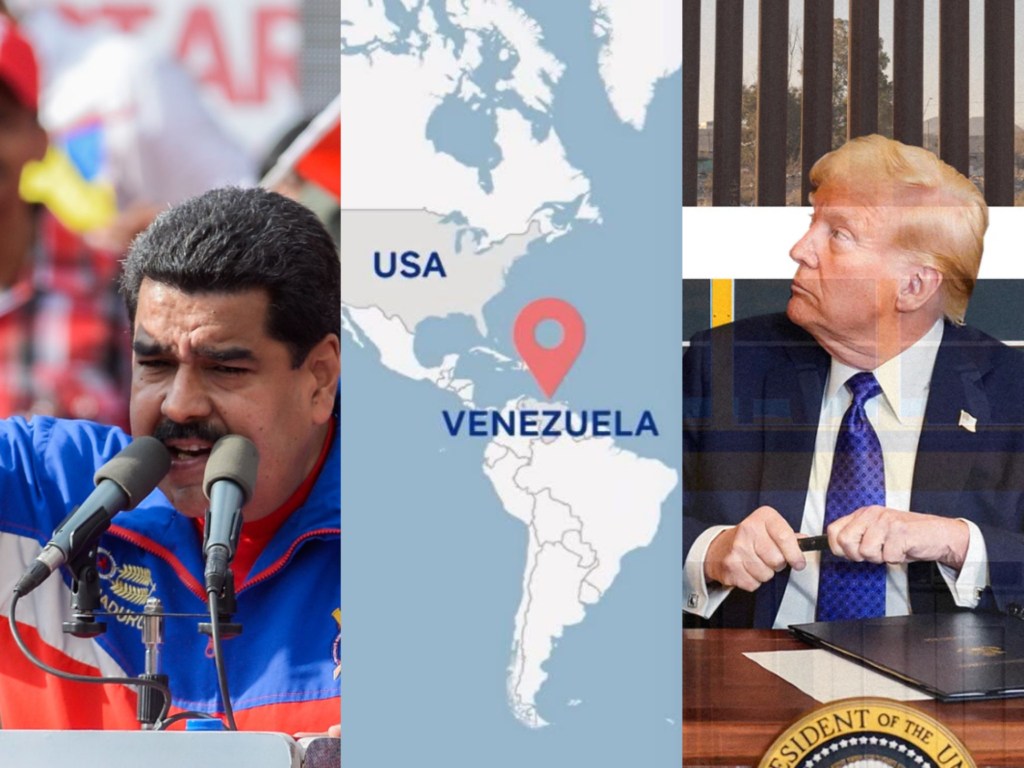
Airspace shutdown, military escalation, regional power plays and Israeli footholds tighten the ring around Venezuela
United States declaration of a complete closure of Venezuelan airspace marked the beginning of a sustained campaign of pressure and intimidation rather than a discrete law-enforcement operation. In late November 2025, the U.S. president ordered airspace above and around Venezuela to be “considered closed in its entirety,” prompting outrage from Caracas, which denounced the order as a “colonialist threat” and a gross violation of sovereignty and international aviation norms. (Reuters)(theguardian.com) That act did not stand alone. The United States has concurrently deployed a substantial military build-up throughout the Caribbean under what is labelled Operation Southern Spear, positioning one of the world’s most powerful carrier strike groups, amphibious forces, destroyers, submarines and special-operations assets within striking distance of Venezuelan coasts. Al Jazeera)(Al Jazeera)(armyrecognition.com). The idea of a “revival” of the Monroe Doctrine, which has historically emphasized U.S. dominance and influence in the Western Hemisphere, has been a topic of debate in some political circles of late in this context.
The warships include the USS Gerald R. Ford carrier strike group, supported by multiple destroyers and cruisers equipped with long-range missiles, accompanied by advanced strike aircraft, surveillance drones and special forces units. Al Jazeera)(armyrecognition.com) U.S. officials describe the posture as part of a counter-narcotics effort targeting alleged cartel networks operating through Venezuelan territory. (armyrecognition.com)(2Al Jazeera) That explanation nonetheless fails to account for the scale and character of the assets deployed, assets configured for large-scale maritime or littoral combat rather than interdiction of low-tech drug smuggling boats.
The decision to combine airspace closure, naval encirclement, cruise-missile capable warships, special-operations forces and aerial dominance signals a comprehensive coercive strategy rather than selective law enforcement. Independent analysts at Chatham House have warned that these strikes, carried out without a UN Security Council mandate or clear demonstration of an imminent armed attack, risk violating international law and eroding the norms that separate policing from warfare. (chathamhouse.org) The pattern resembles a blockade or a preparatory phase for regime change, echoing earlier episodes in Latin American history when external powers employed force to reshape political outcomes.
The recent U.S. airstrikes on suspected drug-trafficking vessels illustrate that the shift from interdiction to aggressive use of force is already underway. At least 83 people have reportedly been killed in around 21 strikes against 22 vessels since September 2025. (en.wikipedia.org)(Al Jazeera) Human rights organisations argue that such killings amount to extrajudicial executions rather than legitimate acts of war or law enforcement. (Al Jazeera) The assumption that drug trafficking constitutes an “armed attack” under international law does not withstand scrutiny, because transnational crime does not qualify as an act of war under customary norms. (Al Jazeera)
(The White House has confirmed that a second strike on a Venezuelan drug boat was fully authorized and legal, carried out under the orders of Secretary of War Pete Hegseth after two “suspects” survived the initial attack. Officials describe the action as “self-defense” in international waters.)
Venezuelan authorities have reacted with military mobilisation and calls for national defence. The government moved to deploy warships, patrol vessels, drones and shore-based air-defence systems along the coastline. (Al Jazeera) The imbalance in naval strength is stark: U.S. forces at sea and undersea vastly outnumber and outgun Venezuela’s combined naval and coastal defence capabilities, meaning any direct, symmetric confrontation would likely see Venezuelan surface and submarine forces neutralised rapidly. (armyrecognition.com) That asymmetry makes naval control and escalation management the decisive variables if conflict unfolds, but also heightens the risk that any miscalculation could trigger a broader confrontation.

The legality of U.S. actions remains deeply contested. Under the charter of the United Nations, use of force against another sovereign state is only permissible in self-defence or with explicit Security Council authorisation. (culs.org.uk) The U.S. claims its operations in the Caribbean target drug-trafficking networks and therefore constitute domestic law-enforcement efforts. (armyrecognition.com) Independent legal experts reject this rationale when lethal force is used far from U.S. territory and without arrest, trial or oversight. (Al Jazeera) Strikes on vulnerable vessels, including survivors after the first attack, raise the possibility of war crimes under international law. (Reuters)
The Issac accords of which Argentina has signed up to, like the Abraham accords in the Middle East, operate as a channel for Israeli expansion into Latin America rather than a neutral framework for regional stability, because they create openings for security, intelligence, land, and resource penetration under the cover of cooperative agreements. Israeli firms linked to the defence and technology sectors have gained access to strategic corridors in Argentina, where indigenous groups have already been displaced to facilitate investment projects tied to extractive ventures and agricultural expansion that favour foreign capital. Visa-free entry arrangements, such as the recent decision by Bolivia, deepen Israeli reach into the region’s internal politics and security structures, giving Tel Aviv a platform that aligns closely with Washington’s longstanding efforts to shape the Western hemisphere’s political direction. That alignment turns the accords into a dual instrument, because Israeli influence reinforces U.S. attempts to fragment regional solidarity, dilute bloc-level opposition to intervention, and build a network of partners willing to host intelligence, surveillance, and commercial infrastructure directed at states resisting U.S. policy. The Venezuelan crisis sits inside that architecture, because any foothold gained by Israel strengthens the broader pressure system aimed at isolating Caracas and undermining regional positions on sovereignty, resource control, and resistance to external military escalation.
Beyond the immediate tactical and legal concerns lies a broader geopolitical battle. Venezuela remains deeply tied to both Russia and China through energy, military cooperation, and infrastructure investment. Beijing and Moscow view Caracas as a strategic foothold in the Western hemisphere and are likely to interpret U.S. pressure as part of a campaign to dismantle that foothold. Russian responses have already condemned the buildup as “excessive military force” and affirmed support for Venezuelan sovereignty. (en.wikipedia.org) The implication reflect a coercive regime change in Venezuela would represent a significant defeat for Moscow and Beijing, and a victory for Washington’s attempt to reassert dominance in Latin America.

The economic dimension of the unfolding crisis relates to the global oil market and to the contest for influence over Venezuela’s natural resources. Venezuela’s substantial reserves make it a strategic target for powers seeking energy security or geopolitical leverage. Chinese involvement through loans and infrastructure investments has given Beijing a role in shaping the future of Venezuela’s resource management. United States efforts to reassert control must therefore contend not only with Venezuelan resistance but also with the interests of other major powers. Attempts to reshape control through sanctions and military pressure risk destabilising markets and provoking broader conflict with states that view such moves as encroachments on their economic interests.
The geopolitical significance of this confrontation extends into the wider context of great-power competition. The Western Hemisphere has become an arena where Washington seeks to demonstrate that it retains decisive influence despite presence and advances by Iran, China and Russia. Venezuela becomes the test case for whether United States military and economic tools can reverse strategic losses and reassert primacy. The outcome will inform calculations by states across the world regarding the reliability of external partnerships and the risks of aligning against or alongside Washington. Actions taken without international legitimacy carry reputational costs and can erode the moral and legal authority that underpins alliances and partnerships. The erosion of that authority would have reverberations beyond the region, affecting United States capacity to build coalitions in future conflicts.
The situation resonates throughout Latin America. Several regional governments have expressed concern over unilateral U.S. military action near their shores and over the prospect of destabilisation that could trigger mass migration, economic dislocation, and political backlash. Organizations advocating regional autonomy emphasise that external military interventions undermine sovereignty and violate the principles of non-intervention that have underpinned Latin American diplomacy for decades. (culs.org.uk) If the U.S. proceeds with aggression, Latin American states may find themselves at a crossroads: either acquiesce and risk regional militarisation or rally around diplomatic frameworks that defend state sovereign rights.
The likelihood of a negotiated resolution appears slim. The overwhelming imbalance of force, combined with the U.S. posture of escalation, constrains diplomatic space for dialogue. Venezuelan appeals to diplomacy or regional mediation will probably falter against a U.S. strategy defined by coercive leverage and force readiness. The political dynamic in Washington further weakens prospects for de-escalation. Internal consensus within the U.S. across administrations and parties, favors hard-line measures framed as necessary to defend homeland security, even when those measures strain international legal norms and provoke global condemnation.
Venezuela’s internal politics also play a role, because pressure from abroad can harden positions or exacerbate divisions. Attempts to coerce political change through military or economic measures often produce backlash rather than compliance. The government’s appeals to sovereignty and resistance carry resonance in a region with a long history of resisting foreign intervention. Domestic narratives emphasising independence and resilience can mobilise support even among populations critical of internal governance. If external pressure intensifies, the government may further deepen ties with Russia and China, thereby entrenching the geopolitical divide that Washington seeks to dismantle.

In aggregate, the developments point toward a trajectory of escalation and confrontation rather than peaceful resolution. What began as a claim of counter-narco operations has assumed the characteristics of coercive intervention. The closure of airspace, the massing of naval power, and the strikes on vessels establish a de facto blockade backed by force. Unless diplomatic pressure increases and legal constraints are strictly enforced, the region risks entering a period of protracted instability, militarisation, and great-power rivalry played out on Latin American soil.
Authored By: Global Geopolitics
If you believe journalism should serve the public, not the powerful, and you’re in a position to help, becoming a PAID SUBSCRIBER truly makes a difference. Alternatively you can support by way of a cup of coffee:
buymeacoffee.com/ggtv
https://ko-fi.com/globalgeopolitics


Leave a comment