
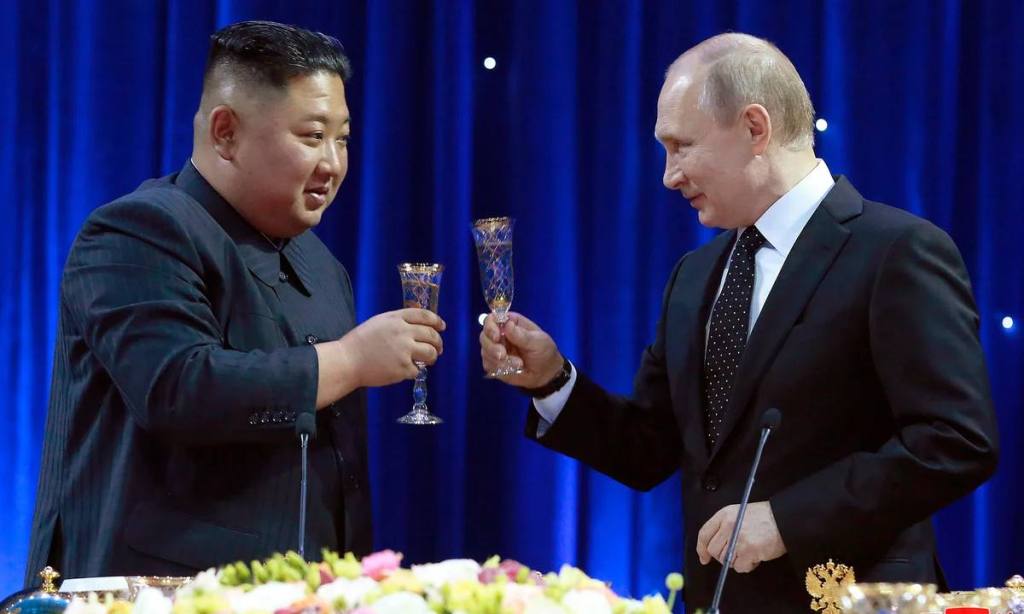
Pyongyang frames military cooperation in Ukraine as a permanent bond
North Korea’s public affirmation of a “shared blood” bond with Russia marks a significant shift in the geopolitics of the Ukraine conflict and the broader contest between great powers. In his New Year message to President Vladimir Putin, Kim Jong Un characterised the Russo‑Pyongyang relationship as a “genuine alliance” forged in combat, a phrase that underscores Pyongyang’s direct involvement in Russia’s war effort and reflects a formalisation of strategic ties that have been decades in the making. Pyongyang and Moscow signed a Treaty on Comprehensive Strategic Partnership in June 2024, reviving a defence pact that obliges each state to provide military assistance if the other is attacked and symbolises a departure from North Korea’s earlier diplomatic isolation. Wikipedia
The military component of this alignment has rapidly become concrete. North Korea has deployed a substantial contingent of troops to support Russian forces, particularly in the Kursk region, where joint operations have taken place against Ukrainian forces following Ukraine’s counter‑offensive in 2024. Independent open‑source military assessments estimate that approximately 10,000 to 15,000 North Korean personnel have entered Russian territory under the terms of the strategic partnership, engaging in combat operations alongside Russian units. Pyongyang’s decision to send troops reflects the treaty’s activation and Moscow’s acute need for manpower as the Ukrainian conflict continues to impose significant attrition on Russian formations. The Korea Times+1
Beyond troop deployment, the cooperation extends to matériel and logistics. North Korea has provided millions of artillery rounds, short‑range ballistic missiles, and other ordnance that have supplemented dwindling Russian stockpiles. These munitions have been particularly important in sustaining Russian operational tempo on the front lines, where high ammunition consumption has outpaced domestic production capacity. Russian compensation to North Korea has included political support, economic assistance, and the transfer of military technology that may enhance Pyongyang’s own defence capabilities. The Korea Times
For Russia, the relationship with North Korea serves multiple strategic ends. Moscow faces increasing isolation under Western sanctions that constrain access to arms and international finance while hindering resupply of its conventional forces. Deepened cooperation with Pyongyang provides an alternative source of manpower and weapons, reducing some immediate operational pressures on the Russian military. At the same time, the partnership augments Russia’s leverage in East Asia by demonstrating that Moscow retains the ability to cultivate reciprocal military alliances outside of formal Western‑aligned frameworks. This is consistent with Russia’s broader pivot towards non‑Western partnerships as part of its strategy to counterbalance Western containment and economic sanctions regimes. ISPI
For North Korea, the benefits are equally tangible and extend beyond battlefield dynamics. Participation in a major conventional conflict offers Pyongyang practical combat experience for its armed forces, something that decades of isolation have denied its military establishment. Analysts note that North Korean troops and engineers gain exposure to modern warfare conditions, albeit in a limited operational environment, which can inform future doctrinal development. Equally, Moscow’s provision of advanced military technology and political backing reinforces Pyongyang’s capacity to resist external pressure, particularly from the United States and its East Asian allies. East Asia Forum
The alliance also has implications for North Korea’s diplomatic posture. Historically dependent on China for economic lifelines, Pyongyang’s deepened engagement with Russia signals a diversification of patronage that may enhance its negotiating position on issues ranging from sanctions relief to nuclear diplomacy. Although China remains North Korea’s principal trading partner, the Kremlin’s willingness to underwrite military cooperation reduces Pyongyang’s singular reliance on Beijing and gives it strategic options that did not exist in the immediate post‑Cold War era. NUS-ODPRT
The entrenchment of military ties between Moscow and Pyongyang carries clear consequences for the regional security architecture in East Asia. Governments in South Korea and Japan have expressed concern that North Korea’s combat experience and access to Russian technology could embolden its posture in the Korean Peninsula, exacerbating already acute tensions and complicating diplomatic efforts towards denuclearisation. A strengthened Russo‑Pyongyang axis also influences the strategic calculations of the United States and its allies, compelling them to reconsider force posture, defence cooperation, and deterrence planning in Northeast Asia. East Asia Forum
International legal implications further complicate the picture. North Korea’s explicit military participation in a conflict widely regarded by many governments as Russia’s illegal invasion of Ukraine has drawn criticism from Western capitals, which view such engagement as a violation of the UN Charter and a threat to the established norms governing the use of force. Although Pyongyang and Moscow justify their cooperation through mutual treaty obligations, critics argue that this rationale obscures the broader consequences for international law and undermines efforts to uphold the norms that have governed interstate conflict since the mid‑twentieth century. The European Union and other multilateral institutions have publicly expressed concern over the breach of sanctions regimes and the escalation of hostilities associated with these alliances. Reddit
The emergence of this Russo‑North Korean alliance must be understood in the wider context of shifting global power dynamics. As great power competition intensifies, states on the periphery of the dominant Western security order seek alternative partnerships that offer security guarantees, economic incentives, and geopolitical leverage. The Kremlin’s readiness to formalise defence commitments with Pyongyang reflects a strategic calculation that Western adversaries can be drawn into deeper confrontation, reducing their capacity to project power elsewhere. For Pyongyang, alignment with Russia bolsters its survival strategy and positions it as an actor of consequence in a multipolar order increasingly contested by the United States and its traditional allies. orfonline.org
The material and symbolic consolidation of Russia–North Korea ties signifies more than a transactional wartime alignment. It represents a reconfiguration of alliance structures that challenges prevailing assumptions about post‑Cold War stability and highlights the fluidity of geopolitical partnerships in an era of contested global governance. As Moscow and Pyongyang continue to reinforce their cooperation, Washington, Tokyo, Seoul, and European capitals will face difficult choices in countering alliances that defy existing security architectures while preserving international norms against unrestrained use of force. dailynk.com
Authored By : Global Geopolitics
If you believe journalism should serve the public, not the powerful, and you’re in a position to help, becoming a PAID SUBSCRIBER truly makes a difference. Alternatively you can support by way of a cup of coffee:
buymeacoffee.com/ggtv
https://ko-fi.com/globalgeopolitics


Leave a comment