Venezuela as a test case for the post-1945 international framework and institutional decay
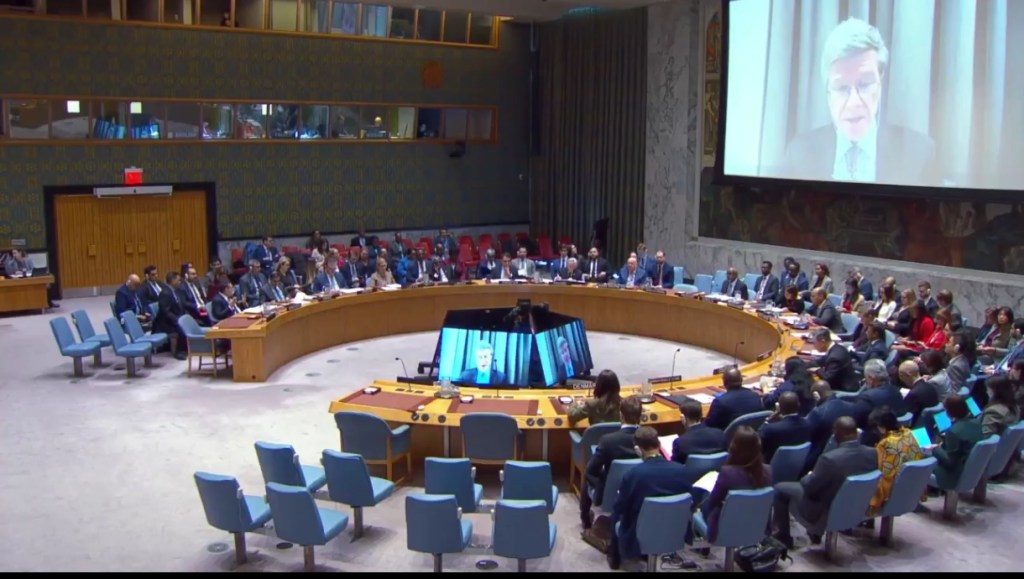
The address delivered by Jeffrey D. Sachs to the United Nations Security Council on 5 January 2026 placed before the council a narrow legal and institutional question rather than a moral judgement on Venezuela’s domestic politics. The matter concerned whether a single member state may lawfully determine the political future of another through force, coercion, or economic pressure. That framing rested squarely on Article 2(4) of the United Nations Charter, which prohibits the threat or use of force against the territorial integrity or political independence of any state. The speech treated this provision as a binding rule of international order rather than a discretionary guideline, and it argued that erosion of this rule carries systemic consequences beyond the immediate case of Venezuela.
Historical record supports the claim that United States foreign policy has repeatedly pursued regime change through overt and covert means since the mid-twentieth century. Lindsey O’Rourke’s archival study documents seventy United States regime change operations between 1947 and 1989, covering Latin America, the Middle East, Asia, and Africa (O’Rourke, 2018). These operations included coups, paramilitary support, electoral manipulation, and economic destabilisation. The end of the Cold War did not end this practice. Scholarly reviews by Bruce Cumings, William Robinson, and Vijay Prashad show continuity in method and intent, even as rhetoric shifted toward humanitarian and democratic language.
Major post-1989 cases cited in the address align with this literature. The 2003 invasion of Iraq proceeded without Security Council authorisation and was later acknowledged by senior United States officials to have rested on false intelligence. The 2011 intervention in Libya exceeded the civilian protection mandate of Resolution 1973 and resulted in state collapse, as documented by the UK House of Commons Foreign Affairs Committee. Operations in Syria from 2011 onward involved extensive covert support to armed groups, confirmed by declassified Defence Intelligence Agency documents and later admissions by United States officials. The 2009 coup in Honduras received diplomatic cover despite clear violations of constitutional order, according to reports by the Inter-American Commission on Human Rights. The 2014 change of government in Ukraine followed sustained external political involvement, a point analysed in detail by political scientists such as Richard Sakwa and Ivan Katchanovski.
Venezuela fits within this established pattern rather than standing as an exceptional case. United States knowledge of, and tacit approval for, the April 2002 coup attempt against President Hugo Chávez is confirmed by contemporaneous State Department communications and later investigative journalism by independent outlets. Subsequent funding of opposition-aligned civil society organisations during the 2010s occurred through agencies such as the National Endowment for Democracy, whose own annual reports describe these programmes. When protests escalated and the Venezuelan state responded with force, sanctions followed. These sanctions did not target individuals alone but struck core state revenue sources.
The 2015 executive order issued by President Barack Obama, declaring Venezuela an “unusual and extraordinary threat to the national security and foreign policy of the United States,” marked a decisive escalation. Legal scholars including Alfred de Zayas, former UN Independent Expert on international order, noted that the designation lacked any credible security rationale and served primarily to establish a domestic legal basis for sanctions. The economic impact of those measures intensified sharply after 2017. Sanctions on the state oil company PDVSA restricted access to finance, spare parts, and export markets. According to data compiled by economists Francisco Rodríguez and Jeffrey Weisbrot, oil production fell by roughly three quarters between 2016 and 2020, while real GDP per capita declined by more than sixty per cent over the same period. These figures align with the address and are consistent across independent economic assessments.
The humanitarian effects of these measures have been extensively documented. Reports by the Centre for Economic and Policy Research and statements by UN rapporteurs concluded that broad sectoral sanctions contributed to shortages of food, medicine, and medical equipment, increasing excess mortality. The UN General Assembly’s repeated votes condemning unilateral coercive measures reflect a shared legal interpretation that such sanctions fall outside the authority of individual states. Under the Charter, only the Security Council may impose binding economic measures, and even then subject to proportionality and humanitarian safeguards.
The unilateral recognition of Juan Guaidó as interim president in January 2019 represented a further departure from established diplomatic practice. Recognition was extended without effective control of territory or institutions, contrary to traditional criteria articulated by jurists such as Hersch Lauterpacht. The subsequent freezing of approximately seven billion dollars in Venezuelan sovereign assets and transfer of control over certain assets to opposition representatives compounded the economic pressure. These actions, taken together with earlier measures, form a continuous effort aimed at political displacement rather than negotiated settlement.
The address situated Venezuela within a broader pattern of unauthorised military activity. Over the preceding year, United States forces conducted bombing operations in Iran, Iraq, Nigeria, Somalia, Syria, Yemen, and Venezuela without Security Council authorisation and without a plausible claim of self-defence under Article 51. Independent monitoring groups such as Airwars and the Bureau of Investigative Journalism have recorded civilian harm associated with several of these campaigns. Public threats issued against multiple UN member states further strained the prohibition on the use of force. Such conduct weakens the normative restraint that has limited interstate war since 1945.
The central claim advanced held that the Security Council bears responsibility not to adjudicate the merits of Venezuela’s government but to uphold the legal order binding all states. Acceptance of unilateral force or economic strangulation as tools of political engineering would normalise practices incompatible with the Charter. Legal scholars including Martti Koskenniemi and Mary Ellen O’Connell have warned that selective enforcement of international law erodes its authority, inviting reciprocal violations by other powers. In a nuclear-armed world, erosion of restraint carries existential risk.
The six actions proposed aimed to restore legal clarity rather than impose political outcomes. Immediate cessation of threats and use of force would reaffirm Article 2(4). Termination of naval quarantine and withdrawal of forward-deployed military assets would remove coercive pressure lacking authorisation. Reaffirmation of Venezuela’s obligations under the Charter and the Universal Declaration of Human Rights preserved the principle that sovereignty does not confer immunity from legal standards. Appointment of a special envoy offered a channel for engagement grounded in law rather than force. A general call for all member states to refrain from unilateral coercive measures reinforced the universality of these rules.
The wider implication concerns the survival of the post-1945 international system. The Charter was designed to replace power politics with rule-based restraint. Allowing it to wither through repeated exception undermines smaller states’ security and accelerates fragmentation into rival blocs. Analysts such as Glenn Diesen and John Mearsheimer, though differing in normative outlook, converge on the assessment that great-power disregard for institutional limits increases systemic instability. The address argued that the council faced a choice between enforcing its founding principles or conceding their irrelevance.
Measured against historical evidence, legal scholarship, and economic data, the speech presented a coherent case grounded in documented practice rather than rhetoric. The Venezuela case illustrates how regime change strategies, whether military or economic, tend to produce prolonged instability and civilian harm while weakening international law. The question placed before the global community concerns institutional survival rather than ideological alignment. Upholding the Charter in this instance would signal that rules apply even to the most powerful members, preserving a minimum framework for peaceful coexistence.
Recommendations
Security Council members should commission an independent legal assessment of unilateral sanctions and naval blockades under the UN Charter and publish its findings. Member states should support reform mechanisms that limit veto use in cases involving clear breaches of Article 2(4). Greater transparency requirements for foreign funding of political actors would reduce covert interference. These steps would strengthen institutional credibility without endorsing any particular government.
Authored By: Global GeoPolitics
If you believe journalism should serve the public, not the powerful, and you’re in a position to help, becoming a PAID SUBSCRIBER truly makes a difference. Alternatively you can support by way of a cup of coffee:
buymeacoffee.com/ggtv


Leave a comment