
A formal expose of the existence of modern slavery through governance, economics, and managed consent.
Modern populations live as slaves without recognising their condition because systems of control evolved to operate without visible chains or masters. Slavery in classical forms relied on overt violence, physical confinement, and constant supervision, yet later systems replaced force with structure, obligation, and belief. Control persists longer and costs less when those subjected to it finance enforcement, legitimise authority, and internalise obedience as freedom. History shows that domination becomes most stable when resistance appears irrational, unnecessary, or impossible within accepted norms.
All systems of domination require enforcement, surveillance, and punishment to deter resistance and deviation. Direct coercion becomes economically unsustainable when applied continuously across large populations. Fiscal history demonstrates that taxation and compulsory labour shifted enforcement costs onto the governed population itself. Charles Tilly’s work on state formation establishes taxation as inseparable from organised violence, with populations compelled to fund institutions regulating their conduct. Police forces, prison systems, military structures, and regulatory bodies persist through public funding extracted under threat of penalty, seizure, or incarceration.
Language surrounding these arrangements reframes coercion as protection, stability, or public service. Authority presents enforcement institutions as guardians against crime, disorder, or external threats, positioning obedience as civic responsibility rather than submission. Hannah Arendt identified this process as administrative domination, where power hides behind procedure, law, and necessity rather than visible command. Resistance weakens when control appears normal, beneficial, or inevitable instead of imposed by identifiable rulers. The absence of visible masters sustains belief in freedom despite persistent compulsion.
Participatory political mechanisms strengthen this arrangement by manufacturing consent through constrained choice. Electoral systems permit populations to select representatives while excluding structural alternatives outside the permitted framework. Robert Michels demonstrated that organisational elites consolidate power regardless of democratic form, producing what he termed the iron law of oligarchy. Citizens vote periodically yet remain unable to refuse taxation, enforcement, or institutional authority regardless of electoral outcomes. Budgetary decisions funding surveillance, policing, and military power proceed irrespective of individual consent.
Economic structures deepen dependency through wage labour, debt, and continuous obligation. Systems organised around currency exchange require individuals to sell labour in order to survive, leaving little time or energy for political resistance. Karl Marx described workers as formally free yet materially compelled, writing that “they do not know it, but they are doing it” in reference to systemic reproduction of domination under capitalism. Alienation arises when labour sustains structures benefiting distant owners and administrators rather than personal autonomy. Time scarcity operates as a mechanism of control by preventing collective organisation and sustained opposition.
Consumption culture absorbs attention and emotional energy, reducing awareness of structural constraints. Sociological studies of consumer capitalism show purchasing behaviour substituting symbolic satisfaction for genuine agency. Herbert Marcuse argued that false needs bind individuals to systems exploiting them while appearing comfortable and rewarding. Satisfaction becomes conditional upon continued participation, debt, and labour, reinforcing dependency rather than freedom. Comfort replaces chains, yet confinement remains effective because escape appears unnecessary or impractical.
Philosophical traditions repeatedly identify human societies as prisons without visible walls. Plato’s Allegory of the Cave presents chained prisoners mistaking shadows for reality, unable to perceive captivity until painful awakening. “They are like ourselves,” Plato wrote, “chained so that they cannot move,” describing conditioned perception and enforced ignorance. Knowledge threatens stability because awareness exposes constraint rather than protection. Liberation requires recognising captivity before physical escape becomes conceivable.
Michel Foucault extended this insight through systematic analysis of modern disciplinary societies. Discipline and Punish documents the shift from spectacle punishment to continuous surveillance producing self-regulating subjects. The Panopticon renders individuals compliant because observation becomes internalised rather than imposed. Society transforms into what Foucault called a carceral continuum, where schools, workplaces, hospitals, and prisons share techniques of monitoring and correction. Walls become unnecessary when behaviour aligns voluntarily with imposed norms.
Franz Kafka captured lived experience within such systems through narratives of opaque bureaucracy and unreachable authority. Characters in The Trial face punishment without explanation, trapped within procedures lacking identifiable decision makers. Power operates impersonally, denying clarity, appeal, or accountability. Kafka’s work demonstrates psychological captivity created by systems obscuring responsibility while enforcing obedience relentlessly. Fear emerges not from visible violence but from administrative uncertainty.
Philip K. Dick described reality itself as an imprisoning construct sustained through deception and repetition. He referred explicitly to a “black iron prison” enclosing consciousness and maintained by false narratives. “The Empire never ended,” Dick wrote, indicating continuity of domination beneath changing appearances. His work aligns with critiques of mediated reality, where information systems shape belief while restricting awareness of alternatives. Control persists because subjects internalise imposed stories as natural or inevitable.
Game theory explains why such systems endure despite widespread dissatisfaction. Individual defection carries high personal cost while offering limited immediate benefit, discouraging resistance. Collective action problems prevent coordinated opposition when trust erodes and punishment remains credible. Rational actors choose compliance under asymmetric power even when recognising injustice, preserving stability through self-interest rather than belief. Systems exploit this equilibrium by maintaining enforcement thresholds sufficient to deter defection without provoking revolt.
Family fragmentation and social atomisation further weaken resistance by dissolving collective bonds. Strong kinship networks historically enabled mutual aid, shared resources, and coordinated defiance. Modern labour mobility, housing precarity, and cultural individualism disrupt these ties, isolating individuals within institutional frameworks. Research on social capital documents declining trust and cohesion alongside expanding administrative authority. Isolation increases reliance on state and corporate systems for survival.
Information control sustains captivity by shaping attention and framing permissible discourse. News and entertainment industries prioritise distraction, spectacle, and polarisation over structural analysis. Media theorists observe that constant stimulation reduces reflection and historical memory, limiting public capacity for sustained critique. Entertainment substitutes engagement, while algorithmic systems reward emotional reaction rather than understanding. Prison walls remain unseen because attention never rests long enough to observe boundaries.
Exit remains theoretically possible yet practically constrained by law, force, and dependency. Withdrawal from taxation, employment systems, or jurisdiction triggers punishment ranging from fines to imprisonment. Cross-border mobility remains regulated through documentation, visas, and enforcement agencies funded by those they restrict. Freedom exists conditionally within systems rather than as an inherent status. Choice operates inside the prison, not beyond it.
These mechanisms replicate historical slavery’s function while abandoning its language. Chains become contracts, overseers become administrators, plantations become workplaces, and whips become fines, audits, and incarceration. Consent arises through ritual participation rather than genuine autonomy. Control persists because subjects finance enforcement, accept narratives of protection, and remain economically dependent. The prison endures precisely because many deny its existence.
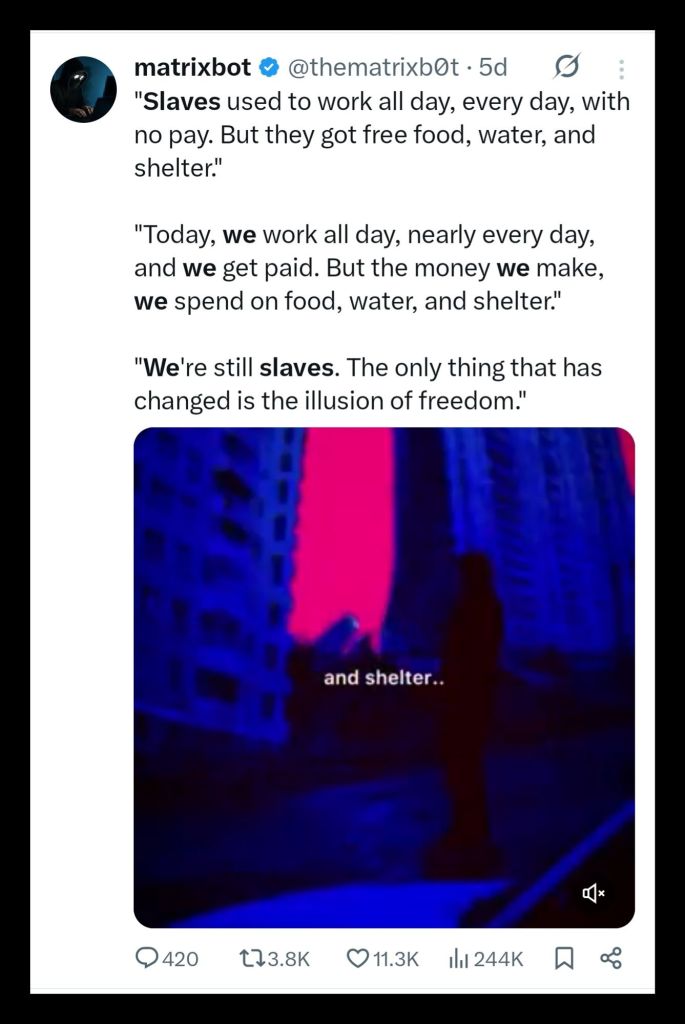
What remains after this system finishes its work resembles damage rather than mere hardship. Lives become spent, weakened, and narrowed until potential dissolves into managed survival. Those in control profit twice, first by inflicting harm, then by selling controlled relief. Illness follows contamination, cures follow illness, and payment follows every promised remedy. Dependency deepens because relief never ends the harm, it only manages symptoms indefinitely.
Psychology fractures under prolonged captivity, producing attachment to the very source of suffering.
Stockholm Syndrome explains why captives defend their captors and repeat imposed narratives sincerely.
A healthy human mind struggles to comprehend such inversion and collapses into confusion instead.
Over time orientation disappears, resistance feels dangerous, and obedience feels like safety. The illusion of living inside this maze becomes stronger than the memory of freedom.
Escape demands resources, clarity, and collective will deliberately stripped from the population. Recognition therefore becomes the final line separating quiet submission from the possibility of exit.
Authored By: Global GeoPolitics
Thank you for visiting. This is a reader-supported publication but shadow banned by the overlords. I cannot do this without your support. You can support by way of a cup of coffee:
buymeacoffee.com/ggtv or


Leave a comment