
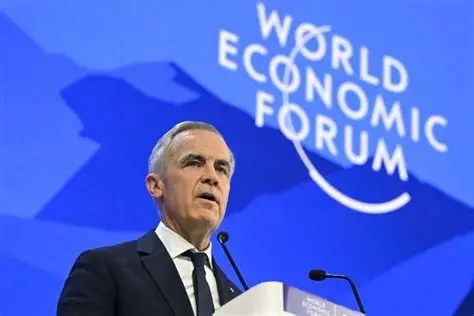
Mark Carney, Davos, and the Open Admission of Western Imperial Hypocrisy That Exposed the Conditional Morality of Western Power
The speech delivered by Canada’s Prime Minister Mark Carney at the World Economic Forum in Davos warrants close scrutiny not for its surface-level defiance, but for the structural admissions it contains regarding Western power, hierarchy, and complicity. Presented publicly as a response to geopolitical instability and American unpredictability, the address functioned more convincingly as a retrospective acknowledgement of an order whose moral justifications have collapsed under their own contradictions. In this respect, the speech resembled a valedictory statement for a system already exhausted, rather than a programme for genuine transformation.
Carney’s most consequential intervention lay in his explicit recognition that the so-called rules-based international order was never applied impartially or universally. By acknowledging that the strongest actors routinely exempted themselves, enforced trade rules asymmetrically, and applied international law selectively according to identity and power, he articulated what scholars of international political economy have documented for decades. The significance did not arise from the novelty of the observation, but from its articulation by a senior Western leader whose career benefited directly from the very arrangements he described. This admission therefore marked not an ethical awakening, but a recalibration prompted by altered national circumstances.
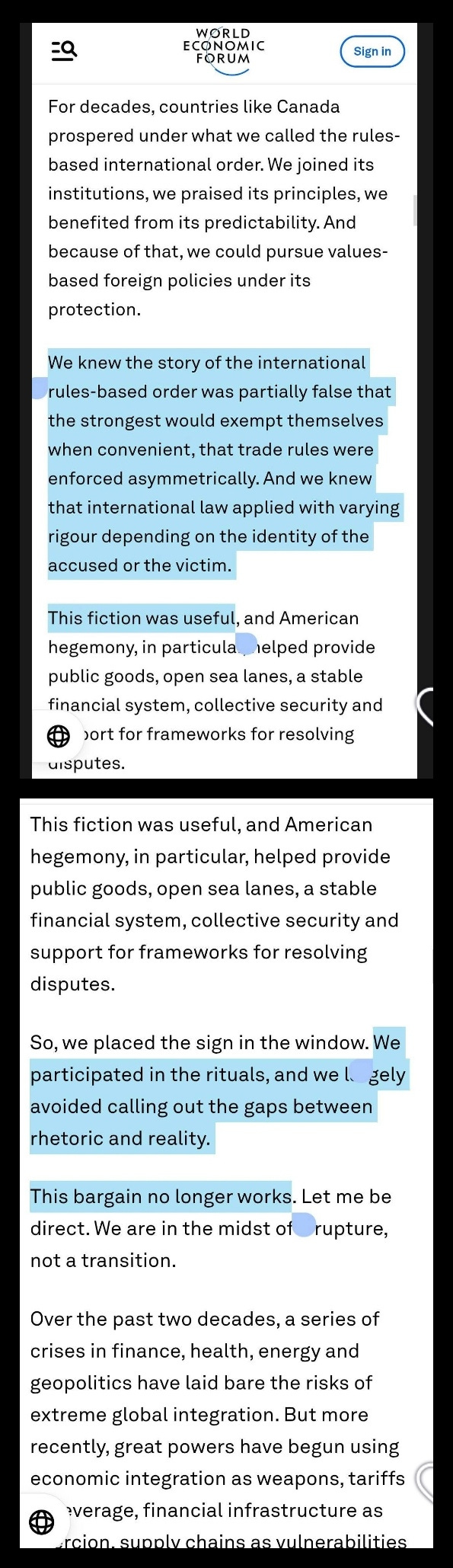
The description of the rules-based order as a “useful fiction” was particularly revealing, because it reframed decades of Western diplomacy as conscious performance rather than principled error. Participation in rituals, avoidance of contradiction, and tolerance of disparity between rhetoric and practice were acknowledged as deliberate choices. Such language implicitly confirms that Western middle powers accepted American hegemony not because it upheld universal norms, but because it delivered material and strategic advantages. The bargain endured precisely because it distributed the gains of imperial dominance across allied states, financial sectors, and political elites.
This framing undermines subsequent claims of principled resistance to unilateralism or coercion, because it establishes that commitment to sovereignty and legality was always conditional. Carney’s assertion that the bargain no longer works indicates that the crisis is not one of values, but of returns. Western middle powers appear unsettled not by injustice itself, but by their relocation from beneficiaries to exposed participants. The shift from being seated at the table to finding themselves on the menu captures this reversal with stark accuracy.
The speech therefore reads less as a defence of international law than as an obituary for a system that ceased to serve its secondary beneficiaries. When Carney speaks of rupture rather than transition, he accurately identifies a structural break, but stops short of acknowledging its causes beyond American behaviour. There was no engagement with how Canada, Europe, and allied financial institutions sustained and enforced this order across the Global South through debt regimes, trade asymmetries, sanctions, and selective intervention. Silence on these dimensions is not accidental, because their acknowledgement would require a reckoning incompatible with elite continuity.
This omission becomes particularly visible when considering Canada’s contemporary foreign policy conduct. The speech contained no reference to Canadian participation in arms transfers to Israel, despite ongoing scrutiny of Western complicity in large-scale civilian harm. The absence is analytically important, because it demonstrates the persistence of selective moral concern even as the rhetoric of fairness is invoked. A critique of asymmetric international law that excludes one of the most visible contemporary cases of such asymmetry risks reinforcing the very fiction the speech purported to abandon.
Carney’s professional background further complicates the moral posture adopted at Davos. As a former Goldman Sachs banker and senior figure within global financial governance, he directly benefited from the neoliberal economic model whose political legitimacy he now appears to bury. The declaration that neoliberal politics ended in 2026 follows naturally from the earlier death of neoliberal economics during the financial crisis of 2008, yet this chronology also highlights the prolonged effort by elites to preserve political cover long after economic failure was evident. The delay was not analytical, but distributive, as costs were externalised while benefits remained concentrated.
The address has been interpreted by some observers as a bold challenge to American dominance, particularly in light of statements about diversifying away from the United States and fundamentally shifting Canada’s strategic posture. However, scepticism remains warranted regarding the material implications of such declarations. Historical precedent suggests that rhetorical distance from Washington has rarely translated into sustained strategic autonomy among Western allies, particularly where security, finance, and technology remain deeply integrated with American systems. Whether Canada would meaningfully resist American coercion in practice remains uncertain.
This uncertainty is reinforced by the broader theatre surrounding Davos itself. The presence and prominence of figures deeply embedded within global corporate and governance networks indicate continuity rather than rupture. Invitations extended to American political leaders as keynote speakers, particularly figures presented publicly as antagonists of globalism, signal accommodation rather than exclusion. Access to the Davos platform functions as an indicator of elite inclusion, not insurgent opposition, because the forum does not elevate actors seeking its dissolution.
The notion that apparent confrontation constitutes managed spectacle gains plausibility when examining the overlap between political leadership, technology firms, defence contractors, and financial institutions represented at Davos. Relationships involving figures such as Larry Fink, Peter Thiel, Alex Karp, Tony Blair, and senior pharmaceutical and technology executives suggest that contention operates within bounded parameters. Rebranding rather than replacement appears to be the dominant mode, with narratives adjusted to accommodate shifting public sentiment while underlying power structures remain intact.
Within this context, Carney’s speech can be read as part of a broader narrative transition, rather than a substantive break. The acknowledgement of hypocrisy serves to pre-empt external critique by incorporating it into elite discourse, thereby neutralising its oppositional force. By conceding that the order was flawed, while avoiding accountability for its consequences, leadership figures retain authority over the terms of reform. This dynamic mirrors earlier moments in which systemic crises were managed through rhetorical adaptation rather than structural redistribution.
The geopolitical hypotheticals raised in response to the speech further illustrate these tensions. Speculation regarding American responses to Canadian economic engagement with China reflects established patterns in which security rationales are invoked selectively to discipline deviation. Historical cases involving Venezuela and Greenland demonstrate how the language of threat can be mobilised to justify intervention or pressure when strategic interests are perceived to be at stake. The uneven application of such logic underscores the persistence of hierarchy even as its moral justification erodes.
The most striking element of the Davos address therefore lies not in its critique of the past, but in its reluctance to articulate a genuinely different future. Acknowledging that the old bargain no longer works does not, by itself, constitute a commitment to dismantling the structures that enabled exploitation. Without explicit recognition of responsibility, redistribution, and constraint on concentrated power, the speech risks functioning as a dignified farewell to an order whose beneficiaries seek to exit gracefully.
In this sense, Carney’s intervention may be best understood as a funerary speech for neoliberal imperial governance, delivered by one of its most accomplished stewards. The tone was reflective rather than repentant, and the conclusions drawn were managerial rather than transformative. For scholars and analysts, its value lies less in the policy signals it sends than in the clarity with which it exposes elite self-awareness at the moment when legitimacy finally fails.
Authored By: Global GeoPolitics
Thank you for visiting. This is a reader-supported publication but shadow banned by the overlords. I cannot do this without your support. You can support by way of a cup of coffee:
buymeacoffee.com/ggtv or


Leave a reply to albertoportugheisyahoocouk Cancel reply