
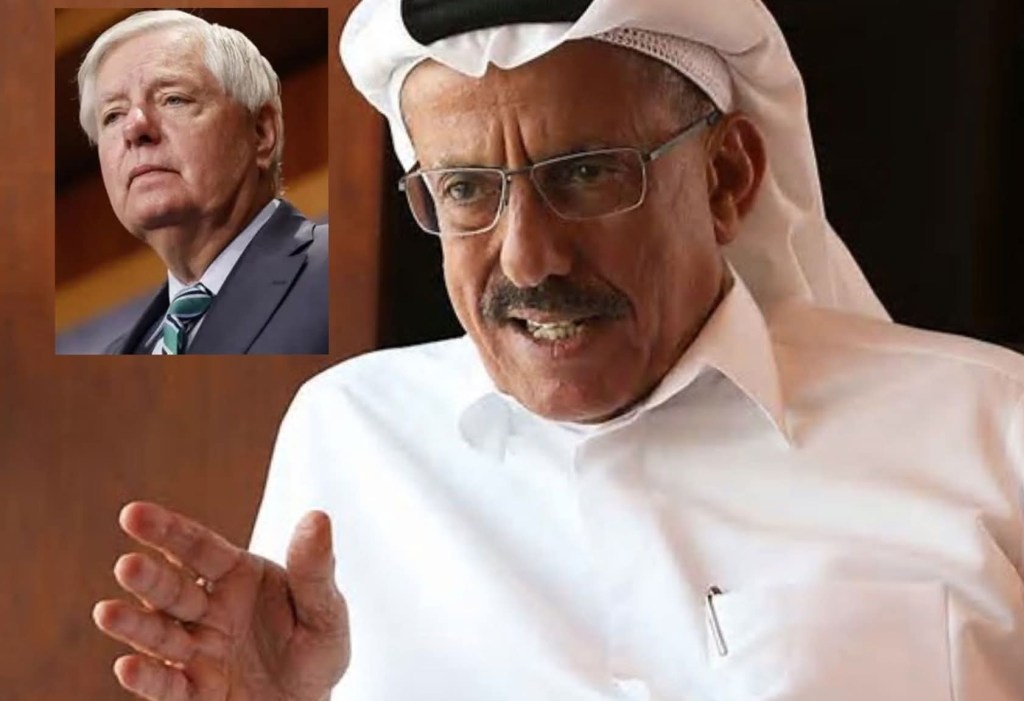
Khalaf Ahmad Al Habtoor’s blunt response to Lindsey Graham’s call for war exposed tensions in the Gulf–U.S. alliance and raised uncomfortable questions about power, interests, and who pays the price for conflict.
The exchange between U.S. Senator Lindsey Graham and Emirati businessman Khalaf Ahmad Al Habtoor unfolded like a small but revealing moment in the larger geopolitical tensions surrounding the Middle East. What began as a call for regional allies to join a widening conflict quickly turned into a public rebuke that resonated far beyond the immediate political context.
Graham had publicly urged the Gulf states to join the war effort, arguing that they too were under threat and should fight alongside the United States. His message was direct: “Hey Gulf states, you’re under attack! Join the war! Fight with us!” The appeal reflected a long-standing expectation in Washington that regional partners would align with American strategy during major confrontations.
But the response from Al Habtoor was immediate and unusually blunt. Addressing the senator’s remarks, he wrote: “I heard the statements of U.S. Senator Lindsey Graham, in which he calls on the Gulf Cooperation Council countries to enter this war, saying that we are also under attack and that we must join the fight. And I say to him clearly: We know full well why we are under attack, and we also know who dragged the entire region into this dangerous escalation without consulting those he calls his ‘allies’ in the region.” (Business Today)
The criticism did not stop there. Al Habtoor pointed directly to comments Graham had made about global energy reserves. According to the senator’s own framing, Iran and Venezuela together hold roughly 31 percent of the world’s oil reserves, a fact he suggested could become strategically advantageous if circumstances changed. For Al Habtoor, those remarks revealed the underlying motivations of the conflict. “Only then does the picture become clear. Only then do we understand why they want this war.” (Business Today)
He also pushed back against the idea that Gulf states were dependent on American protection. “We invest in our security and pay billions of dollars for these weapons. This is an industry that thrives on wars and arms sales, not a charitable endeavour.” The message was clear: arms deals between Washington and the Gulf are business transactions, not acts of generosity or guardianship.
The sharpest line came at the end of his statement, when Al Habtoor addressed Graham directly. “Senator Graham, anyone who hears your statements might think you’re a member of the Israeli Knesset- because you defend Israel’s interests more than you defend the interests of the American people themselves.” The remark landed with unusual force, particularly because it came not from a rival government but from a prominent figure within a long-standing American partner state.
More broadly, Al Habtoor framed the conflict as a power struggle between larger actors whose interests do not necessarily align with those of the region’s populations. “Iran, Israel, and the United States all move according to their own interests, not according to the interests of the peoples of the Middle Eastern Arab countries.” He concluded with a firm rejection of participation: “We will not enter this war to serve the interests of others, nor will we sacrifice our sons in a conflict that could have been avoided through diplomacy and political solutions.” (Business Today)
The episode highlighted a growing tension in the relationship between Washington and parts of the Gulf. For decades the strategic partnership rested on security guarantees, energy markets, and shared geopolitical interests. Yet moments like this suggest a shift in tone, as regional actors increasingly assert their own priorities.
Al Habtoor summarized that position in the simplest terms possible: “We will not be fuel for others’ battles.”
Authored By: Global GeoPolitics
Thank you for visiting. If you believe journalism should serve the public, not the powerful, and you’re in a position to help, becoming a PAID SUBSCRIBER truly makes a difference. Alternatively you can support by way of a cup of coffee:
https://buymeacoffee.com/ggtv |
https://ko-fi.com/globalgeopolitics |
Bitcoin: 3NiK8BoRZnkwJSHZSekuXKFizGPopkE7ns


Leave a comment