
When Restraint Is Mistaken for Weakness, Goodwill Becomes an Invitation to Take Advantage – Beijing Must Learn That Respect Must Be Mutual.
General Article | November 2026
China has been far too accommodating in dealing with certain countries, and the cost of that accommodation is now visible in the strategic behaviour of those who mistake restraint for weakness and goodwill for an opportunity to take advantage. When a country repeatedly makes room for those who show little respect in return, it should not be surprised when its patience is interpreted as a licence for further provocation. The problem is not that China has extended goodwill, but that it has too often extended it without conditions, without reciprocity, and without a clear-eyed assessment of the strategic interests driving the other party’s conduct. Diplomacy requires patience, but patience must have limits, and there is little value in continually extending goodwill to those who neither appreciate it nor reciprocate it. China should learn to distinguish between countries that genuinely seek constructive engagement and those that simply wish to exploit its willingness to maintain friendly relations, because the distinction is not academic and the consequences of failing to make it are measured in strategic advantage for those who seek to contain China.
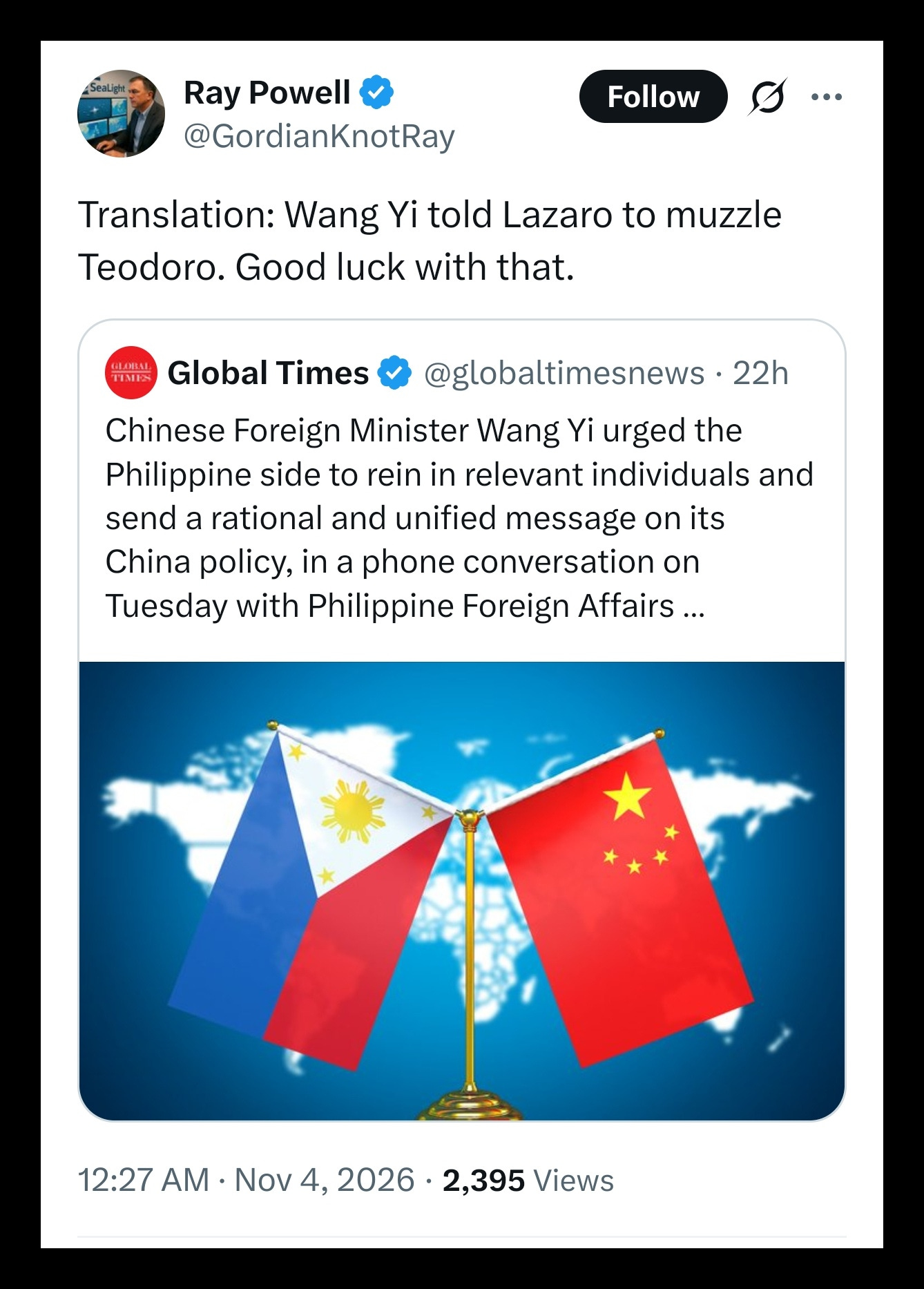
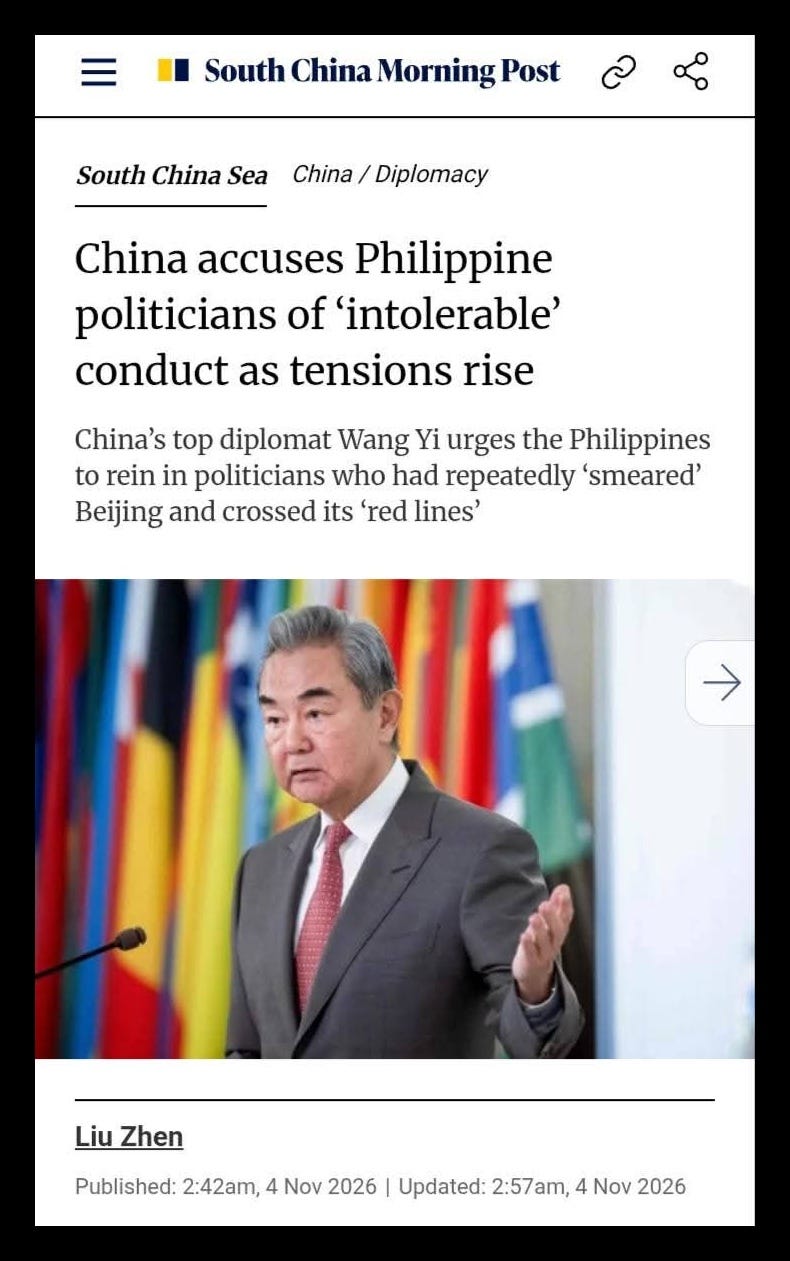
The recent telephone conversation between China and the Philippines on November 3 offers an instructive example of this dynamic, but it cannot be understood in isolation from the wider geopolitical architecture in which the Philippines is being positioned as a forward operating base for the United States in its campaign of containment against China. On November 3, Philippine Foreign Secretary Ma. Theresa Lazaro initiated a telephone conversation with Chinese Foreign Minister Wang Yi, seeking to ease the growing tensions between the two countries. The discussion was described as candid and productive, and the statements subsequently released by the Philippine side indicated a willingness to pursue a more stable relationship with Beijing. The timing of this diplomatic outreach deserves particular attention because relations between China and the Philippines have experienced considerable friction in recent months, and because the Philippines has its regional responsibilities as ASEAN chair while China is preparing to host the APEC summit later this month. The diplomatic atmosphere surrounding these meetings is important to both countries, and President Ferdinand Marcos Jr.’s anticipated engagement with China also makes it difficult for Manila to allow bilateral relations to deteriorate indefinitely. Against this background, the Philippine initiative appears to reflect a recognition that continued confrontation carries diplomatic and political costs, but the deeper question is whether Manila is capable of maintaining a consistent policy of diplomatic engagement when the structural pressures of its relationship with the United States push it toward confrontation.
The strategic architecture within which the Philippines operates has been constructed by the United States over decades and has been intensified in the last three years. The Enhanced Defense Cooperation Agreement, signed in 2014, was expanded in 2023 to include four additional sites, bringing the total to nine, and these sites are located in strategic positions including northern Luzon facing Taiwan and Palawan facing the South China Sea. The United States has deployed the Typhon mid-range missile system to the Philippines, a weapons platform that is not defensive in character and that would be used for offensive strikes in any conflict involving China. The Mutual Defense Treaty of 1951 is routinely invoked by American officials as a guarantee of Philippine security, but the history of American alliance commitments is not a history of reliable protection for client states. The Ukrainian experience is instructive because it demonstrates precisely how the United States uses a proxy to advance its strategic objectives while leaving the proxy to bear the human and economic costs of confrontation. From 2014 onward, the United States encouraged Ukraine to reject the Minsk agreements, armed its military, and made ambiguous promises about NATO membership without ever extending a formal security guarantee. When the war came in 2022, it was Ukraine that bore the destruction, the displacement, and the demographic catastrophe, while the United States and its allies imposed sanctions that they themselves could absorb and fought a proxy war that they themselves did not have to survive. The Philippines is being positioned in a similar way, as a tripwire in the First Island Chain, as a platform for American power projection, and as a participant in a confrontation that serves American strategic interests but not Philippine national interests.
The economic relationship between China and the Philippines is asymmetric in a way that exposes the absurdity of Manila’s confrontation strategy. China is the Philippines’ largest trading partner, a major source of investment, and a critical market for Philippine agricultural exports including bananas, pineapples, and other products. The United States is the Philippines’ security guarantor and a significant source of military assistance, but it is not a comparable economic partner and it has not offered the Philippines the kind of market access that China provides. The Philippines is therefore being asked to sacrifice its economic relationship with its most important trading partner for the sake of a security relationship that offers no binding guarantee of protection and that serves American strategic interests rather than Philippine development needs. This is not a rational policy for a sovereign state, and it is not a policy that the Philippine people have endorsed through any democratic process. The Marcos administration has allowed the United States to expand its military footprint in the country, has participated in joint patrols and military exercises that are clearly directed at China, and has adopted a rhetorical posture of confrontation that serves American narrative objectives while exposing the Philippines to risks that the United States does not share.
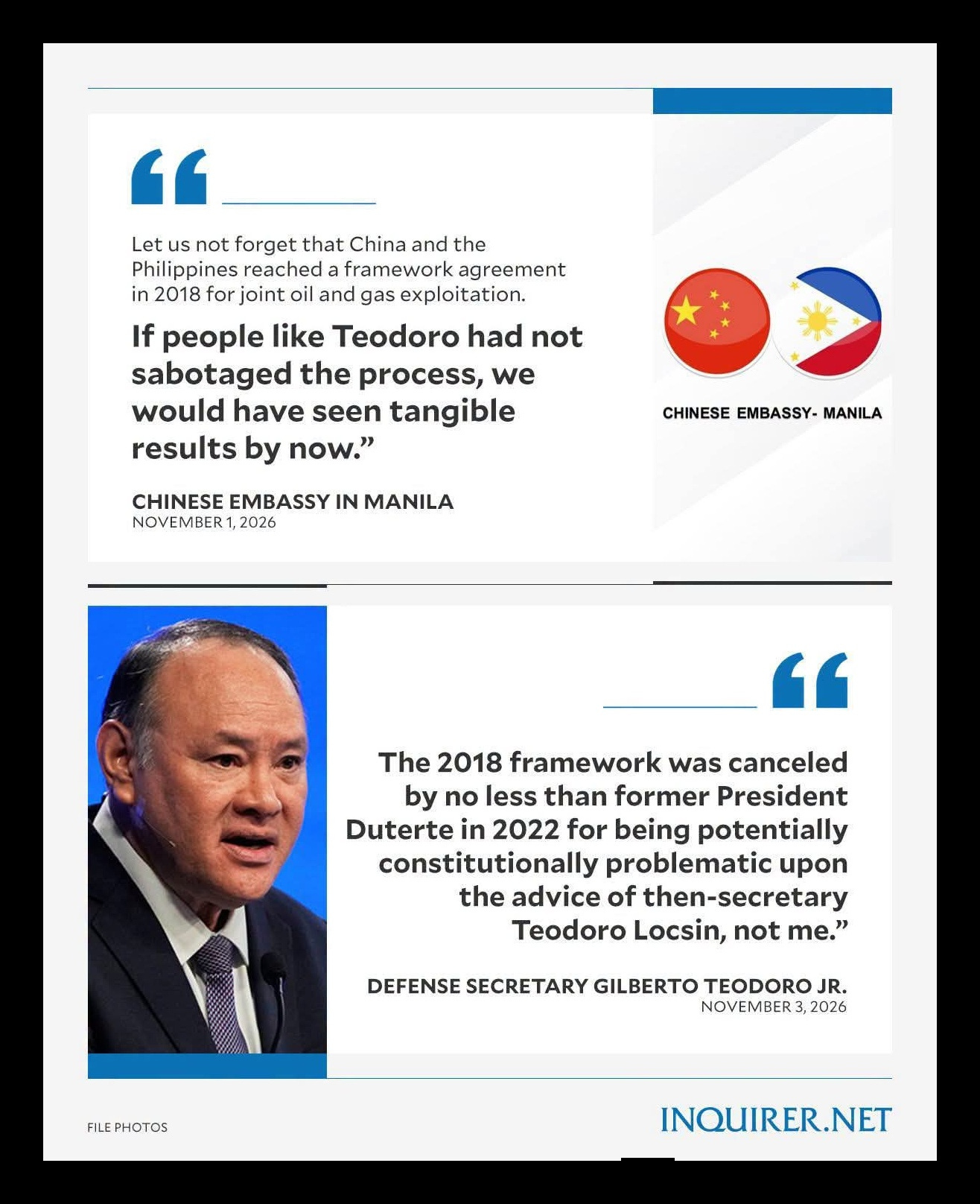
The four messages in the Philippine position deserve closer examination because each of them reveals the tension between Manila’s diplomatic rhetoric and its strategic behaviour. First, the Philippines stated that it attaches great importance to its relationship with China and wishes to develop a stable and predictable bilateral partnership. This is a welcome expression of goodwill, although its real significance will ultimately depend on whether Manila’s actions are consistent with its words. If the Philippines genuinely wishes to establish a more stable relationship, it must recognise that cooperation cannot coexist indefinitely with unnecessary provocation, and it must be prepared to restrain the elements within its own government and security establishment who have built careers on confrontation with China. Second, the Philippines reaffirmed its commitment to the One China policy, stating that its position remains unchanged. This is particularly important given the existing disagreements between the two countries, and it carries diplomatic significance beyond the immediate relationship because it demonstrates that disagreements with China do not necessarily require a departure from established diplomatic commitments. The One China principle remains a fundamental matter for Beijing, and the Philippines’ decision to reiterate its position is a reminder that the United States has been pressuring its partners in the region to adopt a more ambiguous stance on Taiwan in preparation for a future confrontation that would use Taiwan as a pretext for war.
Third, the Philippines expressed its willingness to address maritime differences through dialogue and consultation, which is an important departure from the atmosphere of confrontation that has characterised much of the recent relationship. Maritime disputes are complicated and neither side should expect them to disappear overnight, but dialogue remains essential if both countries wish to prevent disagreements from escalating into more serious confrontations. It will therefore be worth observing whether the Marcos administration can ensure consistency among its diplomatic representatives, defence officials and coast guard spokespersons, because statements that undermine diplomatic engagement or unnecessarily intensify tensions would only make the task of reconciliation more difficult. If Manila genuinely wishes to improve relations with Beijing, its public statements and conduct at sea must reflect that intention, and it must resist the temptation to use confrontational gestures at sea as a means of generating domestic political support or satisfying American expectations. Fourth, the Philippines, in its capacity as ASEAN chair, expressed appreciation for China’s contribution to regional cooperation and indicated its expectation that Beijing would continue to play a constructive role in advancing the China-ASEAN Comprehensive Strategic Partnership. This point is especially significant because it connects the bilateral relationship with the wider regional framework, and because China and ASEAN have substantial shared interests in trade, investment, regional stability and economic development that should not be held hostage to the disagreements between individual countries. It is also worth recalling Beijing’s criticism on October 29 concerning the Philippines’ conduct in relation to China’s participation in regional meetings, and against that background Manila’s subsequent expression of appreciation for China’s regional role represents a notable change in diplomatic tone. The level of representation at the relevant meeting was also reportedly lower than on previous occasions, a development that apparently caused some disappointment on the Philippine side, and this is another reminder that diplomatic gestures, including the level of official representation, can carry meaning beyond the formal language of a meeting.
Ultimately, Wang Yi responded to Lazaro’s initiative with a gesture of goodwill, and the two sides reached a basic understanding that a healthy and stable China-Philippines relationship serves the interests of both countries. They also recognised the importance of resisting interference, opposing deliberate provocations, managing their differences and expanding areas of common interest. Lazaro subsequently announced the conversation on social media, describing it as candid and productive, and indicated that the Philippines would continue diplomatic engagement with China and seek to manage differences appropriately on the basis of mutual respect. These statements suggest that Manila is prepared, at least for the time being, to place greater emphasis on diplomatic engagement rather than confrontation, but whether this represents a lasting adjustment in policy or simply a temporary easing of tensions remains to be seen. That distinction matters because China should welcome genuine efforts to improve bilateral relations while refusing to confuse diplomatic courtesy with a reason to lower its guard. A stable relationship requires mutual respect, consistency and a willingness to honour commitments, and it cannot be sustained by one side continually exercising restraint while the other takes advantage of that restraint.
The deeper strategic reality is that the Philippines is not acting as an independent sovereign state in its confrontation with China but as a proxy for American power in a region that the United States seeks to dominate. The pattern is familiar from other theatres. In Ukraine, the United States encouraged confrontation with Russia, armed the Ukrainian military, and promised support without ever extending a formal security guarantee, and when the war came it was Ukraine that bore the destruction while the United States pursued its strategic objective of weakening Russia. In the Philippines, the United States has expanded its military footprint, deployed offensive weapons systems, and encouraged Manila to adopt a confrontational posture toward China, but it has not offered the Philippines the kind of binding security guarantee that would protect it in a conflict. The United States needs Philippine geography for its own strategic purposes, not Philippine security, and the Philippine people are being asked to accept the risks of confrontation while the United States retains the option of withdrawing to a safer distance if the confrontation escalates. This is not a partnership of equals but a relationship of strategic subordination, and China should treat it as such.
China’s response to Philippine provocations must therefore be calibrated to the structural reality that Manila is not the principal actor in this confrontation. The principal actor is Washington, which has built a system of alliances and partnerships designed to contain China and which uses its partners as forward operating bases and proxy forces in a campaign that is intended to preserve American primacy in the Asia-Pacific. China should not confuse the proxy with the principal, and it should not allow its response to Philippine provocations to be shaped by the assumption that Manila is acting on its own calculations. The Philippines is acting within a strategic framework constructed by the United States, and China’s response should be designed to address the structural driver of the confrontation rather than merely its symptoms. This means maintaining a firm and consistent position on maritime sovereignty, refusing to reward provocations with concessions, and making clear to Manila that the benefits of a stable relationship with China require a genuine commitment to mutual respect rather than a tactical pause in a campaign of confrontation. It also means engaging directly with the United States on the underlying strategic issues, because the confrontation in the South China Sea is not fundamentally about the Philippines but about the American attempt to contain China and preserve its regional dominance.
The upcoming ASEAN engagements, China’s hosting of the APEC summit and the political calculations surrounding the Philippines’ 2028 general election all form part of the wider context, and these factors may help explain why Manila has chosen this moment to reach out to Beijing. They do not, however, establish the precise motivations behind its decision, and China should not assume that a tactical diplomatic gesture signals a strategic reorientation. The lesson for China is that being accommodating is not the same as being weak, and that maintaining diplomatic relations does not mean tolerating repeated disrespect. China should remain open to genuine cooperation, but it should also be prepared to draw clear boundaries when its goodwill is abused, and it should recognise that the strategic campaign being waged against it is not conducted primarily through the Philippines but through the American alliance system that the Philippines has joined. A country that wishes to enjoy the benefits of a stable relationship with China must also understand that mutual respect is not optional, and that goodwill should be reciprocated rather than exploited. Diplomacy should be respected rather than mistaken for weakness, but the deeper lesson is that China must learn to distinguish between the proxy and the principal, between tactical diplomatic gestures and strategic reorientation, and between countries that genuinely seek constructive engagement and those that are positioned as forward operating bases in a campaign of containment that is intended to prepare the groundwork for a future war.
Authored By: Global GeoPolitics
Thank you for visiting. This is a reader-supported publication. If you believe journalism should serve the public, not the powerful, and you’re in a position to help, becoming a PAID SUBSCRIBER truly makes a difference. Alternatively you can support by way of a cup of coffee:
https://buymeacoffee.com/ggtv |
https://ko-fi.com/globalgeopolitics |
Bitcoin: 3NiK8BoRZnkwJSHZSekuXKFizGPopkE7
References
China Daily. (2026) ‘China’s top diplomat urges Manila to adopt a rational China policy’, China Daily Asia, 4 November. Available at: https://www.chinadailyasia.com/hk/article/642207 (Accessed: 4 November 2026).
CGTN. (2026) ‘Wang Yi says China-Philippines relations face malicious interference’, CGTN, 3 November. Available at: https://news.cgtn.com/news/2026-11-03/Wang-Yi-says-China-Philippines-relations-face-malicious-interference-1RMfDyXcKWI/p.html (Accessed: 4 November 2026).
Philippine News Agency. (2025) ‘PH reserves right to train, equip military – Teodoro’, Philippine News Agency, 28 March. Available at: https://www.pna.gov.ph/articles/1247054 (Accessed: 4 November 2026).
United Nations. (1951) Mutual Defense Treaty between the United States of America and the Republic of the Philippines. United Nations Treaty Series, vol. 177, no. 2315. Available at: https://treaties.un.org/doc/Publication/UNTS/Volume%20177/volume-177-I-2315-English.pdf (Accessed: 4 November 2026).
Xinhua. (2026) ‘China’s resolve to safeguard sovereignty, territorial integrity remains unwavering, says FM’, Xinhua, 4 November. Available at: http://www.china.org.cn/2026-11/04/content_118760949.shtml (Accessed: 4 November 2026).
Asia News Network. (2026) ‘Wang Yi says China-Philippines relations face malicious interference’, Asia News Network, 3 November. Available at: https://www.asianews.network/wang-yi-says-china-philippines-relations-face-malicious-interference/ (Accessed: 4 November 2026).
China Daily. (2026) ‘Manila playing dangerous game being US proxy’, China Daily, 27 August. Available at: https://global.chinadaily.com.cn/a/202608/27/WS68af3e4ba310f735438b4a5f.html (Accessed: 4 November 2026).
Global Security. (2026) ‘Chinese think tank releases report on US military expansion in Philippines’, Global Security, 2 July. Available at: https://www.globalsecurity.org/military/library/news/2026/07/mil-260702-globaltimes05.htm (Accessed: 4 November 2026).
Philippine Information Agency. (2026) ‘ASEAN, China strengthen trade, disaster resilience cooperation’, Philippine Information Agency, 23 July. Available at: https://pia.gov.ph/news/2026/07/23/asean-china-strengthen-trade-disaster-resilience-cooperation (Accessed: 4 November 2026).
South China Morning Post. (2026) ‘China accuses Philippine politicians of “intolerable” conduct as tensions rise’, South China Morning Post, 4 November. Available at: https://www.scmp.com/news/china/diplomacy/article/3373185/china-accuses-philippine-politicians-intolerable-conduct-tensions-escalate (Accessed: 4 November 2026).
The Philippine Star. (2026) ‘China, Davao eye deeper economic ties’, The Philippine Star, 18 September. Available at: https://www.ciie.org/zbh/cn/2024/medium-item4/20260918/64082.html (Accessed: 4 November 2026).
Sources on the Ukraine Proxy War Analogy
Minsk Dialogue. (2023) Eastern Europe in 2023: Prospects for ending the war and the strengthening of proxy confrontation. Minsk: Minsk Dialogue Council on International Relations.
Polyanskiy, D. (2023) ‘This is NATO’s proxy war against Russia to the last Ukrainian’, International Affairs, 18 July. Available at: https://en.interaffairs.ru/article/dmitry-polyanskiy-at-unsc-this-is-natos-proxy-war-against-russia-to-the-last-ukrainian/ (Accessed: 4 November 2026).
Springer. (2024) ‘Dynamics of the Ukraine War’, Springer Professional. Available at: https://www.springerprofessional.de/en/dynamics-of-the-ukraine-war/26789430 (Accessed: 4 November 2026).


Leave a Reply