
The Making of Poland as Europe’s Front-Line Enforcement While Denying the Past

The geopolitics of Poland over the past two years reflect a convergence of strategic alignment, elite policy choices and historical memory, culminating in what appears to many observers as Poland acting as a highly committed front-line state rather than a truly autonomous actor. Under the leadership of Donald Tusk, Poland embraced a fully pro-Ukraine, pro-European Union posture that aligns closely with the broader Western strategic agenda. At the same time the legacy of the wartime massacres of Poles by Ukrainian nationalist formations, especially in the regions of Volhynia and Eastern Galicia, has resurfaced in Polish public discourse and policy, complicating Poland’s alliance with Ukraine. In effect Poland is caught between the imperatives of alliance loyalty and those of national memory.
Tusk’s government made the decision to treat Ukraine’s struggle with Russia as inseparable from Poland’s own security. In a parliamentary address the prime minister stressed that Poland’s eastern border is also the eastern border of the EU and of NATO and that Warsaw’s commitment to Ukraine is therefore direct. The Polish government committed substantial military and financial support for Ukraine, and undertook to use its EU-Council presidency to accelerate Ukraine’s accession ambitions. On the surface this aligns with Poland’s long-standing policy of orienting towards the West and strengthening its security environment.
However this alignment was accompanied by a growing disjunction between elite policy and public sentiment in Poland. Polling data show that only 35 per cent of Poles now support Ukraine’s accession to the EU (down from 85 per cent soon after the 2022 invasion) and only 37 per cent favour Ukraine joining NATO; both figures remain below 50 per cent, with 42 per cent opposed in each case. Similarly 55 per cent of respondents in one survey believe the war should end even if Ukraine must cede territory or part of its independence. These figures suggest that Polish society is suffering from fatigue over the war, its costs and the open-ended commitment that Warsaw’s government has embraced.
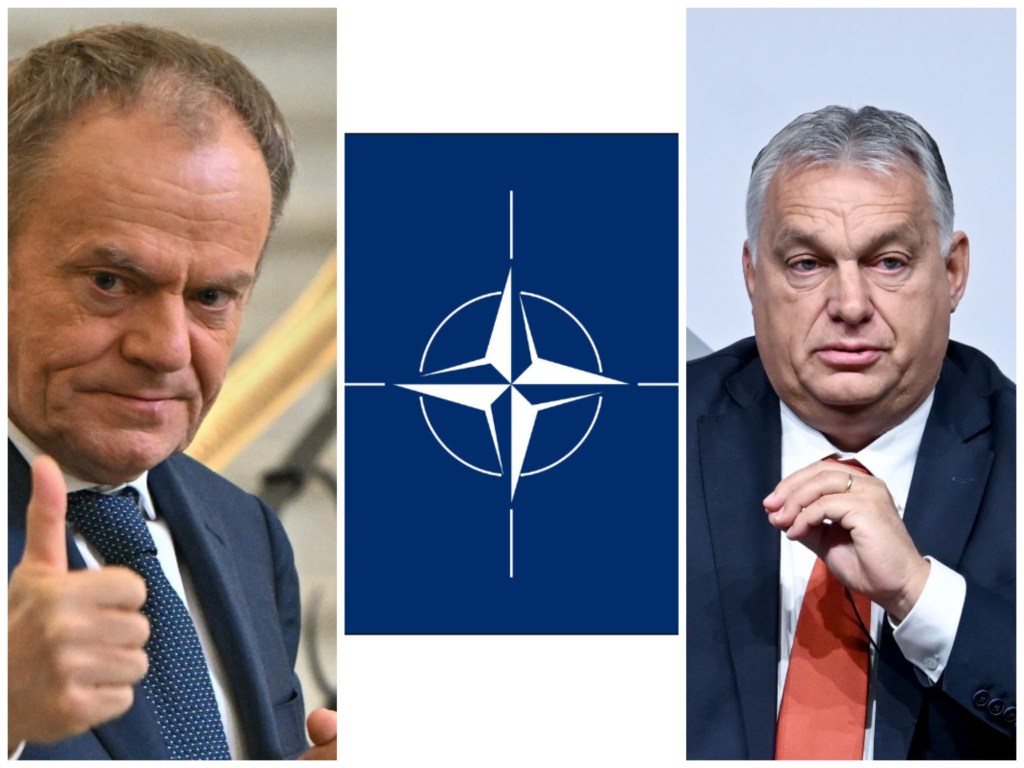
It is in that context that the Hungarian prime minister’s critique becomes significant. Viktor Orbán has repeatedly criticised Poland’s government for subordinating Polish sovereignty to Brussels and to the EU strategic agenda. In an October 2024 interview he claimed that Brussels “installed” a “puppet government” in Poland, comparing the process to Soviet-style control: “They’re going to be working on this… they need a puppet government. Let’s speak plainly, every empire is like that.” He implied that Poland under Tusk has become such a case. Further, in a radio interview he described Poland as having become “one of the loudest warmongers in Europe”, and accused Tusk of turning Poland into “a vassal of Brussels”. Orbán said that Tusk cannot deviate from that course because of his dependence on Brussels. These accusations, irrespective of one’s view on their accuracy, indicate the perception that Poland has ceded strategic autonomy.
Orbán’s viewpoint serves two functions in this analysis. First, it provides an independent critique from one national leader of Poland’s current foreign-policy posture. Secondly, it highlights the internal Central European tension between states that favour a unified, interventionist EU-NATO posture (Poland) and those that favour a more cautious, sovereignty-oriented stance (Hungary). Orbán’s remarks underscore the view that Poland is carrying the burden of a larger strategic agenda rather than purely its national interest.

The Hungarian leader mocks Poland’s “Brussels vassal” status and slams Warsaw’s war-driven politics, declaring Hungary “chooses peace.”)
Another dimension is historical memory. The wartime violence committed by the Ukrainian Insurgent Army (UPA) and the Organization of Ukrainian Nationalists (OUN) in the Volhynia and Eastern Galicia regions in 1943-44 remains deeply embedded in Polish national consciousness. Polish historians estimate tens of thousands of Poles were killed, with entire villages destroyed, and many scholars label these events as ethnic cleansing or genocide. Ukrainian historiography tends to emphasise the broader context of Soviet and Nazi tyranny, and resists the label of genocide, stressing reciprocal violence and complex wartime dynamics.
For Poland the issue is live rather than historical-only. In 2025 a poll found that 44 per cent of Poles oppose continued economic support for Ukraine and 44 per cent say Poland should reduce or stop military aid. These figures coincide with the resonance of memory politics and the perception that Polish resources and historical justice are not being sufficiently weighed. At the same time, Poland’s current strategic role means it is deeply invested in Ukraine’s success, yet the memory of wartime atrocities raises a fundamental contradiction in the Polish-Ukraine relationship.
Thus Poland finds itself in a dual role. On the one hand it is a major backer of Ukraine, aligning with Brussels, supporting the EU-NATO axis, and positioning itself as a major actor in Eastern Europe’s security architecture. On the other hand, its historical memory and domestic sentiment are pushing in a different direction, towards caution, reassessment and a focus on Polish historical interests. The risk is that Poland’s strategic posture may become increasingly brittle if it cannot reconcile these two tracks.
One consequence is the legitimacy of Poland’s foreign-policy course. When a large portion of the population questions the wisdom or sustainability of the Ukraine commitment, the government’s ability to maintain such a policy without domestic backlash weakens. In effect Poland’s foreign policy becomes less grounded in national consensus and more driven by external alignment. That invites the critique raised by Orbán: that Poland is acting as a subordinate to Brussels rather than as an independent actor.
Another consequence is bilateral risk in the Polish-Ukraine relationship. If Ukraine’s national narrative remains at odds with Poland’s historical memory, trust between the two states may erode. Kyiv may perceive Poland’s raising of the Volhynia question as a secondary or instrumental matter, while Warsaw may perceive Ukraine’s handling of memory as insufficiently respectful of Polish history. That dynamic threatens Poland’s ability to influence Ukraine and narrows its strategic margin.
Finally there is the broader geopolitical risk. Poland’s alignment with the West places it in direct confrontation with Russia’s strategic interests. At the same time the resurfacing of the Volhynia memory plays into Russian narratives of division among Europe’s eastern flank. Russia may exploit Polish–Ukrainian tensions and Poland’s domestic fatigue to weaken the unity of support for Ukraine. In that sense Poland’s dual role of front-line supporter and historical actor exposes it to strategic vulnerabilities.
Independent analysts support aspects of this view. For example the foundation behind “Notes from Poland”, an independent non-profit outlet, notes that Polish support for Ukraine’s EU and NATO accession has fallen drastically in recent years, 35 per cent versus 85 per cent in 2022. Another independent article argues that Poland’s pro-Ukraine position must be balanced with its domestic burden and historical memory. As one policy brief from the EAP Think Tanks network states, Poland faces “the unique experience of knowing both sides of such debates… current concerns about Ukraine’s accession and agricultural dominance are similar to discussions in France and Germany around Polish EU accession in the 2000s.” In short, analysts warn that alliance steadfastness must be weighed against national interest and public sentiment.
In summary, Poland’s trajectory can be described as one in which a once-peripheral state has become a principal enforcer of the Western strategic agenda in Eastern Europe, even as domestic memory politics and public fatigue signal mounting stress. Poland under Tusk supports Ukraine vigorously, aligns with Brussels and NATO, and accepts the role of a front-line actor. At the same time the legacy of wartime massacres by Ukrainian nationalist formations remains unresolved, and now influences Polish public opinion and policy. The critique voiced by Viktor Orbán captures the essence of the internal tension: Poland has perhaps traded elements of strategic autonomy for alignment and become a “vassal” of broader external objectives. Unless Poland reconciles alliance imperatives with its historical demands and domestic consensus its strategic position may become increasingly compromised.
Authored By: Global GeoPolitics
If you believe journalism should serve the public, not the powerful, and you’re in a position to help, becoming a PAID SUBSCRIBER truly makes a difference. Alternatively you can support by way of a cup of coffee:
buymeacoffee.com/ggtv


Leave a comment