

Scott Bessent’s two-year decoupling fantasy and why rare earths will drag Africa into the next great conflict
Scott Bessent announced that within one to two years the United States and its allies will stop relying on China for rare earth materials. Bessent presents his timeline with the confidence of a man certain that China can be cornered, yet his own history raises doubts about the judgement behind that promise. He previously worked as a senior figure under George Soros, whose attempts to short Asian markets during the late-1990s financial crises met decisive resistance in Hong Kong, where Beijing’s intervention defeated the strategy and preserved the currency peg. That episode shows that Bessent’s reading of Chinese resolve and state capacity has been wrong at decisive moments, and it invites the question of whether his current predictions reflect analysis or a continuing desire to prove that China can be broken. His claim of a two-year decoupling aligns more with personal conviction than with any demonstrated grasp of industrial timelines, capital requirements, environmental burdens or geopolitical consequences, and that mismatch raises a legitimate concern about whose interests his narrative serves and whether strategic policy is being shaped by financial actors who misjudge their opponent and treat revenge as foresight. The claim by Bissent provides a clear picture of where America intends to push its geopolitical machinery and what price it is prepared to impose on others. America wants to break a dependence that it created. The West abandoned the industrial chemistry that supports separation and magnet production. China built those capabilities layer by layer over thirty years. The United States now wants to reclaim control in twenty-four months.
Mining rare earths is not the difficult part. Every serious geologist recognises that the true barrier lies in purification at the highest industrial scale. The magnets that power missile fins, electric-vehicle motors and fighter-jet actuators demand levels of purity that most countries cannot produce. China gained those abilities through patient development, high-risk capital spending, and relentless training of chemical engineers. It paid the environmental and human costs that Europe and America refused to pay. It built whole towns around toxic waste processing and high precision metallurgy. It connected mines, refineries, factories, ports and energy grids into a single strategic system. That system is not vulnerable to speeches.
The United States has a mine at Mountain Pass that can produce ore. It does not yet have a fully scaled domestic refining and magnet industry. Pilot-line purity exists, but commercial throughput does not. Construction of new plants takes years of environmental approvals, machinery procurement and workforce development. The machines used to build the refineries mostly come from Chinese manufacturers. Re-creating the whole chain means rebuilding the very industrial base the United States dismantled. Political statements do not accelerate the physics and chemistry involved. Japan tried to break dependence on China in 2005. It failed. America now promises to do it faster with less experience.
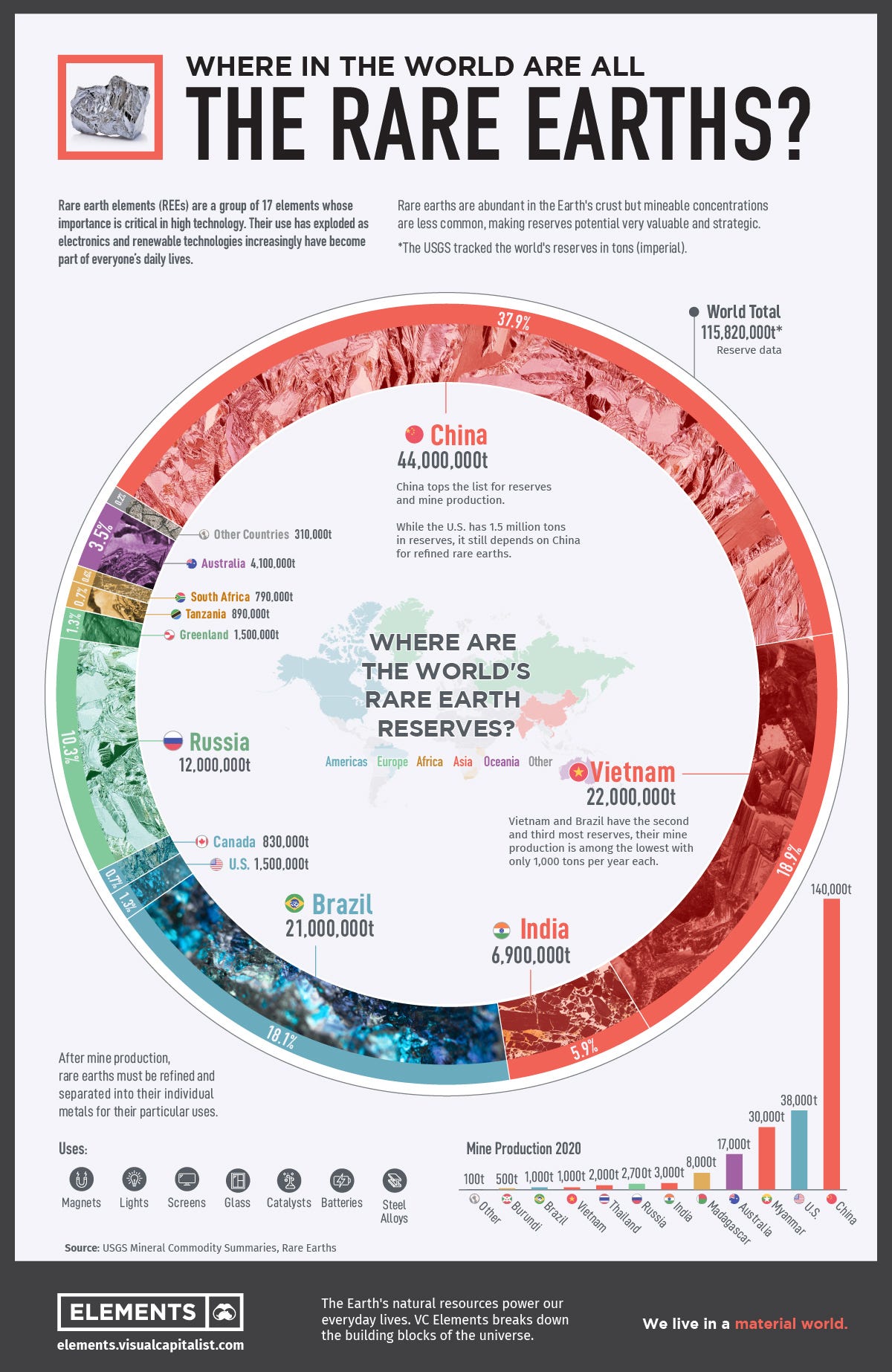
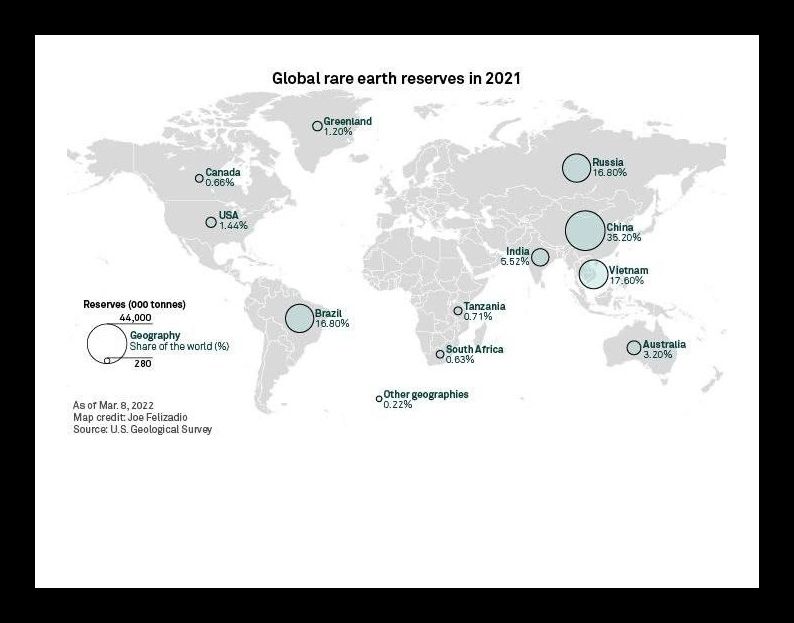
The map of reserves shows that China controls the largest share, but many others hold significant deposits. Brazil, Vietnam, Russia, India, Australia and parts of Africa contain serious material. That map drives the thinking of Western strategists. If America cannot out-process China quickly, it can try to out-source and out-secure ore before China reaches it. That becomes the heart of the current policy. America and its allies aim to hoard the input materials while they scramble to deploy the midstream capacity later. They do not need separation plants first. They need control of the rock.
That shift puts Africa at the centre of the world economy’s next conflict zone. Reserves of rare earths in Nigeria lie in Plateau and Kaduna, regions that have endured years of killings. Foreign advisers now talk of helping Nigeria develop its resource wealth. The pattern of history says that help usually means extraction on terms that favour foreign interests. Congo sits on unrivalled mineral resources and remains unstable. Sudan holds strategic deposits and has been dismembered by conflict. Tanzania contains valuable reserves in a region where politics often swings towards volatility. The same story repeats in each state: a country rich in resources becomes poor in power over them.
Western officials view unrest as an advantage. Instability lowers land prices. It weakens local negotiation. It turns security into a commodity that foreign companies can supply. Without domestic defence capability or strong state governance, governments become dependent on outside contractors to protect mining sites and transport corridors. The cheaper the ore, the faster Western mining firms can gain concessions. That is the brutal calculus. Human lives become line-items under the projections of extraction cost.
China’s interests cut the opposite way. China requires stable logistics. China needs secure rail lines, reliable port access and functioning governments in supplier nations. It built energy infrastructure, trained local technicians, financed roads and rail to ensure that materials move smoothly into integrated industrial zones inside China. It spends money to maintain stability because chaos disrupts refineries back home. The United States calculates that instability deprives China of access. China calculates that infrastructure preserves access. Those opposite incentives will shape every political conflict across Africa’s mineral belt.
If America wants ore in two years, it cannot rely on long negotiations or democratic processes. It will use sanctions, security partnerships, debt leverage, and targeted regime support. Covert influence becomes the default tool. Private military contractors become common scenery around mines. Local militias will fight for control of transport routes because whoever holds the road holds the revenue. When foreign weapons and cash arrive, local grievances turn into armed factions. The map of reserves becomes a map of future wars.
Western policymakers describe the goal as secure supply. The method reveals that the goal is denial of supply to China. America wants to push up the cost of China’s refineries by starving them of feedstock. It wants China to burn money maintaining access through chaos. It wants to force China into new conflicts far from Beijing’s priorities. The speed of Bessent’s timeline makes the strategy obvious. A two-year horizon does not allow industrial growth. It demands geopolitical seizure.
China has pricing power over the refined material. It can starve any Western factory of inputs by limiting exports. It can destroy new competitors by flooding the market temporarily. It can protect its dominance because there is no free market in a product where one player controls nearly the entire refining chain. Western firms cannot survive price wars without complete protective subsidies. Western governments hesitate to commit to long-term industrial plans. Electoral cycles cripple industrial policy. China’s one-directional commitment has no such constraint.
High-tech weapons, renewable energy, robotics, telecommunications and every advanced manufacturing chain rely on rare earth magnets. The state that controls refined product controls the battlefield of industry. China already controls the high-value stage. America now seeks to control the mine mouths. This sets up a world where China owns the brain and America owns the skeleton. Neither can win that contest peacefully.
Africa, with its puppet leaders, stands to lose the most. Western leaders speak of partnership while their defence departments write plans for coercion. Chinese leaders speak of mutual benefit while securing deals that grant decades of exclusive access. African peoples stand between a global rivalry they did not choose and resources they cannot freely defend. Displacement rises before extraction begins, because community control over land disrupts foreign plans. Water supplies become contaminated. Farming communities are pushed aside. Governments facing unrest deploy force against the very people the mines impoverish.
Energy plays a decisive role as China possesses more installed energy generation than the entire Western world combined. It uses that electricity to run refineries, foundries and smelters. The West uses growing portions of its grid for data centres that feed surveillance and social media. Heavy industry in America withered not by accident but by policy. Re-industrialising requires more than money. It requires power, land, skilled labour and political discipline over decades. The United States has not shown such commitment since the mid-twentieth century.
America’s new doctrine treats supply chains as battlefields. Ore shipments become targets. Ports become contested nodes. Railways become military objectives. Each disruption drives prices higher and pushes nations closer to choosing sides. The scramble for African rare earths will reshape alliances. Countries that side with China risk sanctions and covert actions. Countries that side with America risk internal collapse if support evaporates after elections. Neither great power guarantees stability.
Bessent’s timeline exposes the truth. The intention is not industrial self-reliance. The intention is geopolitical denial, accelerated extraction and militarised logistics. The human toll will be paid by those who sit on the minerals. Millions of Africans could be pushed into violence, hunger and displacement. Western media will justify the chaos as necessary for national security. Chinese media will present itself as the stabiliser. Neither will show the graves.
China has already conquered the skills that win the future, and can now focus on innovation. China leads in materials science, not because of ideology but because it built the foundations. America remains stuck rebuilding the factory floor while pretending that patriotic speeches can substitute for reactors and chemists.
The outcome of this struggle will define global power. If America succeeds in controlling ore supply before China can secure every corridor, it may delay China’s ascent by a few years. If China maintains its access while the West fails to scale refining, China will dominate the next century of industrial warfare. Africa’s fate lies between those ambitions. One side bets on chaos. The other bets on infrastructure. Neither bets on African lives.
A world where America and China treat minerals as strategic weapons will not know peace in the regions where those minerals lie. The next decade will be decided in the dust around mines, the choke points on railways, and the boardrooms where contracts are written in languages local villagers cannot read. Geopolitics will determine who refines the ore. Geography will determine who dies for it.
The claim of independence from China promises pride at home and tragedy abroad. The United States wants to break a dependence that powered its economy for twenty years. It plans to do it in a violent hurry. The price will be borne by those far from the benefits. Minerals will move across oceans. The suffering will stay in Africa’s soil.
Western officials will call it strategy but for Africans this is back to survival mode.
Authored By : Global Geopolitics
If you believe journalism should serve the public, not the powerful, and you’re in a position to help, becoming a PAID SUBSCRIBER truly makes a difference. Alternatively you can support by way of a cup of coffee:
buymeacoffee.com/ggtv


Leave a comment