
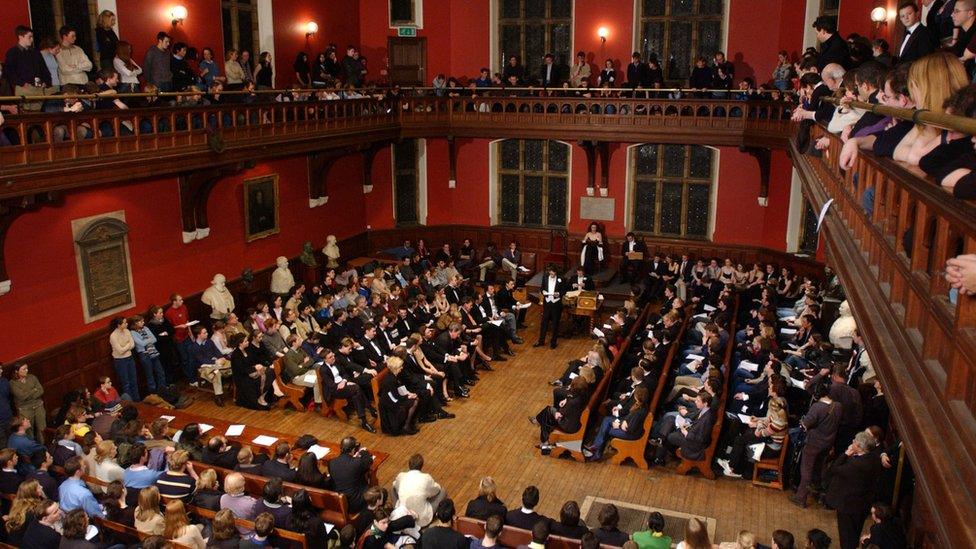
Historical evidence, not rhetoric, determined which state posed the greater risk.
Israel’s record of regional military action shaped the Oxford Union vote because students weighed available evidence against claims presented by Hillel Neuer, whose arguments leaned on broad assertions about Iranian proxies rather than demonstrable patterns of state force. Observers who study coercive power in the Middle East have noted for years that Israel conducts routine cross-border strikes with regularity unmatched by any other regional state, a pattern documented by researchers such as Dr Lorenzo Kamel of the University of Turin, whose fieldwork traced continuous Israeli operations across Lebanon, Syria, Gaza and the West Bank over more than a decade (Kamel 2021). Students hearing both speakers could recognise that historical continuity carries more analytical weight than Neuer’s focus on hypothetical intentions attributed to Tehran.
Mohammad Shtayyeh argued that Israel behaves as an expansionist colonial power backed by Western sponsors, and his description mirrors established scholarly work from historians such as Professor Avi Shlaim, who demonstrated through archival work how Israeli policy consistently relied on territorial absorption, demographic engineering and military dominance (Shlaim 2014). Shtayyeh’s emphasis on Israel acting above the law matched evidence presented by independent jurists such as John Dugard, former UN Special Rapporteur, who detailed systematic Israeli violations of occupation law across multiple reports supported by first-hand inquiry (Dugard 2013). Students could therefore observe that Shtayyeh presented a body of corroborated material grounded in decades of documentation, while Neuer relied heavily on political framing and guilt-by-association arguments that lacked comparable evidentiary rigour.
Neuer’s core claim rested on the idea that Iran exports revolutionary violence across the Middle East through armed groups, yet independent analysts such as Dr Roxane Farmanfarmaian at Cambridge have argued that most of these groups operate on domestic political calculations shaped primarily by internal grievances and local power balances rather than remote Iranian command (Farmanfarmaian 2020). Hezbollah’s integration within Lebanese state institutions, the Houthis’ long history of conflict with Yemeni elites, and Iraqi militias’ deep roots in the aftermath of the 2003 invasion all weaken Neuer’s argument because each case demonstrates autonomous actors responding to local pressures rather than functioning as Iranian expeditionary forces. Students hearing the debate could recognise that Neuer attributed near-total agency to Tehran despite sustained scholarly evidence indicating far more decentralised dynamics.
Shtayyeh’s focus on direct state violence rather than proxy dynamics anchored the discussion in measurable facts. Analysts such as Professor Virginia Tilley, whose demographic and legal studies on the occupied territories are widely cited in academic circles, noted that Israeli military power produces structural instability because occupation, settlement expansion and land confiscation generate continuous friction with neighbouring states (Tilley 2017). Shtayyeh’s argument that Israel destabilises the region through permanent occupation resonated with this literature, which details how Israeli policy shapes displacement flows, resource contests and political volatility from southern Lebanon to the Jordan Valley. Students assessing both cases could therefore observe that Shtayyeh drew from extensive empirical documentation regarding state conduct, while Neuer relied largely on interpreting motivations rather than measurable actions.
Neuer attempted to frame Iran as a global sponsor of terrorism by citing plots against dissidents abroad, yet researchers at institutes such as the Carnegie Endowment and Chatham House have cautioned repeatedly that such covert operations, though serious, remain limited in geographic scale and do not resemble Israel’s overt, ongoing, cross-border military campaigns. Independent security scholar Trita Parsi has shown through interviews with Western and Middle Eastern officials that Israeli covert activity, including assassinations of Iranian scientists and targeted strikes in Syria, often exceeds Iranian foreign operations in frequency and lethality (Parsi 2019). Students hearing both perspectives could therefore weigh Neuer’s claims against independent findings showing Israeli reach surpassing Iranian activity in both scope and visibility.
Shtayyeh’s point about nuclear asymmetry gained traction because independent analysts have long warned that Israel’s undeclared nuclear arsenal introduces unique destabilising dynamics. Scholars such as Avner Cohen, who authored landmark studies on Israel’s nuclear programme based on declassified materials and insider testimony, argued that opacity surrounding the arsenal reduces external oversight and increases the risk of miscalculation (Cohen 2010). Students could recognise that a nuclear state operating outside international inspection regimes presents a greater systemic danger than a non-nuclear state subject to continual monitoring by the International Atomic Energy Agency. Neuer failed to address this imbalance with factual precision, leaving a gap between his narrative and widely acknowledged realities within nuclear security scholarship.
Neuer argued that Iran created failed states through support for insurgent groups, yet independent field researchers such as Dr Isa Blumi, whose extensive work in Yemen documented the collapse of state structures following foreign intervention, found that external military campaigns by Saudi Arabia and the United Arab Emirates, supported by US and UK weapons systems, played far larger roles in the fragmentation of Yemen (Blumi 2018). Students well-versed in international relations could therefore recognise that Neuer’s attribution of societal collapse to Iran alone contradicted a strong evidence base demonstrating multi-state responsibility and substantial Western involvement. Shtayyeh’s framing of Israeli actions as primary destabilising forces aligned more closely with documented patterns of unilateral strikes, territorial seizures and settlement growth rather than speculative narratives of proxy manipulation.
Shtayyeh reminded the audience that Palestinians experienced decades of displacement, military rule and restrictions enforced by a state that repeatedly ignored UN resolutions, a fact recorded extensively by independent organisations such as Al-Haq and B’Tselem, whose field researchers compile detailed incident reports based on direct testimonies and geospatial evidence. Their documentation showed consistent patterns of home demolitions, land seizures and lethal force against civilians across the occupied territories (B’Tselem 2022). Students could therefore understand that Shtayyeh’s argument rested on verifiable realities lived daily by millions under occupation. Neuer’s responses relied more on deflection than substantive evidence challenging those findings.
Neuer placed significant weight on the claim that Iranian influence destabilised Gaza, yet independent historians such as Professor Rashid Khalidi have shown that the core drivers of conflict in Gaza stem from blockade, repeated military operations and the political fragmentation produced by external pressures rather than Iranian direction (Khalidi 2020). Students evaluating both positions could note that these conclusions arise from decades of archival research and interviews across Palestinian society, offering a deeper empirical base than Neuer’s political characterisations. Shtayyeh’s portrayal of Gaza’s humanitarian collapse therefore aligned with long-standing academic consensus grounded in material conditions rather than ideological narratives.
Neuer framed Israel as a defensive actor responding to existential threats, yet independent Israeli historians such as Ilan Pappé argued that Israeli military doctrine relies heavily on pre-emptive force, territorial creation of “facts on the ground”, and systematic pressure on neighbouring states (Pappé 2016). Students familiar with these works could see that Neuer offered a securitised narrative detached from documented policy patterns. Shtayyeh’s description of Israel acting without external constraint matched the findings of numerous scholars who argued that repeated Western diplomatic protection insulated Israel from accountability mechanisms that apply to other states. Students therefore had reason to view Shtayyeh’s claims as more grounded in historical continuity.
Neuer blamed Iran for destabilising Syria through support for Damascus, yet analysts such as Professor Joshua Landis have shown that the Syrian conflict emerged from domestic unrest, international proxy competition, and large-scale foreign intervention, with Israeli airstrikes occurring throughout the war against targets across Syrian territory (Landis 2021). Students could weigh Neuer’s selective interpretation against a fuller record showing Israel conducting hundreds of strikes inside Syria over several years, shaping regional escalation patterns. Shtayyeh argued that Israel’s military actions expand conflicts beyond immediate borders, and this claim aligned with long-term conflict research examining spillover effects generated by aerial bombardment and territorial encroachment.

Neuer suggested that Iranian activity in Lebanon created continuous instability, yet scholars such as Amal Saad documented the evolution of Hezbollah as a hybrid political-military actor shaped primarily by domestic Lebanese power structures and regional deterrence dynamics rather than by Iranian command (Saad 2021). Students following the debate could recognise that Neuer presented a simplified chain of causation not supported by independent research. Shtayyeh’s focus on Israeli incursions, border violations and land appropriation provided a more direct link to actual state-driven escalation mechanisms observable in available reporting and satellite imagery.
Shtayyeh’s argument gained further weight because independent conflict researchers such as Dr Elizabeth Tsurkov have documented how Israeli bombardment patterns in Syria and Lebanon frequently trigger retaliatory exchanges that strain diplomatic channels and risk broader escalation (Tsurkov 2022). These studies show how routine operations by a conventionally superior state generate predictable cycles of reaction, which supports Shtayyeh’s contention that Israel acts while others respond. Neuer offered no substantial rebuttal grounded in comparable data.
Students observing both speakers could conclude that Neuer relied heavily on narrative framing centred on Iranian ideology, while Shtayyeh grounded his case in observable behaviour, documented military operations and long-established scholarly work on occupation and regional power projection. Independent analysts across multiple disciplines have identified Israeli military activity, nuclear opacity and territorial expansion as structurally destabilising forces with long historical roots. Neuer’s failure to address these elements with factual precision weakened his argument because he did not meet the evidentiary standard required in a setting where participants value rigorous reasoning.

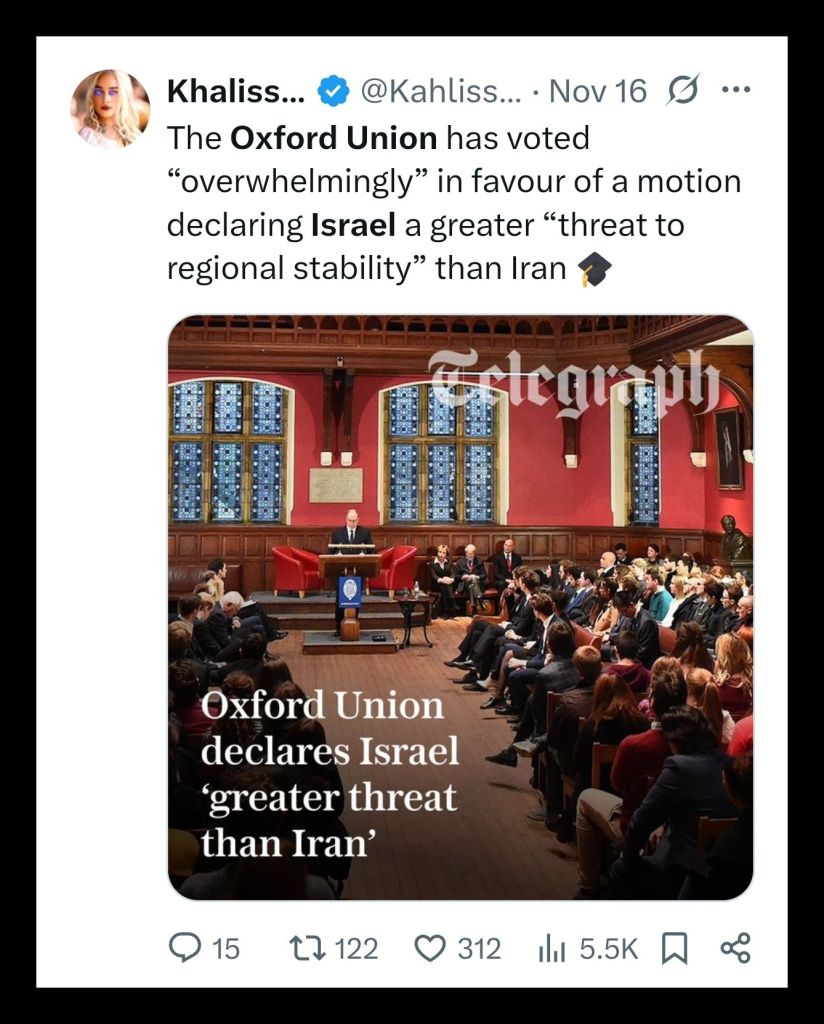
The Oxford Union voted that “Israel is a greater threat to regional stability than Iran” by an overwhelming majority of 265 to 113. Last year, the Union also voted that “Israel is an apartheid state responsible for genocide” by an overwhelming majority of 278 to 59. The vote therefore reflected a clear assessment rather than ideological bias. Students weighed extensive records of Israeli cross-border action, nuclear policy, occupation practices and expansionist strategies against Neuer’s broad claims regarding Iran and concluded that Israel poses the greater regional danger. Their decision aligned with decades of independent research across history, security studies and international law, forming a judgement grounded in evidence rather than sentiment or political pressure.
Authored By: Global Geopolitics
If you believe journalism should serve the public, not the powerful, and you’re in a position to help, becoming a PAID SUBSCRIBER truly makes a difference. Alternatively you can support by way of a cup of coffee:
buymeacoffee.com/ggtv
https://ko-fi.com/globalgeopolitics


Leave a comment