
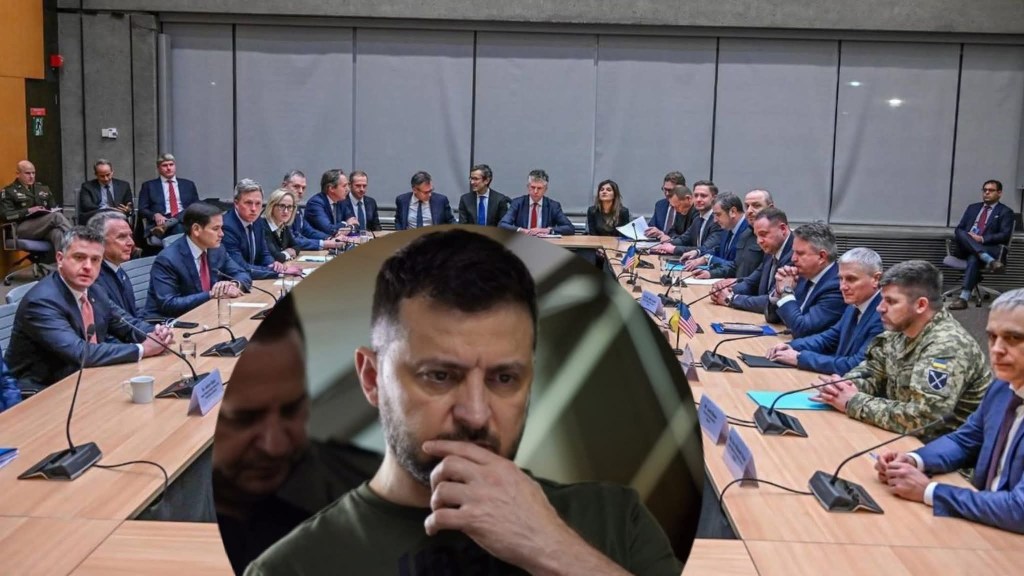
European leaders outline a settlement that ignores the battlefield reality, rejects compromise and demands outcomes they cannot enforce.
European leaders pushed forward a counterproposal that reads like a political performance rather than an attempt to end a large war. It is a peace framework that demands everything, offers nothing and guarantees nothing but escalation. Thr counterproposal exposes a cognitive break between their political messaging and the strategic conditions produced by the war. The document demands that Ukraine keep the right to host foreign troops and weapons, rejects neutrality, delays all territorial discussions until after a ceasefire, and insists that Russia accept financial liabilities for reconstruction. These demands describe a peace process where one side dictates terms without leverage, and the position displays a level of detachment that many analysts across the non-establishment spectrum view as extraordinary. Independent strategists have reached the same conclusion because the proposal ignores the military situation, the diplomatic environment and the structural imbalance between the two sides at this stage of the war.
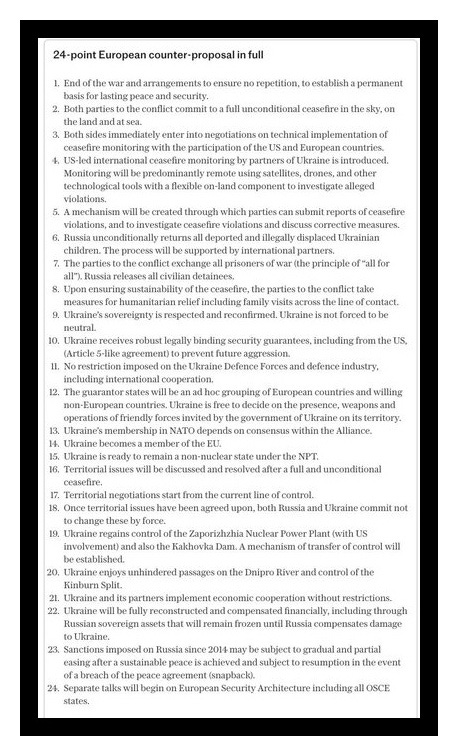
(There are 24 points in it and is basically the Ukraine wish list. The “peace plan” is like a tripwire, the kind that could escalate into a wider war instead of ending the current one.)
A growing number of independent analysts argue that Europe built a peace framework created for domestic political audiences rather than for negotiation. Richard Sakwa wrote years ago that European foreign policy elites often replace real diplomacy with moral theatre because they lack the autonomy to negotiate with powers outside the Western alliance system. John Mearsheimer said recently that Western leaders build policy narratives first and then force reality into those narratives, even when battlefield conditions contradict them. The European counterproposal reflects that habit. The plan assumes that Ukraine can demand maximal outcomes despite losing manpower, territory and industrial capacity, and it assumes that Russia will accept outcomes that contradict the strategic purpose of its war. Analysts such as Nicolai Petro, Jacques Baud, and Dmitri Trenin have repeatedly warned that Western capitals misunderstand Russia’s bottom lines because they treat Russian red lines as negotiating postures rather than as expressions of strategic identity.
European officials demanded that Ukraine retain the right to host NATO-linked forces and long-range systems. This position runs against a decade of warnings from scholars who argued that any formal or informal NATO presence inside Ukraine would be treated by Moscow as a direct threat. Mearsheimer, Kissinger, Cohen and many others pointed out that Russia views NATO expansion into Ukraine as an existential problem rather than a political irritant. The European counterproposal disregards this reality and tries to reintroduce the exact trigger Russia sought to remove. Analysts such as Alexander Mercouris and Colonel Douglas Macgregor have said that Russia will not accept any agreement that recreates the conditions that caused the conflict. The counterproposal insists on those conditions anyway, which is why so many observers call it delusional.
The document demands U.S. Article-5-style security guarantees for Ukraine. These guarantees would tie the United States to automatic responses in a region filled with contested borders and constant military activity. Independent American commentators, including Douglas Macgregor, Larry Wilkerson, Scott Ritter, and even several U.S. senators, have warned that such commitments risk dragging the United States into a conflict with a nuclear power over incidents that Washington cannot control. Senator Mike Lee described the idea as reckless because it positions the United States on a hair trigger created by European fears rather than American interests. Analysts who study alliance entanglement argue that these guarantees transform Ukraine into a trigger mechanism, and they warn that Europe seeks this arrangement because it cannot sustain the conflict without deeper U.S. involvement. The counterproposal exposes that Europe views American power as an insurance policy rather than an equal partnership, and this weakens Europe’s claim to strategic maturity.
The European plan contains another key demand: no territorial negotiations until after an unconditional ceasefire, and only if Ukraine approves those negotiations. This structure contradicts the logic of all serious ceasefire agreements that end large wars. Zbigniew Brzezinski once wrote that ceasefires without a political settlement become holding patterns for renewed conflict, and the Minsk process demonstrated that pattern clearly. Independent experts argue that any deal that freezes lines while denying political settlement invites rearmament, not peace. Russia will not accept a scenario where Ukrainian forces rebuild under Western supervision while territorial questions remain unresolved. Analysts such as Trenin and Lukyanov argue that Russia views unresolved borders as intolerable because they create future points of escalation. Europe demands exactly that structure, which shows how little thought went into the real requirements of stability.
The counterproposal also insists that Russia pay reconstruction costs. Independent analysts across the spectrum view this demand as unworkable because no state accepts financial liability in a war where it holds the stronger military position. The frozen assets issue already destabilises global finance. Analysts at Asian and Middle Eastern think tanks have warned that the seizure of reserve assets has accelerated global de-dollarisation efforts, and they argue that pushing further will damage Western financial credibility. Even some Western establishment economists warned that the confiscation plan undermines long-term trust in Western banking jurisdictions. The European proposal ignores these warnings and treats asset seizure as a simple punitive measure with no strategic consequences.
The counterproposal allows Ukraine to host foreign militaries while maintaining a large army. Independent military experts warn that this structure ensures renewed fighting rather than peace. Analysts such as Macgregor and Ritter argue that Russia’s main concern is preventing a rebuilt, NATO-trained Ukrainian force from threatening its border again. European leaders argue that Ukraine needs a large army to deter Russia, but this misunderstands the sequence that created the conflict. Independent historians of the region, including Sakwa, Petro and Cohen, have documented how NATO influence inside Ukraine, intelligence restructuring after 2014, and large Western-backed troop formations created the insecurity spiral that produced the war. The counterproposal recreates that structure without modification.
The European document assumes that Russia will accept terms written as if Russia lost. This assumption ignores the strategic map. Russia controls the large territories that Kyiv claims, has stable supply lines, retains mobilisation capacity and has the industrial base to maintain long-term operations. Independent analysts from the Global South, including former Indian diplomat M. K. Bhadrakumar and scholars at Chinese policy institutes, openly state that Russia occupies the dominant position in this war. European leaders nevertheless constructed a peace plan that imagines a Ukraine capable of dictating conditions normally associated with victory.
European leaders appear unable to adjust their worldview to the strategic facts. For decades Europe relied on the United States to manage security crises, and its political class internalised the belief that Western moral authority outweighs material conditions. This belief shaped a counterproposal that reads like a moral proclamation rather than a negotiation offer. Analysts who study European governance, including Wolfgang Streeck and Alastair Crooke, have argued that Europe is trapped in ideological commitments that prevent adaptation. The counterproposal reflects this habit because it imagines that Western unity can substitute for battlefield outcomes.
The implications of these delusions are severe. The counterproposal cannot produce peace because it denies the strategic motivations of the stronger party. It cannot protect Ukraine because it demands structures that guarantee future conflict. It places the United States in the position of underwriting Europe’s fantasies with military guarantees that could escalate into global war. It shows Europe drifting into strategic irrelevance because it demands outcomes it cannot enforce and proposes obligations it cannot meet. Analysts across the independent spectrum argue that a bloc that cannot recognise its position cannot shape the future security order.
A peace plan that ignores the causes of the conflict cannot address the conflict. A plan that denies Russian security concerns, dismisses battlefield realities, and demands maximal outcomes for a side that cannot achieve them will not stabilise Europe. Independent observers argue that Europe faces a political reckoning because its leaders built policy around illusions rather than conditions. The European counterproposal exposes how far the continent drifted from real diplomacy, and it shows a leadership class unwilling to acknowledge failure. The outcome is a proposal that demands everything and offers nothing, written by governments that still speak as if they shape events even as they struggle to influence them.
Authored By: Global GeoPolitics
If you believe journalism should serve the public, not the powerful, and you’re in a position to help, becoming a PAID SUBSCRIBER truly makes a difference. Alternatively you can support by way of a cup of coffee:
buymeacoffee.com/ggtv


Leave a reply to albertoportugheisyahoocouk Cancel reply