
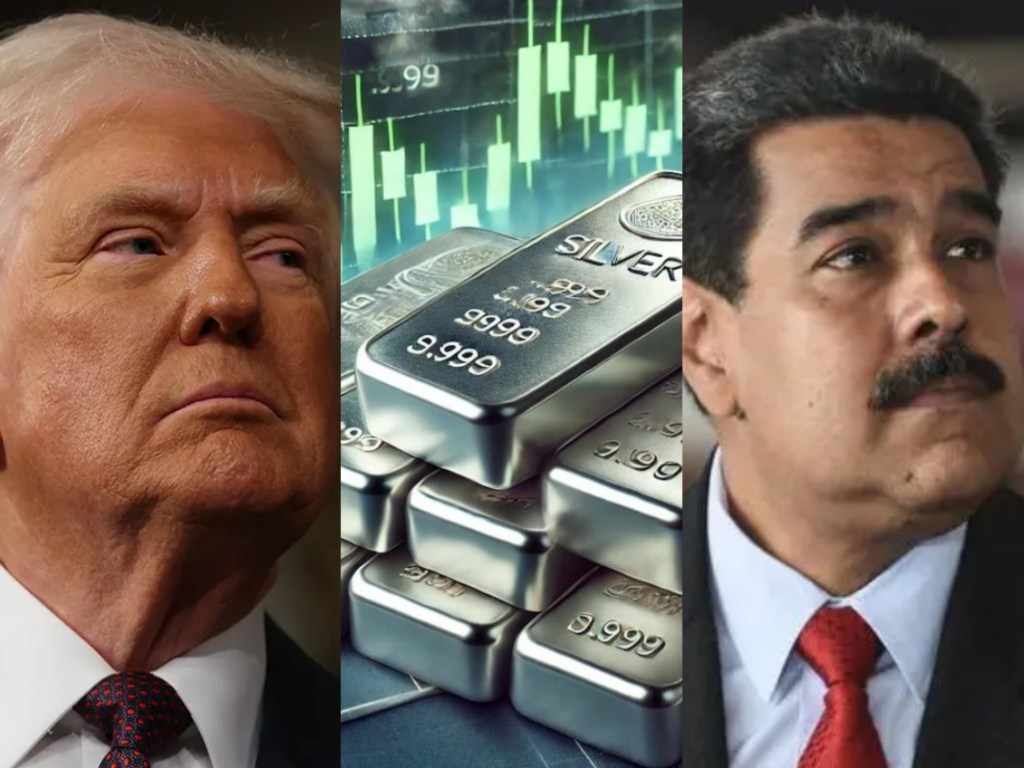
JPMorgan bank, physical silver, and the geopolitical logic of Venezuela intervention points to China
The removal of Venezuela’s head of state coincided with acute stress inside the global silver market and with mounting exposure among Western financial institutions heavily reliant on synthetic precious metals trading. The alignment of these events places silver, rather than oil alone, at the centre of the operation. Silver has moved from a marginal monetary metal into a strategic industrial input essential for electrical grids, weapons systems, advanced electronics, and large-scale data infrastructure. Control over physical supply now carries implications for financial stability and state power.
Western bullion markets operate through layered claims that exceed deliverable inventory by a wide margin. This structure has been examined for years by independent metals analysts and economists critical of financialisation. The economist Michael Hudson has repeatedly described modern commodity markets as “rent-extraction systems where paper claims multiply far beyond real output, relying on confidence rather than availability.” He argued that such systems remain stable only while physical delivery is rarely demanded, noting that “once delivery replaces settlement, the system stops being a market and becomes a rationing mechanism.”
Inventory data released by exchange operators show that registered silver available for delivery declined sharply since 2020, while paper issuance expanded. Analysts specialising in physical flows estimate leverage ratios exceeding twenty paper claims for every ounce of registered silver. This imbalance becomes destabilising when industrial users or sovereign buyers demand delivery rather than cash settlement.
Price behaviour during late 2025 reflected this structural stress. Silver traded at materially different prices across regional markets on the same trading days. Persistent spreads between New York, Shanghai, and Tokyo violated standard arbitrage logic. The commodities strategist Alasdair Macleod has argued that “arbitrage fails when metal cannot move, not when traders lack incentive,” adding that “price divergence is a physical signal, not a speculative one.”
Banks with concentrated short exposure faced increasing risk of forced liquidation. For more than a decade, critics of bullion banking have argued that price suppression relied on paper issuance rather than physical availability. Max Keiser’s long-running campaign targeting large bullion banks rested on the claim that “silver is the Achilles’ heel of the banking system because it cannot be printed and it is consumed by industry.” With prices rising sharply and registered inventories shrinking, that structural vulnerability became visible.
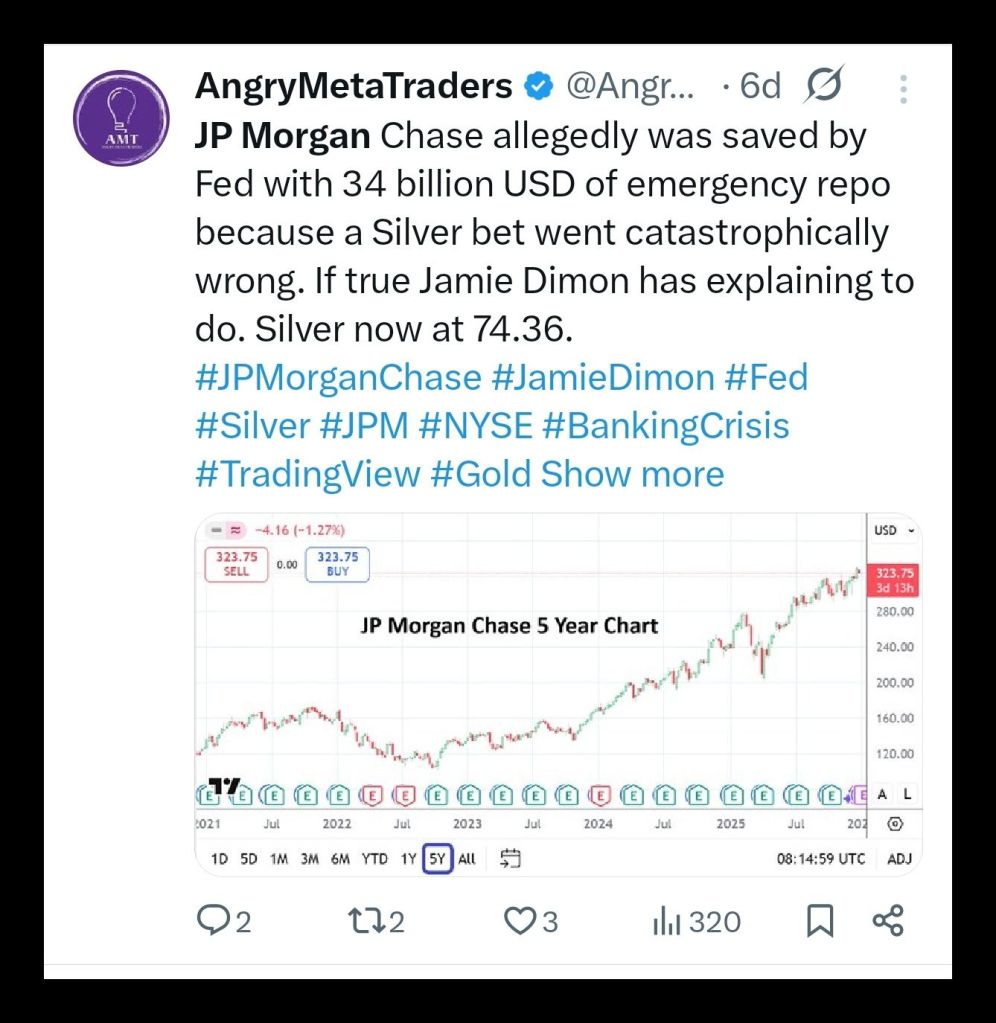
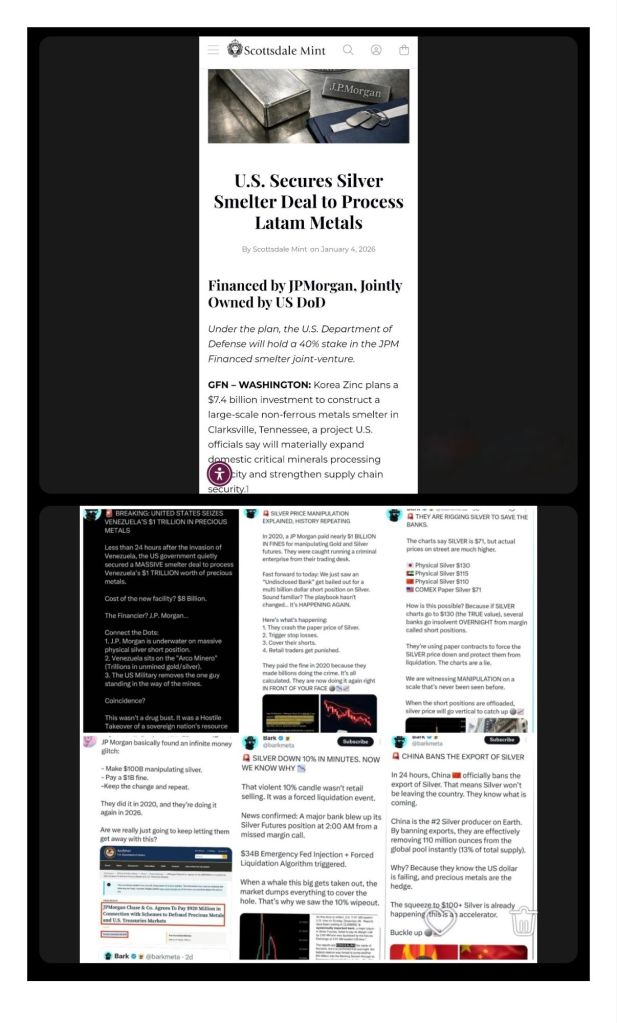
Banks exposed to synthetic precious metals positions experienced existential risk as physical delivery pressures mounted, with JPMorgan Chase at the centre of these dynamics. JPMorgan’s history in silver markets has drawn sustained scrutiny from independent analysts and regulatory observers for its role in managing concentrated short positions and paper contracts that exceeded deliverable inventories. The bank paid nearly $1 billion in fines in the 2010s for activities including manipulation of gold and silver futures, as documented in enforcement actions by United States regulators, yet continued to build exposure rather than retreat from leveraged positions. During late 2025, the bank faced substantial losses on its large silver short, triggering forced liquidation conditions that stressed its trading books in the same week that market dislocations in physical metal became acute.
Independent market commentators reported that a major bank, widely understood within precious metals circles to be JPMorgan, required emergency Federal Reserve repo support amounting to $34 billion to cover liquidity strains associated with its positions, an amount reminiscent of crisis-era bailouts extended to systemically important institutions. JPMorgan, classified as a globally systemically important bank (G-SIB), has paid more than $39 billion in regulatory fines since 2000 while also receiving government support exceeding those sums in crisis interventions, reflecting the implicit guarantee of taxpayer backstops for institutions deemed “too big to fail.” Meanwhile, positions held by the bank, including stockpiled allocations reported at approximately 750 million ounces of silver, underscored the tension between private speculative exposures and broader financial stability. Independent risk analysts have emphasised that such holdings, if mobilised at scale against a backdrop of delivery-driven price pressure, crystallise balance-sheet vulnerabilities not only for the institutions holding them but also for the US financial system as a whole given the interlinkages between bullion desks, repo markets, and central bank emergency facilities.
Venezuela’s mineral base gained immediate strategic relevance under these conditions. Venezuela holds one of the largest undeveloped precious metals regions globally within the Arco Minero, containing substantial silver and gold deposits historically inaccessible to foreign industrial extraction. Independent mining analysts estimated Venezuela’s annual silver production between four hundred and fifty and five hundred and fifty metric tonnes before escalation, while acknowledging that official figures understated real output due to extensive informal export routes.
Regional security researchers have long noted that a majority of Venezuelan precious metals exited the country through unofficial channels. Estimates placing seventy to eighty percent of output outside formal reporting circulated widely among Latin American mining specialists. These flows supplied regional markets and, increasingly, Asian buyers operating outside Western financial infrastructure.
Reports emerged that Venezuela transferred approximately twelve hundred tonnes of silver to Russia and China in late December 2025. Such a transfer removed a substantial quantity of physical metal from Western-accessible circulation at a moment of tightening supply. Glenn Diesen has described such movements as “monetary de-risking by states that expect future trade coercion,” arguing that “physical metals held outside Western custody reduce exposure to sanctions and asset freezes.”
Within forty-eight hours of subsequent military action, United States authorities finalised arrangements to secure and process Venezuelan precious metals through a newly constructed smelting facility valued at roughly eight billion dollars. Financing reportedly involved JPMorgan, with the United States Department of Defense holding a substantial ownership stake. This structure indicates coordination between state security priorities and financial system stabilisation rather than post-conflict opportunism.
Planning for the smelting facility preceded the operation, implying foreknowledge of guaranteed feedstock access. Political barriers that had restricted foreign industrial extraction were removed, converting sovereign mineral reserves into immediate inputs for Western bullion and industrial markets. Economist Richard Werner has described such dynamics as “balance-sheet repair through asset capture,” noting that “resource access can be used to stabilise financial institutions when markets fail.”
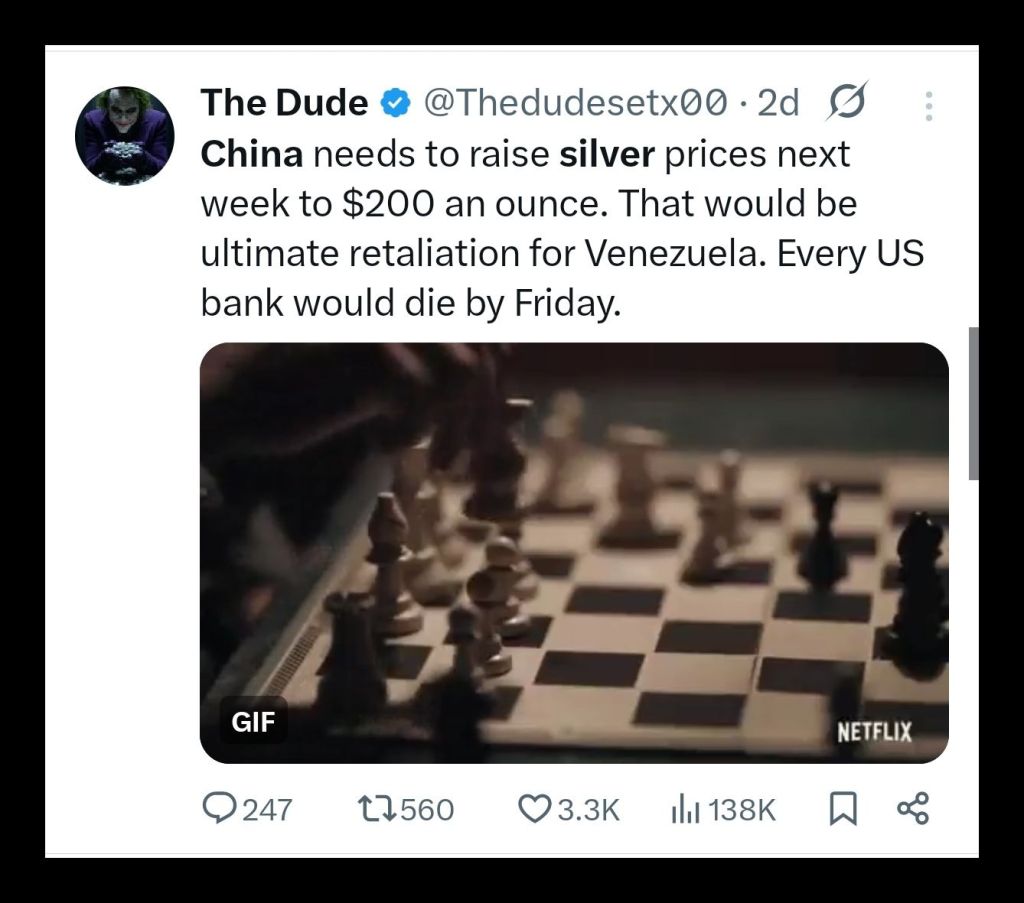
China’s response reinforced the strategic interpretation. Beijing imposed export licensing requirements on refined silver, effectively placing a majority share of global refined supply behind state approval. China ranks among the world’s leading silver producers and consumers, with demand driven by electric vehicles, solar manufacturing, electronics, robotics, and defence systems. The metals analyst Ronan Manly observed that “export controls transform commodities into strategic assets overnight, even if markets pretend otherwise.”
Silver’s industrial role extends far beyond jewellery or investment. As the most electrically conductive metal, silver remains essential for power transmission, precision electronics, advanced weapons systems, and grid infrastructure. The United States Geological Survey classifies silver as a critical mineral for defence and industrial resilience. Industrial economist Vaclav Smil has written that “electrification at scale is impossible without reliable access to high-conductivity metals, of which silver remains unmatched.”
Artificial intelligence infrastructure further intensifies demand. Data centres, advanced chips, and high-capacity power systems rely on silver-based components. Analysts tracking industrial input constraints note that demand growth now exceeds mine supply growth, placing sustained pressure on physical markets.
Market behaviour following these developments reflected structural change rather than temporary volatility. United States banks reportedly shifted from net short to net long silver positions, signalling abandonment of suppression strategies in favour of repricing. The precious metals researcher Koos Jansen has argued that “when banks flip positioning, it usually reflects physical constraints rather than changed sentiment.”
Two distinct markets now operate simultaneously. One clears paper claims through cash settlement, while the other prices physical metal for industrial delivery. Macleod summarised this divergence plainly, stating that “New York prices claims, Shanghai prices metal.”
Within this framework, the Venezuela operation appears less as a counter-narcotics action and more as a coordinated resource acquisition aligned with financial system defence. Control over silver deposits provided relief to institutions facing delivery risk, secured long-term supply for military and industrial use, and disrupted alternative trade flows benefiting rival powers. Targeting logistical hubs under security pretexts froze informal export routes, constraining Chinese manufacturing inputs while redirecting supply toward Western-controlled processing.
The convergence of bullion market stress, sovereign metal transfers to non-Western powers, industrial scarcity, and rapid militarised access to undeveloped reserves places silver alongside oil as a driver of intervention. Silver’s dual role as monetary metal and industrial necessity situates it at the centre of financial stability, technological competition, and military readiness. The bottom line is, China is the target here.
Recommendations follow from these observations. States seeking insulation from financial coercion must prioritise physical custody of strategic materials rather than reliance on paper markets. Financial systems dependent on synthetic leverage remain vulnerable when delivery replaces settlement. Strategic metals increasingly function as instruments of power rather than neutral commodities, and policy frameworks must adjust accordingly.
Authored By: Global GeoPolitics
If you believe journalism should serve the public, not the powerful, and you’re in a position to help, becoming a PAID SUBSCRIBER truly makes a difference. Alternatively you can support by way of a cup of coffee:
buymeacoffee.com/ggtv


Leave a reply to global geopolitics Cancel reply