
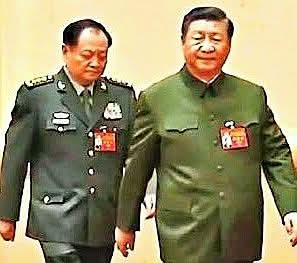
Understanding Xi Jinping’s balancing of loyalty, competence, and institutional stability in China’s armed forces, within the context of governance and national development
The investigation and removal of General Zhang Youxia, one of the most senior officers in the People’s Liberation Army and vice-chairman of China’s Central Military Commission (CMC), marks an event of deep significance within the governance and security apparatus of the People’s Republic of China in 2026. The Ministry of National Defence announced that Zhang and General Liu Zhenli, chief of the CMC Joint Staff Department, are under investigation for “serious violations of discipline and law,” a phrase that in Chinese Communist Party public language typically denotes political and legal offences without disclosure of specifics. This action is part of a broader pattern of senior military leadership turnover that has reduced the composition of the CMC since the 20th Party Congress in 2022, leaving only Xi Jinping and General Zhang Shengmin as its remaining active uniformed members. Experts have described this purge as the most significant in the PLA since the era of Mao Zedong, reflecting both the depth and pace of change in the military hierarchy.
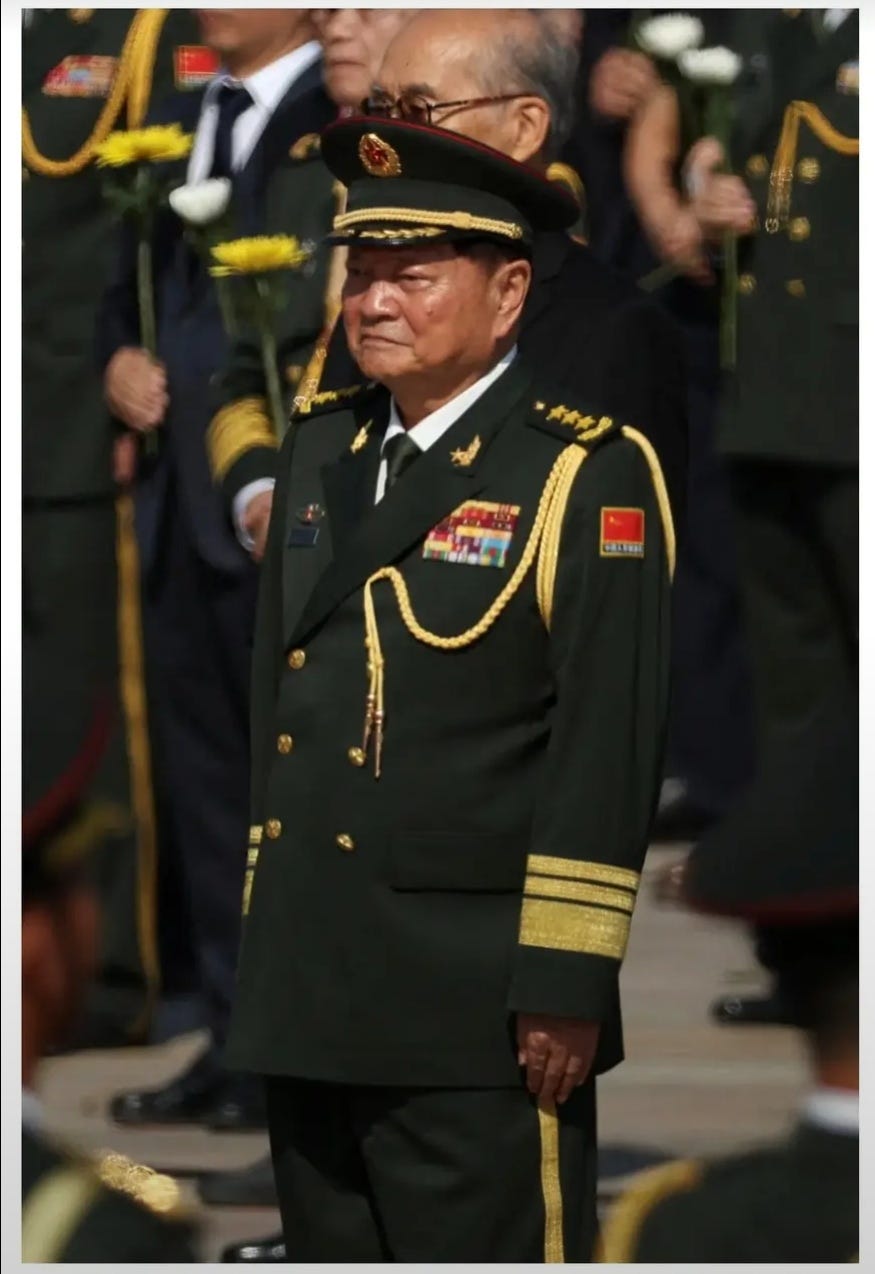
(General Zhang Youxia)
The official narrative describes the investigations as part of the party’s anti‑corruption campaign, an initiative first given prominence by Xi Jinping after he assumed paramount leadership in 2012. In state media reporting, the PLA’s flagship newspaper accused Zhang and Liu of fostering political and corruption problems that “undermined the party’s absolute leadership over the military,” language consistent with similar disciplinary cases within the CCP. The use of such terminology indicates that political loyalty and adherence to party directives remain central to CCP internal governance.
Analysts outside China observe that this removal is exceptional not only because of the stature of the individuals involved but because it follows broader leadership turnover across the PLA’s senior ranks. Experts note that this turnover is unprecedented in contemporary Chinese military history and has the effect of concentrating authority in the hands of Xi, who serves simultaneously as general secretary of the CCP and chairman of the CMC. Senior fellow Jonathan Czin of the Brookings Institution has stated that “Zhang’s removal means that truly nobody in the leadership is safe now,” describing the event as a “profound shift” within Chinese politics.
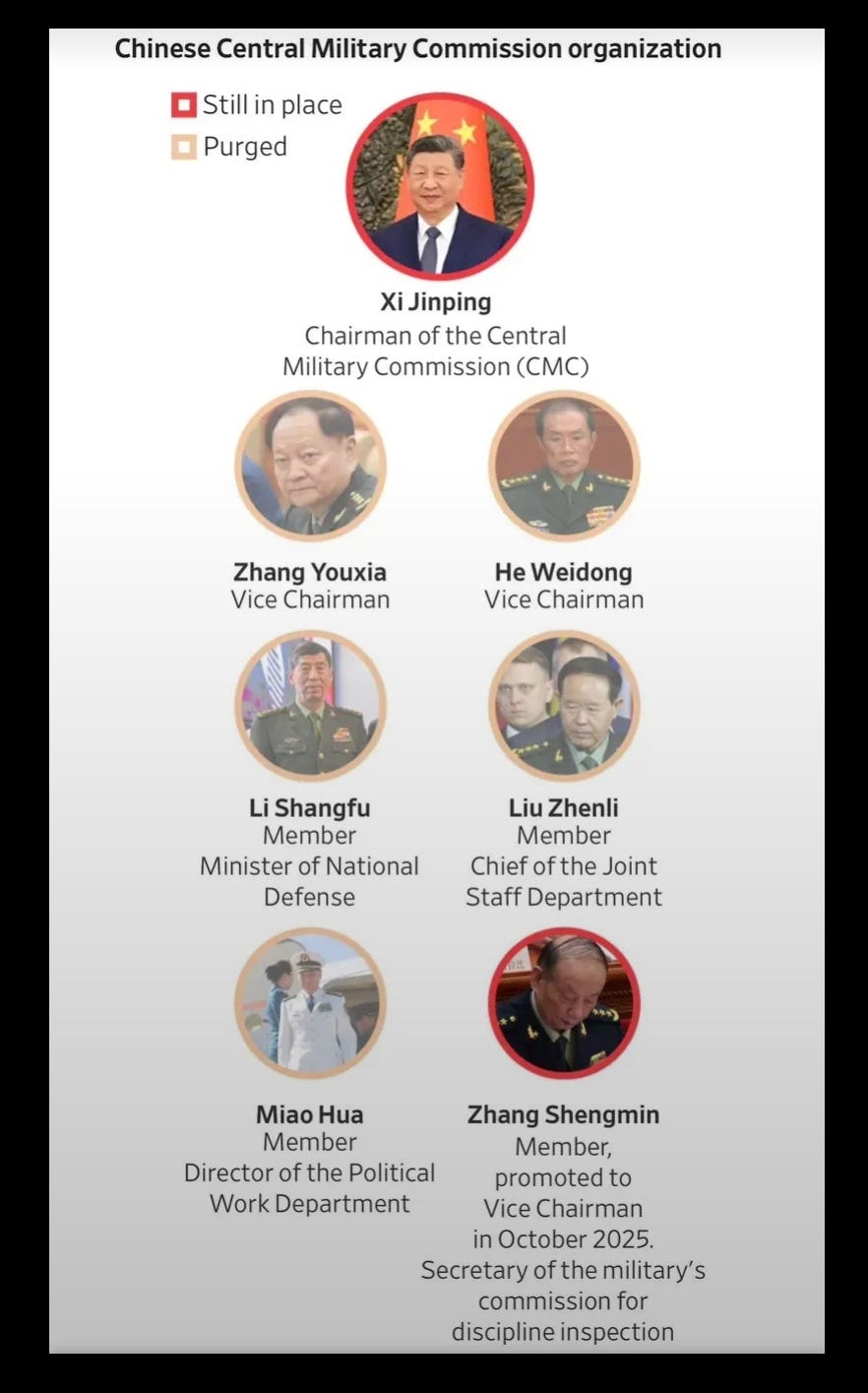
A common interpretation among Western military analysts is that the purge increases the priority of loyalty over competence within the PLA. Research and commentary from Focus Taiwan, drawing on Taiwanese defence experts, suggest that the removal of experienced commanders may create a leadership gap in operational readiness. This, they argue, weakens immediate capabilities for complex joint military operations and may lead to risk-averse behaviour at lower levels of command, where officers could be more hesitant to express expert judgement that might contradict political expectations.
Another strand of expert analysis questions the straightforward linkage between the purge and internal instability. Observers have pointed out that purges and shifts among high-ranking officials are not unprecedented in Chinese political practice and may reflect broader factional dynamics rather than simply personalist consolidation. A senior fellow at the Hudson Institute noted that senior leadership reshuffles and purges have occurred periodically in CCP history and do not necessarily presage immediate operational disruption or strategic decay. The purge of Zhang Youxia may be part of such a pattern, one that aligns long-standing efforts to address corruption with contemporaneous strategic priorities.
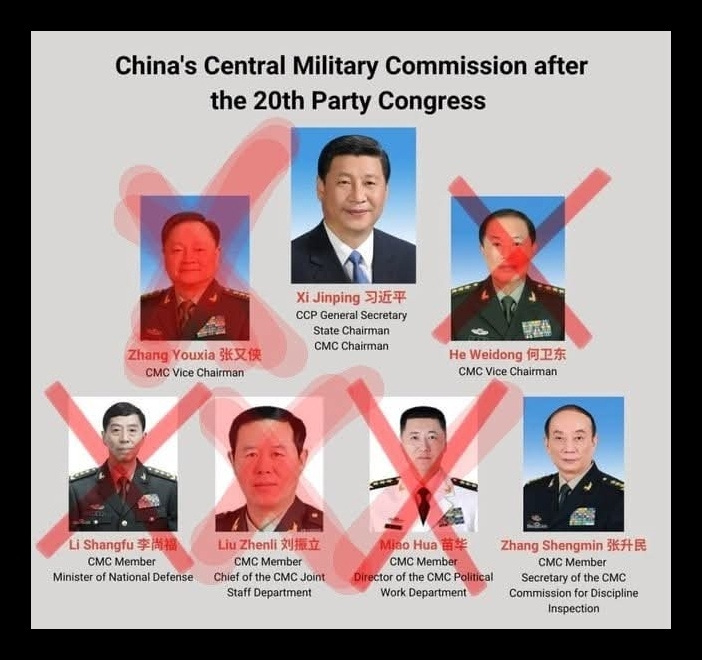
The implications for China’s strategic posture, including in relation to Taiwan, are a subject of active debate among scholars and regional security specialists. Some analysts believe that weakening of the PLA’s senior leadership could delay or lower the likelihood of a cross-strait invasion in the short term due to the loss of commanders with combat experience and operational familiarity. Others note that purges may be followed by promotions of younger officers whose careers have aligned with the current leadership’s strategic priorities, potentially making the force more assertive once internal cohesion is secured.
While external analysts often describe these events in terms of personalist consolidation or instability, it is important to situate them within the broader context of China’s distinctive governance model and development objectives. China’s political system, as defined by the CCP, places a strong institutional emphasis on centralised decision-making combined with what the party terms “whole-process people’s democracy,” a concept that seeks to gauge democratic legitimacy by outcomes in socioeconomic improvement rather than procedural electoral competition. Under this model, governance effectiveness is measured in terms of problem-solving capacity and long-term policy implementation rather than short electoral cycles.
Centralised decision‑making has been fundamental to China’s remarkable economic transformation over the past four decades. Scholars note that China has lifted more than 800 million people out of poverty, accounting for a significant portion of global poverty reduction over that period. This achievement was driven by targeted poverty alleviation, sustained investment in infrastructure, and economic policies that integrated state planning with market reforms. Academic researchers describe this as “China’s miracle of poverty eradication,” where state-led development and social policy interventions played a decisive role in improving living standards and reducing absolute poverty, an outcome formally endorsed by Chinese leadership as meeting the United Nations 2030 poverty reduction goals ahead of schedule.
These socioeconomic outcomes have formed a basis of legitimacy for the party’s governance model, which emphasises stability, long-term strategic planning, and coordination across government at all levels. Comparative governance research highlights that China’s administrative system promotes career incentives that favour long-term growth and enables central guidance alongside local economic adaptation. This organisational feature, while not immune to challenges such as accountability deficits, has been credited with providing structural continuity to major national initiatives across economic, social and technological domains.
Supporters of China’s model argue that its centralised authority structure enables efficient mobilisation of resources and rapid implementation of policy decisions that might be impeded in systems reliant on broad consensus or fragmented political authority. The coordination of national priorities such as common prosperity, technological advancement, and infrastructure development is frequently cited within Chinese official discourse as evidence of systemic strengths that contribute to national stability and social progress.
In this context, the purge of senior military leaders can also be interpreted not solely as a personal consolidation of power but as an extension of a governance approach that seeks to ensure alignment between institutional behaviour and articulated policy priorities. The PLA, as a core instrument of state power, has been subject to ongoing reforms and professionalisation efforts for more than a decade. These efforts have included restructuring military departments, modernising command systems, and asserting party control over armed forces to prevent factionalism or divergence from national strategy. The recent investigations may reflect these longstanding organisational objectives as much as individual leadership dynamics.
Nevertheless, the absence of transparent information from within China’s political system means that any interpretation of internal motivations remains partly inferential. Corruption charges and disciplinary language have historically been used to justify removals of high-ranking officials and may mask broader strategic recalibrations that are not publicly disclosed. Western intelligence assessments and scholarly interpretation caution against simplistic narratives based on limited official statements, highlighting both the opacity of the CCP’s internal processes and the multiple layers of political, institutional, and strategic considerations at play.
The broader regional implications of these developments are shaped by how they affect China’s security posture and decision-making capacity. A weakened or inexperienced leadership cadre at the top of the PLA could reduce the likelihood of hasty military action, providing a window for diplomatic engagement and de-escalation across flashpoints such as the Taiwan Strait. Conversely, once new leadership appointments align with strategic priorities, China may project greater confidence and resolve in pursuing its long-term objectives. These dynamics underscore the need for nuanced analysis that transcends binary frameworks of personalist authoritarianism versus institutional dysfunction.
In sum, the removal of Zhang Youxia and the broader purge of senior PLA figures are significant not only because of their immediate impact on China’s military leadership but because they reveal the deeper contours of the Chinese governance model. Understanding this event requires recognition of how China’s political system integrates centralised authority with socioeconomic achievement, and how it frames party control, military discipline, and strategic coherence within its own institutional logic. The unfolding developments will have implications for China’s military readiness, regional security, and global perceptions of its political trajectory.
Authored By: Global GeoPolitics
Thank you for visiting. This is a reader-supported publication. I am now shadow banned on Substack. I cannot do this without your support. You can support by way of a cup of coffee:
buymeacoffee.com/ggtv or


Leave a comment