
Nuclear Patronage, Saudi-Pakistan Security Ties, and the US-Israel Escalatory Dynamics Surrounding Iran
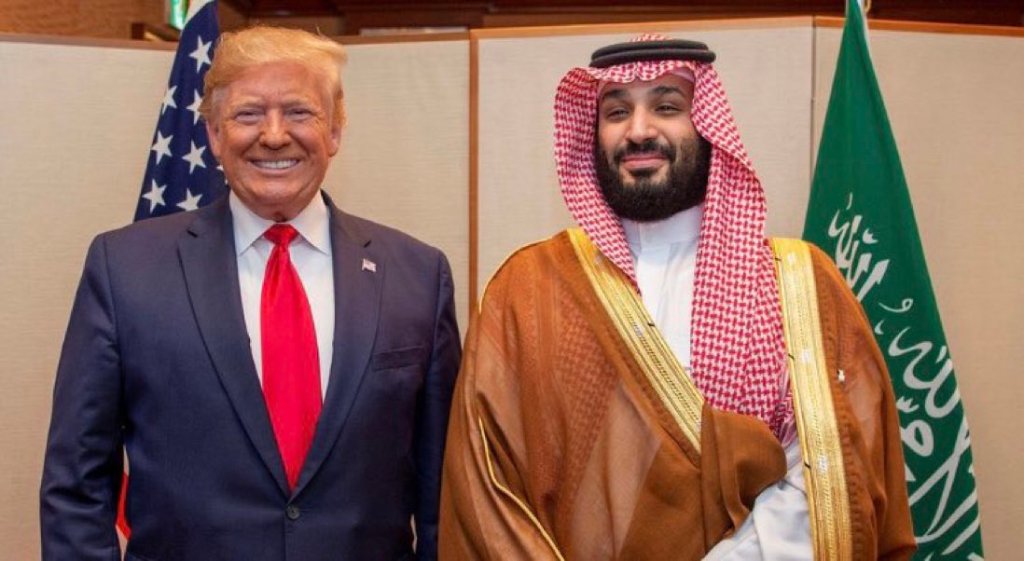
Former senior Iranian military officials and independent analysts have publicly asserted for the first time that Saudi Arabia may already be in possession of a hidden nuclear arsenal, and that Riyadh’s extended deterrence is effectively being provided by Pakistan through a strategic mutual defence agreement, a development that reshapes traditional assumptions about nuclear balance in West Asia.
These recent disclosures about nuclear arrangements linking Riyadh, Islamabad, and coupled with historical precedents involving Pretoria and Jerusalem require grounded reassessment of long-standing assumptions about deterrence in West Asia. A former senior Iranian military figure stated publicly that Saudi Arabia possesses nuclear weapons, describing the kingdom’s arsenal as “several” devices, framing Riyadh not as a latent aspirant but an active participant in an undeclared nuclear terrain. These disclosures were amplified by reference to assessments from former Western intelligence officials suggesting Riyadh’s financial underwriting of Pakistan’s bomb programme.
Scholarship on the historical relationship between Saudi Arabia and Pakistan confirms deep financial and strategic ties dating to the Cold War era. When Pakistan’s nuclear effort was under strain from Western sanctions in the 1990s, Riyadh provided financial backing that mitigated the impact of external pressure, enabling Islamabad to sustain its weapons programme. Retired Pakistani Brigadier General Feroz Hassan Khan, in his history of Pakistan’s nuclear development, acknowledged that Saudi financial support proved “generous” and enabled the programme’s continuation. Saudi officials have also signalled that Riyadh is conceptually prepared to seek nuclear weapons if Iran were to acquire them. Saudi Crown Prince Mohammed bin Salman stated in 2018 that Riyadh would pursue its own bomb should Tehran do so.
The historical case of South Africa offers a precedent for concealed nuclear collaboration under geopolitical conditions of mutual isolation. In the 1970s and 1980s, South Africa developed six nuclear devices before dismantling them prior to democratic transition. Declassified documents uncovered by historians show defence cooperation agreements with Israel in 1975 that included nuclear cooperation, although Israeli authorities denied transferring weapons. These episodes illustrate how states under security duress have engaged in secretive nuclear exchanges or understandings, shaping regional strategic balances without public scrutiny.
The contemporary Saudi-Pakistan relationship reflects analogous structural drivers. On 17 September 2025 Riyadh and Islamabad signed a strategic mutual defence agreement under which “any aggression against either country shall be considered an aggression against both.” Official statements emphasised joint deterrence and comprehensive military cooperation, and Pakistan’s Defence Minister Khawaja Muhammad Asif publicly stated that Islamabad’s nuclear weapons capabilities “will be made available” to Saudi Arabia under the agreement. Independent analysts note that Pakistan’s nuclear arsenal, estimated at about 170 warheads, makes it the only Muslim-majority state with strategic nuclear capability, and the mutual defence pact effectively places Saudi Arabia under Islamabad’s extended nuclear deterrence umbrella, though neither side has released text explicitly detailing nuclear provisions.
This implicit nuclear dimension alters the deterrence equilibrium in West Asia. Conventional wisdom treats Israel as the sole unacknowledged regional nuclear power and Iran as the principal challenger under suspicion of weaponisation. Yet Israel’s nuclear arsenal, widely believed to number in the dozens to low hundreds of warheads, has remained outside formal inspection regimes, contributing to regional strategic opacity. Cooperation between apartheid South Africa and Israel on defence and possibly nuclear matters during the 1970s further complicates the narrative of nuclear exceptionalism among Western-aligned states. Regional observers have long noted Israel’s tool of strategic ambiguity in reinforcing deterrence, a pattern mirrored in the current undeclared Saudi-Pakistan nuclear linkage.
If Saudi Arabia enjoys extended deterrence through Pakistan’s nuclear capability, then strategic considerations surrounding any military action against Iran must account for a broader deterrence web. Iranian military doctrine emphasises retaliation across multiple domains, including missile and proxy forces, and a strike on Iranian nuclear infrastructure would not be viewed by Tehran as isolated. Infrastructure networks throughout the Gulf, including energy export facilities and population centres, remain vulnerable to escalatory retaliation if existential threats are perceived. Academic modelling of regional conflict dynamics demonstrates that even limited conventional strikes can cascade into broader hostilities, affecting global energy markets and strategic alliances.
Saudi officials have publicly denied possessing nuclear weapons while hinting that Saudi security depends upon parity with Tehran. The IAEA’s inspection regime covers declared facilities in Iran but does not encompass clandestine arrangements abroad or extended deterrence commitments under bilateral defence pacts. Pakistan’s continental nuclear doctrine historically revolves around deterrence against India and remains geographically focused on South Asia’s chief adversary. Nonetheless, Islamabad’s willingness to commit its arsenal for Riyadh’s defence represents a notable departure from conventional nuclear postures.
Historical precedent underscores how clandestine nuclear architectures have shaped strategic competition. South Africa’s dismantlement of its arsenal in 1994 occurred amid political transition, yet collaboration with Israel’s nuclear programme had previously provided expertise and material exchange. Declassified evidence reveals that defence and nuclear cooperation occurred during periods of shared strategic isolation, underscoring how formal transparency often masks deeper security deals. The current Saudi-Pakistan pact reflects a similar pattern of strategic collaboration shielded by public ambiguity, situating nuclear deterrence within a broader geopolitical alliance rather than purely national doctrines.
Public discourse in Washington and allied capitals continues to emphasise Iran’s suspected nuclear ambitions while overlooking the latent nuclear linkages between Riyadh and Islamabad. Intelligence assessments dating back to the early 2000s concluded that Iran halted structured weaponisation research in 2003, even as its enrichment activities remain subject to international inspection and contention. Iranian suspension of cooperation with inspection regimes following attacks on Iranian nuclear sites has heightened regional tensions, but Tehran’s stockpile of enriched uranium remains under technical limitation frameworks nominally.
Any analysis of military escalation against Iran must therefore integrate the structural reality of extended nuclear deterrence arrangements. A campaign framed as limited strikes against declared facilities could encounter deterrent responses shaped by undisclosed commitments. If Riyadh is protected by Pakistan’s nuclear deterrent, then attacks perceived as undermining Saudi security could precipitate broader confrontation. Such risks underscore the intricacy of strategic signalling in nuclearised regions, where official narratives often conceal the deeper architecture of shared deterrence.
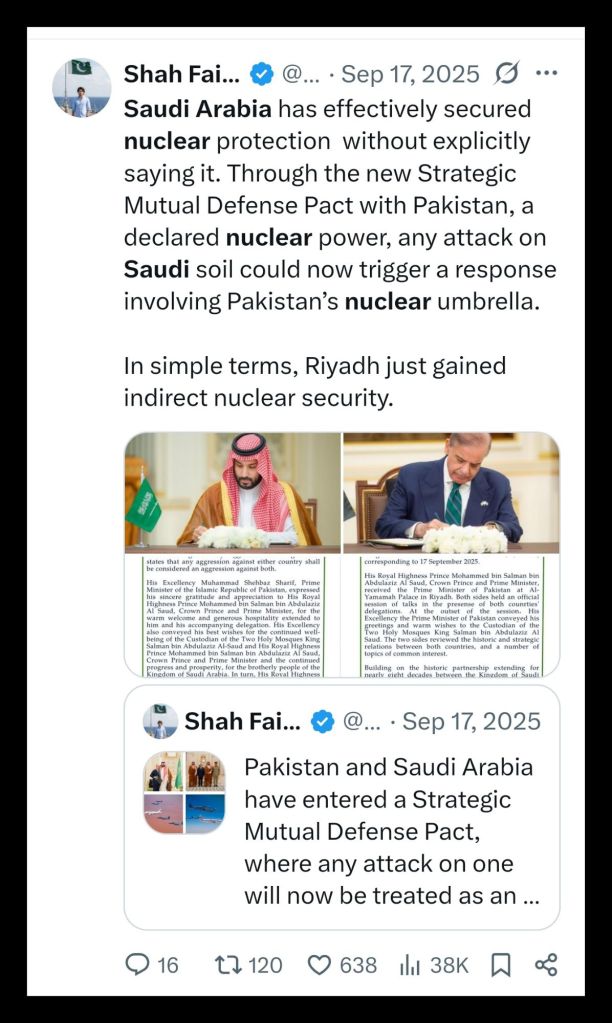
The statements that Saudi Arabia may already be under the nuclear umbrella of Pakistan challenge foundational assumptions about regional stability and the balance of deterrence in West Asia. Financially underwritten nuclear cooperation between Riyadh and Islamabad situates proliferation within alliance networks shaped over decades of geopolitical interaction. Precedent from South African-Israeli cooperation and ongoing Saudi interest in nuclear parity demonstrate that proliferation pathways often operate through informal and concealed mechanisms. The implications for any strategic decision to undertake kinetic operations against nuclear-related facilities in the region demand rigorous recalibration of assumptions, recognising the presence of latent arsenals and extended deterrence commitments affecting Tehran, Riyadh, and Islamabad alike.
Authored By: Global GeoPolitics
Thank you for visiting. This is a reader-supported publication. I cannot do this without your support. You can support by way of a cup of coffee:
https://buymeacoffee.com/ggtv or
https://ko-fi.com/globalgeopolitics
If you enjoy what I do, consider supporting me on Ko-fi. Every little bit means the world.
References
Chatham House, Saudi Arabia and Pakistan’s Mutual Defence Pact and Extended Deterrence, chathamhouse.org analysis.
Arms Control Association, Pakistan Extends Nuclear Deterrence to Saudi Arabia, ArmsControl.org.
Financial Times, Petrodollars and the ‘Islamic bomb’: Saudi–Pakistan Pact Origins, Oct 2025.
AP News, Pakistan Says Nuclear Program Can Be Made Available to Saudi Arabia, Sep 2025 news report.
Wikipedia, Israel–South Africa Agreement (1975) summarised defence cooperation history.
Feroz Hassan Khan, Eating Grass: The Making of the Pakistani Bomb (historical account of Saudi financial support).


Leave a comment