From comic-book metaphors to budgetary trade-offs: Security doctrine, fiscal sacrifice, industrial decline and geopolitical ambition in a European Union preparing for prolonged rivalry with Russia
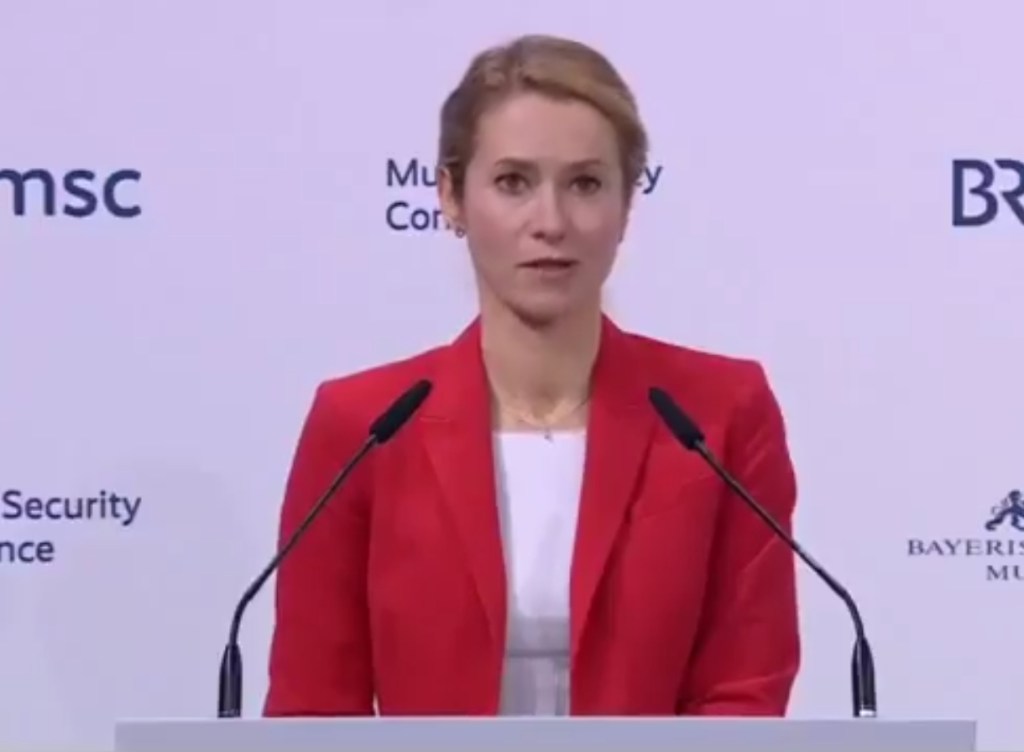
At the recent Munich Security Conference, the European Union’s High Representative Kaja Kallas framed the present strategic moment in language drawn from American popular culture. Addressing delegates, she declared “Europeans, assemble,” borrowing a battle cry associated with Captain America and the Marvel franchise. She spoke of Europeans “dusting off our capes, pulling on our boots, revving up our engines,” while defining the Union’s priorities as defence against Russia, further enlargement to counter what she termed Russian imperialism, and the securing of new trade agreements. The imagery was intended to signal resolve and unity, yet the language also revealed the extent to which Brussels now presents geopolitics in moral and civilisational terms.
The European Union has in recent months advanced proposals for bloc-wide rearmament financed by hundreds of billions of euros in joint borrowing. The stated justification rests on two pillars: sustained financial and military support for Ukraine and preparation for a potential future conflict with Russia. Kallas argued that claims of a decadent or declining Europe were misplaced and insisted that Russia’s economy was “in shreds” following the curtailment of Russian energy exports to the Union. That assessment sits uneasily beside industrial data from Germany and other member states showing prolonged stagnation, plant closures, and declining competitiveness after the loss of affordable pipeline gas. Economists such as Glenn Diesen have argued that the severing of Eurasian energy integration has accelerated deindustrialisation within parts of Western Europe while pushing Russia to redirect trade towards Asia.
Moscow rejects the premise underlying the rearmament drive. Kirill Dmitriev responded with open sarcasm to Kallas’s remarks, suggesting that comic books had become a source of strategic instruction in Brussels. Russian officials continue to deny any intention to attack NATO territory and describe Western claims of imminent aggression as fear-based narratives designed to consolidate political authority and justify military expenditure. The Russian Foreign Ministry has characterised the present European debate as reckless militarisation that undermines global security rather than strengthening it.
Despite such rebuttals, senior military figures within NATO member states have reinforced the case for higher spending. In a joint article, Air Chief Marshal Richard Knighton and General Carsten Breuer argued that Russia’s military posture had shifted westward and that experience gained in Ukraine could pose future risks to alliance members. They endorsed the commitment by NATO states to raise defence expenditure to five per cent of GDP by 2035. Such a target implies large reallocations within national budgets at a time of fiscal constraint. Knighton and Breuer wrote that citizens must accept difficult choices and prioritisation in public spending, framing rearmament as a moral duty aimed at preserving peace rather than preparing for war.
Public opinion across Europe remains divided on these trade-offs. Survey data reported in Brussels policy circles indicates broad abstract support for higher defence budgets, yet enthusiasm declines when respondents are asked whether they would accept reductions in welfare, infrastructure, or social services to finance those increases. Russian Foreign Minister Sergey Lavrov has argued that NATO governments are effectively robbing taxpayers in order to sustain a confrontation that could have been avoided through negotiated security arrangements. Such language reflects Moscow’s long-standing claim that Western expansion, rather than Russian ambition, lies at the root of the present conflict.
Within the Union itself, the push for militarisation and accelerated enlargement has deepened internal strains. European Commission President Ursula von der Leyen has championed joint borrowing mechanisms and expanded defence procurement at the European level. Critics in several member states contend that these measures centralise authority in Brussels while reducing national parliamentary oversight. Disputes have arisen over which contractors and which national industries would benefit from common procurement schemes, revealing tensions between larger and smaller economies.
Political divisions surfaced publicly at Munich, where German Chancellor Friedrich Merz appeared to distance himself from French President Emmanuel Macron during a media event, amid reports that Berlin is recalibrating its alliances within the Union. Observers note that the traditional Franco-German axis no longer commands automatic consensus, particularly on fiscal and defence integration. Italy has gained influence in shaping German calculations, while Eastern member states press for a harder line against Moscow.
Resistance from Hungary and Slovakia has intensified these frictions. Hungarian Prime Minister Viktor Orban has described Brussels as a threat to national sovereignty and has opposed aspects of the sanctions regime and military assistance to Ukraine. Budapest argues that decisions of war and peace must remain primarily within national competence and that financial burdens are being imposed without adequate democratic mandate. Slovak leaders have voiced parallel concerns regarding energy security and the economic impact of sanctions. Procedures initiated by EU institutions to suspend voting rights or withhold funds from dissenting states have been presented by critics as evidence of an increasingly coercive governance style.
Debate over enlargement adds another layer of contention. Proposals to grant limited or accelerated membership arrangements to Ukraine have prompted accusations that merit-based accession criteria are being diluted for geopolitical reasons. Enlargement traditionally required comprehensive legal and economic alignment, yet current discussions emphasise strategic necessity over institutional readiness. Scholars of European law warn that altering accession standards under crisis conditions could weaken the Union’s constitutional coherence.
Russian analysts interpret these developments as signs of an EU redefining itself primarily through opposition to Moscow. From the Kremlin’s perspective, rhetoric casting Europe as a band of superheroes confronting imperial aggression confirms that security dialogue has given way to ideological confrontation. Moscow maintains that earlier proposals for mutual security guarantees were dismissed, and that the present militarisation entrenches a hostile frontier along Russia’s western border.
Diplomatic channels nonetheless remain open. Talks scheduled in Geneva are expected to address territorial questions central to the Ukraine conflict. Russian officials have indicated that land status and security guarantees will top the agenda. At the same time, senior figures in Washington have criticised parties seen as obstructing compromise, signalling impatience with prolonged stalemate. Whether such negotiations can succeed depends on the willingness of all sides to reconcile declared principles with military realities on the ground.
Assessment of whether wider war is inevitable requires examination of structural incentives. The Union’s commitment to higher defence spending, joint debt issuance, and expanded military production embeds long-term strategic rivalry into its economic framework. Russia’s redirection of trade and its consolidation of domestic military industry indicate preparation for sustained confrontation rather than rapid détente. Mutual distrust has hardened through sanctions, asset freezes, and battlefield losses. Each step taken in the name of deterrence is interpreted by the other side as confirmation of hostile intent.
European leaders argue that rearmament preserves peace by raising the cost of aggression. Russian officials argue that expansion and militarisation narrow diplomatic space and increase the probability of miscalculation. The balance between deterrence and provocation remains contested among scholars and policymakers. Absent a comprehensive security settlement addressing territorial disputes, alliance expansion, and sanctions regimes, the risk of escalation will persist even if active hostilities in Ukraine subside.
My recommendations to this train wreck would be that European institutions should subject major defence borrowing and enlargement decisions to explicit parliamentary approval within member states to restore democratic legitimacy. Direct security dialogue between Brussels and Moscow should resume alongside the Geneva talks to clarify red lines and reduce misinterpretation. Budgetary commitments approaching five per cent of GDP warrant phased review mechanisms linked to measurable security indicators rather than open-ended targets. Durable stability in Europe will require negotiated security arrangements that address the interests and fears of all parties rather than reliance solely on military accumulation.
Authored By: Global GeoPolitics
Thank you for visiting. This is a reader-supported publication. You can support by way of a cup of coffee:
https://buymeacoffee.com/ggtv or https://ko-fi.com/globalgeopolitics
References
Kallas, K. Remarks at the Munich Security Conference, Munich, February 2026.
Dmitriev, K. Public comments responding to Kallas’s Munich remarks, February 2026.
Lavrov, S. Statements on NATO militarisation and European defence spending, Russian Foreign Ministry briefings, 2025–2026.
Knighton, R., and Breuer, C. Joint op-ed on NATO defence commitments and public spending priorities, February 2026.
Von der Leyen, U. European Commission communications on EU defence integration and joint borrowing instruments, 2024–2026.
Orban, V. Public addresses and interviews on EU sovereignty disputes and sanctions policy, 2024–2026.
Merz, F. Statements at the Munich Security Conference and German federal press briefings, February 2026.
Macron, E. Remarks on European strategic autonomy and defence integration, 2024–2026.
North Atlantic Treaty Organization. Summit declarations committing members to increased defence expenditure targets up to five per cent of GDP by 2035.
European Commission. Policy proposals on joint defence procurement, enlargement frameworks, and Ukraine assistance packages, 2023–2026.
European Council conclusions on sanctions regimes against Russia and financial support mechanisms for Ukraine, 2022–2026.
Diesen, G. Academic commentary on Eurasian integration, European deindustrialisation, and NATO expansion dynamics, University of South-Eastern Norway, various publications and lectures, 2022–2025.
Sakwa, R. Analysis of European security architecture and post-Cold War NATO enlargement, University of Kent, published works including Frontline Ukraine and related essays.
Mearsheimer, J. J. Lectures and essays on the Ukraine war and great power competition, University of Chicago, 2022–2025.
Chatham House. Research papers on European defence integration and fiscal implications of rearmament, 2024–2025.
German Federal Statistical Office (Destatis). Industrial output and energy cost data following the reduction of Russian gas imports, 2022–2025.
Politico Europe. Public opinion polling summaries on defence spending trade-offs in NATO countries, 2025–2026.
Wall Street Journal. Reporting on NATO war games performance and drone warfare implications, February 2026.
Russian Foreign Ministry. Official transcripts on Geneva peace talks agenda and territorial discussions, February 2026.
United States Department of State. Statements regarding participation and expectations for the Geneva negotiations, February 2026.


Leave a comment