

Military Primacy, Strategic Fragmentation, and U.S.-Israeli Security Doctrine in the Middle East in the Name of The Greater Israel Plan
The claim that American policy in the Middle East is principally driven by the promotion of democracy sits uneasily alongside the historical record of strategic planning and material interests that have shaped it. Since the end of the Cold War, and especially after the attacks of September 11, 2001, successive administrations have articulated a doctrine of regional transformation that placed military primacy and geopolitical alignment at its core. The 2000 report published by the Project for the New American Century, titled Rebuilding America’s Defenses, argued for the preservation of overwhelming American military superiority and an expanded posture in the Persian Gulf. It further suggested that the process of military transformation would likely proceed slowly absent a catalytic crisis comparable to a “new Pearl Harbor.” After 9/11, the 2002 National Security Strategy formalized a doctrine of preemption, asserting the right of the United States to act unilaterally against emerging threats before they fully materialized. Within that strategic framework, regime change in Iraq was presented as both a security imperative and a democratic mission.
Retired General Wesley Clark later recounted that shortly after 9/11 he was shown a Pentagon memorandum describing plans to confront multiple governments in the Middle East, including Iraq, Syria, Lebanon, Libya, Somalia, Sudan, and Iran. Whether interpreted as a fixed operational blueprint or as evidence of expansive strategic thinking within the Department of Defense, the account suggested that Iraq was not an isolated case but part of a broader regional vision. That vision emphasised restructuring the political order of the Middle East in ways consistent with American security doctrine and alliance commitments. It also intersected with longstanding Israeli strategic debates concerning the risks posed by consolidated hostile neighbors. In 1982, Oded Yinon published an article titled “The Zionist Plan for the Middle East – A Strategy for Israel in the Nineteen Eighties,” arguing that Israel’s long-term security could be strengthened through the fragmentation of neighboring states along ethnic and sectarian lines. In the decades that followed, the Middle East experienced severe instability and fragmentation in countries including Lebanon, Syria, Iraq, Libya, Sudan, and Somalia, alongside ongoing conflict in the Gaza Strip. These developments closely resemble the pattern of regional fragmentation described in Yinon’s article and are consistent as evidence that the strategic logic he outlined has corresponded with subsequent geopolitical realities.
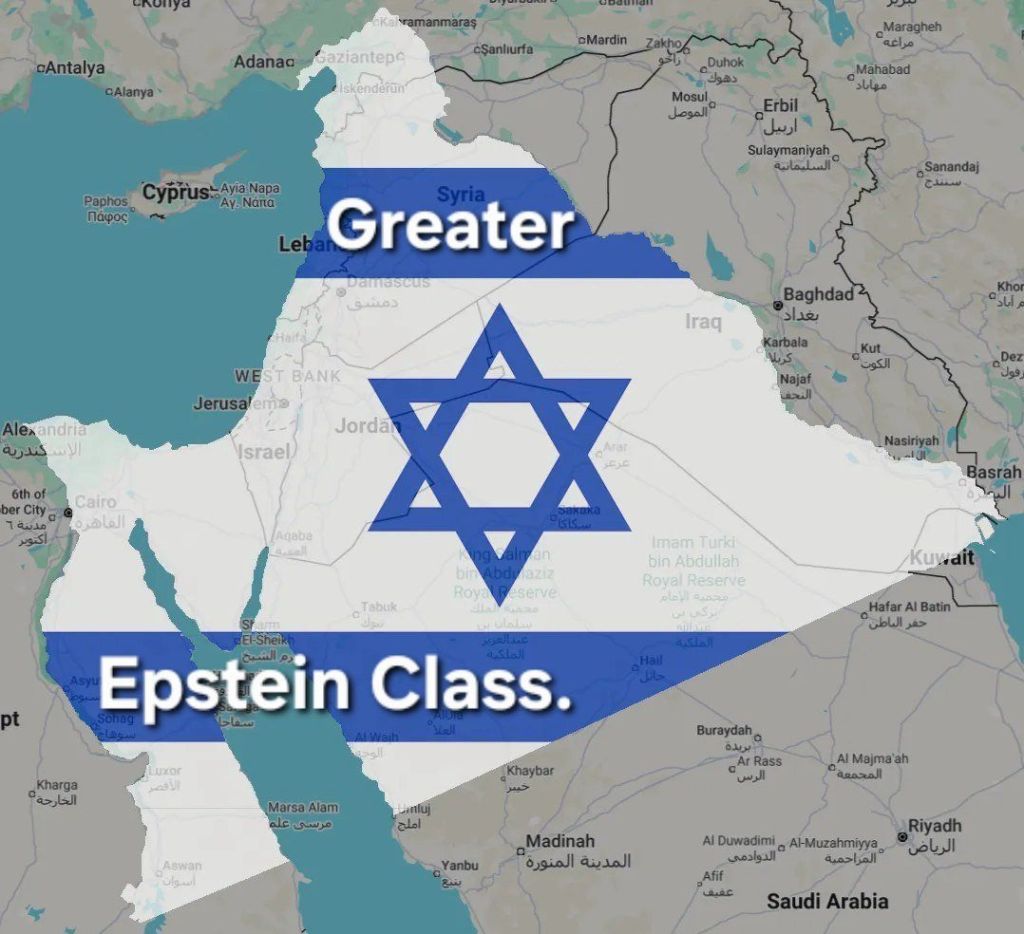
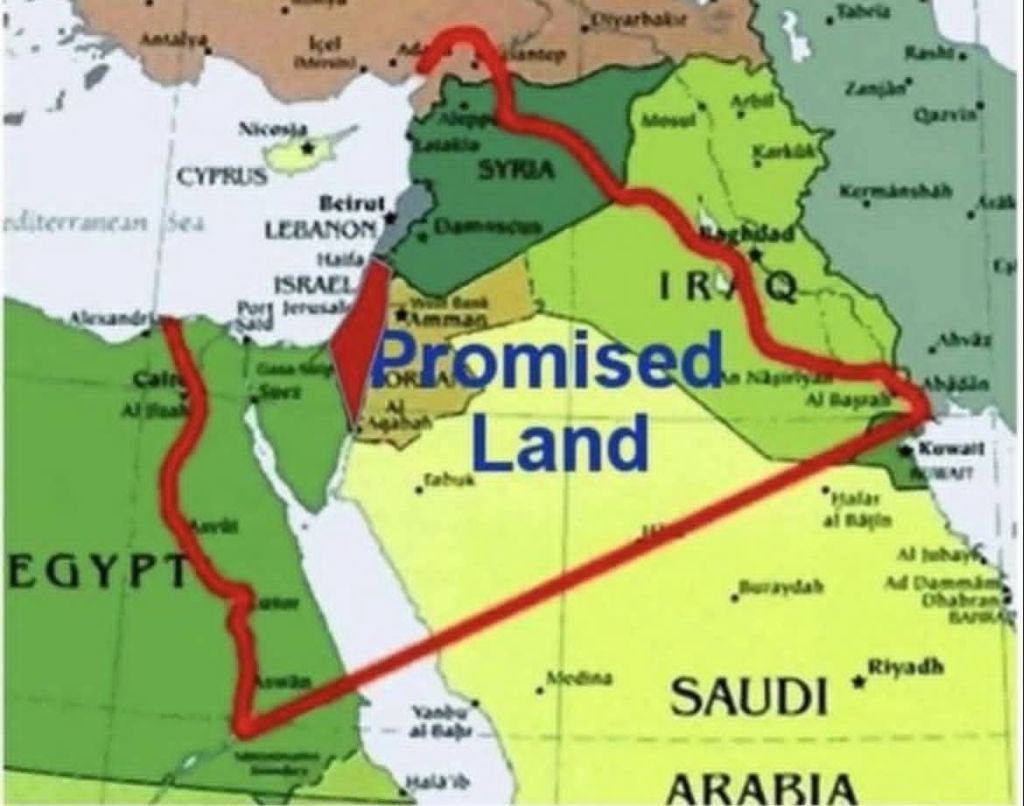
The 2003 invasion of Iraq must therefore be understood within this wider doctrinal and institutional context rather than as a spontaneous response to intelligence failures. The removal of Saddam Hussein eliminated a regime long considered adversarial by Washington, yet it also produced extensive privatised contracting opportunities for American firms involved in reconstruction, logistics, and energy services. Political economist Michael Parenti argued that the war could be considered a success for the interests that planned it, even if it failed to deliver stability or democratic consolidation for Iraq. Defense contractors, private security companies, and oil service corporations received substantial government contracts funded by American taxpayers, while the human and fiscal burdens were distributed across the broader population. From this perspective, the war’s outcome depended upon the vantage point adopted, that it was costly and destabilising for many, yet profitable and strategically clarifying for some.
The tension between democratic rhetoric and strategic calculation predates Iraq and extends to Iran. In 1953, the Central Intelligence Agency participated in the overthrow of Prime Minister Mohammad Mosaddegh after he nationalised Iranian oil assets, restoring monarchical rule under Mohammad Reza Pahlavi. That episode demonstrated that alignment with Western energy and security interests could take precedence over democratic process when the two came into conflict. Since the 1979 Iranian Revolution, the Islamic Republic has occupied a central place in American containment policy, facing sanctions, diplomatic isolation, and periodic military confrontation. The tools deployed against Tehran have included financial restrictions enabled by dollar dominance, secondary sanctions affecting third parties, cyber operations, and forward military deployments throughout the Gulf region. These instruments allow sustained pressure without formal declarations of war, thereby institutionalizing confrontation while avoiding full-scale invasion.
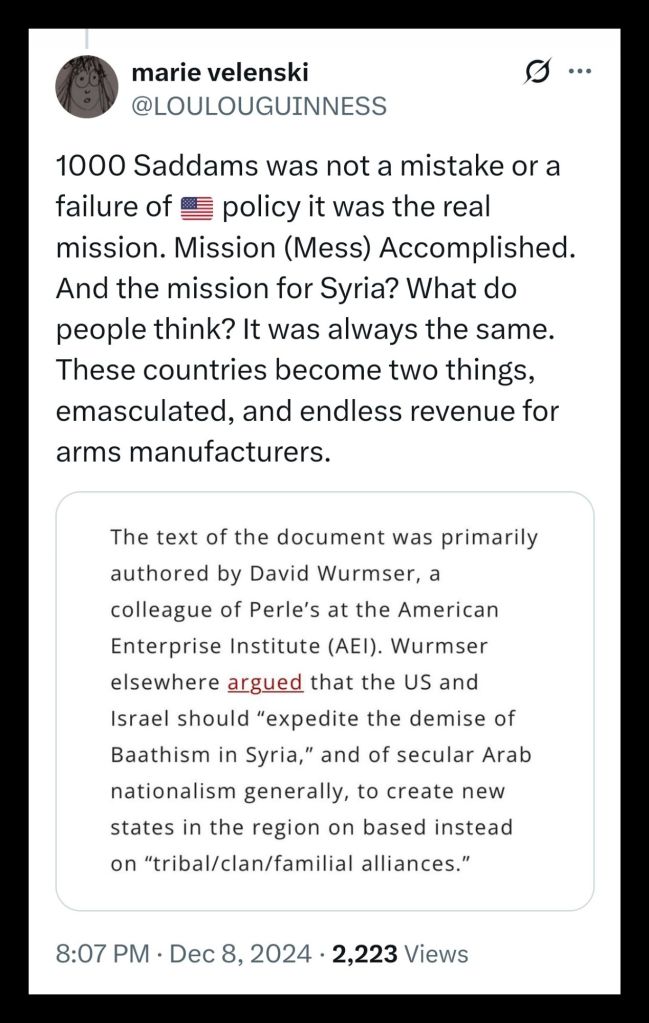
Debates about fragmenting adversarial states, whether in Iraq, Syria, or Iran, reflect a recurring strategic logic that divided polities pose less concentrated resistance than unified ones. Although such outcomes are rarely acknowledged as explicit objectives, discussions in policy circles have entertained the possibility that decentralization or internal partition could limit the capacity of hostile regimes to project power. The ethical and humanitarian consequences of such fragmentation, however, have proven severe in cases where state authority collapsed. Nevertheless, from a realist standpoint, the weakening of a rival may be judged advantageous even when the resulting order is unstable.
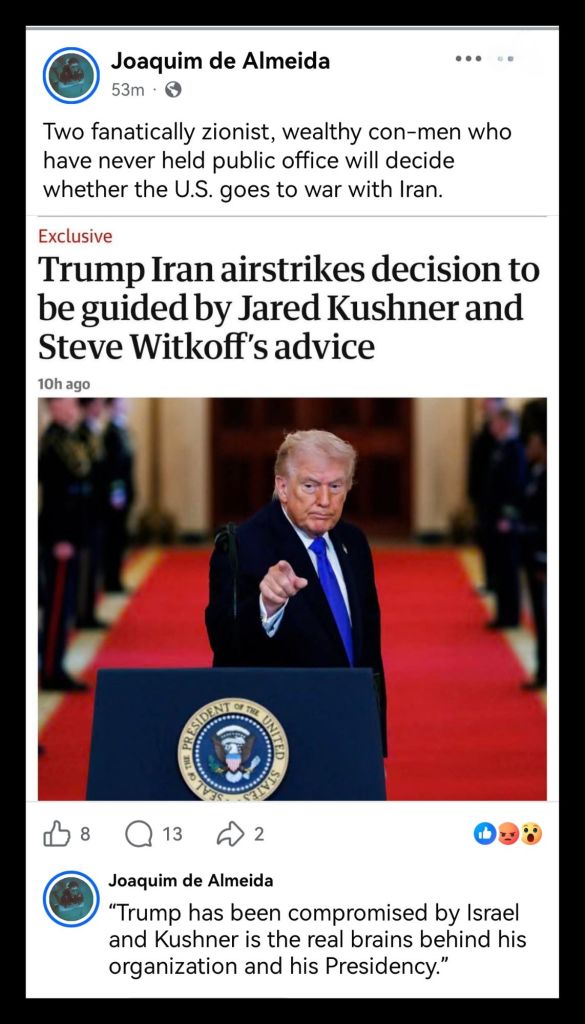
As tensions periodically intensify between Washington and Tehran, it is necessary to distinguish between declared ideals and operational incentives. Military action generates concentrated economic benefits for specific sectors, while distributing financial and human costs across the general public. Democratic language remains central to official justification, yet strategic dominance, alliance maintenance, and energy security consistently shape policy execution. The history of American engagement in the Middle East suggests that democracy promotion has often functioned as a legitimizing narrative accompanying a more enduring pursuit of geopolitical primacy. Any future confrontation with Iran will inevitably be assessed through competing lenses of security necessity and material interest, and its consequences will likely reveal once again the persistent gap between aspiration and structure that has defined the region’s modern history.
My article on how Iraq invasion was a success for the Epstein Class:
The Total Financial Subjugation of Iraq After 2003 by the United States
Why Iraq Governs Without Access to Its Own Income via an External U.S Banking Authority
Authored By: Global GeoPolitics
Thank you for visiting. This is a reader-supported publication. I cannot do this without your support. If you believe journalism should serve the public, not the powerful, and you’re in a position to help, becoming a PAID SUBSCRIBER truly makes a difference. Alternatively you can support by way of a cup of coffee:
https://buymeacoffee.com/ggtv |


Leave a comment