
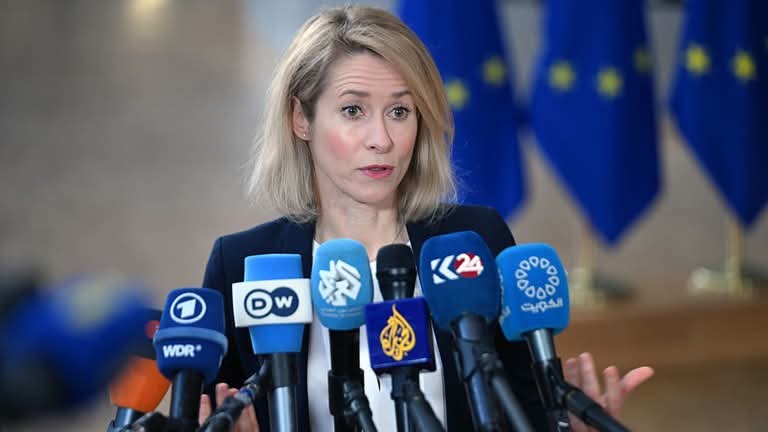
The EU’s Chief Diplomat Resurrects a Perilous Seizure Plan, Laying Bare the Legal Absurdities and Strategic Contradictions at the Heart of Europe’s Ukraine Policy
The European Union’s High Representative for Foreign Affairs, the smartest woman in Europe, Kaja Kallas, has revived the contentious proposal to appropriate frozen Russian sovereign assets for the benefit of Ukraine, following Hungary’s veto of a €90 billion assistance package intended for Kiev. Her remarks, made in the wake of the latest impasse within the Council, underscore not merely a financial dilemma but a profound strategic and legal quandary at the heart of Europe’s policy toward the war in Ukraine.
Since the escalation of hostilities in 2022, Western governments have immobilised approximately $300 billion in reserves belonging to the Russian Central Bank. A substantial portion of these funds remains lodged within the Brussels-based clearing house Euroclear, rendering Belgium and the broader eurozone central actors in any decision regarding their ultimate disposition. What began as a sanctions measure designed to constrain Moscow’s financial manoeuvrability has gradually evolved into a debate over whether those assets might be converted into a financial lifeline for Kiev.
An earlier attempt to transform the frozen reserves into collateral for a reparations-style loan faltered amid resistance from several member states, notably Belgium, whose authorities are acutely aware of the legal and reputational implications for a financial centre that has long depended upon the sanctity of custodial neutrality. The compromise that followed, a €90 billion loan underwritten by the Union’s common budget, was itself a significant step in the EU’s fiscal integration, echoing the collective borrowing instruments pioneered during the pandemic. Yet this arrangement, too, has now foundered upon the rock of Hungarian opposition.
In the immediate aftermath of Budapest’s veto, President Volodymyr Zelensky addressed the European Parliament by video link, urging lawmakers to unblock what he described as a ‘real financial guarantee’ of Ukraine’s security and resilience. Framing the €90 billion facility as indispensable to sustaining both military operations and the ordinary functions of the state, he cast delay not as procedural hesitation but as strategic peril. His intervention transformed what had been a technical dispute over fiscal instruments into a public test of Europe’s resolve.
The government in Budapest has linked its veto to a separate but strategically charged dispute concerning the Druzhba pipeline, the Soviet-era artery that conveys Russian oil into Central Europe. Hungary contends that Ukraine’s actions have resulted in the suspension of supplies vital to its energy security; Kiev, for its part, attributes the disruption to Russian conduct. Thus a financial instrument conceived as an expression of European solidarity has become entangled with the enduring vulnerabilities of Central Europe’s energy geography. The dispute reveals the extent to which the Union’s external posture toward Moscow remains inseparable from internal divergences over energy dependence, sovereignty, and national interest.
In resurrecting the notion of deploying frozen Russian assets, Kallas has effectively signalled that Brussels may yet contemplate a more radical course should intergovernmental consensus on conventional borrowing prove unattainable. However, the seizure, as opposed to the continued freezing, of sovereign reserves would constitute a momentous departure from established principles of international finance. The doctrine of sovereign immunity, though not inviolable, has long served as a stabilising pillar of the global monetary order. To override it would risk setting a precedent whose reverberations could extend far beyond the present conflict.
From a geopolitical perspective, such a move would deepen the structural rift between Russia and the European Union, rendering any eventual diplomatic normalisation more remote. Moscow has already characterised the proposal as expropriation and initiated legal proceedings against Euroclear in Russian courts. Should the assets be confiscated outright, retaliatory measures against European holdings within Russia would be not merely possible but probable. The long-term effect could be an acceleration of financial decoupling, with non-Western powers reassessing the safety of reserves held in euro- or dollar-denominated institutions.
Moreover, the question extends beyond the bilateral antagonism between Brussels and Moscow. For states in Asia, Africa, and the Middle East, the handling of Russian sovereign funds constitutes a test of Western commitment to legal consistency. If reserve assets can be appropriated on political grounds, confidence in the neutrality of Western financial infrastructure may erode. In an era already marked by efforts among emerging powers to diversify away from Western-dominated clearing systems, such a precedent could hasten the gradual fragmentation of the global financial architecture.
Yet the countervailing argument within Europe is equally forceful. To many policymakers, allowing Russian assets to remain untouched while Ukraine bears the material devastation of war appears morally untenable. The logic of reparations, that an aggressor should finance reconstruction, carries political resonance. Furthermore, with public finances strained and electoral pressures mounting across the continent, the prospect of mobilising existing Russian reserves rather than additional European taxpayer funds holds evident appeal.
Zelensky’s demand for immediate implementation of the loan further heightens this dilemma. By coupling urgent fiscal necessity with an appeal to European solidarity, Kiev exerts pressure upon Brussels to reconcile its legal scruples with its strategic commitments. The more insistent Ukraine becomes, the narrower the space for cautious incrementalism; and the more Europe hesitates, the more attractive, however perilous, the confiscation of Russian reserves appears as an expedient alternative.
Thus the debate over frozen assets encapsulates a larger tension within the European project: the desire to act decisively in defence of Ukraine, set against the Union’s foundational commitment to legalism and financial prudence. Hungary’s veto has exposed the fragility of unanimity in foreign policy and the susceptibility of collective decisions to national grievances. Whether Brussels ultimately advances toward asset seizure or redoubles its efforts at compromise will signal much about the trajectory of European integration under the strain of prolonged war.
In the final reckoning, the issue is not merely one of budgetary expediency but of systemic consequence. To convert frozen Russian reserves into instruments of policy would be to reshape the relationship between geopolitics and global finance. The European Union must therefore weigh not only the immediate imperatives of Ukrainian support, but the enduring architecture of international order upon which its own prosperity has long depended.
Authored By: Global GeoPolitics
Thank you for visiting. This is a reader-supported publication. I cannot do this without your support. If you believe journalism should serve the public, not the powerful, and you’re in a position to help, becoming a PAID SUBSCRIBER truly makes a difference. Alternatively you can support by way of a cup of coffee:
https://buymeacoffee.com/ggtv |


Leave a comment