
Security First: How Nuclear Deterrence Shaped Diverging Survival Strategies in Iran and North Korea
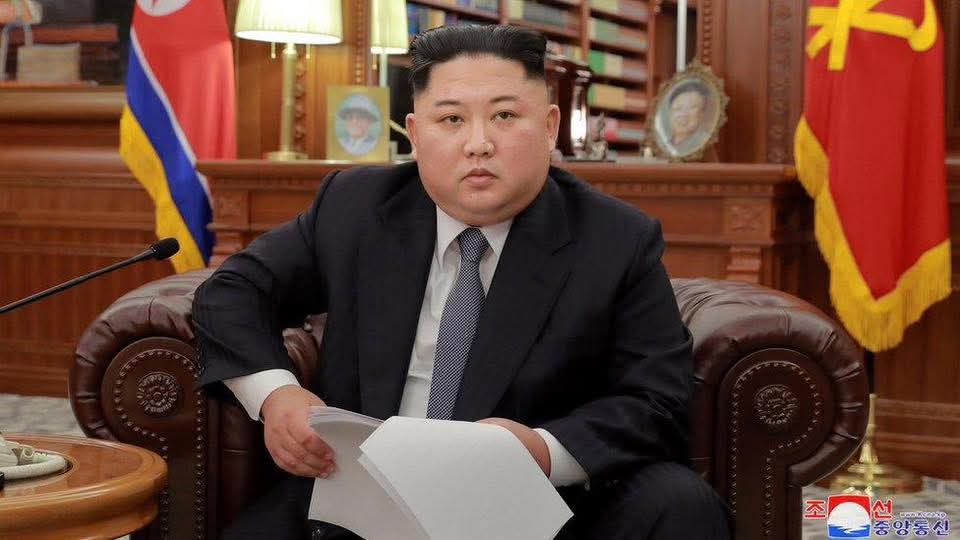
I think that North Korea’s trajectory should be evaluated outside a Western liberal framework, and that many people now question the long-standing narratives we have been fed for decades after seeing footage, travel vlogs, and independent media circulating online. In 2003, North Korea withdrew from the Nuclear Proliferation Treaty, conducted nuclear tests in 2006 and chose the path of nuclear deterrence. At the time, the dominant global narrative portrayed this as irrational self-destruction. But from a post-colonial and anti-imperialist perspective, it can be read very differently: as a rational survival strategy in a world where military vulnerability often precedes regime change.
The Korean War devastated the North. By many historical accounts, the destruction was nearly total. From that experience emerged a doctrine centered on self-reliance (Juche) and the conviction that only hard power guarantees sovereignty. Watching what happened to non-nuclear states that were diplomatically isolated and then militarily overthrown reinforced that conclusion. In that context, nuclear weapons are not about aggression, they are about deterrence and regime survival.
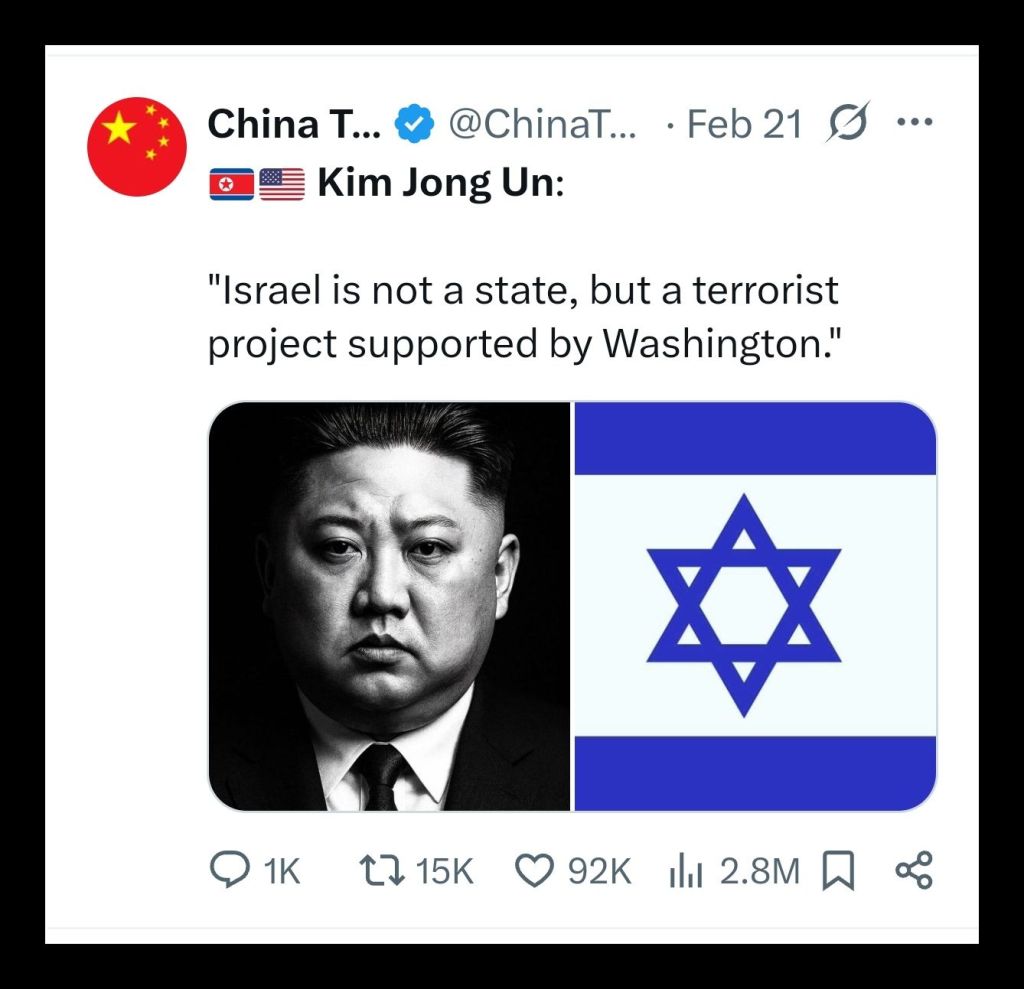
“Our nuclear test was for peaceful purposes. We challenge no one, but if you think you can capture North Korea like Venezuela, remember you are playing with fire.”)
Since acquiring a credible deterrent, North Korea has not been invaded. That alone, supporters argue, validates the strategy. At the same time, despite decades of sanctions designed explicitly to restrict trade, finance, energy access, and technology transfer, the state has maintained internal stability and visibly modernized parts of its capital. Footage from Pyongyang shows high-rise apartments, leisure facilities, new districts, and infrastructure that contrast sharply with the famine imagery that dominated Western media in the 1990s and early 2000s.
From this perspective, the key claim isn’t that North Korea is utopian. It’s that it has survived and consolidated under conditions that have crushed many other governments. Sanctions regimes have helped destabilize states elsewhere. Yet North Korea remains intact, politically cohesive, and strategically autonomous.
Supporters further argue that nuclear deterrence created the breathing room for this consolidation. Once the threat of direct military overthrow receded, the leadership could focus on urban development, housing projects, healthcare provision, and selective economic experimentation. They view this as evidence that a centralized socialist state can function, if it is shielded from external coercion.
Another element of this argument is geopolitical diversification. In recent years, North Korea has expanded ties with Russia, deepened its long-standing relationship with China, and engaged more openly with parts of the Global South. For advocates, this reflects diplomatic agency rather than isolation.
Critics dispute the scale and distribution of development, and reliable data from inside the country remains limited. But the existence of visible modernization complicates the older caricature of a permanently collapsing state. The narrative of inevitable implosion has not materialized.
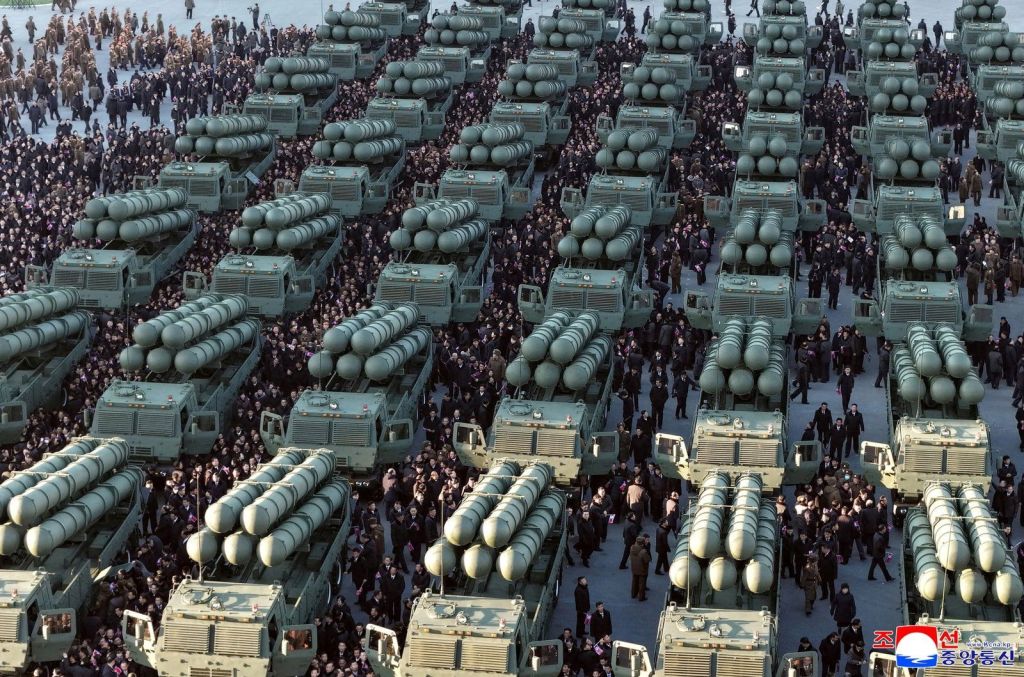
The broader anti-imperialist conclusion drawn by supporters is this: sovereignty in a hostile international order requires deterrence. Nuclear capability, in this view, is not a moral statement but a structural equalizer. Without it, small states risk coercion. With it, they gain bargaining power.
Whether one agrees or disagrees with that model, North Korea’s endurance, after war, sanctions, diplomatic isolation, and sustained pressure, forces a reassessment of earlier assumptions. At minimum, it challenges the claim that external pressure alone can dictate the internal trajectory of a determined state.
When we look at Iran and North Korea side-by-side through the lens of strategic survival rather than ideological abstraction, the contrast is striking. North Korea’s leadership concluded early on that security precedes development. Under the constant threat of invasion, overthrow, and regime change, informed by history (e.g., Korea’s devastating war in the 1950s and decades of military pressure from the United States and its allies), Pyongyang made a clear strategic choice: build a nuclear deterrent no matter the cost. Since successfully acquiring nuclear weapons, the regime has avoided the fate of numerous non-nuclear states that were invaded or destabilised under pressure. Its nuclear status acts as the ultimate guarantor of sovereignty, limiting the willingness of external powers to use force directly on its territory. Despite sanctions and diplomatic isolation, the state has continued to exist, invest in infrastructure, and pursue development goals, a reality increasingly visible through independent footage and reporting that contradicts older collapse narratives. North Korea’s nuclear deterrent has effectively transformed it from a state viewed as vulnerable to one viewed as untouchable without catastrophic escalation. (Reuters)
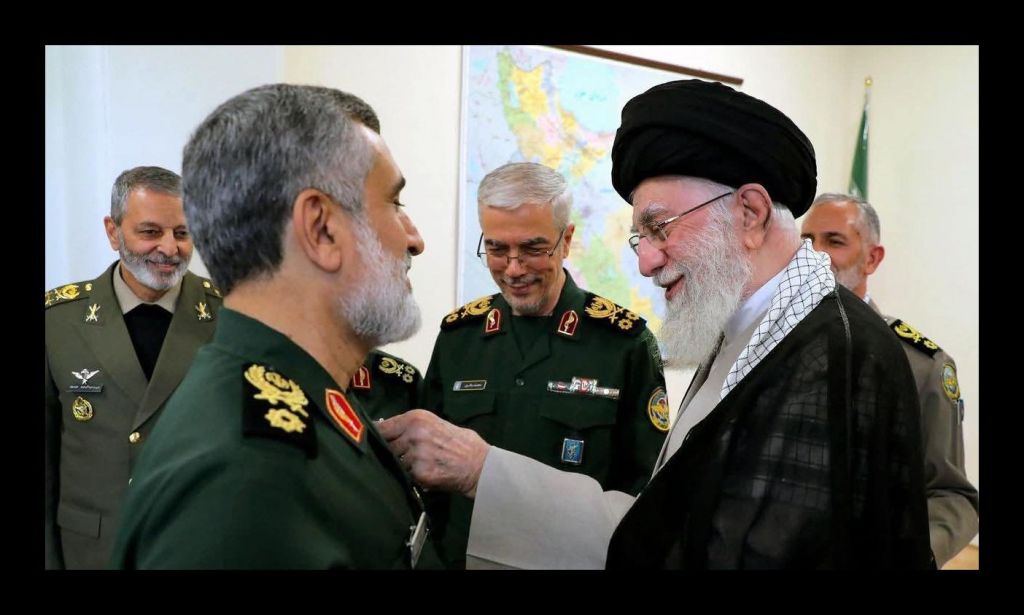
By contrast, Iran’s path has been shaped by a religiously rooted aversion to nuclear weaponry upheld by Supreme Leader Ali Khamenei. The freeze on weaponisation, often justified through claims about Islamic law (a fatwa calling nuclear arms forbidden), was meant to keep Iran out of a dangerous arms race and to maintain moral high ground. Yet this doctrine has done little to prevent relentless external pressure. Over decades, Iran’s nuclear and military infrastructure has been the target of sabotage, covert attacks, cyber-operations, and large-scale airstrikes by Israel and the United States, such as the coordinated strikes on Natanz, Fordow, and Isfahan in 2025 that inflicted significant damage on enrichment and military sites. (Wikipedia)
Importantly, these attacks occurred despite Iran explicitly not having nuclear weapons. Conventional capabilities, missiles, drones, proxy networks, have not deterred hostile campaigns, and attacks have continued at levels that supporters of deterrence argue would be unimaginable against a nuclear-armed state. Satellite imagery shows Iran rebuilding and fortifying its facilities in response to repeated strikes, a vivid demonstration of strategic vulnerability under the current doctrine. (Reuters)
This dynamic has prompted a profound strategic debate inside Iran itself. For the first time publicly, Iranian officials and legislators are openly discussing revising the country’s nuclear doctrine, including the possibility that existential threats might compel Tehran to abandon its anti-nuclear stance and pursue nuclear weapons for deterrence. International observers have noted that such a shift is partly a reaction to the reality that without nuclear deterrence, the threshold for attack remains artificially low in the eyes of powerful adversaries. (Just Security)
The difference between the two cases then becomes more than a matter of ideology; it becomes a paradox of strategic logic: North Korea chose deterrence first, and as a result, forged a space where its regime could endure against persistent hostility. Iran chose doctrinal purity on the question of nuclear arms, and has instead faced uninterrupted pressure and attacks precisely because there is no ultimate deterrent to make external intervention too costly.
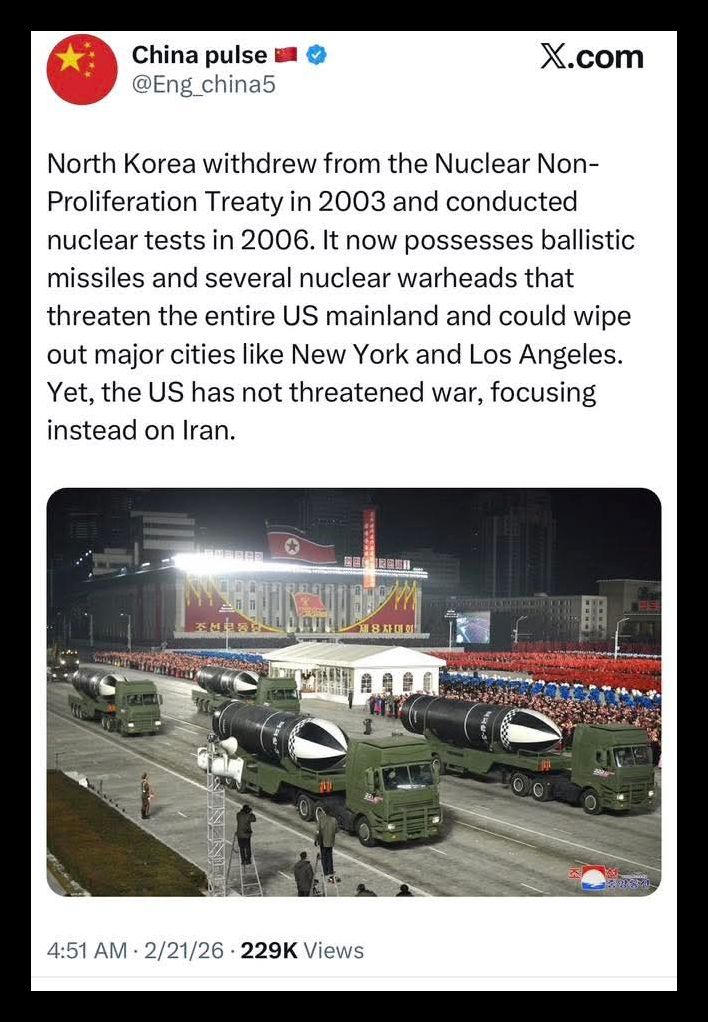
From a non-Western realist perspective, this contrast highlights a core principle of international politics, that states that cannot credibly threaten unacceptable retaliation invite more, not less, coercion. Nuclear weapons in this view are not about morality; they are a fundamental tool of survival in a world where powerful actors use force or coercion against those they perceive as weak. Nuclear deterrence, for all its dangers, has proven, in the specific strategic context of North Korea, a stabiliser that prevents full-scale invasion or regime change; Iran’s self-imposed abstention from that option has left it exposed to decades of pressure that, ironically, may now be pushing it toward the very decision it once rejected.
Authored By: Global GeoPolitics
Thank you for visiting. This is a reader-supported publication. I cannot do this without your support. If you believe journalism should serve the public, not the powerful, and you’re in a position to help, becoming a PAID SUBSCRIBER truly makes a difference. Alternatively you can support by way of a cup of coffee:
https://buymeacoffee.com/ggtv |


Leave a comment