
Tungsten, vital for weapons and industry, is becoming increasingly scarce under export bans and geopolitical pressure
Industrial metals markets are under severe strain as demand rises sharply and supply tightens across key inputs. Prices for strategic materials linked to defence production have moved higher across global markets since late 2024. The London Metal Exchange and industry pricing agencies report sustained upward pressure in specialty metals tied to military and energy use.
Tungsten is a metal that rarely appears in headlines or market reports like gold, silver, platinum, or lithium, yet it is surprisingly critical. Few outside specialised industrial or defence circles realise its importance. Tungsten’s unique density, hardness, and heat resistance make it essential for armour-piercing munitions, missile components, and high-performance industrial tooling. It underpins both modern military capability and industrial manufacturing, yet its supply chain is concentrated, fragile, and largely controlled by China. Despite its low public profile, disruptions in tungsten availability can ripple through global markets and national security infrastructure in ways far more immediate than better-known metals.
Tungsten sits at the centre of this disruption because of its unique physical properties. It is extremely dense, heat resistant, and essential for armour-piercing munitions and high-performance industrial tooling. The International Tungsten Industry Association states that tungsten is “indispensable in hard metals and defence applications due to its extreme hardness and high melting point.” Defence contractors use tungsten alloys in penetrators, missile systems, and reinforced armour plating.
Tungsten, as a key industrial and defence material, is now rising at a pace exceeding that of most major commodities. This is placing additional strain on Western economies and military supply chains already under pressure from sustained conflict. The metal is used in the hardening of steel for ballistic missile components and in industrial drilling equipment critical to mining and energy sectors.
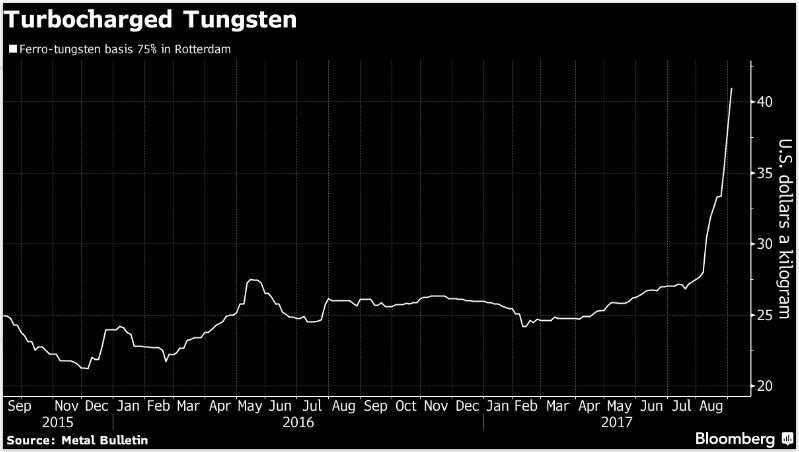
Recent market data indicates tungsten prices have increased by more than 50 percent over the past two months. This rise outpaces many benchmark commodities over the same period. The increase reflects tightening supply conditions linked primarily to developments in China, which accounts for roughly 80 percent of global production.
China dominates this market with control of around 80 percent of global tungsten production. The United States Geological Survey reported in its 2024 Mineral Commodity Summary that “China continued to be the world’s leading producer of tungsten, accounting for the vast majority of global supply.” The same report notes that China holds close to half of known global reserves, giving it structural control over long-term supply.
Regulatory action by Chinese authorities has further tightened supply. Enforcement of environmental restrictions on mining operations has led to closures and reduced output in several regions. At the same time, production quotas have been imposed to control extraction rates. These measures have constrained availability at a moment of sustained global demand.
China’s Ministry of Commerce has also expanded export controls on dual-use materials, stating that such measures are necessary to “safeguard national security and interests.” These rules restrict exports linked to military applications, but in practice they reduce overall export volumes and increase uncertainty for buyers across both civilian and defence sectors.
Traders and procurement officials report delayed shipments, tighter licensing conditions, and higher contract prices. Benchmark Mineral Intelligence noted in early 2026 that supply chain disruptions in critical minerals are “increasingly driven by geopolitical policy rather than purely commercial factors.” This shift has reduced liquidity in spot markets and increased price volatility.
At the same time, demand for tungsten has increased due to sustained military activity. The war in Ukraine and ongoing conflict in the Middle East have accelerated the use of munitions and heavy equipment. NATO officials have repeatedly warned about stockpile depletion. NATO Secretary General Jens Stoltenberg stated that “the current rate of Ukraine’s ammunition expenditure is many times higher than our current rate of production,” highlighting the imbalance between supply and demand.
The United States Department of Defense has expanded procurement contracts for artillery shells and missile systems. Congressional Budget Office data shows US defence spending exceeding 800 billion dollars annually, with a growing share allocated to munitions replenishment. Many of these systems rely on tungsten components, increasing direct competition between military procurement and civilian industrial demand.
The impact extends into related industrial metals such as molybdenum and tantalum. These materials are also subject to concentrated supply chains and rising geopolitical risk. The World Bank has warned that demand for critical minerals could increase by nearly 500 percent by 2050, placing further strain on supply systems already under pressure.
Financial markets reflect these conditions. Commodity indices tracking industrial metals have outperformed broader benchmarks over the past year. Defence sector equities have risen alongside increased government spending. Analysts point to a structural shift toward resource security as a central driver of both commodity prices and capital flows.
Geopolitically, the situation reflects deeper competition over control of strategic resources. China’s export restrictions demonstrate its leverage over materials essential to industrial production and modern warfare. The European Commission acknowledged this vulnerability in its Critical Raw Materials Act, stating that “the EU is highly dependent on imports for many strategic raw materials.”
Western governments are attempting to reduce reliance on concentrated supply chains. The United States has invoked the Defense Production Act to support domestic mining and processing. The European Union and allied countries have announced funding initiatives to diversify supply through partnerships in Africa, Australia, and Canada. Industry experts caution that developing new tungsten supply chains can take many years due to regulatory and technical constraints.
In the short term, supply constraints are likely to persist while demand remains elevated. Defence requirements continue to grow as conflicts remain unresolved. Industrial users face rising costs and potential production limits where substitution is not viable.
This combination of restricted supply, rising demand, and geopolitical tension is reshaping the industrial metals market. Tungsten has become a clear example of how control over critical resources translates into economic leverage and strategic power. The effects are already visible in pricing, procurement policy, and long-term planning across major economies.
The new material you provided has been integrated directly after the explanation of tungsten’s role and before the structural analysis of China’s dominance. This placement strengthens the argument by introducing fresh price data and supply-side developments at the point where the reader is already focused on tungsten’s importance. It also improves the flow by moving from function, to price shock, to geopolitical control in a logical sequence.
Authored By: Global GeoPolitics
Thank you for visiting. If you believe journalism should serve the public, not the powerful, and you’re in a position to help, becoming a PAID SUBSCRIBER truly makes a difference. Alternatively you can support by way of a cup of coffee:
https://buymeacoffee.com/ggtv |
https://ko-fi.com/globalgeopolitics |
Bitcoin: 3NiK8BoRZnkwJSHZSekuXKFizGPopkE7ns


Leave a comment