
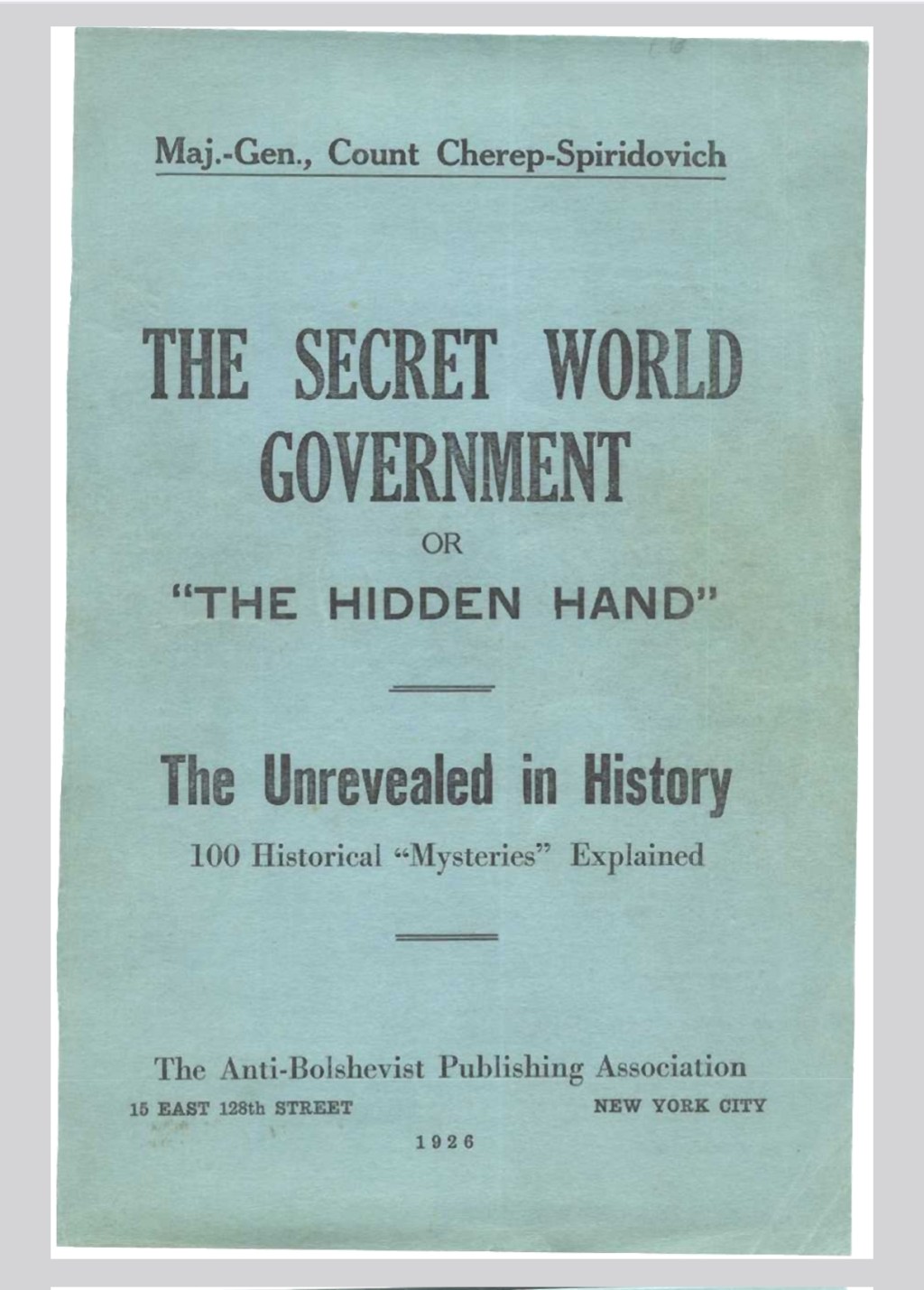
Almost a century ago, in the aftermath of the Russian Revolution, former Russian general Arthur Cherep-Spiridovich published “The Secret World Government, or The Hidden Hand.”
Writing in 1926, he argued that the great political upheavals of his era were not isolated or spontaneous events. He believed that behind revolutions, wars, financial systems and political movements stood a highly organized network of powerful individuals operating beyond the visible structures of government.
He called this network the “Hidden Hand” and claimed that it consisted of roughly 300 influential men. He identified international finance as one of its principal sources of power and argued that these networks could influence governments, political movements, the press and the direction of international affairs.
He wrote:
“Almost nobody knows that all the so-called Satanic forces are autocratically led by Pan-Judaism, headed now by Edouard Rothschild V-th in Paris… he and 300 others compose the World Government, the ‘Hidden Hand’.”
Cherep-Spiridovich was writing in a period of extraordinary upheaval: the First World War had destroyed empires, the Bolsheviks had seized power in Russia, revolutionary movements were spreading across Europe, and international finance was becoming increasingly interconnected.
He believed these developments represented something larger than ordinary political competition.
He warned of another world war. He examined the growing power of international financial interests. He anticipated continuing revolutionary upheaval and the expansion of Bolshevik influence beyond Russia. He emphasized the political power of newspapers, propaganda and control of information. He also warned that economic and financial power could increasingly operate across national borders, allowing powerful private interests to influence governments without formally controlling them.
Within two decades, the world had experienced another global war.
The Soviet Union had become a superpower. Communism had expanded across Eastern Europe and Asia. International financial institutions had become permanent features of the postwar order. Mass propaganda had become an indispensable instrument of modern warfare and politics. Political power increasingly operated through networks extending beyond individual nation-states.
Cherep-Spiridovich’s analysis therefore deserves to be examined on its substance, not dismissed simply because he described the forces behind these developments in conspiratorial terms.
There is also a striking continuity in the idea of a small group of approximately 300 powerful people. Decades later, John Coleman developed the concept of the “Committee of 300” in his book “Conspirators’ Hierarchy.” The idea did not originate with Coleman; references to a group of approximately 300 powerful figures already existed in earlier political literature, including the writings of Walther Rathenau and Cherep-Spiridovich.
The evidence establishes that powerful private networks, secret organizations, intelligence operations, financial interests and relationships between political and economic elites are real historical phenomena. The existence of such networks is not a matter of speculation.
The deeper question is how these networks interact, how much influence they exercise, and whether seemingly separate institutions sometimes function as parts of a larger structure of power.
That question is particularly relevant today, because the concentration of financial, political, corporate and informational power has grown enormously since Cherep-Spiridovich’s time.
His book is therefore worth reading not merely as an historical curiosity, but as an early attempt to map the hidden relationships behind visible political events.
Written in 1926, it offers a remarkable window into the way one observer understood the emerging architecture of global power and raises questions about that architecture that remain relevant a century later.
Global Geopolitics
You can read the book here:
https://dn790007.ca.archive.org/0/items/secret-world-government/secret-world-government.pdf
https://t.me/ggtvstreams
The Forgotten Book That Warned the World of What Was to Come
Arthur Cherep-Spiridovich, Bolshevik Revolution, Committee of 300, covert operations, elite networks, financial power, geopolitical power, global institutions, global power, hidden networks, historical conspiracies, intelligence agencies, international elites, international finance, mass media, new world order, political history, political influence, propaganda, Russian Revolution, secret government, secret societies, Soviet Union, The Hidden Hand, The Secret World Government, world government, World War II

One response to “The Forgotten Book That Warned the World of What Was to Come”
-
I have not read Arthur Cherep-Spiridovich’ book “The Secret World Government” or “The Hidden Hand”, but my own two books, “The Game of War and a Path to Peace” and “$$$$$s In Their Hearts” show that I think very much like the Russian author.
From what I read in this excellent GG article, I think there may be just one difference between Mr Cherep-Spiridovich book and mine: for me many of those 300 individuals work on behalf of religious corporations, who are in fact more experienced in business and waring matters than any banking, industrial or political concern.
LikeLike


Leave a comment