
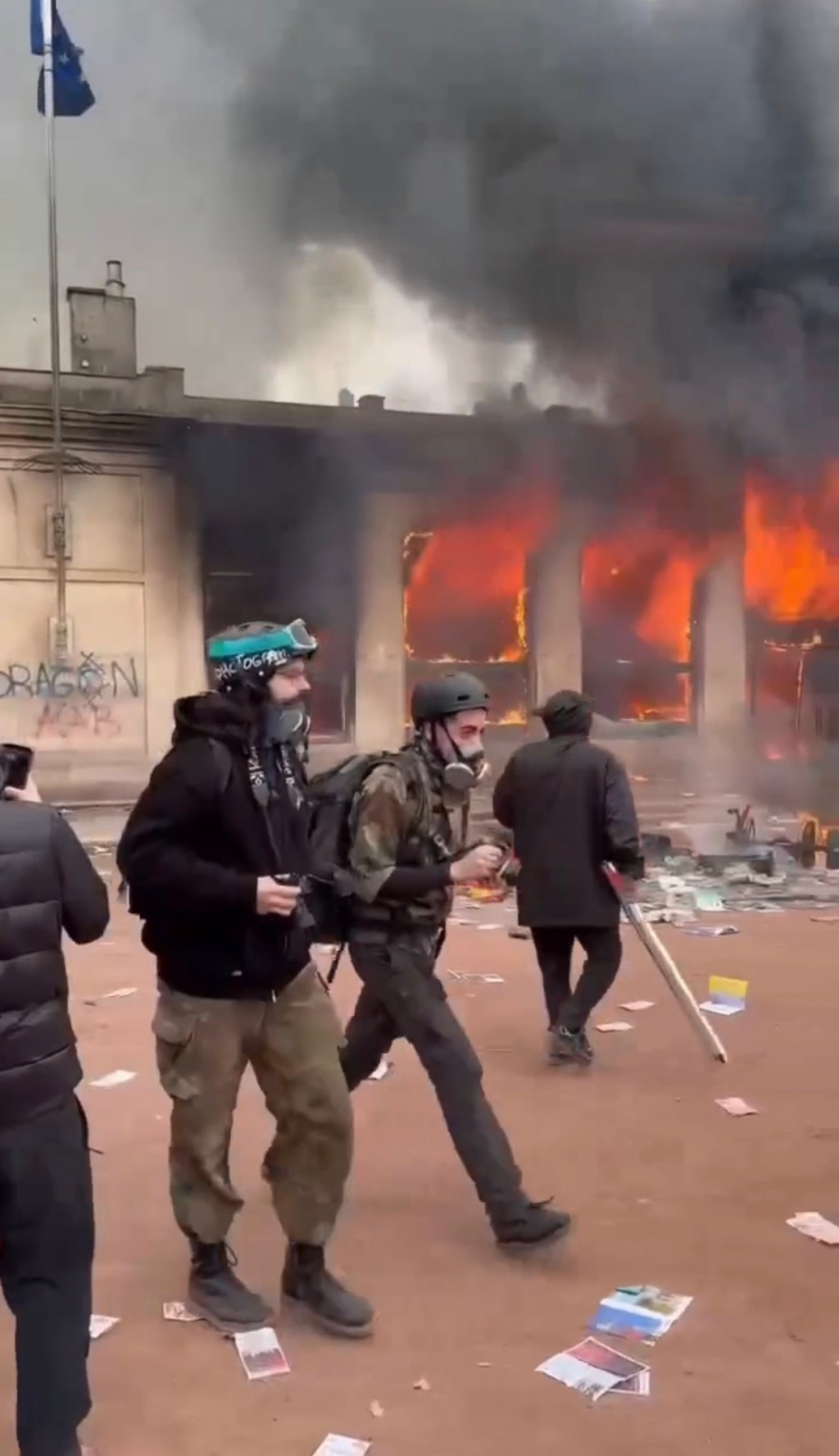
How the French state deploys troops to defend Saudi oil in the Middle East while enforcing brutal austerity and police repression against its own citizens at home.
Editorial Analysis | October 2026
The French Republic is currently witnessing an unprecedented convergence of domestic social combustion and quiet, lethal imperialist military deployment into the Middle East. While the streets of Paris and other major cities burn with the fury of half a million citizens protesting austerity and the soaring cost of living, the French government is simultaneously committing troops and air defence systems to protect the Saudi Arabian oil port at Yanbu. Paris officially classifies this military intervention in the Red Sea as strictly defensive, but placing French soldiers on a combatant’s soil during an active shooting war constitutes direct participation in the broader regional conflict. The profound significance of this dual reality lies in the stark contradiction between the state’s domestic rhetoric and its foreign actions. The government insists that there is absolutely nothing left in the public treasury to fund pensions or basic social services, yet it miraculously finds the financial resources and military personnel to defend another nation’s energy infrastructure. The timing of this quiet military deployment, occurring under the cover of massive domestic unrest, raises serious questions regarding the manufacturing of consent for war. A government sending its soldiers into someone else’s war naturally prefers the home front to be looking the other way, focused on tear gas and burning barricades. The overwhelming noise of the domestic inferno effectively drowns out the silence of the military deployment, allowing the state to proceed unchecked without public debate.
The material roots of the domestic French crisis are directly connected to this foreign military entanglement, a reality the French president himself briefly acknowledged. President Emmanuel Macron admitted during his emergency address that the high fuel prices provoking public outrage are intrinsically related to the Western war in Iran. The imperialist strategy pursued by the United States and its NATO vassals to control global energy flows and contain the multipolar world has triggered massive energy shocks across the European continent. The French working class is being forced to absorb the material costs of this imperial decline through devastating austerity measures, pension cuts, and a rapidly deteriorating standard of living. Rather than breaking with the American empire or demanding peace in the Middle East, the French state obediently transfers the burden of the crisis onto its own citizens. The structural contradictions of the Eurozone further exacerbate this dynamic, functioning as a deliberate mechanism of class rule designed to enforce austerity and redistribute wealth upwards. The Euro operates as a fixed exchange rate system that prevents necessary currency devaluations and forces capital flight from weaker economies like France to stronger ones like Germany. Because the French economy generates excess savings that are invested in Germany rather than domestically, the French state must run a large budget deficit by mathematical necessity. The resulting structural imbalance generates unsustainable deficits, which the state attempts to resolve through austerity by dismantling the social safety net.
The response of the French state to the protests exposes the true nature of liberal democracy as the dictatorship of the capitalist class. Macron’s emergency address mourning the destruction of looted stores and burned cars as an attack on France itself prioritizes private property over human suffering. He expresses no shame for the millions of workers unable to heat their homes and no anger at the billionaires hoarding the wealth. By attempting to separate peaceful protesters from looters and rioters, the state seeks to fracture the working class and isolate the most marginalized and desperate elements. This false dichotomy serves as a tactical justification for the inevitable police crackdown, utilizing the state’s monopoly on violence to protect the capitalist order. The liberal framework portrays the nation as the property, where damaging a luxury boutique is an attack on the state, but starving a pensioner is merely a statistic. The state’s monopoly on violence is unleashed not to protect the people, but to protect the wealth of the capitalists, ensuring that the brutalized and marginalized are isolated and crushed.
The social unrest sweeping across France is not an isolated phenomenon, but rather a manifestation of a broader European refusal to tolerate systemic immiseration. From the student-led protests in Albania demanding the resignation of the prime minister over the sale of coastal land to foreign developers, to the waves of unrest in Belgium, Italy, Portugal, and Greece, the same underlying anger is surfacing. Populations are reacting to rising costs, shrinking public services, and governments that continuously demand patience while elites carve up whatever remains to sell. The social contract that once guaranteed a modicum of stability in exchange for compliance has been systematically dismantled by decades of neoliberal policies. The ruling classes now face a continent-wide crisis of legitimacy as the material conditions of the working class deteriorate rapidly.
From a realist perspective, the French state is caught in a structural trap defined by its subordinate position within the American-led imperial hierarchy. Paris cannot break with Washington because its security and financial architecture remain tied to the broader Western alliance system. The deployment to Yanbu is a calculated, albeit desperate, move to secure energy supply lines in a losing geopolitical game, rather than a genuine defensive measure. The game-theoretic dynamics of the Eurozone reveal a zero-sum conflict where the German bourgeoisie extracts surplus value from the French economy through fixed exchange rates. France is trapped in a structural adjustment programme without the ability to devalue its currency or default on its debt without triggering a systemic collapse. The French state, trapped in the death throes of a vassal relationship to a declining American empire, cannot blame the true causes of the crisis because it manages that very system. The government offers only the theater of listening, promising to hear the concerns of the people while offering absolutely no material relief, no price caps, and no wage increases. The liberal state pacifies the masses with the illusion of representation while delivering the brutal reality of austerity and class war.
The political crisis also demonstrates the inevitable trajectory of the capitalist class when confronted with the threat of left-wing radicalism. The centrist and right-wing factions of capital, including the National Rally of Marine Le Pen, offer a false alternative that merely redirects working-class anger towards immigrants and the European Union while continuing the fundamental policies of austerity. Le Pen’s brand of fascism is a desperate attempt by the capitalist class to restore law and order and maintain the capitalist hierarchy, sacrificing the rights of the marginalized to ensure the survival of the system. The working class faces a stark choice between submitting to the dictatorship of capital and its fascist alternatives, or organizing to overthrow the capitalist state. Without a disciplined revolutionary vanguard to lead them, the spontaneous anger of the masses remains vulnerable to repression or co-optation by the far-right. The ultimate resolution of the crisis requires the construction of a disciplined Marxist-Leninist organization capable of leading the working class in the overthrow of the capitalist system. The abolition of the Eurozone as an instrument of financial oppression and the establishment of a socialist society based on the dictatorship of the proletariat remain the only viable paths forward for the European working class.
Authored By: Global GeoPolitics
Thank you for visiting. This is a reader-supported publication. If you believe journalism should serve the public, not the powerful, and you’re in a position to help, becoming a PAID SUBSCRIBER truly makes a difference. Alternatively you can support by way of a cup of coffee:
https://buymeacoffee.com/ggtv |
https://ko-fi.com/globalgeopolitics |
Bitcoin: 3NiK8BoRZnkwJSHZSekuXKFizGPopkE7ns
References
Bank for International Settlements (2025) Annual Economic Report: Monetary Unions and Structural Divergence. Basel: BIS. Available at: https://www.bis.org (Accessed: 19 October 2026).
Berletic, B. (2026) French Protests and Eurozone Crisis. The New Atlas. Available at: https://www.youtube.com/@TheNewAtlas (Accessed: 19 October 2026).
Eurostat (2026) Capital Intensity and Productivity in the Eurozone. Brussels: European Commission. Available at: https://ec.europa.eu/eurostat (Accessed: 19 October 2026).
Le Monde (2026) ‘Macron addresses the nation as protests escalate’, Le Monde, 17 October. Available at: https://www.lemonde.fr (Accessed: 19 October 2026).
Varoufakis, Y. (2026) The Eurozone Crisis and the Perpetual Bond Proposal. DiEM25. Available at: https://diem25.org (Accessed: 19 October 2026).


Leave a Reply