

Unpacking the geopolitical logic, economic fallout, and structural rebalancing of global trade

If the United States imposes a 100 percent tariff on Chinese goods starting November 1, 2025, in response to China’s newly intensified export controls on strategic minerals, we are witnessing a structural escalation rather than mere posturing. That move vastly expands the economic front of U.S.–China confrontation; it tilts the balance toward a multi‑dimensional conflict in which trade, technology, supply chains, finance, diplomacy and potentially military posturing become battlegrounds. The question is not whether China will respond, but how, where, and with what effectiveness. The deeper question is whether this titanic gamble will succeed in enforcing U.S. objectives and what the final settlement, if any, might look like.
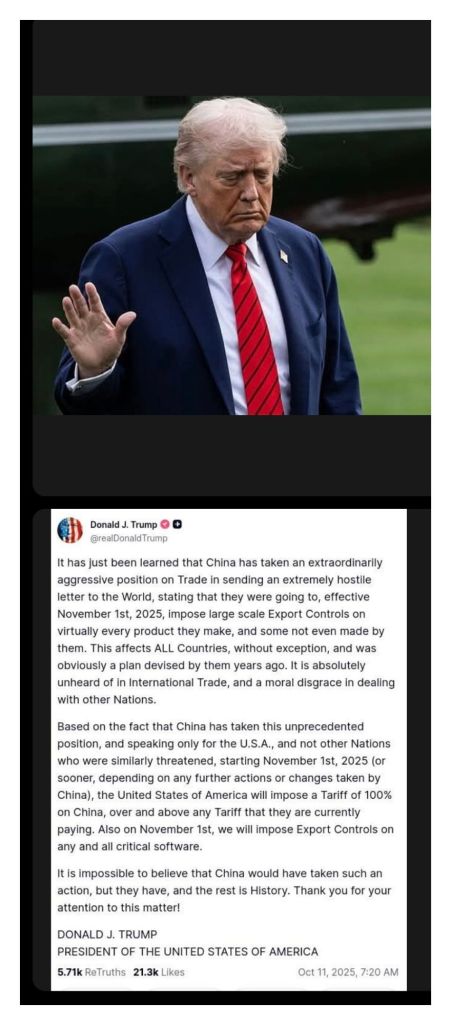
From a purely arithmetic perspective, a 100 percent tariff marks an extreme measure. Under such rates, Chinese exports to the U.S. would face a de facto doubling of cost, rendering a vast proportion uncompetitive, particularly in lower‑margin products or goods with elastic demand. According to a scenario crafted by the Economist Intelligence Unit, such a shock could cause China’s exports to the U.S. to decline by roughly 6 percent in the first year, rising to an average drop of 10 percent annually over three years if substitution effects intensify. The EIU estimates an aggregate hit to China’s real GDP of 2.5 percentage points over 2025–27, including knock‑on effects on investment and consumption. (Economist Intelligence Unit) Goldman Sachs, in more moderate terms, has projected that China’s growth forecasts must be cut by 0.5 percentage points in both 2025 and 2026, even after assuming stimulus measures. (goldmansachs.com) Thus, the economic consequences are likely to be severe, barring extraordinary countermeasures.
In the face of such a shock, China’s response will need to be multipronged. It cannot fight a tariff war purely on tariffs, because tit‑for‑tat reciprocal tariffs of equal magnitude would inflict self‑harm, especially on exports of American agricultural goods or high‑value industrial items. Instead, it will deploy monetary and fiscal policy aggressively, expand internal demand, reorient trade networks, weaponize export controls, escalate strategic diplomacy, and leverage political and financial organ systems beyond tariffs.
On the macroeconomic front, Beijing is already preparing accommodative policy. It has room to reduce the reserve requirement ratio (RRR), cut interest rates, increase fiscal deficit spending, and provide targeted subsidies to export sectors or distressed regions. Indeed, Goldman Sachs estimates that the Chinese government may add 6 trillion RMB (roughly $823 billion) in net spending compared to 2024 levels to dampen the external shock. (goldmansachs.com) The EIU scenario envisions a cumulative 200 basis‑point cut in RRR and 60 basis points in policy rates over 2025–27. (Economist Intelligence Unit) However, such stimulus has limits in China’s structural context: debt levels are high, local governments risk collapse, real estate remains fragile, and marginal returns from further stimulus diminish. Moreover, the sheer scale of the external shock will force capital outflows and downward pressure on the renminbi, a problem Beijing must juggle carefully to avoid triggering a currency crisis.

Thus China will likely adopt a managed devaluation rather than aggressive collapse of its currency. The EIU expects a temporary slide to around RMB 8 against the dollar, before stabilizing in the RMB 7.7–7.8 range via intervention. (Economist Intelligence Unit) Beijing’s strategy is to protect export competitiveness without unleashing runaway inflation or destabilising debt stress. The challenge is enormous.
On trade and supply chains, China will accelerate and deepen the “China + 1” reconfiguration of global value chains (GVCs). An important recent study of supply chain realignment under overlapping crises (pandemic, Ukraine war, U.S.–China tensions) shows that China’s exports remained robust, embedding upstream segments into Asian, European, and regional intermediaries. The authors warn that true decoupling is highly difficult; the U.S. will struggle to fully replace Chinese input chains or upstream manufacturing dependencies in the near term. (arxiv.org) China will lean further into this advantage, cementing its upstream position while shifting final assembly or downstream processing to partner countries in Southeast Asia, South Asia, Africa, and Latin America. Through such diversification, China seeks to blunt the full impact of U.S. tariffs while preserving technological leverage.
China’s export controls on critical minerals, nickel, lithium, rare earth components, will be a major lever. Beijing may expand blacklists, restrict exports to certain jurisdictions, throttle supply, or redesign licensing schemes to disadvantage U.S. firms. Already, China has announced some export controls on strategic minerals, citing non‑proliferation and national security obligations. Such moves directly strike at U.S. industries that depend on Chinese supply chains for batteries, semiconductors, aerospace, EVs, and defence components.
In diplomacy, China will intensify pressure on countries reliant on its trade, investment or infrastructure, promising favorable terms, credits, or market access to win alignment or neutrality. It will push BRICS, ASEAN, the Global South, Africa, Latin America, and regional blocs to resist U.S. pressure, advocating multipolarism. It will also lean on supply chains and financial infrastructure: China’s cross‑border payment system (CIPS), its growing use of bilateral currency swaps and the potential development of digital currency rails offer alternatives to U.S.-dominated financial systems. A recent study models how geopolitical tensions are driving migrations away from systems like SWIFT toward alternative networks, with participants in Russia, India, Saudi Arabia, Argentina already shifting. (arxiv.org) That financial fragmentation is a strategic asset for China in resisting U.S. financial coercion.
China also retains structural advantages of time, scale, state capacity and the imperative of regime cohesion. Top Chinese strategic thinkers operate on multi‑decade timelines rather than election cycles. As Dean Cheng, a scholar at the U.S. Institute of Peace, argues, Chinese grand strategy is not reactive, but forward‑looking. “When we talk about the Chinese having a long‑term plan, we’re not talking one year or two years, we’re talking decades.” (United States Institute of Peace) That orientation gives China the patience to absorb initial damage and fight a war of attrition across domains.
Nevertheless, considerable obstacles lie ahead. China’s demographic decline, rising debt, internal inequality, real estate instability, and local government fiscal stress weaken its buffer. Escalated stimulus or debt guarantees could trigger moral hazard, banking fragility, or inflation. Capital flight and external debt pressure will mount. The harder the economic squeeze, the greater internal dissent risk, especially in provinces or sectors heavily exposed to U.S. markets. Furthermore, U.S. industries, consumers and political actors may feel inflationary pain, but the U.S. retains the capacity to absorb shocks via its reserve currency, financial dominance, military alliances and defense reach.
Would the U.S. blockade of Chinese trade succeed in forcing Beijing to capitulate to U.S. demands? Doubtful. The U.S. lacks the capacity to fully replace China in many critical industrial supply chains within short timeframes. Even aggressive subsidy or reshoring policies in the U.S. will take years, if possible, and will carry enormous fiscal burden. The systemic interdependence is deep. A Trump administration may count on geopolitical shock to coerce China, but China is unlikely to concede on strategic domains such as technological sovereignty, supply chain fate, or the China model itself. The confrontation is less about short‑term trade balances than about systemic order.
The more plausible outcome is a negotiated accommodation under duress, something like a “truce with teeth.” China may agree to modest loosening of export controls, concessions on certain sectors, increased market access to partners aligned with the U.S., or establishment of dispute resolution frameworks, but only in return for rollback of tariffs or freeze of escalation. That is, the final equilibrium is likely to be a Cold War style modus vivendi, not total surrender.
Geopolitically, the consequences of this escalation are profound. The global order will fracture further: we may see distinct blocs organized around the U.S. and China, with third parties forced to pick sides or balance carefully. Already, institutions and financing networks are bifurcating. Countries in Asia, Africa, Latin America may face coercive pressure from both sides and will pursue hedging strategies. The BRICS bloc, regional trade agreements excluding the U.S., and alternative financial architectures will gain greater traction. The hegemony of U.S. financial and trade norms will face existential challenge. The rhetoric of “decoupling” will accelerate practical decoupling in technology, supply chains, and ideology. Financial fragmentation will increase, sanction regimes will intensify, and currency alliances may erode dollar dominance incrementally.
In East Asia, flashpoints loom: Taiwan, the South China Sea, and missile deployment zones become more tense. The U.S. might respond to China’s softer front (economic) aggression with harder power measures, naval posturing, island fortification, security pacts with Japan, South Korea, Australia, possibly prepositioned deterrence. China must decide whether to escalate militarily or hold in the economic and diplomatic domains. The risk is that economic war becomes kinetic war. The United States may see escalation into conventional or hybrid conflict as logical if Beijing pressures Taiwan or cuts off straits. China must ensure its military, nuclear, missile deterrent and anti‑access / area denial (A2/AD) systems are ready for escalation.
In sum, the war between China and the U.S. would be a war of attrition, not blitz. The initial U.S. gambit of 100 percent tariffs seeks to shock, destabilize Chinese confidence, fracture Chinese alliances, and raise the political cost of continued resistance. But Beijing has both the motive and the capacity to respond. It can mitigate initial damage through stimulus, reorientation of trade, export control, strategic diplomacy and financial infrastructure decoupling. It can endure a long, grinding confrontation that taxes U.S. political will more than Chinese resilience, particularly if the U.S. faces internal opposition over inflation, recession or systemic backlash.
Victory in the narrow sense of forcing China to reverse core policies or cede sovereignty is unlikely. But success in a narrower objective, pulling concessions, locking China into rules, weakening its long‑term momentum, reshaping supply chains in favor of U.S. allies, may be plausible. The end game is not Chinese collapse, but managed containment under duress, with a new global order of bifurcated blocs, reduced integration, and perpetually high tension. That is the realistic equilibrium one must expect from this confrontation.
The escalation has now moved beyond tariffs into a multi-domain contest marked by synchronised retaliatory measures on both sides. On 11 October 2025, President Trump announced not only a 100% tariff on all Chinese goods but also new export controls targeting all categories of critical software, effective from 1 November. This action signals an overt weaponisation of the software ecosystem and reveals the deepening of U.S. industrial policy objectives aimed at severing Chinese access to key digital infrastructure. The inclusion of “all critical software” remains intentionally broad, giving the U.S. Department of Commerce and the Bureau of Industry and Security discretionary power to restrict categories that include, but are not limited to, semiconductor design software, aerospace systems, AI development platforms, and cryptographic tools. The purpose of this move is to halt China’s technological trajectory and reinforce a digital iron curtain between the two systems.
China’s response has been neither passive nor symbolic. Beijing has launched a set of precisely targeted countermeasures timed to coincide with U.S. actions. Most notably, China initiated antitrust investigations into two major U.S.-linked technology companies: Qualcomm and Nvidia. The Qualcomm case concerns its attempted acquisition of Autotalks, an Israeli firm specialising in autonomous driving systems, while Nvidia is under renewed scrutiny for alleged violations of conditions imposed during its acquisition of Mellanox. These actions serve several functions simultaneously: they constrain the operations of strategic competitors, send a deterrent signal to other Western tech firms active in China, and demonstrate China’s ability to use its regulatory framework as a geopolitical tool.
In a parallel move, China has introduced port fees specifically targeting vessels connected to U.S. entities. These fees apply to any ship that is U.S.-flagged, U.S.-built, or operated, owned, or even partially financed by U.S. companies. Implementation begins 14 October, precisely the same day the United States imposes increased port service fees on Chinese-built, -flagged, or -operated vessels. The mirroring of these policies is not coincidental but strategic; both sides are now actively disrupting maritime logistics and signalling a willingness to fragment global shipping networks, one of the last remaining spaces of mutual interdependence. Independent shipping analysts, such as Greg Knowler of the Journal of Commerce, note that these disruptions, if sustained, could lead to structural reshoring of port operations and the regionalisation of maritime trade corridors by 2026.
China’s Ministry of Commerce and the General Administration of Customs also announced new export controls targeting strategic materials, including five types of medium and heavy rare earths (such as holmium), equipment for rare earth processing, superhard materials, and components critical to lithium batteries and artificial graphite anodes. These restrictions, effective from 8 November, target vulnerabilities in Western high-tech manufacturing chains, particularly those tied to renewable energy storage, electric vehicles, and defence systems. According to a 2024 report by the Centre for Strategic and Budgetary Assessments, 79% of rare earth processing globally is still controlled by China, even if mining has diversified slightly. Thus, these measures could delay Western energy transition timelines and defence procurement cycles significantly.
Simultaneously, China National Mineral Resources Group (CNMRG) has signed an agreement with BHP Billiton to settle spot iron ore transactions in renminbi (RMB), beginning in Q4 of 2025. This is a calculated strike at the petrodollar-style dominance of the U.S. dollar in commodity markets. BHP, although headquartered in Australia, remains heavily exposed to U.S. capital markets and institutional investment, and sells approximately 40% of its iron ore output to China. The agreement effectively gives China more control over the price benchmark of iron ore while reducing its vulnerability to fluctuations in dollar liquidity and U.S. sanctions risk. As noted by Zoltan Pozsar, formerly of Credit Suisse and now at Ex Uno Plures, such de-dollarisation initiatives represent a “long-term structural unbundling of global finance from U.S. military and economic hegemony.”
Though rarely acknowledged by mainstream media, these moves have been interpreted by several independent analysts as part of an explicit strategy of asymmetric economic warfare. Alexander Mercouris, writing for The Duran, argues that China’s tactics are “calibrated to exact maximum economic pain without breaching thresholds that invite open kinetic conflict.” Economist Michael Hudson concurs, noting that “by targeting shipping and minerals, China attacks the arteries of empire, its supply chains and resource pricing power, without needing to fire a single shot.” Whether such tactics succeed in forcing the U.S. to de-escalate is another matter. Washington appears committed to intensifying pressure across every axis, viewing this conflict as not merely economic, but existential.
Crucially, the imposition of simultaneous measures by both parties, tariffs, export controls, shipping sanctions, antitrust probes, and currency realignments, suggests that this is not a transient trade dispute. It marks a phase shift in the U.S.–China confrontation, where each domain of interdependence becomes a potential theatre of contest. The cumulative effect of these actions, supply chain fragmentation, financial de‑risking, industrial policy realignment, and bloc-based trade, is nothing short of a reconfiguration of global economic architecture. China’s moves, especially on critical minerals and port infrastructure, are not retaliatory in the narrow sense but represent a coherent counter‑offensive grounded in long-term strategic planning.
The implications for global governance institutions are equally stark. Institutions like the WTO, IMF, and World Bank are being marginalised as both powers disregard rule-based norms in favour of coercive economic statecraft. The recent Chinese port fees and antitrust investigations were imposed without recourse to international adjudication, just as the United States made its tariff and software export decisions unilaterally under the Section 301 framework. This collapse of multilateral dispute mechanisms signals the erosion of post–World War II economic governance and the rise of great power-managed spheres of influence. In essence, both powers are now operating under the logic of exclusion rather than integration, with third countries increasingly compelled to align with one bloc or another.
These developments occur in the shadow of the upcoming APEC Summit. Yet, as even Chinese analysts close to the leadership have noted, the likelihood of productive dialogue is rapidly diminishing. If APEC does proceed, it will do so without substantive negotiation, merely serving as a platform for rhetorical entrenchment. Trump has already publicly questioned whether the meeting is worth attending, given the “unprecedented aggression” from Beijing. For its part, Beijing appears equally disinterested in symbolic diplomacy that yields no strategic dividends. In this context, summits no longer offer off-ramps, they have become stages for the airing of irreconcilable positions.
Authored By: Global Geopolitics
Popular Information is powered by readers who believe that truth still matters. When just a few more people step up to support this work, it means more lies exposed, more corruption uncovered, and more accountability where it’s long overdue. If you believe journalism should serve the public, not the powerful, and you’re in a position to help, becoming a PAID SUBSCRIBER truly makes a difference.
buymeacoffee.com/ggtv
https://ko-fi.com/globalgeopolitics


Leave a comment