
Why industrial dependence and surrender-era agreements undermine Tokyo’s push toward confrontation
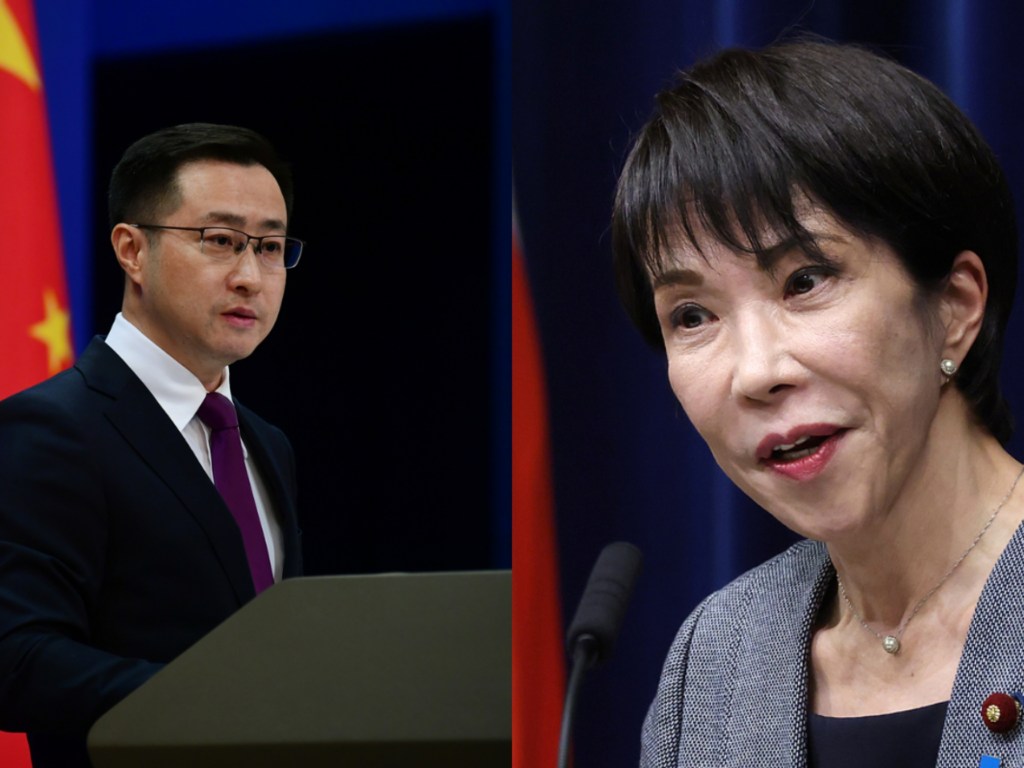
The dispute between Japan and China became clearer once official statements confirmed the issue involved military supply restrictions rather than general trade policy. Japan’s prime minister, Sanae Takaichi, publicly committed her government to accelerated remilitarisation and explicit preparation for potential conflict with China. That announcement collided almost immediately with industrial reality, revealing structural dependence on Chinese-controlled supply chains essential for modern weapons production.
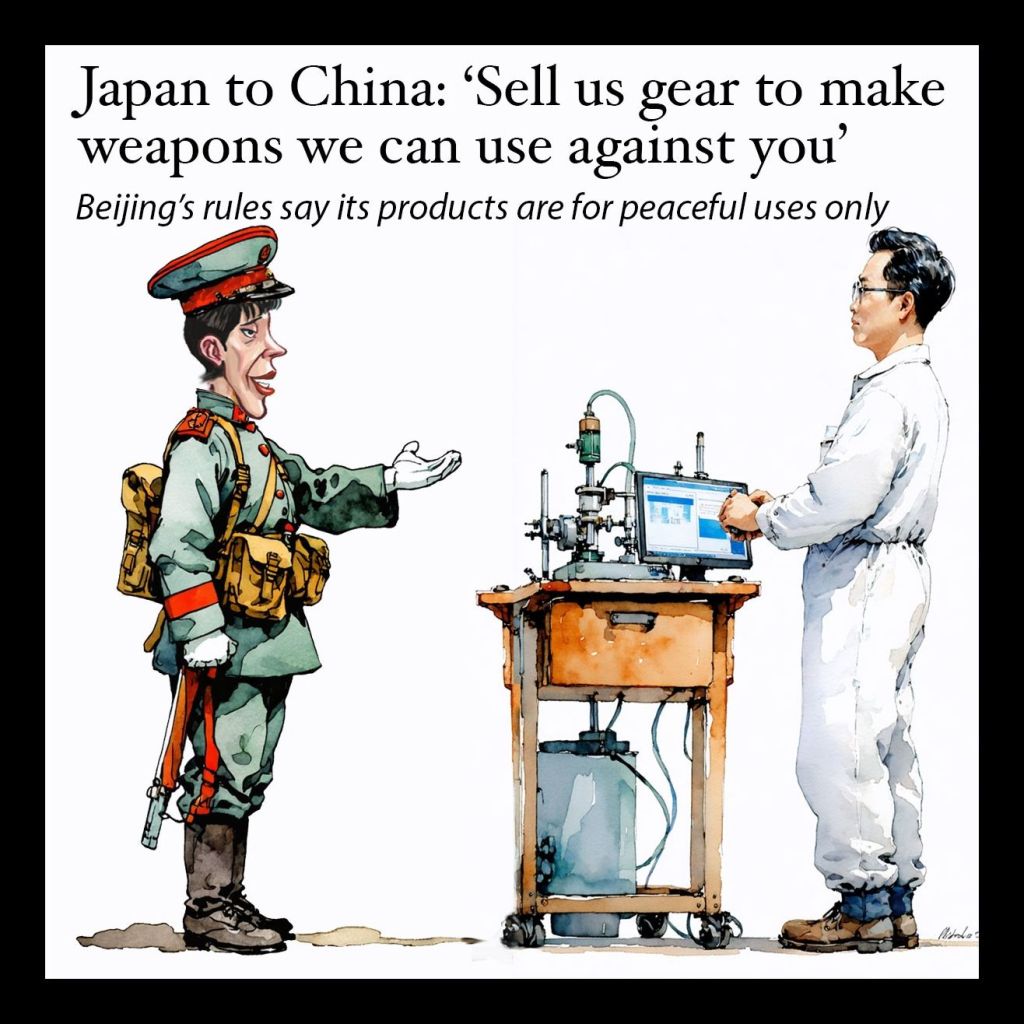
The situation involved material constraints in weapons production rather than disagreement over diplomatic phrasing. Japanese defence planners cannot produce advanced missiles, drones, aircraft, or guidance systems without access to specific rare earth elements and precision components overwhelmingly refined and supplied by China. When Beijing clarified that such materials would not be exported for hostile military use, Tokyo responded with diplomatic outrage rather than strategic recalibration.
China’s position was articulated through the Ministry of Commerce of the People’s Republic of China in a January 6 statement that avoided escalation language. The statement did not announce a general export ban and did not target civilian or peaceful trade. It specified that dual-use items would not be approved for export where end use involved military deployment against China.
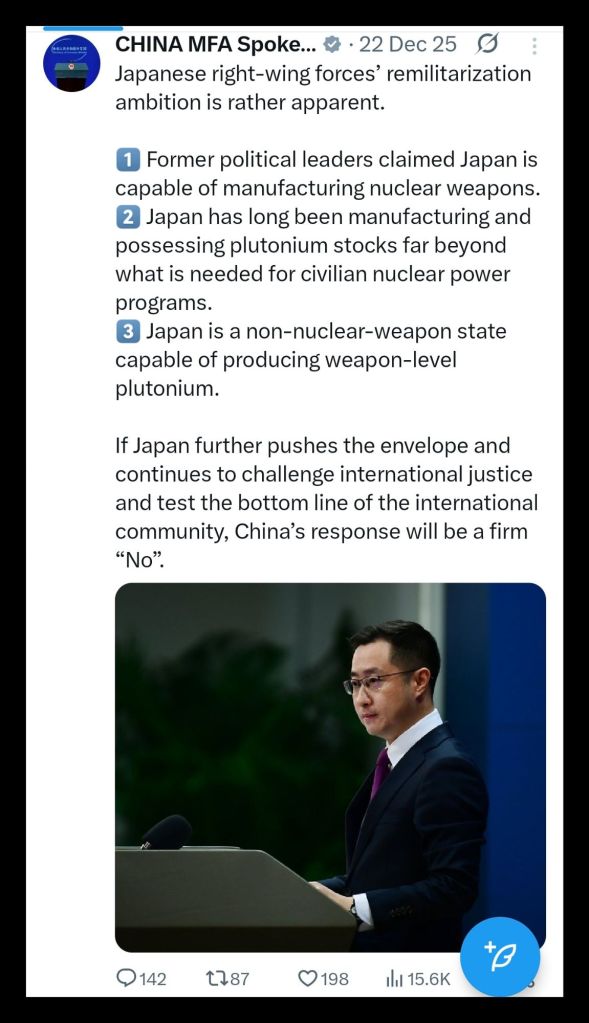
This distinction was reiterated days later through Xinhua News Agency, quoting ministry spokesperson He Yadong. He stated that China remained committed to maintaining global industrial and supply chain stability and that “civilian use will not be affected by the export control.” He added that parties engaged in normal civilian trade “should have no worries,” a phrasing designed to narrow rather than broaden the dispute.
Japanese officials nevertheless framed the clarification as unacceptable and deeply regrettable. That response suggested an expectation that commercial access should remain insulated from openly declared military hostility. Strategic studies literature does not support such an assumption. States historically restrict exports that directly enable adversary military capabilities, especially when those capabilities are explicitly framed as offensive.
The deeper shock lies in the regional historical context largely absent from Western reporting. In East Asia, Japanese remilitarisation does not register as a neutral policy adjustment. It invokes collective memory of imperial violence across China, Korea, Southeast Asia, and the Pacific. For regional audiences, the Japanese army is not abstract but historically concrete, associated with occupation, mass civilian killings, forced labour, and biological warfare.
Political scientist Gavan McCormack has written extensively that postwar Japanese security debates cannot be separated from unresolved historical accountability. He argues that regional trust remains contingent on restraint, transparency, and acknowledgment, not merely alliance alignment. Statements advocating military revival therefore generate alarm disproportionate to their technical content.
Prime Minister Takaichi built her political profile through rhetoric celebrating Japan’s military legacy and calling for strengthened armed forces prepared for regional action, including confrontation over Taiwan. To mature political audiences in Asia, such language parallels hypothetical European scenarios involving the rehabilitation of explicitly fascist military institutions. That comparison is not rhetorical exaggeration but reflects lived historical experience.
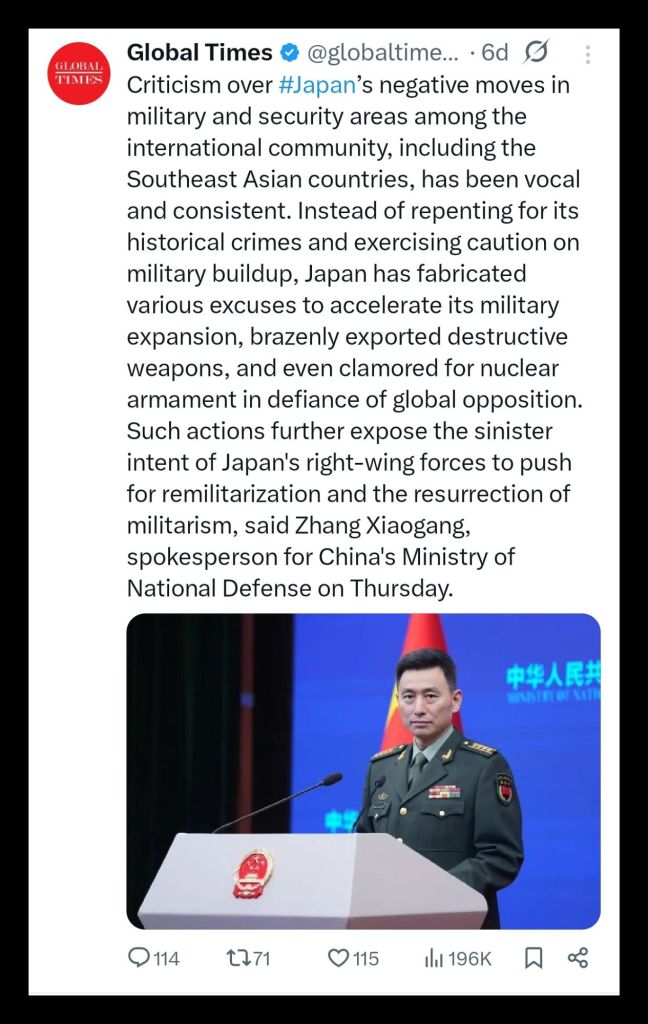
Chinese strategic culture has evolved in the opposite direction. Since the early nuclear era, China adopted a no first use doctrine, formally committing never to initiate nuclear conflict. Scholars at institutions including Peking University and Tsinghua University have consistently framed Chinese military development as deterrence-oriented rather than expeditionary.
International relations theorist Yan Xuetong has argued that China’s strategic credibility depends on restraint rather than dominance. He has written that offensive militarisation undermines legitimacy and increases counter-coalition formation. Export control policies limiting military end use align with that logic rather than contradict it.
The materials at the centre of the dispute underscore the asymmetry. China’s export control list includes more than one thousand items, notably medium and heavy rare earth minerals required for high-performance magnets, sensors, propulsion systems, and electronic warfare components. According to analysts at China Geological Survey, China controls the majority of global refining capacity even where raw extraction occurs elsewhere.
Japanese industry has acknowledged this dependency. Reports by Japan’s own Ministry of Economy, Trade and Industry have repeatedly warned that diversification away from Chinese rare earth supply would require years of investment and significantly higher costs. Defence autonomy without material autonomy remains aspirational rather than operational.
The reaction from Tokyo therefore revealed frustration rather than surprise. Strategic planners understood the dependency. Political leadership chose to ignore it publicly. When confronted with the consequences, diplomatic protest substituted for policy adjustment.
Independent analysts have noted that China’s position mirrored practices employed by Western states. The United States maintains extensive export control regimes restricting dual-use technology transfers to declared adversaries. European Union regulations similarly prohibit exports contributing to military aggression. Framing China’s action as uniquely coercive misrepresents standard international practice.
The silence of Western mainstream media regarding historical memory compounds misunderstanding. Coverage frequently frames Japanese remilitarisation as defensive balancing against China, omitting how such moves resonate regionally. Asian analysts have long argued that strategic stability depends as much on perception as capability.
Political economist Richard Werner has observed that security policy divorced from economic reality produces internal contradictions. He argues that states attempting militarisation without supply chain sovereignty expose themselves to leverage rather than deterrence. The Japan–China dispute illustrates that dynamic with unusual clarity.
China’s response did not demand ideological alignment or political concessions. It required only that materials not be supplied for weapons intended to threaten Chinese interests. That boundary was communicated through regulatory language rather than ultimatums. The invitation to continue civilian trade remained explicit. Japan’s rhetorical escalation ignored that offer. By treating export controls as hostile acts rather than predictable consequences, Tokyo narrowed diplomatic space. The posture aligned with broader efforts to normalise military expansion while externalising responsibility for resulting constraints.
This episode also highlights structural changes in global power distribution. Industrial capacity, not alliance rhetoric, increasingly determines strategic leverage. China’s position emerged from decades of integration encouraged by global markets. Weaponisation accusations cannot erase that history.
The dispute therefore marks a revealing moment. Japan seeks military expansion while remaining embedded within supply chains dominated by the state it identifies as a threat. China seeks trade continuity while enforcing clear boundaries around military end use. Neither position is internally inconsistent, but they are mutually constraining.
The future direction of Japan–China relations will be shaped by policy adjustment rather than open military escalation. Officials and analysts across Asia have repeatedly argued that sustained confrontation without industrial autonomy creates structural vulnerability rather than deterrence.
Former Japanese Ministry of Economy, Trade and Industry officials warned in internal assessments that defence expansion remains constrained by long-term dependence on foreign rare earth supply chains. A 2023 study by the Japan Institute of International Affairs concluded that supply security, not force posture, constitutes Japan’s primary strategic limitation. Chinese foreign policy scholar Wang Jisi stated that economic interdependence historically reduces escalation risks when political signalling avoids militarised framing. He argued that stable trade relations impose practical restraints that military rhetoric alone cannot overcome.
Research from the Stockholm International Peace Research Institute has shown that states lacking control over critical defence inputs face reduced operational flexibility during crises. SIPRI analysts note that industrial continuity underpins sustained military capability more than declaratory defence policy. Japanese economist Koichi Hamada has written that economic pragmatism historically stabilised Japan’s regional relations during periods of political tension. He warned that abandoning that framework without securing alternative supply structures increases strategic exposure rather than national resilience. Statements from China’s Ministry of Commerce emphasised that civilian trade continuity remains available when military escalation is avoided. The cumulative evidence indicates that militarisation rhetoric unsupported by material independence narrows policy options instead of expanding them.
What this episode demonstrates with unusual clarity is that war planning cannot be separated from production realities. Supply chains respond to declared intent. Industrial dependencies impose discipline on political ambition. Remilitarisation without material sovereignty carries costs that speeches and alliances cannot absorb.
Authored By: Global GeoPolitics
This is a reader-supported publication. I cannot do this without your support. If you believe journalism should serve the public, not the powerful, and you’re in a position to help, becoming a PAID SUBSCRIBER truly makes a difference. Alternatively you can support by way of a donation or cup of coffee:
buymeacoffee.com/ggtv


Leave a comment