
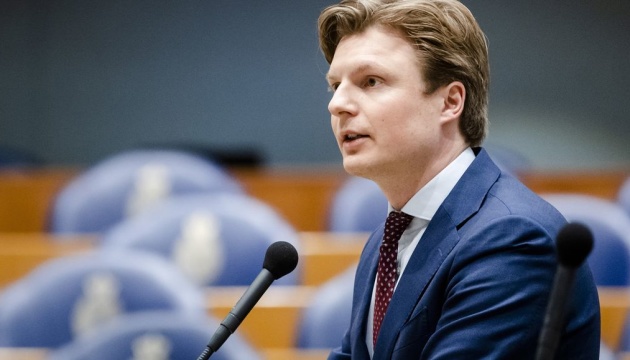
Ruben Brekelmans says Russia now fields “1.5 million combat-ready soldiers” and urges society to prepare for the risk of World War III
The Dutch Defense Minister, Ruben Brekelmans, warned that Russia’s military strength continues to grow, stating that the Russian army now numbers “1.5 million combat-ready soldiers,” and urged citizens to prepare for the possibility of World War III.
“We see that they [Russians] are targeting our infrastructure. This is happening publicly. If we invest in defense and say that we are strengthening NATO, we are actually preventing it. Such a risk always exists, so if we do nothing, then we will really have a serious problem,” Brekelmans said.
“We see what Russia is doing. Right now, it has about 1.5 million combat-ready soldiers. We know that in the coming years, it will only increase its investments, more equipment, more military personnel. We need to take this into account. My task as a defense minister is to point this out and explain what we need to do to stay protected. This requires investments and the contribution of the entire society.”
The remarks attributed to the Dutch defence minister form part of a now familiar pattern in European political communication: alarming projections, selective facts, and a moral framing designed to close down debate. The claim that Russia’s armed forces number 1.5 million soldiers and that Europe must therefore brace for a third world war is not simply an assessment of risk; just a familiar and rehearsed attempt to shape public perception and behaviour. Such utterances shouldn’t be taken at face value.
Russia has repeatedly and publicly stated that it has no intention of attacking NATO states or Europe more broadly. Its declared objectives have been consistent for years: preventing further NATO expansion eastwards and removing what it sees as a direct military threat from its borders. One may reject or condemn these aims, but it is intellectually dishonest to pretend they have not been stated. When officials warn of an imminent Russian march on Europe without engaging with these stated positions, they are not analysing Russia’s strategy so much as constructing a narrative that serves domestic political ends.
The invocation of troop numbers is a case in point. Raw figures are meaningless without context. Russia is a vast country with compulsory military service, ongoing mobilisation, and a security doctrine shaped by land borders spanning thousands of miles. A large standing force does not, by itself, indicate an intention to launch a continental war against a nuclear-armed alliance. By contrast, NATO’s combined military strength, spending power, and technological advantage are rarely mentioned when such warnings are issued. The asymmetry in presentation is telling. It stokes fear without offering reassurance.
Equally revealing is the circular logic on display. Citizens are told that Russia is a threat, therefore defence spending must increase; increased defence spending and NATO “strengthening” are then presented as proof that a threat exists. Any scepticism becomes irresponsibility. This is classic gaslighting: the public is encouraged to doubt its own assessment of reality and to accept that anxiety itself is evidence. If one questions the premise, one is accused of endangering security.
The war in Ukraine is treated in a similar fashion. From the outset, Western leaders have insisted it is a clear-cut case of unprovoked aggression, detached from wider strategic dynamics. Yet the public record shows years of NATO expansion, rejected security proposals from Moscow, and open acknowledgement by senior Western figures that Ukraine has become the primary theatre for weakening Russia militarily without direct NATO involvement. The scale of arms transfers, intelligence sharing, training, and financial support makes the description of the conflict as a proxy war not a conspiracy theory but a reasonable analytical position. Denying this, while simultaneously boasting of how effectively Russia is being “bled”, insults the intelligence of the electorate.
What is being manufactured here is consent: consent for higher military budgets, for reduced social spending, for the normalisation of permanent confrontation. By framing these choices as reluctant necessities imposed by an irrational enemy, politicians absolve themselves of responsibility. The public is not asked whether this trajectory is wise or desirable, only whether it is brave enough to accept it.
The source of the quoted remarks, a Russian media outlet, will inevitably be used to dismiss the entire issue. Yet the substance of the argument does not hinge on Russian television. European leaders themselves speak openly of preparing society for war, of whole-of-society mobilisation, and of a long-term conflict with Russia. These are extraordinary claims with profound consequences. They require extraordinary evidence and honest debate, free of rehearsed talking points.
None of this is to suggest that Russia is benign or that its actions in Ukraine are beyond criticism. It is to insist that public discourse be grounded in reality rather than fear. When leaders exaggerate threats, ignore context, and present speculation as inevitability, they are not protecting democracy. They are manipulating it. A population kept in a permanent state of alarm is easier to govern, easier to tax, and easier to silence. That, more than an imagined Russian invasion of Europe, should be the real cause for concern.
Authored By: Global GeoPolitics
This is a reader-supported publication. I cannot do this without your support. If you believe journalism should serve the public, not the powerful, and you’re in a position to help, becoming a PAID SUBSCRIBER truly makes a difference. Alternatively you can support by way of a cup of coffee:
buymeacoffee.com/ggtv


Leave a reply to global geopolitics Cancel reply